
GPR64 (G-Protein coupled Receptor 64; also HE6) is a 110 kDa (predicted) member of the B class of GCPRs. Within this class GPR64 belongs to a Large N-termini family-B 7-transmembrane (LNB-7TM) subclass of receptors (also known as adhesion-GCPRs). GPR64 has restricted expression, being found in stereocilia cell membranes of epididymal caput epithelial cells and, to a limited extent, on osteoblasts. The function of GPR64 is somewhat unclear, but in the epididymis, it may be involved in fluid transport. Mature human GPR64 is a 980 amino acid (aa) 7-TM glycoprotein (SwissProt Q8IZP9). It contains an extended extracellular N-teminus (aa 38-627), seven consecutive TM segments (aa 628-878) and a C-terminal cytoplasmic tail (aa 879-1010). The extended extracellular region possesses a juxtamembrane GPS domain (aa 567-618) that serves as a proteolytic cleavage site. Enzymatic activity here generates a 180 kDa soluble form that stays associated with a 40 kDa membrane-embedded fragment. Notably, isolation of the membrane fragment gives rise to oligomers that run at > 250 kDa in SDS-PAGE. There are multiple splice variants. The one used for immunization to generate this antibody contains a deletion of aa 88-101 (RefSeq NP_001073328). Four other splice forms show single block deletions of aa 65-67, 51-66, 52-75, and 906-956, respectively. Three others possesses aa substitutions; a 20 aa block for aa 52-101, and a common 12 aa block that can substitute for either aa 68-101 or aa 52-101. Over aa 38-64 and 68-553 of RefSeq NP_001073328, human and mouse GPR64 share 69% aa sequence identity.

Scientific images may be resized, cropped, or adjusted for brightness or contrast for presentation purposes. These updates are limited to presentation and do not affect the underlying scientific interpretation of the data. Where available, additional source data may be provided upon request.
Key Product Details
Species Reactivity
Validated:
Cited:
Applications
Validated:
Cited:
Label
Antibody Source
Product Specifications
Immunogen
Leu38-Asn64, Glu68-Thr553
Accession # NP_001073328
Specificity
Clonality
Host
Isotype
Scientific Data Images for GPR64 Antibody
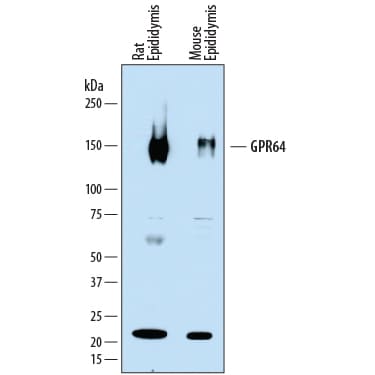
Detection of Rat and Mouse GPR64 by Western Blot.
Western blot shows lysates of rat epididymis tissue and mouse epididymis tissue. PVDF membrane was probed with 2 µg/mL of Sheep Anti-Human/Mouse/Rat GPR64 Antigen Affinity-purified Polyclonal Antibody (Catalog # AF7977) followed by HRP-conjugated Anti-Sheep IgG Secondary Antibody (Catalog # HAF016). A specific band was detected for GPR64 at approximately 150 kDa (as indicated). This experiment was conducted under reducing conditions and using Immunoblot Buffer Group 1.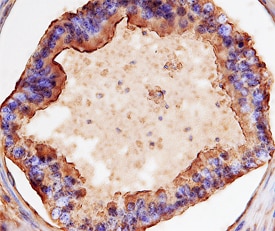
GPR64 in Human Epididymus.
GPR64 was detected in immersion fixed paraffin-embedded sections of human epididymus using Sheep Anti-Human/Mouse/Rat GPR64 Antigen Affinity-purified Polyclonal Antibody (Catalog # AF7977) at 3 µg/mL overnight at 4 °C. Before incubation with the primary antibody, tissue was subjected to heat-induced epitope retrieval using Antigen Retrieval Reagent-Basic (Catalog # CTS013). Tissue was stained using the Anti-Sheep HRP-DAB Cell & Tissue Staining Kit (brown; Catalog # CTS019) and counterstained with hematoxylin (blue). Specific staining was localized to plasma membranes of epithelial cells. View our protocol for Chromogenic IHC Staining of Paraffin-embedded Tissue Sections.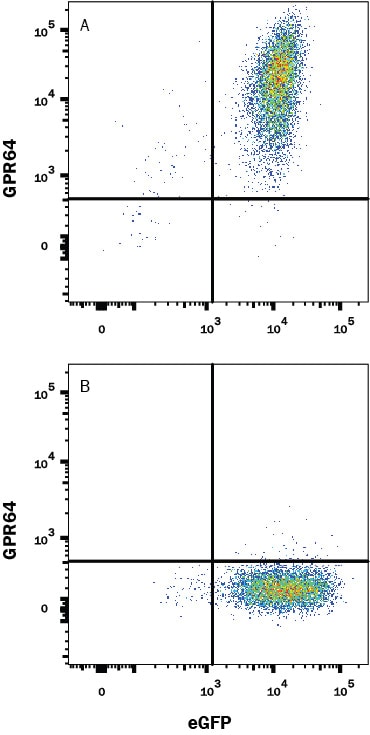
Detection of GPR64 in HEK293 Human Cell Line Transfected with Human GPR64 and eGFP by Flow Cytometry.
HEK293 human embryonic kidney cell line transfected with (A) Human GPR64 or (B) Human GPR75 and eGFP was stained with Sheep Anti-Human GPR64 Affinity-Purified Polyclonal Antibody (Catalog # AF7977) followed by Allophycocyanin-conjugated Anti-Sheep IgG Secondary Antibody (Catalog # F0127). Quadrant markers were set based on control antibody staining (Catalog # 5-001-A). View our protocol for Staining Membrane-associated Proteins.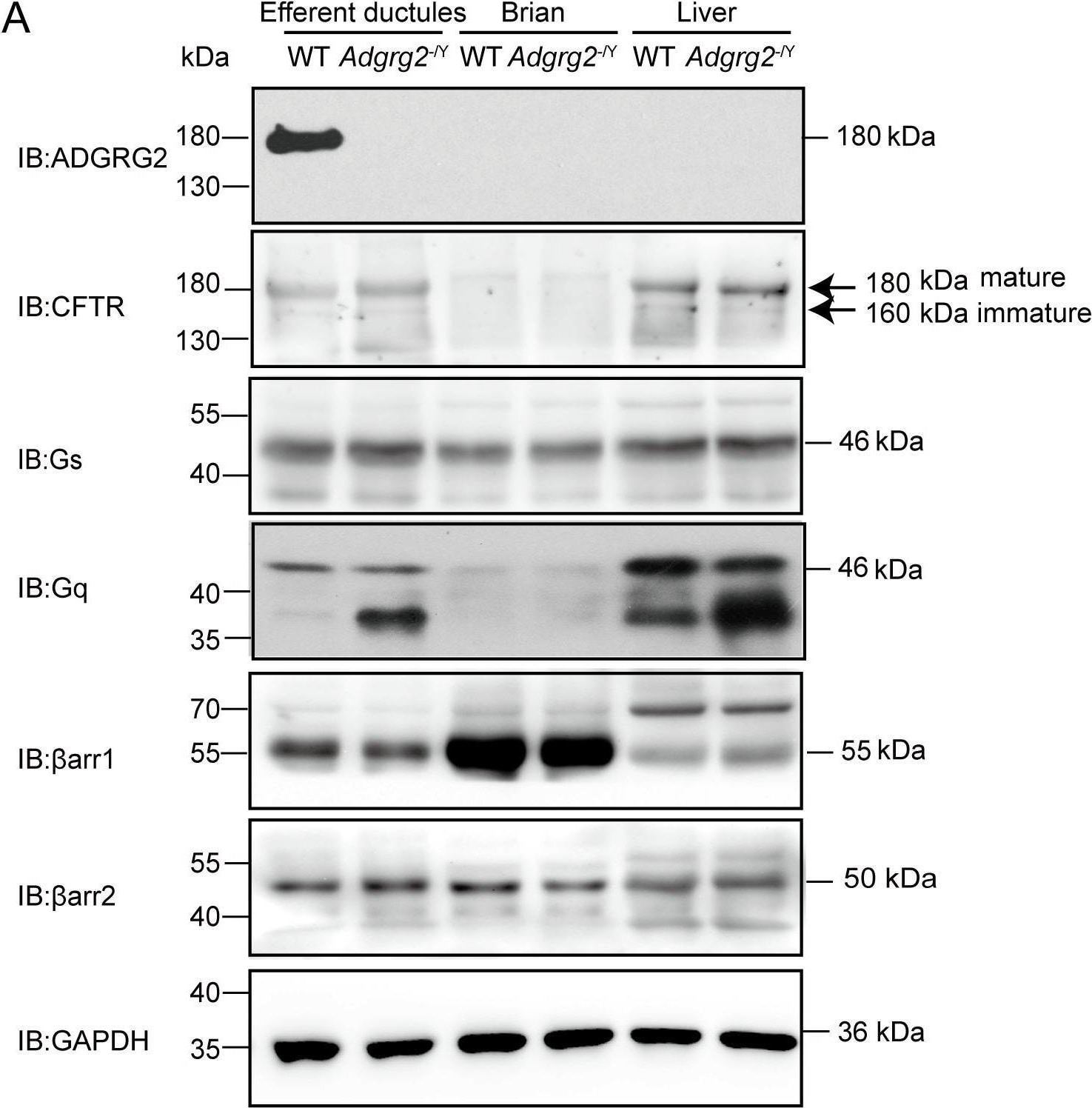
Detection of GPR64 by Western Blot
The expression of ADGRG2, CFTR, Gs, Gq, beta -arrestin-1, beta -arrestin-2 in efferent ductules, brain and liver tissue of WT and Adgrg2-/Y mice.(A) Western blot analysis of ADGRG2, CFTR, Gs, Gq, beta -arrestin-1, beta -arrestin-2 expression in efferent ductules, brain and liver tissue of WT and Adgrg2-/Y mice. A representative western blot from at least three independent experiments was shown. (CFTR antibody:20738–1-AP, Proteintech). (B) Bar graph representation and statistical analyses of (A). All blots were normalized to GAPDH. n.s., no significant difference; Adgrg2-/Y mice compared with WT mice in the same tissue. Image collected and cropped by CiteAb from the following open publication (https://pubmed.ncbi.nlm.nih.gov/29393851), licensed under a CC-BY license. Not internally tested by R&D Systems.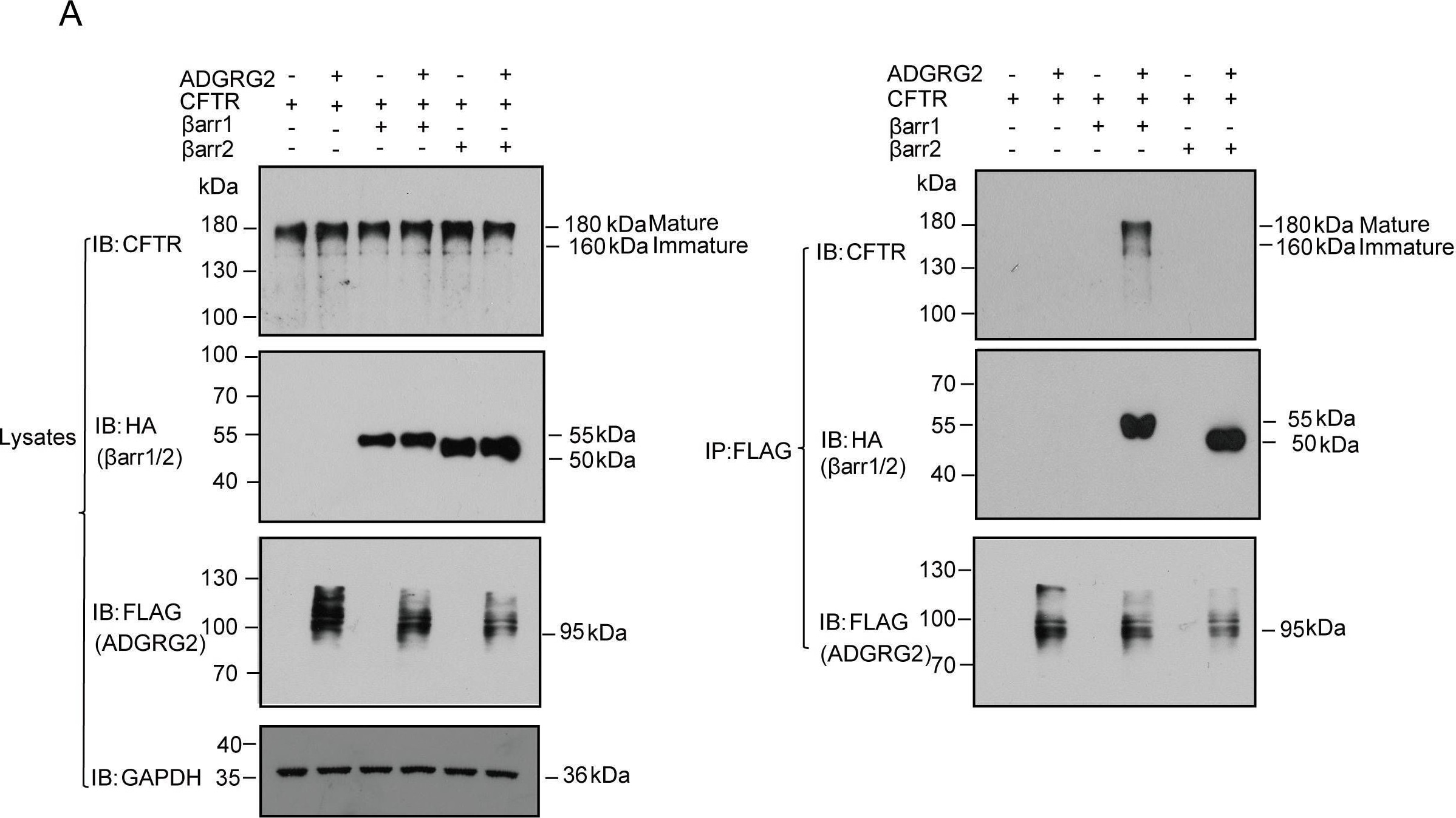
Detection of GPR64 by Western Blot
The complex formation between ADGRG2, beta -arrestin-1 and CFTR in HEK293 cells.(A) HEK293 cells were transfected with equal amount plasmids encoding ADGRG2, CFTR, beta -arrestin-1 or beta -arrestin-2 plasmids. The Flag- ADGRG2 were pulled down by M2-Flag beads and the associated CFTR, beta -arrestins were detected by western blot. Representative images from at least three independent experiments are shown (CFTR antibody:20738–1-AP, Proteintech). (B) Bar graph representation and statistical analyses of (A).***p<0.001, IP protein of ADGRG2 overexpressed cells were compared with control plasmids transfected cells respectively. n.s., no significant difference. Image collected and cropped by CiteAb from the following open publication (https://pubmed.ncbi.nlm.nih.gov/29393851), licensed under a CC-BY license. Not internally tested by R&D Systems.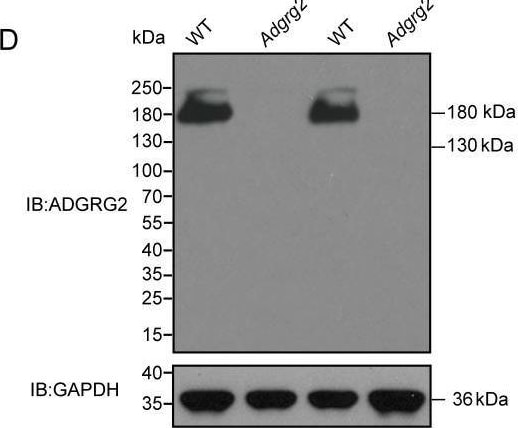
Detection of GPR64 by Western Blot
The ADGRG2 protein knockout strategy, PCR strategy and western blot results of Adgrg2-/Y and Gnaq+/- mice.(A) Schematic representation of the ADGRG2 knockout strategy for the Adgrg2-/Y mice. 2 bp nucleotides were removed and 10 bp nucleotides were inserted in the first exon of the ADGRG2 gene in the ADGRG2 mutant mice by the CRISP-CAS9 approach. In the ADGRG2-deficient mice, the translation of ADGRG2 was terminated at the 7th amio acid after the signal peptide. (B) Schematic representation for the primers used in the genotyping of the ADGRG2 mutant mice or their wild-type littermates. (C) Schematic description of the PCR strategy and expected results for genotyping. The genotyping of mice was determined by PCR and visualized by bromide staining of agarose Gels. (D) Western blot analysis of ADGRG2 expression in efferent duct tissue of WT and Adgrg2-/Y mice. All blots were normalized to GAPDH. (E) Bar graph representation and statistical analyses of (D). At least three independent experiments were carried out. (F) Western blot analysis of Gq expression in efferent duct tissue of WT and Gnaq+/- mice. All blots were normalized to GAPDH. (G) Bar graph representation and statistical analyses of (F). At least three independent experiments were carried out. (E,G) *p<0.05, **p<0.01, ***p<0.001, Adgrg2-/Y mice or Gnaq+/- mice were compared with WT mice. n.s., no significant difference. Image collected and cropped by CiteAb from the following open publication (https://pubmed.ncbi.nlm.nih.gov/29393851), licensed under a CC-BY license. Not internally tested by R&D Systems.Applications for GPR64 Antibody
Flow Cytometry
Sample: HEK293 Human Cell Line Transfected with Human GPR64 and eGFP
Immunohistochemistry
Sample: Immersion fixed paraffin-embedded sections of human epididymus
Western Blot
Sample: Rat epididymis tissue and mouse epididymis tissue
Flow Cytometry Panel Builder
Bio-Techne Knows Flow Cytometry
Save time and reduce costly mistakes by quickly finding compatible reagents using the Panel Builder Tool.
Advanced Features
- Spectra Viewer - Custom analysis of spectra from multiple fluorochromes
- Spillover Popups - Visualize the spectra of individual fluorochromes
- Antigen Density Selector - Match fluorochrome brightness with antigen density

Formulation, Preparation, and Storage
Purification
Reconstitution
Sterile PBS to a final concentration of 0.2 mg/mL. For liquid material, refer to CoA for concentration.
Formulation
Shipping
Stability & Storage
- 12 months from date of receipt, -20 to -70 °C as supplied.
- 1 month, 2 to 8 °C under sterile conditions after reconstitution.
- 6 months, -20 to -70 °C under sterile conditions after reconstitution.
Calculators
Background: GPR64
Long Name
Alternate Names
Gene Symbol
UniProt
Additional GPR64 Products
Product Documents for GPR64 Antibody
Certificate of Analysis
To download a Certificate of Analysis, please enter a lot or batch number in the search box below.
Note: Certificate of Analysis not available for kit components.
Product Specific Notices for GPR64 Antibody
For research use only
Related Research Areas
Citations for GPR64 Antibody
 Powered by Bioz
Customer Reviews for GPR64 Antibody
There are currently no reviews for this product. Be the first to review GPR64 Antibody and earn rewards!
Have you used GPR64 Antibody?
Submit a review and receive an Amazon gift card!
$25/€18/£15/$25CAN/¥2500 for a review with an image
$10/€7/£6/$10CAN/¥1110 for a review without an image
Submit a review
Protocols
Find general support by application which include: protocols, troubleshooting, illustrated assays, videos and webinars.
- 7-Amino Actinomycin D (7-AAD) Cell Viability Flow Cytometry Protocol
- Antigen Retrieval Protocol (PIER)
- Antigen Retrieval for Frozen Sections Protocol
- Appropriate Fixation of IHC/ICC Samples
- Cellular Response to Hypoxia Protocols
- Chromogenic IHC Staining of Formalin-Fixed Paraffin-Embedded (FFPE) Tissue Protocol
- Chromogenic Immunohistochemistry Staining of Frozen Tissue
- ClariTSA™ Fluorophore Kits
- Detection & Visualization of Antibody Binding
- Extracellular Membrane Flow Cytometry Protocol
- Flow Cytometry Protocol for Cell Surface Markers
- Flow Cytometry Protocol for Staining Membrane Associated Proteins
- Flow Cytometry Staining Protocols
- Flow Cytometry Troubleshooting Guide
- Fluorescent IHC Staining of Frozen Tissue Protocol
- Graphic Protocol for Heat-induced Epitope Retrieval
- Graphic Protocol for the Preparation and Fluorescent IHC Staining of Frozen Tissue Sections
- Graphic Protocol for the Preparation and Fluorescent IHC Staining of Paraffin-embedded Tissue Sections
- Graphic Protocol for the Preparation of Gelatin-coated Slides for Histological Tissue Sections
- IHC Sample Preparation (Frozen sections vs Paraffin)
- Immunofluorescent IHC Staining of Formalin-Fixed Paraffin-Embedded (FFPE) Tissue Protocol
- Immunohistochemistry (IHC) and Immunocytochemistry (ICC) Protocols
- Immunohistochemistry Frozen Troubleshooting
- Immunohistochemistry Paraffin Troubleshooting
- Intracellular Flow Cytometry Protocol Using Alcohol (Methanol)
- Intracellular Flow Cytometry Protocol Using Detergents
- Intracellular Nuclear Staining Flow Cytometry Protocol Using Detergents
- Intracellular Staining Flow Cytometry Protocol Using Alcohol Permeabilization
- Intracellular Staining Flow Cytometry Protocol Using Detergents to Permeabilize Cells
- Preparing Samples for IHC/ICC Experiments
- Preventing Non-Specific Staining (Non-Specific Binding)
- Primary Antibody Selection & Optimization
- Propidium Iodide Cell Viability Flow Cytometry Protocol
- Protocol for Heat-Induced Epitope Retrieval (HIER)
- Protocol for Liperfluo
- Protocol for Making a 4% Formaldehyde Solution in PBS
- Protocol for VisUCyte™ HRP Polymer Detection Reagent
- Protocol for the Characterization of Human Th22 Cells
- Protocol for the Characterization of Human Th9 Cells
- Protocol for the Preparation & Fixation of Cells on Coverslips
- Protocol for the Preparation and Chromogenic IHC Staining of Frozen Tissue Sections
- Protocol for the Preparation and Chromogenic IHC Staining of Frozen Tissue Sections - Graphic
- Protocol for the Preparation and Chromogenic IHC Staining of Paraffin-embedded Tissue Sections
- Protocol for the Preparation and Chromogenic IHC Staining of Paraffin-embedded Tissue Sections - Graphic
- Protocol for the Preparation and Fluorescent IHC Staining of Frozen Tissue Sections
- Protocol for the Preparation and Fluorescent IHC Staining of Paraffin-embedded Tissue Sections
- Protocol for the Preparation of Gelatin-coated Slides for Histological Tissue Sections
- Protocol: Annexin V and PI Staining by Flow Cytometry
- Protocol: Annexin V and PI Staining for Apoptosis by Flow Cytometry
- R&D Systems Quality Control Western Blot Protocol
- TUNEL and Active Caspase-3 Detection by IHC/ICC Protocol
- The Importance of IHC/ICC Controls
- Troubleshooting Guide: Fluorokine Flow Cytometry Kits
- Troubleshooting Guide: Immunohistochemistry
- Troubleshooting Guide: Western Blot Figures
- Western Blot Conditions
- Western Blot Protocol
- Western Blot Protocol for Cell Lysates
- Western Blot Troubleshooting
- Western Blot Troubleshooting Guide
- View all Protocols, Troubleshooting, Illustrated assays and Webinars