
Plexin B3 is a type I transmembrane glycoprotein that belongs to the Plexin B subfamily of semaphorin receptors (1, 2). Human Plexin B3 contains a 44 amino acid (aa) signal sequence, a 1211 aa extracellular domain (ECD), a 21 aa transmembrane domain, and a 633 aa cytoplasmic domain that includes features common to other Plexins, such as an LRR (C1) and LRF (C2) domain, and a PDZ motif common to B Plexins (1). The PDZ motif is thought to be involved in RhoA activation and axonal growth cone collapse downstream of semaphorin engagement (3). The human Plexin B3 ECD shares 81%, 81%, 83% and 75% aa identity with mouse, rat, bovine and canine Plexin B3, respectively. It contains a sema domain and a Plexin-semaphorin-integrin (PSI) or Met-related sequence (MRS) domain, each of which contains a potential proteolytic cleavage site (2). Detection of 160 and 140 kDa species along with the full-length 260 kDa Plexin B3 in homogenates of human neocortex indicates that proteolytic processing may occur in vivo (2). The ECD also contains four glycine/proline-rich IPT/TIG domains, which are immunoglobulin-like domains found in Plexins, transcription factors, and the scatter factor receptors Met and Ron. B Plexins, including Plexin B3, can interact with Met and Ron, activating these receptors upon semaphorin engagement (4, 5). Plexin B3 and its identified ligand, the transmembrane semaphorin Sema5A, are both expressed during differentiation and migration of central nervous system oligodendrocytes (5‑7). However, the developmental functions of Sema5A are likely independent of Plexin B3, which is not significantly expressed prenatally (8). In turn, Plexin B3 may exhibit Sema5A-independent activity, as homophilic interactions of sema domains are reported to stimulate neurite outgrowth of postnatal cerebellar neurons (2).
Human Plexin B3 Antibody
R&D Systems | Catalog # AF4958


Scientific images may be resized, cropped, or adjusted for brightness or contrast for presentation purposes. These updates are limited to presentation and do not affect the underlying scientific interpretation of the data. Where available, additional source data may be provided upon request.
Key Product Details
Species Reactivity
Validated:
Cited:
Applications
Validated:
Cited:
Label
Antibody Source
Product Specifications
Immunogen
His45-Gln1255 (Glu1156Asp)
Accession # Q9ULL4
Specificity
Clonality
Host
Isotype
Scientific Data Images for Human Plexin B3 Antibody
Detection of Human Plexin B3 by Western Blot.
Western blot shows lysates of rat embryonic hippocampal neurons. PVDF membrane was probed with 1 µg/mL Sheep Anti-Human Plexin B3 Antigen Affinity-purified Polyclonal Antibody (Catalog # AF4958) followed by HRP-conjugated Anti-Sheep IgG Secondary Antibody (Catalog # HAF016). For additional reference, Recombinant Human Plexin B3 (Catalog # 4958-PC) (1 ng) was included. A specific band for Plexin B3 was detected at approximately 140 kDa (as indicated). This experiment was conducted under reducing conditions and using Immunoblot Buffer Group 8.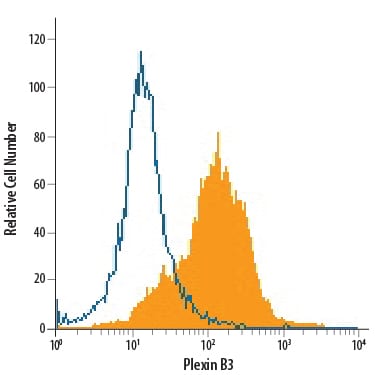
Detection of Plexin B3 in A172 Human Cell Line by Flow Cytometry.
A172 human glioblastoma cell line was stained with Sheep Anti-Human Plexin B3 Antigen Affinity-purified Polyclonal Antibody (Catalog # AF4958, filled histogram) or isotype control antibody (Catalog # 5-001-A, open histogram), followed by Allophycocyanin-conjugated Anti-Sheep IgG Secondary Antibody (Catalog # F0127).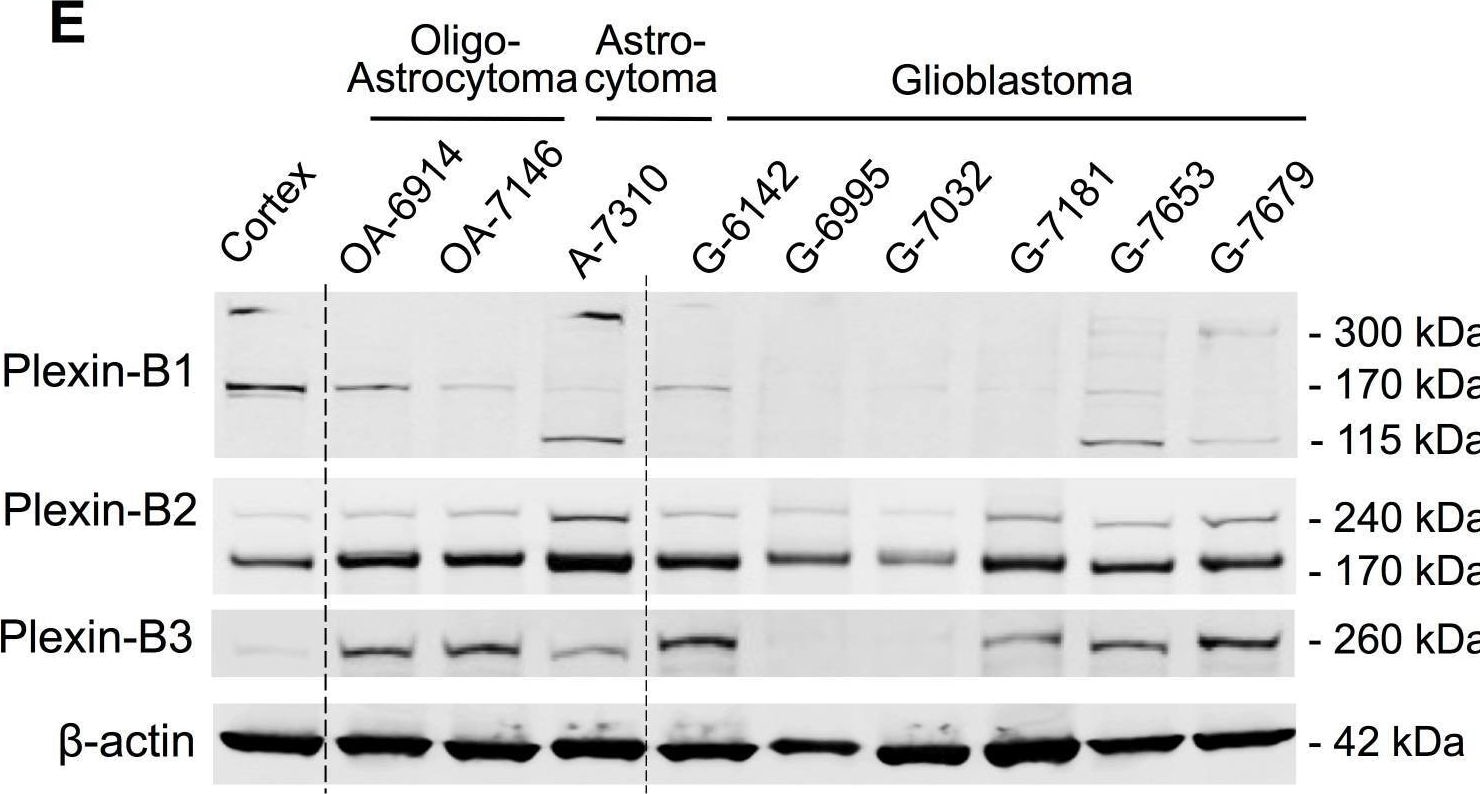
Detection of Plexin B3 by Western Blot
Plexin-B2 is upregulated in gliomaA) Relative Plexin-B gene expressions in glioma vs. normal brain from microarray data of four patient studies (B, Bredel et al. (n=49); S, Sun et al. (n=49); T, TCGA (n=424); R, Rembrandt (n=454)). Whiskers show top and bottom quartiles. PLXNB2 was upregulated in all four glioma studies. B) Relative PLXNB2 expression in four molecular subtypes of glioblastoma (TCGA dataset; proneural, n=113; neural, n=70; classical, n=112; mesenchymal, n=128). C) Abundance of Plexin-B and Sema4 mRNA in TCGA glioblastoma samples (n=169), shown as RSEM counts (upper quartile boundary normalized to 1000). PLXNB2 exhibited the highest mean abundance level overall, and SEMA4B, 4C and 4D exhibited higher levels than other Sema4s. D) PLXNB2 mean expression is significantly increased in all WHO glioma types (NCI/Rembrandt patient cohort; n=454; probeset 208890_s_at) and highest in glioblastoma (p<0.001). E) Western blot of nine surgical samples from glioma patients reveals robust Plexin-B2 protein expression (170 kDa band is the processed, mature form of Plexin-B2). Normal human cortex served as control. Plexin-B1 and -B3 protein are variably expressed among glioma samples. Image collected and cropped by CiteAb from the following open publication (https://pubmed.ncbi.nlm.nih.gov/25762646), licensed under a CC-BY license. Not internally tested by R&D Systems.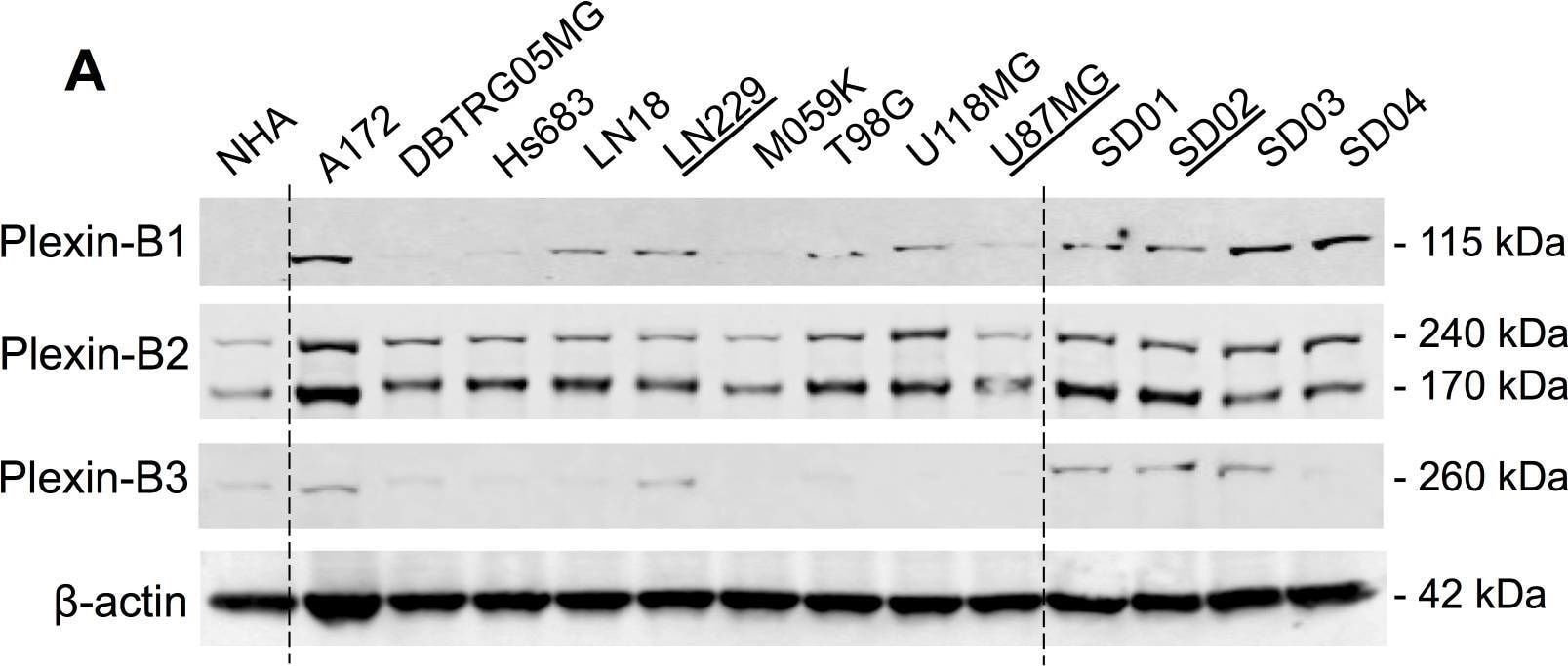
Detection of Plexin B3 by Western Blot
Plexin-B2 expression in glioma cell lines and shRNA knockdownA) Western blot of nine human ATTC glioma cell lines and four glioblastoma stem cell lines (GSC) reveals robust Plexin-B2 protein expression. Normal human astrocytes (NHA) served as control. Plexin-B1 and -B3 are expressed at variable levels in ATCC glioma cell lines and in GSC. B) Stable knockdown of Plexin-B2 with two lentiviral shRNA vectors in LN229, U87MG, and SD02 lines, as measured by Western blot quantification. C) Immunocytochemistry for Plexin-B2 in LN229, U87MG, and SD02 cells confirms reduced Plexin-B2 expression in knockdown lines. Scale bar: 20 μm. Image collected and cropped by CiteAb from the following open publication (https://pubmed.ncbi.nlm.nih.gov/25762646), licensed under a CC-BY license. Not internally tested by R&D Systems.Applications for Human Plexin B3 Antibody
CyTOF-ready
Flow Cytometry
Sample: A172 human glioblastoma cell line
Western Blot
Sample: Rat embryonic hippocampal neurons
Flow Cytometry Panel Builder
Bio-Techne Knows Flow Cytometry
Save time and reduce costly mistakes by quickly finding compatible reagents using the Panel Builder Tool.
Advanced Features
- Spectra Viewer - Custom analysis of spectra from multiple fluorochromes
- Spillover Popups - Visualize the spectra of individual fluorochromes
- Antigen Density Selector - Match fluorochrome brightness with antigen density

Formulation, Preparation, and Storage
Purification
Reconstitution
Reconstitute at 0.2 mg/mL in sterile PBS. For liquid material, refer to CoA for concentration.
Formulation
Shipping
Stability & Storage
- 12 months from date of receipt, -20 to -70 °C as supplied.
- 1 month, 2 to 8 °C under sterile conditions after reconstitution.
- 6 months, -20 to -70 °C under sterile conditions after reconstitution.
Calculators
Background: Plexin B3
References
- Negishi, M. et al. (2005) Cell. Mol. Life Sci. 62:1363.
- Hartwig, C. et al. (2005) BMC Neurosci. 6:53.
- Swiercz, J.M. et al. (2002) Neuron 35:51.
- Conrotto, P. et al. (2004) Oncogene 23:5131.
- Artigiani, S. et al. (2004) EMBO Rep. 5:710.
- Goldberg, J.L. et al. (2004) J. Neurosci. 24:4989.
- Worzfeld, T. et al. (2004) Eur. J. Neurosci. 19:2622.
- Fiore, R. et al. (2005) Mol. Cell. Biol. 25:2310.
Alternate Names
Gene Symbol
UniProt
Additional Plexin B3 Products
Product Documents for Human Plexin B3 Antibody
Certificate of Analysis
To download a Certificate of Analysis, please enter a lot or batch number in the search box below.
Note: Certificate of Analysis not available for kit components.
Product Specific Notices for Human Plexin B3 Antibody
For research use only
Citations for Human Plexin B3 Antibody
 Powered by Bioz
Customer Reviews for Human Plexin B3 Antibody
There are currently no reviews for this product. Be the first to review Human Plexin B3 Antibody and earn rewards!
Have you used Human Plexin B3 Antibody?
Submit a review and receive an Amazon gift card!
$25/€18/£15/$25CAN/¥2500 for a review with an image
$10/€7/£6/$10CAN/¥1110 for a review without an image
Submit a review
Protocols
Find general support by application which include: protocols, troubleshooting, illustrated assays, videos and webinars.
- 7-Amino Actinomycin D (7-AAD) Cell Viability Flow Cytometry Protocol
- Cellular Response to Hypoxia Protocols
- Extracellular Membrane Flow Cytometry Protocol
- Flow Cytometry Protocol for Cell Surface Markers
- Flow Cytometry Protocol for Staining Membrane Associated Proteins
- Flow Cytometry Staining Protocols
- Flow Cytometry Troubleshooting Guide
- Intracellular Flow Cytometry Protocol Using Alcohol (Methanol)
- Intracellular Flow Cytometry Protocol Using Detergents
- Intracellular Nuclear Staining Flow Cytometry Protocol Using Detergents
- Intracellular Staining Flow Cytometry Protocol Using Alcohol Permeabilization
- Intracellular Staining Flow Cytometry Protocol Using Detergents to Permeabilize Cells
- Propidium Iodide Cell Viability Flow Cytometry Protocol
- Protocol for Liperfluo
- Protocol for the Characterization of Human Th22 Cells
- Protocol for the Characterization of Human Th9 Cells
- Protocol: Annexin V and PI Staining by Flow Cytometry
- Protocol: Annexin V and PI Staining for Apoptosis by Flow Cytometry
- R&D Systems Quality Control Western Blot Protocol
- Troubleshooting Guide: Fluorokine Flow Cytometry Kits
- Troubleshooting Guide: Western Blot Figures
- Western Blot Conditions
- Western Blot Protocol
- Western Blot Protocol for Cell Lysates
- Western Blot Troubleshooting
- Western Blot Troubleshooting Guide
- View all Protocols, Troubleshooting, Illustrated assays and Webinars