
Siglecs (sialic acid binding Ig-like lectins) are a subgroup of the immunoglobulin superfamily that interact with sialic acids in glycoproteins and glycolipids. Siglec-5 binds to alpha-2, 3- and alpha-2, 6-linked sialic acid equally. It occurs as a disulfide-linked dimer of approximately 140 kDa with the highest expression levels in hematopoietic tissues. Siglec-5 has an inhibitory motif within its cytoplasmic domain. Siglec-14 is an activating receptor that shares 99.5% aa sequence identity with Siglec-5 through the first two extracellular Ig domains and displays a similar glycan binding preference.
Human Siglec-5/Siglec-14 Antibody (194128)
R&D Systems | Catalog # MAB10721


Scientific images may be resized, cropped, or adjusted for brightness or contrast for presentation purposes. These updates are limited to presentation and do not affect the underlying scientific interpretation of the data. Where available, additional source data may be provided upon request.
Key Product Details
Species Reactivity
Validated:
Human
Cited:
Human, Fungus
Applications
Validated:
ELISA Capture (Matched Antibody Pair), Neutralization, Flow Cytometry, CyTOF-ready
Cited:
Immunohistochemistry, Western Blot, Neutralization, Flow Cytometry, Immunocytochemistry, Immunoprecipitation
Label
Unconjugated
Antibody Source
Monoclonal Mouse IgG1 Clone # 194128
Loading...
Product Specifications
Immunogen
Mouse myeloma cell line NS0-derived recombinant human Siglec‑5/Siglec‑14
Lys18-Thr434
Accession # O15389
Lys18-Thr434
Accession # O15389
Specificity
Detects human Siglec‑5/Siglec‑14 in ELISAs. In sandwich immunoassays, 100% cross-reactivity with recombinant human (rh) Siglec-14 is observed and no cross-reactivity with rhSiglec-3, rhSiglec-7, or rhSiglec-9 is observed.
Clonality
Monoclonal
Host
Mouse
Isotype
IgG1
Endotoxin Level
<0.10 EU per 1 μg of the antibody by the LAL method.
Scientific Data Images for Human Siglec-5/Siglec-14 Antibody (194128)
Detection of Siglec‑5/14 in Human Monocytes by Flow Cytometry.
Human blood derived monocytes were stained with Mouse Anti-Human Siglec-5/14 Monoclonal Antibody (Catalog # MAB10721, filled histogram) or isotype control antibody (Catalog # MAB002, open histogram), followed by Phycoerythrin-conjugated Anti-Mouse IgG F(ab')2Secondary Antibody (Catalog # F0102B).
Cell Adhesion Mediated by Siglec‑5 and Neutralization by Human Siglec‑5/14 Antibody.
Recombinant Human Siglec-5 Fc Chimera (Catalog # 1072-SL), immobilized onto a microplate, supports the adhesion of human red blood cells in a dose-dependent manner (orange line). Adhesion elicited by Recombinant Human Siglec-5 Fc Chimera (5 µg/mL) is neutralized (green line) by increasing concentrations of Mouse Anti-Human Siglec-5/14 Mono-clonal Antibody (Catalog # MAB10721). The ND50 is typically 0.04-0.2 µg/mL.
Human Siglec-5 / Siglec-14 ELISA Standard Curve
Recombinant Human Siglec‑5/CD170 Fc Chimera (Catalog # 1072-SL) was serially diluted and captured by Mouse Anti-Human Siglec‑5/Siglec‑14 Monoclonal Antibody (Catalog # MAB10721) coated on a Clear Polystyrene Microplate (Catalog # DY990). Mouse Anti-Human Siglec‑5/Siglec‑14 Biotinylated Monoclonal Antibody (Catalog # ) was incubated with the protein captured on the plate. Detection of the standard curve was achieved by incubating Streptavidin-HRP (Catalog # DY998)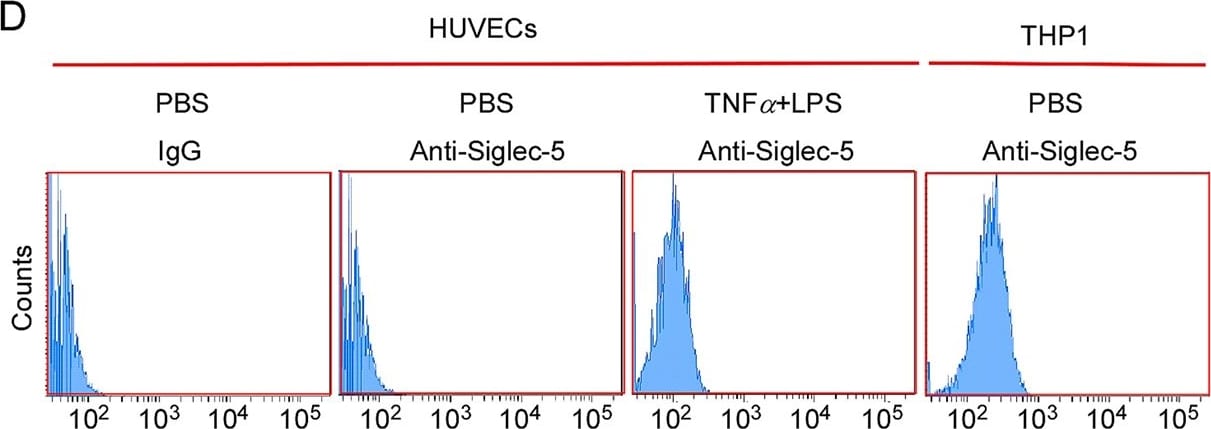
Detection of Siglec-5/Siglec-14 by Flow Cytometry
Siglec-5 is required for mediating the interaction of human monocytes and endothelial cells.(A) Before adding THP1-RFP cells, the activated HUVECs were pretreated with or without 1.5 μg/ml of anti-siglec-4a or anti-Siglec-5. Then THP1-RFP cell adherent was analyzed by the same procedure described above.(B) 6 random fields per well were imaged from (A) and the cell numbers in each field were counted by Qupath. The adherent cell numbers were averaged and presented as mean ± SD, n = 6. One-way ANOVA analysis followed by Tukey’s test was performed. **P < 0.01, ***P < 0.001, ****P < 0.0001.(C) Western blot of cell lysates from HUVECs treated with TNF alpha (10 ng/ml) and LPS (1 μg/ml) for different time points as indicated. The blot was probed by primary antibodies as indicated and imaged by secondary antibody-HRP.(D) HUVECs were stimulated with TNF alpha and LPS overnight and then incubated with anti-Siglec-5 and Alex468-tagged anti-IgG secondary antibody complex. THP1 cells were also stained as a control. The stained cells were analyzed by Flow cytometry. Image collected and cropped by CiteAb from the following open publication (https://linkinghub.elsevier.com/retrieve/pii/S0167488925001223), licensed under a CC-BY license. Not internally tested by R&D Systems.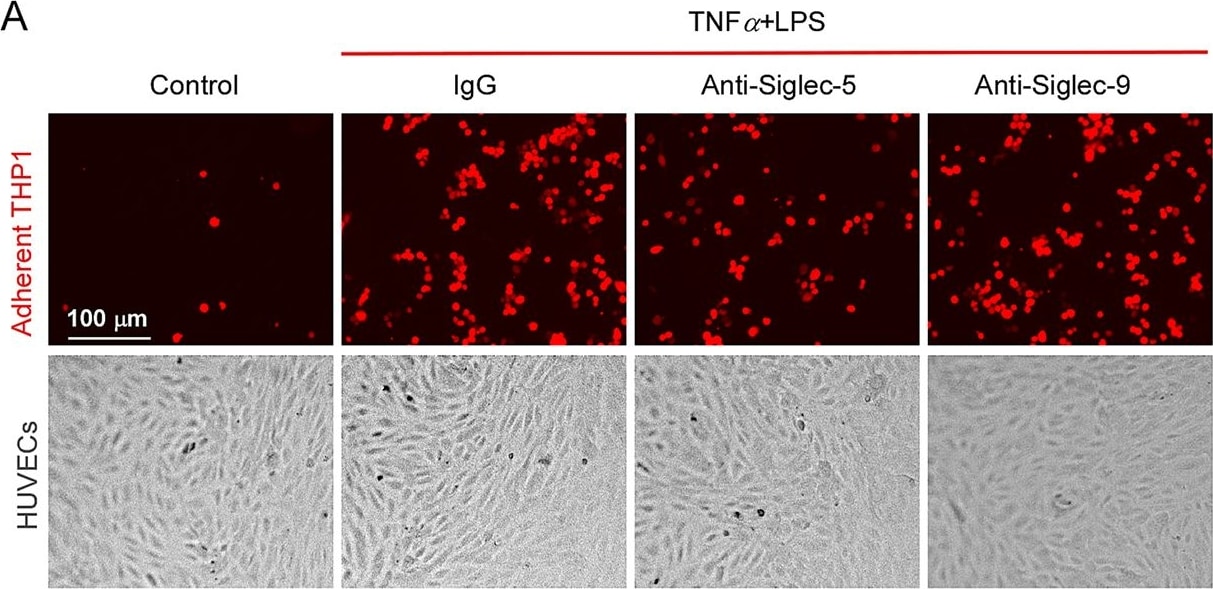
Detection of Siglec-5/Siglec-14 by Immunocytochemistry/ Immunofluorescence
Siglec-5 is required for mediating the interaction of human monocytes and endothelial cells.(A) Before adding THP1-RFP cells, the activated HUVECs were pretreated with or without 1.5 μg/ml of anti-siglec-4a or anti-Siglec-5. Then THP1-RFP cell adherent was analyzed by the same procedure described above.(B) 6 random fields per well were imaged from (A) and the cell numbers in each field were counted by Qupath. The adherent cell numbers were averaged and presented as mean ± SD, n = 6. One-way ANOVA analysis followed by Tukey’s test was performed. **P < 0.01, ***P < 0.001, ****P < 0.0001.(C) Western blot of cell lysates from HUVECs treated with TNF alpha (10 ng/ml) and LPS (1 μg/ml) for different time points as indicated. The blot was probed by primary antibodies as indicated and imaged by secondary antibody-HRP.(D) HUVECs were stimulated with TNF alpha and LPS overnight and then incubated with anti-Siglec-5 and Alex468-tagged anti-IgG secondary antibody complex. THP1 cells were also stained as a control. The stained cells were analyzed by Flow cytometry. Image collected and cropped by CiteAb from the following open publication (https://linkinghub.elsevier.com/retrieve/pii/S0167488925001223), licensed under a CC-BY license. Not internally tested by R&D Systems.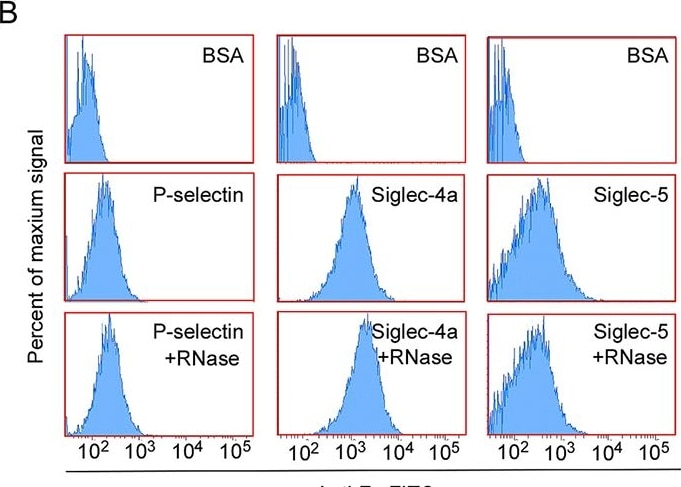
Detection of Siglec-5/Siglec-14 by Flow Cytometry
Identification of Siglec-5 as the binding partner of glycoRNAs from THP1 cells.(A) FACS analysis of THP1 cells labeled by pre-complex of E-selectin-Fc, P-selectin-Fc, VCAM-1-Fc, ICAM-1-Fc, Siglec-4a-Fc, Siglec-5-Fc and anti-Fc-FITC (left). The images taken from these cells by microscopy (right).(B) FACS analysis of THP1 cells pretreated with or without RNase then stained with the indicated pre-complex.(C) The images taken from these cells in (B) by microscopy. The fluorescence intensity from biological triplicate was analyzed by Cytation 3 Cell Imaging Multi-mode Reader (Biotek Instruments) and presented as mean ± SD, n = 6. One-way ANOVA was performed. **P < 0.01, ***P < 0.001, ****P < 0.0001, n.s means no significance.(D) Biotinylated RNA was incubated with pre-binding anti-Fc-beads with indicated protein-Fc chimera and then analyzed by northern blot as described above.(E) Native RNAs were analyzed by northern blot. After blocking, the membrane was probed by pre-complex of Siglec-4a-Fc (1.5 μg/ml) or Siglec-5-Fc (1.5 μg/ml) with anti-Fc-HRP (1.5 μg/ml) for 2 h at 4 °C. The blot was imaged by iBright 1500. Blot of biotinylated RNA from labeled THP1 cells was probed by anti-biotin-HRP. Image collected and cropped by CiteAb from the following open publication (https://linkinghub.elsevier.com/retrieve/pii/S0167488925001223), licensed under a CC-BY license. Not internally tested by R&D Systems.Applications for Human Siglec-5/Siglec-14 Antibody (194128)
Application
Recommended Usage
CyTOF-ready
Ready to be labeled using established conjugation methods. No BSA or other carrier proteins that could interfere with conjugation.
Flow Cytometry
2.5 µg/106 cells
Sample: Human blood derived monocytes
Sample: Human blood derived monocytes
Neutralization
Measured by its ability to neutralize Siglec‑5-mediated adhesion of human red blood cells. Kelm, S. et al. (1994) Current Biology 4:965. The Neutralization Dose (ND50) is typically 0.04-0.2 µg/mL in the presence of 5 µg/mL Recombinant Human Siglec‑5 Fc Chimera.
Human Siglec-5 Sandwich Immunoassay
Please Note: Optimal dilutions of this antibody should be experimentally determined.
Flow Cytometry Panel Builder
Bio-Techne Knows Flow Cytometry
Save time and reduce costly mistakes by quickly finding compatible reagents using the Panel Builder Tool.
Advanced Features
- Spectra Viewer - Custom analysis of spectra from multiple fluorochromes
- Spillover Popups - Visualize the spectra of individual fluorochromes
- Antigen Density Selector - Match fluorochrome brightness with antigen density

Formulation, Preparation, and Storage
Purification
Protein A or G purified from hybridoma culture supernatant
Reconstitution
Reconstitute at 0.5 mg/mL in sterile PBS. For liquid material, refer to CoA for concentration.
Loading...
Formulation
Lyophilized from a 0.2 μm filtered solution in PBS with Trehalose. *Small pack size (SP) is supplied either lyophilized or as a 0.2 µm filtered solution in PBS.
Shipping
Lyophilized product is shipped at ambient temperature. Liquid small pack size (-SP) is shipped with polar packs. Upon receipt, store immediately at the temperature recommended below.
Stability & Storage
Use a manual defrost freezer and avoid repeated freeze-thaw cycles.
- 12 months from date of receipt, -20 to -70 °C as supplied.
- 1 month, 2 to 8 °C under sterile conditions after reconstitution.
- 6 months, -20 to -70 °C under sterile conditions after reconstitution.
Calculators
Background: Siglec-5/Siglec-14
Long Name
Sialic Acid Binding Ig-like Lectin 5
Alternate Names
CD170;CD33L2;OBBP2;OB-BP2;Sialic acid-binding Ig-like lectin 5;SIGLEC5;SIGLEC-5
Entrez Gene IDs
8778 (Human)
Gene Symbol
SIGLEC5
UniProt
Additional Siglec-5/Siglec-14 Products
Product Documents for Human Siglec-5/Siglec-14 Antibody (194128)
Certificate of Analysis
To download a Certificate of Analysis, please enter a lot or batch number in the search box below.
Note: Certificate of Analysis not available for kit components.
Product Specific Notices for Human Siglec-5/Siglec-14 Antibody (194128)
For research use only
Citations for Human Siglec-5/Siglec-14 Antibody (194128)
 Powered by Bioz
Customer Reviews for Human Siglec-5/Siglec-14 Antibody (194128)
There are currently no reviews for this product. Be the first to review Human Siglec-5/Siglec-14 Antibody (194128) and earn rewards!
Have you used Human Siglec-5/Siglec-14 Antibody (194128)?
Submit a review and receive an Amazon gift card!
$25/€18/£15/$25CAN/¥2500 for a review with an image
$10/€7/£6/$10CAN/¥1110 for a review without an image
Submit a review
Protocols
Find general support by application which include: protocols, troubleshooting, illustrated assays, videos and webinars.
- 7-Amino Actinomycin D (7-AAD) Cell Viability Flow Cytometry Protocol
- Extracellular Membrane Flow Cytometry Protocol
- Flow Cytometry Protocol for Cell Surface Markers
- Flow Cytometry Protocol for Staining Membrane Associated Proteins
- Flow Cytometry Staining Protocols
- Flow Cytometry Troubleshooting Guide
- Intracellular Flow Cytometry Protocol Using Alcohol (Methanol)
- Intracellular Flow Cytometry Protocol Using Detergents
- Intracellular Nuclear Staining Flow Cytometry Protocol Using Detergents
- Intracellular Staining Flow Cytometry Protocol Using Alcohol Permeabilization
- Intracellular Staining Flow Cytometry Protocol Using Detergents to Permeabilize Cells
- Propidium Iodide Cell Viability Flow Cytometry Protocol
- Protocol for Liperfluo
- Protocol for the Characterization of Human Th22 Cells
- Protocol for the Characterization of Human Th9 Cells
- Protocol: Annexin V and PI Staining by Flow Cytometry
- Protocol: Annexin V and PI Staining for Apoptosis by Flow Cytometry
- Troubleshooting Guide: Fluorokine Flow Cytometry Kits
- View all Protocols, Troubleshooting, Illustrated assays and Webinars
Loading...