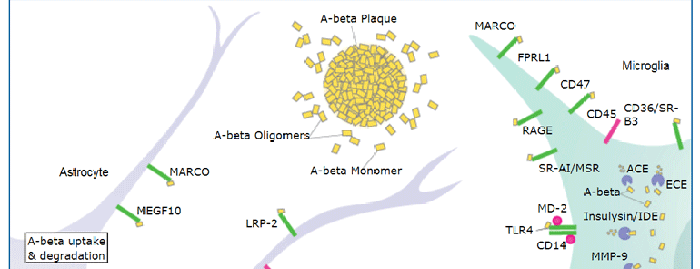
The type I class A macrophage scavenger receptor (SR-AI; also MSR-AI) is a 70-80 kDa protein that belongs to an ever expanding family of transmembrane molecules collectively referred to as scavenger receptors (1-3). Receptors of this family contain characteristic extracellular domains and bind to a series of generally unrelated, but negatively-charged/polyanionic ligands (1, 3). Human SR-AI is a type II transmembrane glycoprotein that is 451 amino acids (aa) in length. It contains a 50 aa cytoplasmic tail, a 26 aa transmembrane segment and a 375 aa extracellular region (4, 5). The extracellular region contains four definitive domains, with a membrane proximal spacer of 33 aa, an alpha -helical coiled-coil domain of 163 aa, a collagen-like domain of 69 aa, and a cysteine-rich C-terminus of 110 aa (4, 6). The cysteine-rich domain (CRD) forms three intrachain disulfide bonds (7). The functional form of the molecule is a 220-230 kDa membrane-associated trimer that, in human, apparently has two disulfide bonded chains and a third noncovalently associated subunit (8, 9). Human extracellular region is 73% and 72% aa identical to bovine and mouse SR-AI extracellular region, respectively. The human gene for SR-A gives rise to three isoforms; the I isoform of 451 aa, the II isoform of 358 aa, and the III isoform of 388 aa (4, 5, 10). All are equal through the first 344 aa which includes the cytoplasmic tail through the collagenous domain. Isoform II (SR-AII) shows a severe truncation of the CRD, but is expressed on the cell surface. Isoform III (SR-AIII) has a modest truncation of the CRD, and cannot be expressed on the cell surface. Their functions are unknown. However, relative to SR-AI, SR-AII is known to show differential sensitivity to LPS and receptor binding to gram-negative bacteria (9, 11), while SR-AIII is known to be a dominant-negative isoform (10). SR-AIII may achieve this by either heterotrimerizing with SR-AI, or simply eliminating the production of SR-AI mRNA.

![Human SR-AI/MSR Antibody [Biotin]](https://resources.rndsystems.com/images/icons/RnD-Default-Product-Image_Antibodies-Icon.svg "Human SR-AI/MSR Antibody [Biotin]")
Key Product Details
Species Reactivity
Human
Applications
Western Blot
Label
Biotin
Antibody Source
Polyclonal Goat IgG
Loading...
Product Specifications
Immunogen
Mouse myeloma cell line NS0-derived recombinant human SR-AI/MSR
Lys77-Leu451
Accession # P21757
Lys77-Leu451
Accession # P21757
Specificity
Detects human SR-AI/MSR in Western blots. In Western blots, approximately 35% cross-reactivity with recombinant mouse SR-AI is observed.
Clonality
Polyclonal
Host
Goat
Isotype
IgG
Applications for Human SR-AI/MSR Antibody [Biotin]
Application
Recommended Usage
Western Blot
0.1 µg/mL
Sample: Recombinant Human SR-AI/MSR (Catalog # 2708-MS)
Sample: Recombinant Human SR-AI/MSR (Catalog # 2708-MS)
Formulation, Preparation, and Storage
Purification
Antigen Affinity-purified
Reconstitution
Reconstitute at 0.2 mg/mL in sterile PBS.
Loading...
Formulation
Lyophilized from a 0.2 μm filtered solution in PBS with BSA as a carrier protein.
Shipping
The product is shipped at ambient temperature. Upon receipt, store it immediately at the temperature recommended below.
Stability & Storage
Use a manual defrost freezer and avoid repeated freeze-thaw cycles.
- 12 months from date of receipt, -20 to -70 °C as supplied.
- 1 month, 2 to 8 °C under sterile conditions after reconstitution.
- 6 months, -20 to -70 °C under sterile conditions after reconstitution.
Calculators
Background: SR-AI/MSR
References
- Platt, N. and S. Gordon (2001) J. Clin. Invest. 108:649.
- Linton, M.F. and S. Fazio (2001) Curr. Opin. Lipidol. 12:489.
- Platt, N. and S. Gordon (1998) Chem. Biol. 5:R193.
- Matsumoto, A. et al. (1990) Proc. Natl. Acad. Sci. USA 87:9133.
- Emi, M. et al. (1993) J. Biol. Chem. 268:2120.
- Naito, M. et al. (1992) Am. J. Pathol. 141:591.
- Resnick, D. et al. (1996) J. Biol. Chem. 271:26924.
- Ashkenas, J. et al. (1993) J. Lipid Res. 34:983.
- Penman, M. et al. (1991) J. Biol. Chem. 266:23985.
- Gough, P.J. et al. (1998) J. Lipid Res. 39:531.
- Peiser, L. et al. (2000) Inf. Immun. 68:1953.
Long Name
Macrophage Scavenger Receptor Types I and II
Alternate Names
CD204, MSR1, SCARA1, SRAI
Gene Symbol
MSR1
UniProt
Additional SR-AI/MSR Products
Product Documents for Human SR-AI/MSR Antibody [Biotin]
Certificate of Analysis
To download a Certificate of Analysis, please enter a lot or batch number in the search box below.
Note: Certificate of Analysis not available for kit components.
Product Specific Notices for Human SR-AI/MSR Antibody [Biotin]
For research use only
Related Research Areas
Customer Reviews for Human SR-AI/MSR Antibody [Biotin]
There are currently no reviews for this product. Be the first to review Human SR-AI/MSR Antibody [Biotin] and earn rewards!
Have you used Human SR-AI/MSR Antibody [Biotin]?
Submit a review and receive an Amazon gift card!
$25/€18/£15/$25CAN/¥2500 for a review with an image
$10/€7/£6/$10CAN/¥1110 for a review without an image
Submit a review
Protocols
Find general support by application which include: protocols, troubleshooting, illustrated assays, videos and webinars.
- Cellular Response to Hypoxia Protocols
- R&D Systems Quality Control Western Blot Protocol
- Troubleshooting Guide: Western Blot Figures
- Western Blot Conditions
- Western Blot Protocol
- Western Blot Protocol for Cell Lysates
- Western Blot Troubleshooting
- Western Blot Troubleshooting Guide
- View all Protocols, Troubleshooting, Illustrated assays and Webinars
Loading...
Associated Pathways