Human TGF-beta 1 Biotinylated Fluorokine Flow Cytometry Kit
Human TGF-beta 1 Biotinylated Fluorokine Flow Cytometry Kit Summary
Specifications
Product Datasheets
Background: TGF-beta 1
Transforming Growth Factor Beta 1, 2, and 3 (TGF-beta 1, TGF-beta 2, and TGF-beta 3) are highly pleiotropic cytokines that virtually all cell types secrete. TGF-beta molecules are proposed to act as cellular switches that regulate processes such as immune function, proliferation, and epithelial-mesenchymal transition. Targeted deletions of these genes in mice show that each TGF-beta isoform has some non-redundant functions: TGF-beta 1 is involved in hematopoiesis and endothelial differentiation; TGF-beta 2 affects development of cardiac, lung, craniofacial, limb, eye, ear, and urogenital systems; and TGF-beta 3 influences palatogenesis and pulmonary development. The full range of in vitro biological activities of TGF-beta 5 has not yet been explored. However, TGF-beta 1, TGF-beta 2, TGF-beta 3, and TGF-beta 5 have been found to be largely interchangeable in an inhibitory bioassay, and it is anticipated that TGF-beta 5 will show a spectrum of activities similar to the other TGF-beta family members. To date, the production of TGF-beta 5 has only been demonstrated in Xenopus.
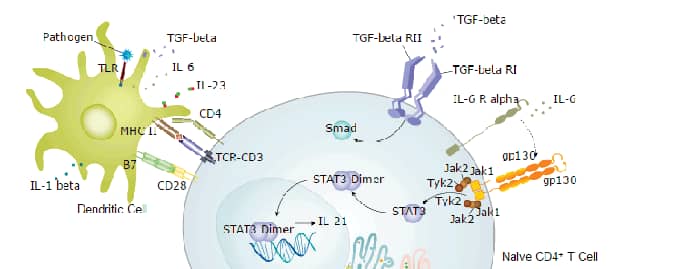
TGF-beta ligands are initially synthesized as precursor proteins that undergo proteolytic cleavage. The mature segments form active ligand dimers via a disulfide-rich core consisting of the characteristic 'cysteine knot'. TGF-beta signaling begins with binding to a complex of the accessory receptor betaglycan (also known as TGF-beta RIII) and a type II serine/threonine kinase receptor termed TGF-beta RII. This receptor then phosphorylates and activates a type I serine/threonine kinase receptor, either ALK-1 or TGF-beta RI (also called ALK-5). The activated type I receptor phosphorylates and activates Smad proteins that regulate transcription. Use of other signaling pathways that are Smad-independent allows for distinct actions observed in response to TGF-beta in different contexts.
Citations for Human TGF-beta 1 Biotinylated Fluorokine Flow Cytometry Kit
R&D Systems personnel manually curate a database that contains references using R&D Systems products. The data collected includes not only links to publications in PubMed, but also provides information about sample types, species, and experimental conditions.
9
Citations: Showing 1 - 9
Filter your results:
Filter by:
-
Serine protease HTRA1 antagonizes transforming growth factor-beta signaling by cleaving its receptors and loss of HTRA1 in vivo enhances bone formation.
Authors: Graham J, Chamberland A, Lin Q, Li X, Dai D, Zeng W, Ryan M, Rivera-Bermudez M, Flannery C, Yang Z
PLoS ONE, 2013-09-11;8(9):e74094. 2013-09-11
-
Connective tissue growth factor antagonizes transforming growth factor-beta1/Smad signalling in renal mesangial cells.
Authors: O'Donovan HC, Hickey F, Brazil DP, Kavanagh DH, Oliver N, Martin F, Godson C, Crean J
Biochem. J., 2012-01-01;441(1):499-510. 2012-01-01
-
IL-28 supplants requirement for T(reg) cells in protein sigma1-mediated protection against murine experimental autoimmune encephalomyelitis (EAE).
Authors: Rynda A, Maddaloni M, Ochoa-Reparaz J, Callis G, Pascual DW
PLoS ONE, 2010-01-14;5(1):e8720. 2010-01-14
-
Analysis of the contribution of receptor subdomains to the cooperative binding and internalization of transforming growth factor-beta (TGF-beta) type I and type II receptors.
Authors: Zwaagstra JC, Collins C, Langlois MJ, O'Connor-McCourt MD
Exp. Cell Res., 2008-06-19;314(14):2553-68. 2008-06-19
-
Specific signals involved in the long-term maintenance of radiation-induced fibrogenic differentiation: a role for CCN2 and low concentration of TGF-beta1.
Authors: Haydont V, Riser BL, Aigueperse J, Vozenin-Brotons MC
Am. J. Physiol., Cell Physiol., 2008-04-09;294(6):C1332-41. 2008-04-09
-
Microsatellite unstable colorectal cancer cell lines with truncating TGFbetaRII mutations remain sensitive to endogenous TGFbeta.
Authors: Baker K, Raut P, Jass JR
J. Pathol., 2007-11-01;213(3):257-65. 2007-11-01
-
Compromised lymphocytes infiltrate hepatocellular carcinoma: the role of T-regulatory cells.
Authors: Unitt E, Rushbrook SM, Marshall A, Davies S, Gibbs P, Morris LS, Coleman N, Alexander GJ
Hepatology, 2005-04-01;41(4):722-30. 2005-04-01
-
Fibroblast-specific expression of a kinase-deficient type II transforming growth factor beta (TGFbeta) receptor leads to paradoxical activation of TGFbeta signaling pathways with fibrosis in transgenic mice.
Authors: Denton CP, Zheng B, Evans LA, Shi-wen X, Ong VH, Fisher I, Lazaridis K, Abraham DJ, Black CM, de Crombrugghe B
J. Biol. Chem., 2003-04-21;278(27):25109-19. 2003-04-21
-
A synthetic peptide from transforming growth factor beta type III receptor inhibits liver fibrogenesis in rats with carbon tetrachloride liver injury.
Authors: Ezquerro IJ, Lasarte JJ, Dotor J, Castilla-Cortazar I, Bustos M, Penuelas I, Blanco G, Rodriguez C, Lechuga Mdel C, Greenwel P, Rojkind M, Prieto J, Borras-Cuesta F
Cytokine, 2003-04-01;22(1):12-20. 2003-04-01
FAQs
No product specific FAQs exist for this product, however you may
View all Flow Cytometry Kit FAQsReviews for Human TGF-beta 1 Biotinylated Fluorokine Flow Cytometry Kit
There are currently no reviews for this product. Be the first to review Human TGF-beta 1 Biotinylated Fluorokine Flow Cytometry Kit and earn rewards!
Have you used Human TGF-beta 1 Biotinylated Fluorokine Flow Cytometry Kit?
Submit a review and receive an Amazon gift card.
$25/€18/£15/$25CAN/¥75 Yuan/¥2500 Yen for a review with an image
$10/€7/£6/$10 CAD/¥70 Yuan/¥1110 Yen for a review without an image