

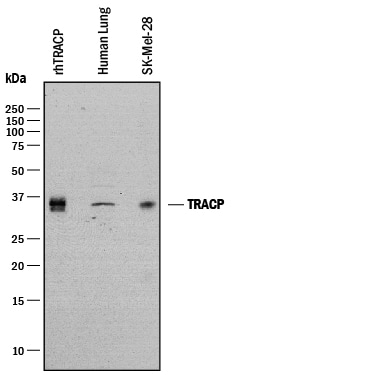
Encoded by the ACP5 gene, Tartrate Resistant Acid Phosphatase (TRACP or TRAP) is also known as Purple Acid Phosphatase (PAP) or Acid Phosphatase 5 (ACP5) (1). The deuced amino acid (aa) sequence of human ACP5 predicts a signal peptide (aa 1 to 21) and a mature chain (aa 22 to 325). R&D Systems' recombinant human ACP5 consists of aa 22 to 320, without the last 5 residues, RRARP.
ACP5 is expressed at high levels by osteoclasts, macrophages and dendritic cells (2). Two forms, 5a and 5b, circulating in human blood, are derived from different cell types and have different functions. Derived from macrophages and dendritic cells, 5a is a marker of inflammatory conditions. Derived from osteoclasts, 5b is a marker of bone resorption. Compared to 5a, 5b does not contain sialic acid residues, has a higher specific activity and pH optimum, and may be processed into a disulfide-linked dimer (3).
