
RANK Ligand (receptor activator of NF-kappa B ligand [RANKL], also called TNF-related activation-induced cytokines (TRANCE), osteoprotegerin ligand [OPGL], and osteoclast differentiation factor [ODF]), is a member of the tumor necrosis factor (TNF) family. RANK Ligand was originally identified as an immediate early gene upregulated by T cell receptor stimulation. The human RANK Ligand cDNA encodes a type II transmembrane protein of 317 amino acids with a predicted cytoplasmic domain of 47 amino acids, a 21 amino acids transmembrane region, and an extracellular domain of 249 amino acids. The extracellular domain contains two potential N‑linked glycosylation sites. Mouse and human RANK Ligand share 85% amino acid identity. RANK Ligand is primarily expressed in T cells and T cell rich organs, such as thymus and lymph nodes. The multi-functions of RANK Ligand include induction of activation of the c-jun N‑terminal kinase, enhancement of T cell growth and dendritic cell function, induction of osteoclastogenesis, and lymph node organogenesis. RANK is the cell surface signaling receptor of RANK Ligand. RANK has been shown to undergo receptor clustering during signal transduction. Osteoprotegerin, a soluble member of the TNF receptor family which binds RANK Ligand, is a naturally occurring decoy receptor that counterbalances the effects of RANK Ligand.
Human TRANCE/TNFSF11/RANK L Antibody
R&D Systems | Catalog # AF626

Scientific images may be resized, cropped, or adjusted for brightness or contrast for presentation purposes. These updates are limited to presentation and do not affect the underlying scientific interpretation of the data. Where available, additional source data may be provided upon request.
Key Product Details
Species Reactivity
Validated:
Cited:
Applications
Validated:
Cited:
Label
Antibody Source
Product Specifications
Immunogen
Gln73-Asp317 (Ala194Gly)
Accession # O14788
Specificity
Clonality
Host
Isotype
Endotoxin Level
Scientific Data Images for Human TRANCE/TNFSF11/RANK L Antibody
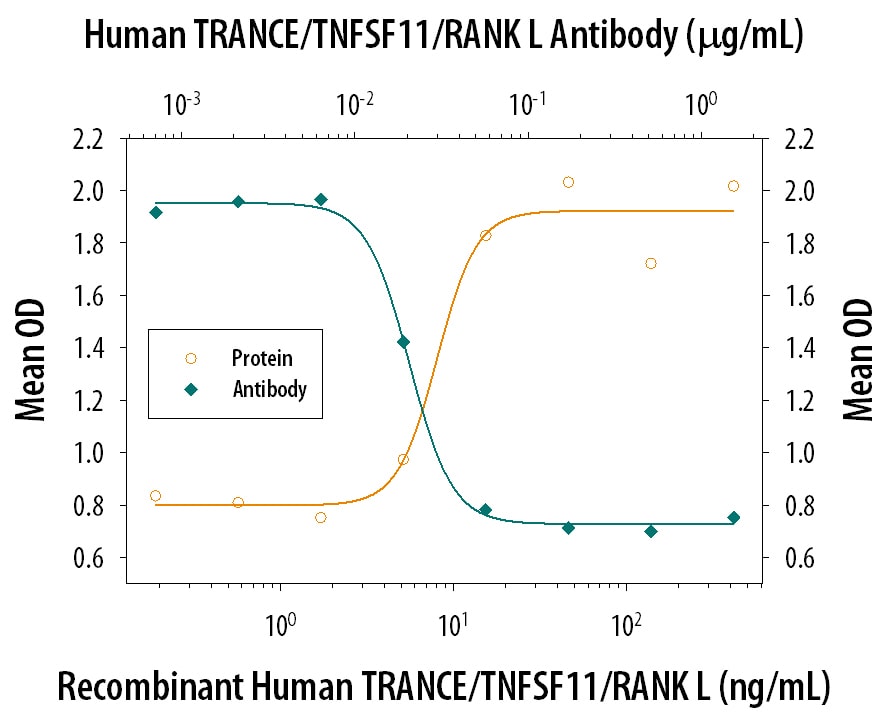
Osteoclast-Like Cell Form-ation Induced by TRANCE/ TNFSF11/RANK L and Neutralization by Human TRANCE/TNFSF11/RANK L Antibody.
In the presence of Recombinant Mouse M-CSF (20 ng/mL, 416-ML), Recombinant Human TRANCE/ TNFSF11/RANK L (390-TN) induces osteoclast-like cell formation in RAW 264.7 mouse macrophages in a dose-dependent manner (orange line), as measured by TRAP (tartrate-resistant acid phosphatase) solution assay. Under these conditions, osteoclast-like cell formation elicited by Recombinant Human TRANCE/TNFSF11/ RANK L (10 ng/mL) is neutral-ized (green line) by increasing concentrations of Goat Anti-Human TRANCE/TNFSF11/ RANK L Antigen Affinity-purified Poly-clonal Antibody (Catalog # AF626). The ND50 is typically 0.01-0.04 µg/mL.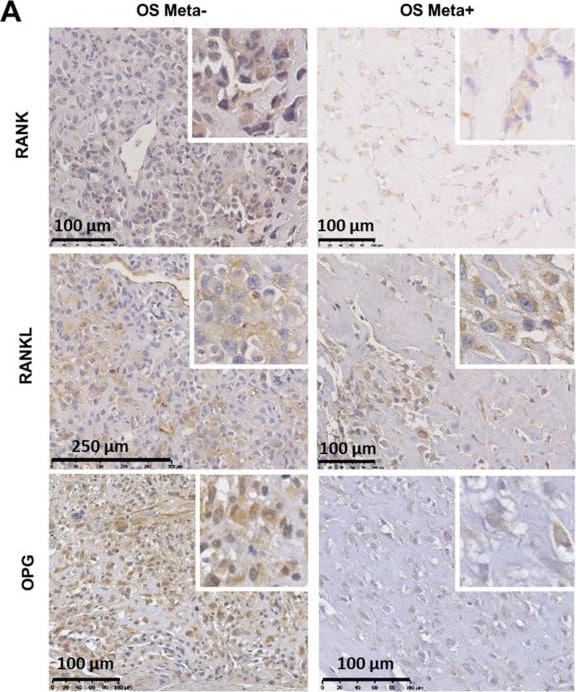
Detection of TRANCE/RANK L/TNFSF11 by Immunohistochemistry
Tissue array analysis of RANK, RANKL and OPG expressions in a cohort of 50 biopsies of patients with (n = 28) and without (n = 22) metastases at time of diagnosis. Representative views of the different immuno-stainings are presented (A) with enlargement inset to clearly show the stained osteosarcoma cells. Statistical analyses (Student test) of the staining based on the percentage of stained osteosarcoma cells revealed a significantly lower number of positive cells for RANKL and OPG in the metastatic patient group, while no difference was observed between the two groups concerning the number of RANK-expressing cells (B). Statistical analysis of the three ratios between these factors, established individually for each patient, showed that only the OPG/RANK ratio was significantly different between the two groups with lower values in the metastatic patient group (C). ns: not significant. *: p < 0.05. p values are given for each test. Image collected and cropped by CiteAb from the following open publication (https://pubmed.ncbi.nlm.nih.gov/30355966), licensed under a CC-BY license. Not internally tested by R&D Systems.Applications for Human TRANCE/TNFSF11/RANK L Antibody
Western Blot
Sample: Recombinant Human TRANCE/TNFSF11/RANK L (Truncated) (Catalog # 390-TN)
Neutralization
Formulation, Preparation, and Storage
Purification
Reconstitution
Reconstitute at 0.2 mg/mL in sterile PBS. For liquid material, refer to CoA for concentration.
Formulation
Shipping
Stability & Storage
- 12 months from date of receipt, -20 to -70 °C as supplied.
- 1 month, 2 to 8 °C under sterile conditions after reconstitution.
- 6 months, -20 to -70 °C under sterile conditions after reconstitution.
Calculators
Background: TRANCE/TNFSF11/RANK L
References
- Wong, B.R. et al. (1997) J. Biol. Chem. 272:25190.
- Anderson, D.M. et al. (1997) Nature 390:175.
- Nakagawa, N. et al. (1998) Biochem. Biophys. Res. Commun. 245:382.
- Kong, Y-Y. et al. (1999) Nature 397:315.
Long Name
Alternate Names
Gene Symbol
UniProt
Additional TRANCE/TNFSF11/RANK L Products
Product Documents for Human TRANCE/TNFSF11/RANK L Antibody
Certificate of Analysis
To download a Certificate of Analysis, please enter a lot or batch number in the search box below.
Note: Certificate of Analysis not available for kit components.
Product Specific Notices for Human TRANCE/TNFSF11/RANK L Antibody
For research use only
Related Research Areas
Citations for Human TRANCE/TNFSF11/RANK L Antibody
 Powered by Bioz
Customer Reviews for Human TRANCE/TNFSF11/RANK L Antibody
There are currently no reviews for this product. Be the first to review Human TRANCE/TNFSF11/RANK L Antibody and earn rewards!
Have you used Human TRANCE/TNFSF11/RANK L Antibody?
Submit a review and receive an Amazon gift card!
$25/€18/£15/$25CAN/¥2500 for a review with an image
$10/€7/£6/$10CAN/¥1110 for a review without an image
Submit a review
Protocols
Find general support by application which include: protocols, troubleshooting, illustrated assays, videos and webinars.
- Cellular Response to Hypoxia Protocols
- R&D Systems Quality Control Western Blot Protocol
- Troubleshooting Guide: Western Blot Figures
- Western Blot Conditions
- Western Blot Protocol
- Western Blot Protocol for Cell Lysates
- Western Blot Troubleshooting
- Western Blot Troubleshooting Guide
- View all Protocols, Troubleshooting, Illustrated assays and Webinars
Associated Pathways
