
MHC Class II RT1B Antibody (OX-6) - BSA Free
Novus Biologicals | Catalog # NB100-65541

![Immunohistochemistry: MHC Class II RT1B Antibody (OX-6) - BSA Free [NB100-65541]](https://resources.rndsystems.com/images/products/MHC-Class-II-RT1B-Antibody-OX-6-Immunohistochemistry-NB100-65541-img0017.jpg "Immunohistochemistry: MHC Class II RT1B Antibody (OX-6) - BSA Free [NB100-65541]")
Scientific images may be resized, cropped, or adjusted for brightness or contrast for presentation purposes. These updates are limited to presentation and do not affect the underlying scientific interpretation of the data. Where available, additional source data may be provided upon request.
Key Product Details
Validated by
Species Reactivity
Validated:
Cited:
Applications
Validated:
Cited:
Label
Antibody Source
Format
Product Specifications
Immunogen
Reactivity Notes
Specificity
Clonality
Host
Isotype
Scientific Data Images for MHC Class II RT1B Antibody (OX-6) - BSA Free
Immunohistochemistry: MHC Class II RT1B Antibody (OX-6) - BSA Free [NB100-65541]
MHC-Class-II-RT1B-Antibody-OX-6-Immunohistochemistry-NB100-65541-img0017.jpg![Western Blot: MHC Class II RT1B Antibody (OX-6)BSA Free [NB100-65541]](https://resources.rndsystems.com/images/products/MHC-Class-II-RT1B-Antibody-OX-6-Western-Blot-NB100-65541-img0011.jpg "Western Blot: MHC Class II RT1B Antibody (OX-6)BSA Free [NB100-65541]")
Western Blot: MHC Class II RT1B Antibody (OX-6)BSA Free [NB100-65541]
Western Blot: MHC Class II RT1B Antibody (OX-6) [NB100-65541] - Total protein from mouse placenta and spleen was separated on a 12% gel by SDS-PAGE, transferred to PVDF membrane and blocked in 5% non-fat milk in TBST. The membrane was probed with 2.0 ug/ml anti-RT1b in 1% milk, and detected with an anti-mouse HRP secondary antibody using chemiluminescence.![Immunohistochemistry-Paraffin: MHC Class II RT1B Antibody (OX-6) - BSA Free [NB100-65541]](https://resources.rndsystems.com/images/products/MHC-Class-II-RT1B-Antibody-OX-6-Immunohistochemistry-Paraffin-NB100-65541-img0014.jpg "Immunohistochemistry-Paraffin: MHC Class II RT1B Antibody (OX-6) - BSA Free [NB100-65541]")
Immunohistochemistry-Paraffin: MHC Class II RT1B Antibody (OX-6) - BSA Free [NB100-65541]
Immunohistochemistry-Paraffin: MHC Class II RT1B Antibody (OX-6) [NB100-65541] - IHC analysis of a formalin fixed and paraffin embedded tissue section of mouse spleen using MHC Class II RT1B antibody (clone OX-6) at 1:100 dilution. The signal was developed using HRP-labelled secondary antibody and DAB reagent, and the nuclei were counterstained with hematoxylin. The antibody generated very specific signal in a subset of spleenocytes.![Flow Cytometry: MHC Class II RT1B Antibody (OX-6) - BSA Free [NB100-65541]](https://resources.rndsystems.com/images/products/MHC-Class-II-RT1B-Antibody-OX-6-Flow-Cytometry-NB100-65541-img0005.jpg "Flow Cytometry: MHC Class II RT1B Antibody (OX-6) - BSA Free [NB100-65541]")
Flow Cytometry: MHC Class II RT1B Antibody (OX-6) - BSA Free [NB100-65541]
Flow Cytometry: MHC Class II RT1B Antibody (OX-6) [NB100-65541] - Staining of rat spleen cells.![Immunohistochemistry: MHC Class II RT1B Antibody (OX-6) - BSA Free [NB100-65541]](https://resources.rndsystems.com/images/products/MHC-Class-II-RT1B-Antibody-OX-6-Immunohistochemistry-NB100-65541-img0019.jpg "Immunohistochemistry: MHC Class II RT1B Antibody (OX-6) - BSA Free [NB100-65541]")
![Flow Cytometry: MHC Class II RT1B Antibody (OX-6) - BSA Free [NB100-65541]](https://resources.rndsystems.com/images/products/MHC-Class-II-RT1B-Antibody-OX-6-Flow-Cytometry-NB100-65541-img0012.jpg "Flow Cytometry: MHC Class II RT1B Antibody (OX-6) - BSA Free [NB100-65541]")
Flow Cytometry: MHC Class II RT1B Antibody (OX-6) - BSA Free [NB100-65541]
Flow Cytometry: MHC Class II RT1B Antibody (OX-6) [NB100-65541] - Analysis using Alexa Fluor (R) 488 conjugate of NB100-65541. Rat Splenocytes were stained with MHC Class II RT1B (OX-6) antibody NB100-65541 (blue) and a matched isotype control NBP2-27287 (orange). Cells were incubated in an antibody dilution of 1 ug/mL for 20 minutes at room temperature. The antibodies were directly conjugated to Alexa Fluor 488.![Western Blot: MHC Class II RT1B Antibody (OX-6)BSA Free [NB100-65541]](https://resources.rndsystems.com/images/products/MHC-Class-II-RT1B-Antibody-OX-6-Western-Blot-NB100-65541-img0002.jpg "Western Blot: MHC Class II RT1B Antibody (OX-6)BSA Free [NB100-65541]")
Western Blot: MHC Class II RT1B Antibody (OX-6)BSA Free [NB100-65541]
Western Blot: MHC Class II RT1B Antibody (OX-6) [NB100-65541] - Rat Spleen Tissue lysate probed with MHC Class II antibody.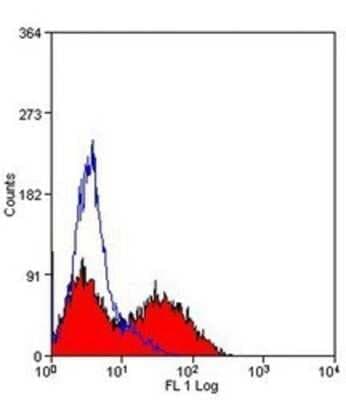
Flow Cytometry: MHC Class II RT1B Antibody (OX-6) - BSA Free [NB100-65541] -
Flow Cytometry: MHC Class II RT1B Antibody (OX-6) - BSA Free [NB100-65541] - Staining of rat splenocytes with Mouse anti Rat MHC class II RT1B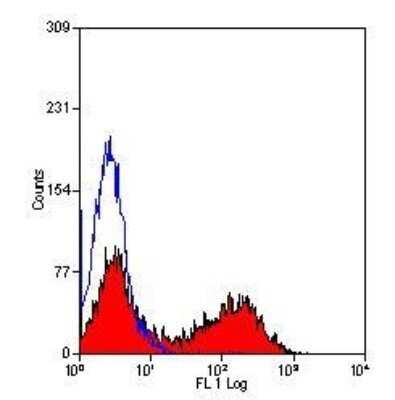
Flow Cytometry: MHC Class II RT1B Antibody (OX-6) - BSA Free [NB100-65541] -
Flow Cytometry: MHC Class II RT1B Antibody (OX-6) - BSA Free [NB100-65541] - Staining of rat spleen cells.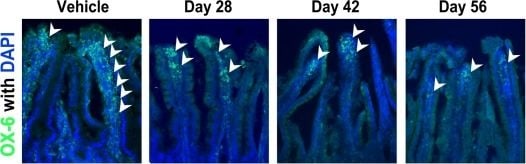
Immunocytochemistry/ Immunofluorescence: MHC Class II RT1B Antibody (OX-6) - BSA Free [NB100-65541] -
Immunocytochemistry/ Immunofluorescence: MHC Class II RT1B Antibody (OX-6) - BSA Free [NB100-65541] - Administration of cord blood cells with plasma in the 6-OHDA PD rat model: Assessment of immune cell activation, & pro-inflammatory cytokine production in the intestine. Confocal imaging shows a significant reduction in OX-6 (MHC II) expression in the intestinal mucosa of 6-OHDA animals that were given a combination of cord blood cells & plasma. This therapy also resulted in a significant decrease in TNF expression in this animal model. Quantitative analyses of the estimated OX-6 expression & TNF are displayed in the graphs above. Representative merged images above show co-localization of OX-6 (Green) or TNF (Red) with DAPI+ (Blue) expression from cells in the small intestine of 6-OHDA PD animals. Arrow heads indicate positive staining of OX-6 & TNF expression in intestinal villi. Scale bar = 100 μm Image collected & cropped by CiteAb from the following publication (https://pubmed.ncbi.nlm.nih.gov/31317505), licensed under a CC-BY license. Not internally tested by Novus Biologicals.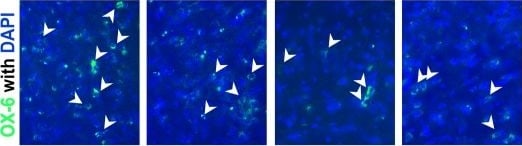
Immunocytochemistry/ Immunofluorescence: MHC Class II RT1B Antibody (OX-6) - BSA Free [NB100-65541] -
Immunocytochemistry/ Immunofluorescence: MHC Class II RT1B Antibody (OX-6) - BSA Free [NB100-65541] - Administration of cord blood cells with plasma in the 6-OHDA PD rat model: Assessment of TH-positive dopaminergic neurons, immune cell activation, & pro-inflammatory cytokine production. Tyrosine hydroxylase (TH) staining (top row) was used to investigate the potential effect of combined cord blood cell with plasma injection on dopaminergic neuron populations in the substantia nigra pars compacta (SNpc). Analysis of fluorescent intensity revealed significant protection & retention of dopaminergic cells in the SNpc in 6-OHDA animals treated with cord blood cells & plasma, compared to vehicle controls. Cord blood treated groups also demonstrated significant reductions immune cell activation (OX-6) & pro-inflammatory cytokine production (TNF). Overall, the combination of cord blood cells & plasma can significantly modulate the exacerbated immune response through downregulation of pro-inflammatory cytokine production & immune cell activation in the 6-OHDA rat model at all time points tested. Photomicrographs correspond to representative SN in coronal sections immune-labeled with TH, OX-6 or TNF antibody. Scale bar = 50 μm Image collected & cropped by CiteAb from the following publication (https://pubmed.ncbi.nlm.nih.gov/31317505), licensed under a CC-BY license. Not internally tested by Novus Biologicals.Applications for MHC Class II RT1B Antibody (OX-6) - BSA Free
Flow Cytometry
Immunocytochemistry/ Immunofluorescence
Immunohistochemistry
Immunohistochemistry Free-Floating
Immunohistochemistry-Frozen
Immunohistochemistry-Paraffin
Western Blot
Reviewed Applications
Read 1 review rated 3 using NB100-65541 in the following applications:
Flow Cytometry Panel Builder
Bio-Techne Knows Flow Cytometry
Save time and reduce costly mistakes by quickly finding compatible reagents using the Panel Builder Tool.
Advanced Features
- Spectra Viewer - Custom analysis of spectra from multiple fluorochromes
- Spillover Popups - Visualize the spectra of individual fluorochromes
- Antigen Density Selector - Match fluorochrome brightness with antigen density

Formulation, Preparation, and Storage
Purification
Formulation
Format
Preservative
Concentration
Shipping
Stability & Storage
Background: MHC Class II RT1B
Alternate Names
Gene Symbol
Additional MHC Class II RT1B Products
Product Documents for MHC Class II RT1B Antibody (OX-6) - BSA Free
Certificate of Analysis
To download a Certificate of Analysis, please enter a lot or batch number in the search box below.
Product Specific Notices for MHC Class II RT1B Antibody (OX-6) - BSA Free
This product is for research use only and is not approved for use in humans or in clinical diagnosis. Primary Antibodies are guaranteed for 1 year from date of receipt.
Citations for MHC Class II RT1B Antibody (OX-6) - BSA Free
 Powered by Bioz
Customer Reviews for MHC Class II RT1B Antibody (OX-6) - BSA Free (1)
Have you used MHC Class II RT1B Antibody (OX-6) - BSA Free?
Submit a review and receive an Amazon gift card!
$25/€18/£15/$25CAN/¥2500 for a review with an image
$10/€7/£6/$10CAN/¥1110 for a review without an image
Submit a review
-
Application: ImmunofluorescenceSample Tested: Mouse PancreasSpecies: MouseVerified Customer | Posted 03/05/2013
There are no reviews that match your criteria.
Protocols
Find general support by application which include: protocols, troubleshooting, illustrated assays, videos and webinars.
- 7-Amino Actinomycin D (7-AAD) Cell Viability Flow Cytometry Protocol
- Antigen Retrieval Protocol (PIER)
- Antigen Retrieval for Frozen Sections Protocol
- Appropriate Fixation of IHC/ICC Samples
- Cellular Response to Hypoxia Protocols
- Chromogenic IHC Staining of Formalin-Fixed Paraffin-Embedded (FFPE) Tissue Protocol
- Chromogenic Immunohistochemistry Staining of Frozen Tissue
- ClariTSA™ Fluorophore Kits
- Detection & Visualization of Antibody Binding
- Extracellular Membrane Flow Cytometry Protocol
- Flow Cytometry Protocol for Cell Surface Markers
- Flow Cytometry Protocol for Staining Membrane Associated Proteins
- Flow Cytometry Staining Protocols
- Flow Cytometry Troubleshooting Guide
- Fluorescent IHC Staining of Frozen Tissue Protocol
- Graphic Protocol for Heat-induced Epitope Retrieval
- Graphic Protocol for the Preparation and Fluorescent IHC Staining of Frozen Tissue Sections
- Graphic Protocol for the Preparation and Fluorescent IHC Staining of Paraffin-embedded Tissue Sections
- Graphic Protocol for the Preparation of Gelatin-coated Slides for Histological Tissue Sections
- ICC Cell Smear Protocol for Suspension Cells
- ICC Immunocytochemistry Protocol Videos
- ICC for Adherent Cells
- IHC Sample Preparation (Frozen sections vs Paraffin)
- Immunocytochemistry (ICC) Protocol
- Immunocytochemistry Troubleshooting
- Immunofluorescence of Organoids Embedded in Cultrex Basement Membrane Extract
- Immunofluorescent IHC Staining of Formalin-Fixed Paraffin-Embedded (FFPE) Tissue Protocol
- Immunohistochemistry (IHC) and Immunocytochemistry (ICC) Protocols
- Immunohistochemistry Frozen Troubleshooting
- Immunohistochemistry Paraffin Troubleshooting
- Intracellular Flow Cytometry Protocol Using Alcohol (Methanol)
- Intracellular Flow Cytometry Protocol Using Detergents
- Intracellular Nuclear Staining Flow Cytometry Protocol Using Detergents
- Intracellular Staining Flow Cytometry Protocol Using Alcohol Permeabilization
- Intracellular Staining Flow Cytometry Protocol Using Detergents to Permeabilize Cells
- Preparing Samples for IHC/ICC Experiments
- Preventing Non-Specific Staining (Non-Specific Binding)
- Primary Antibody Selection & Optimization
- Propidium Iodide Cell Viability Flow Cytometry Protocol
- Protocol for Heat-Induced Epitope Retrieval (HIER)
- Protocol for Liperfluo
- Protocol for Making a 4% Formaldehyde Solution in PBS
- Protocol for VisUCyte™ HRP Polymer Detection Reagent
- Protocol for the Characterization of Human Th22 Cells
- Protocol for the Characterization of Human Th9 Cells
- Protocol for the Fluorescent ICC Staining of Cell Smears - Graphic
- Protocol for the Fluorescent ICC Staining of Cultured Cells on Coverslips - Graphic
- Protocol for the Preparation & Fixation of Cells on Coverslips
- Protocol for the Preparation and Chromogenic IHC Staining of Frozen Tissue Sections
- Protocol for the Preparation and Chromogenic IHC Staining of Frozen Tissue Sections - Graphic
- Protocol for the Preparation and Chromogenic IHC Staining of Paraffin-embedded Tissue Sections
- Protocol for the Preparation and Chromogenic IHC Staining of Paraffin-embedded Tissue Sections - Graphic
- Protocol for the Preparation and Fluorescent ICC Staining of Cells on Coverslips
- Protocol for the Preparation and Fluorescent ICC Staining of Non-adherent Cells
- Protocol for the Preparation and Fluorescent ICC Staining of Stem Cells on Coverslips
- Protocol for the Preparation and Fluorescent IHC Staining of Frozen Tissue Sections
- Protocol for the Preparation and Fluorescent IHC Staining of Paraffin-embedded Tissue Sections
- Protocol for the Preparation of Gelatin-coated Slides for Histological Tissue Sections
- Protocol for the Preparation of a Cell Smear for Non-adherent Cell ICC - Graphic
- Protocol: Annexin V and PI Staining by Flow Cytometry
- Protocol: Annexin V and PI Staining for Apoptosis by Flow Cytometry
- R&D Systems Quality Control Western Blot Protocol
- TUNEL and Active Caspase-3 Detection by IHC/ICC Protocol
- The Importance of IHC/ICC Controls
- Troubleshooting Guide: Fluorokine Flow Cytometry Kits
- Troubleshooting Guide: Immunohistochemistry
- Troubleshooting Guide: Western Blot Figures
- Western Blot Conditions
- Western Blot Protocol
- Western Blot Protocol for Cell Lysates
- Western Blot Troubleshooting
- Western Blot Troubleshooting Guide
- View all Protocols, Troubleshooting, Illustrated assays and Webinars
FAQs for MHC Class II RT1B Antibody (OX-6) - BSA Free
-
Q: Does this antibody recognize MHCII from the C57BL6 strain?
A: I heard back from our lab to your question on haplotype vs reactivity of MHC Class II Antibody (OX-6) [NB100-65541]. He told me that we would not expect this antibody to recognize C57BL6 or C57BL6/j since they are haplotype b.