
ARSG is a member of the aryl sulfatase family of enzymes with a high degree of amino acid sequence similarity to ARSA and ARSB. ARSG mRNA is expressed in a ubiquitous manner, being detected in most adult and embryonic tissues of the mouse (1).
Mouse Arylsulfatase G/ARSG Antibody
R&D Systems | Catalog # AF4600

Key Product Details
Species Reactivity
Mouse
Applications
Western Blot, Immunoprecipitation
Label
Unconjugated
Antibody Source
Polyclonal Sheep IgG
Loading...
Product Specifications
Immunogen
Chinese hamster ovary cell line CHO-derived recombinant mouse Arylsulfatase G/ARSG
Gly17-Val525
Accession # Q3TYD4
Gly17-Val525
Accession # Q3TYD4
Specificity
Detects mouse Arylsulfatase G/ARSG in direct ELISAs and Western blots. In direct ELISAs and Western blots, less than 2% cross-reactivity with recombinant mouse ARSA, recombinant human (rh) ARSB and rhARSJ is observed.
Clonality
Polyclonal
Host
Sheep
Isotype
IgG
Scientific Data Images for Mouse Arylsulfatase G/ARSG Antibody
Detection of Mouse Arylsulfatase G/ARSG by Western Blot
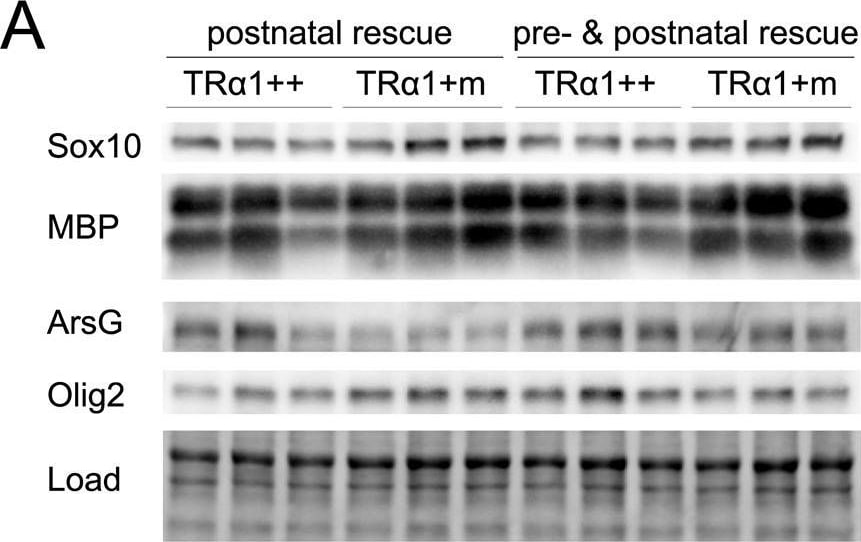
Oligodendrocyte protein levels are rescued in TRa1+m hypothalamus by early postnatal thyroid hormone. (A-D) Comparison of the protein-expression of oligodendrocyte markers from the whole-hypothalamus homogenates in adult wild type (TR alpha 1++) and TR alpha 1+m mutant, in which TR alpha 1 signaling was reactivated either postnatally or pre- and postnatally by crossing to endogenously hyperthyroid TR beta knockout mice or additionally bred by hyperthyroid TR beta knockout dams. Raw western blots (A-C) and their quantifications (B,D) for the expression of classic oligodendrocyte markers (A,B) and some of the differentially expressed genes between TR alpha 1++ and TR alpha 1+m (C,D) on the TR beta knockout background (postnatal rescue) and additionally bred by TR beta knockout dams (pre- and postnatal rescue). *P<0.05 for TR alpha 1++ versus TR alpha 1+m mutant; #P<0.05 for additional effect of prenatal treatment (two-way ANOVA, n=3 per group, Table S1). Data are mean±s.d. AU, arbitrary unit. Image collected and cropped by CiteAb from the following open publication (https://pubmed.ncbi.nlm.nih.gov/36715020), licensed under a CC-BY license. Not internally tested by R&D Systems.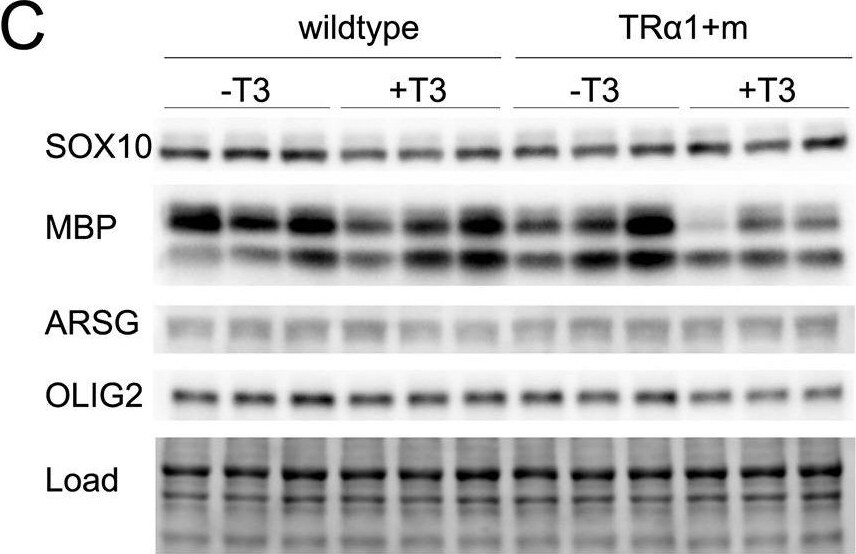
Detection of Mouse Arylsulfatase G/ARSG by Western Blot
Alterations in oligodendrocytic proteins in the TRa1+m hypothalamus. (A-F) Comparison of the protein-expression of cellular and oligodendrocyte markers from whole-hypothalamus homogenates in adult wild type and TR alpha 1+m mutant, with and without T3 treatment. Raw western blots (A,C,E) and their quantifications (B,D,F) for the expression of overall hypothalamic cell markers (A,B), classic oligodendrocyte markers (C,D) and four potentially differentially expressed genes between the WT and the mutant (E,F). *P<0.05, **P<0.01, ***P<0.001 for wild type versus TR alpha 1+m mutant; #P<0.05 for T3-treatment; $P<0.05, $$P<0.01 for interaction between T3 treatment and genotype (two-way ANOVA, n=3 per group, Table S1). Data are mean±s.d. AU, arbitrary unit. Image collected and cropped by CiteAb from the following open publication (https://pubmed.ncbi.nlm.nih.gov/36715020), licensed under a CC-BY license. Not internally tested by R&D Systems.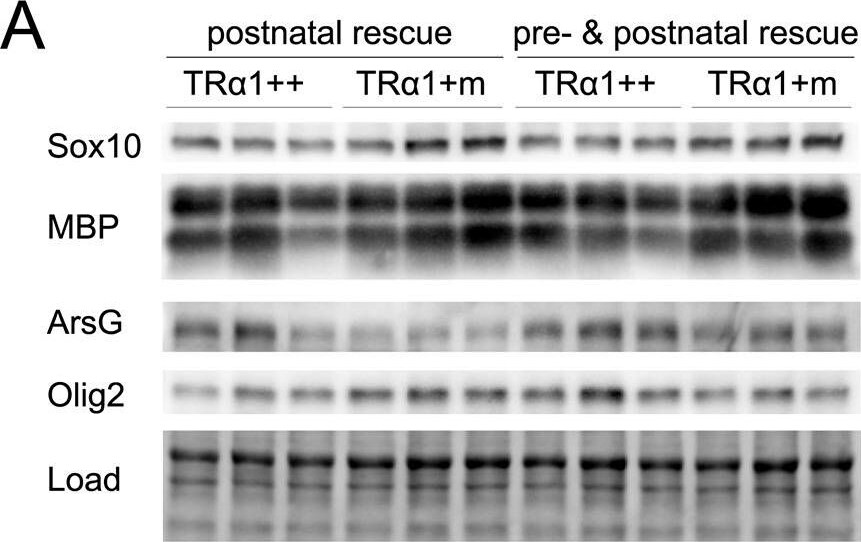
Detection of Mouse Arylsulfatase G/ARSG by Western Blot
Oligodendrocyte protein levels are rescued in TRa1+m hypothalamus by early postnatal thyroid hormone. (A-D) Comparison of the protein-expression of oligodendrocyte markers from the whole-hypothalamus homogenates in adult wild type (TR alpha 1++) and TR alpha 1+m mutant, in which TR alpha 1 signaling was reactivated either postnatally or pre- and postnatally by crossing to endogenously hyperthyroid TR beta knockout mice or additionally bred by hyperthyroid TR beta knockout dams. Raw western blots (A-C) and their quantifications (B,D) for the expression of classic oligodendrocyte markers (A,B) and some of the differentially expressed genes between TR alpha 1++ and TR alpha 1+m (C,D) on the TR beta knockout background (postnatal rescue) and additionally bred by TR beta knockout dams (pre- and postnatal rescue). *P<0.05 for TR alpha 1++ versus TR alpha 1+m mutant; #P<0.05 for additional effect of prenatal treatment (two-way ANOVA, n=3 per group, Table S1). Data are mean±s.d. AU, arbitrary unit. Image collected and cropped by CiteAb from the following open publication (https://pubmed.ncbi.nlm.nih.gov/36715020), licensed under a CC-BY license. Not internally tested by R&D Systems.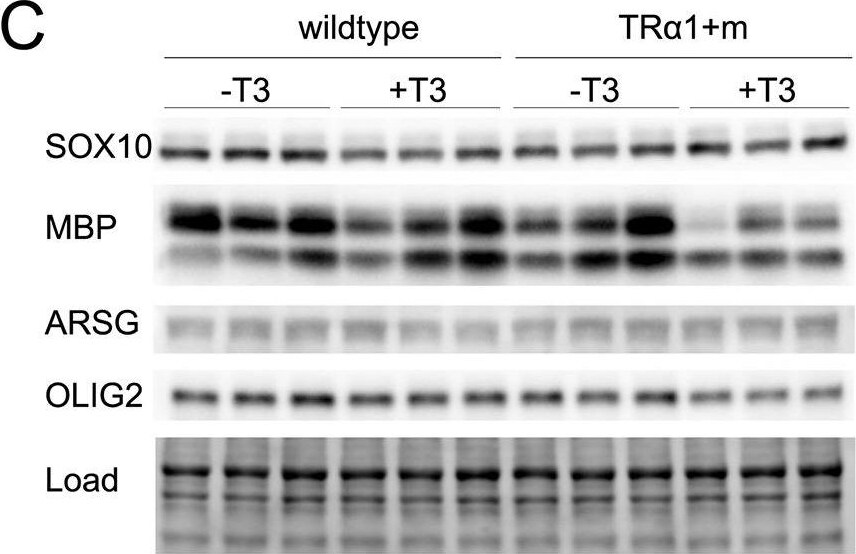
Detection of Mouse Arylsulfatase G/ARSG by Western Blot
Alterations in oligodendrocytic proteins in the TRa1+m hypothalamus. (A-F) Comparison of the protein-expression of cellular and oligodendrocyte markers from whole-hypothalamus homogenates in adult wild type and TR alpha 1+m mutant, with and without T3 treatment. Raw western blots (A,C,E) and their quantifications (B,D,F) for the expression of overall hypothalamic cell markers (A,B), classic oligodendrocyte markers (C,D) and four potentially differentially expressed genes between the WT and the mutant (E,F). *P<0.05, **P<0.01, ***P<0.001 for wild type versus TR alpha 1+m mutant; #P<0.05 for T3-treatment; $P<0.05, $$P<0.01 for interaction between T3 treatment and genotype (two-way ANOVA, n=3 per group, Table S1). Data are mean±s.d. AU, arbitrary unit. Image collected and cropped by CiteAb from the following open publication (https://pubmed.ncbi.nlm.nih.gov/36715020), licensed under a CC-BY license. Not internally tested by R&D Systems.Applications for Mouse Arylsulfatase G/ARSG Antibody
Application
Recommended Usage
Immunoprecipitation
25 µg/mL
Sample: Conditioned cell culture medium spiked with Recombinant Mouse Arylsulfatase G/ARSG (Catalog # 4600-SU), see our available Western blot detection antibodies
Sample: Conditioned cell culture medium spiked with Recombinant Mouse Arylsulfatase G/ARSG (Catalog # 4600-SU), see our available Western blot detection antibodies
Western Blot
0.1 µg/mL
Sample: Recombinant Mouse Arylsulfatase G/ARSG (Catalog # 4600-SU)
Sample: Recombinant Mouse Arylsulfatase G/ARSG (Catalog # 4600-SU)
Formulation, Preparation, and Storage
Purification
Antigen Affinity-purified
Reconstitution
Reconstitute at 0.2 mg/mL in sterile PBS. For liquid material, refer to CoA for concentration.
Loading...
Formulation
Lyophilized from a 0.2 μm filtered solution in PBS with Trehalose. *Small pack size (SP) is supplied either lyophilized or as a 0.2 µm filtered solution in PBS.
Shipping
Lyophilized product is shipped at ambient temperature. Liquid small pack size (-SP) is shipped with polar packs. Upon receipt, store immediately at the temperature recommended below.
Stability & Storage
Use a manual defrost freezer and avoid repeated freeze-thaw cycles.
- 12 months from date of receipt, -20 to -70 °C as supplied.
- 1 month, 2 to 8 °C under sterile conditions after reconstitution.
- 6 months, -20 to -70 °C under sterile conditions after reconstitution.
Calculators
Background: Arylsulfatase G/ARSG
References
- Ferrante, F. et al. (2002) Eur. J. Hum. Genetics 10:813.
Alternate Names
ARSG, ASG
Gene Symbol
ARSG
UniProt
Additional Arylsulfatase G/ARSG Products
Product Documents for Mouse Arylsulfatase G/ARSG Antibody
Certificate of Analysis
To download a Certificate of Analysis, please enter a lot or batch number in the search box below.
Note: Certificate of Analysis not available for kit components.
Product Specific Notices for Mouse Arylsulfatase G/ARSG Antibody
For research use only
Related Research Areas
Citations for Mouse Arylsulfatase G/ARSG Antibody
 Powered by Bioz
Customer Reviews for Mouse Arylsulfatase G/ARSG Antibody
There are currently no reviews for this product. Be the first to review Mouse Arylsulfatase G/ARSG Antibody and earn rewards!
Have you used Mouse Arylsulfatase G/ARSG Antibody?
Submit a review and receive an Amazon gift card!
$25/€18/£15/$25CAN/¥2500 for a review with an image
$10/€7/£6/$10CAN/¥1110 for a review without an image
Submit a review
Protocols
Find general support by application which include: protocols, troubleshooting, illustrated assays, videos and webinars.
- Cellular Response to Hypoxia Protocols
- Immunoprecipitation Protocol
- R&D Systems Quality Control Western Blot Protocol
- Troubleshooting Guide: Western Blot Figures
- Western Blot Conditions
- Western Blot Protocol
- Western Blot Protocol for Cell Lysates
- Western Blot Troubleshooting
- Western Blot Troubleshooting Guide
- View all Protocols, Troubleshooting, Illustrated assays and Webinars
Loading...