
Cathepsin D is a lysosomal aspartic protease of the pepsin family (4). Mouse Cathepsin D is synthesized as a precursor protein, consisting of a signal peptide (residues 1‑20), a propeptide (residues 21‑64), and a mature chain (residues 65‑410) (1‑3). It is expressed in most cells and overexpressed in breast cancer cells (5). It is a major enzyme in protein degradation in lysosomes, and also involved in the presentation of antigenic peptides. Mice deficient in this enzyme showed a progressive atrophy of the intestinal mucosa, a massive destruction of lymphoid organs, and a profound neuronal ceroid lipofucinosis, indicating that Cathepsin D is essential for proteolysis of proteins regulating cell growth and tissue homeostasis (6). Cathepsin D secreted from human prostate carcinoma cells is responsible for the generation of angiostatin, a potent endogeneous inhibitor of angiogenesis (6).
Mouse Cathepsin D Antibody [Biotin]
R&D Systems | Catalog # BAF1029

Scientific images may be resized, cropped, or adjusted for brightness or contrast for presentation purposes. These updates are limited to presentation and do not affect the underlying scientific interpretation of the data. Where available, additional source data may be provided upon request.
Key Product Details
Species Reactivity
Applications
Label
Antibody Source
Product Specifications
Immunogen
Ile21-Leu410
Accession # Q3UCD9
Specificity
Clonality
Host
Isotype
Scientific Data Images for Mouse Cathepsin D Antibody [Biotin]
Detection of Mouse Cathepsin D by Western Blot
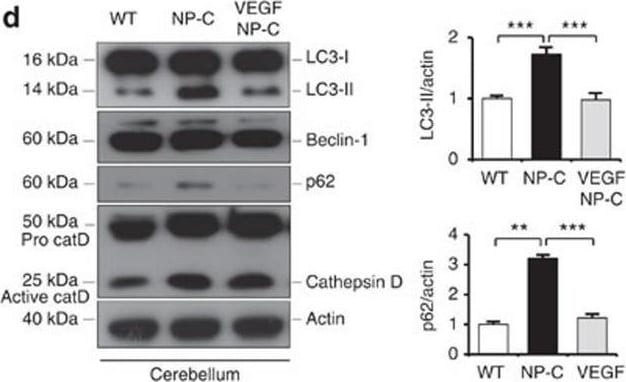
VEGF replenishment reverses defective autophagy in NP–C mice.(a) Western blot analysis of LC3, beclin-1, p62 and cathepsin D in primary cultured PNs derived from WT, NP–C and VEGF/NP–C mice (WT, n=5; NP–C, n=6; and VEGF/NP–C, n=6). (b) Immunocytochemistry of LC3 in WT, NP–C and VEGF/NP–C PNs (n=6 per group; scale bar, 20 μm). (c) Cathepsin D activity in primary cultured PNs (WT, n=5; NP–C, n=6; and VEGF/NP–C, n=6). (d) Western blot analysis of LC3, beclin-1, p62 and cathepsin D in the cerebellums of 6-week-old WT, NP–C and VEGF/NP–C mice (WT, n=6; NP–C, n=7; and VEGF/NP–C, n=7). (e) Cathepsin D activity in the cerebellums of WT, NP–C and VEGF/NP–C mice (WT, n=5; NP–C, n=6; and VEGF/NP–C, n=6). (f) EM images and quantification data of the cerebellum (n=5 per group; low-magnification scale bar, 1 μm; high-magnification scale bar, 200 nm). Arrow indicates autophagic vacuole. (g) Western blot analysis of Rab5 and Rab7 levels in the cerebellum (n=6 per group). (h) Cerebellar sections were immunostained with anti-active caspase-3 and the number of active caspase-3-positive cells in PCL was quantified (n=5 per group; scale bar, 50 μm). a–g, one-way analysis of variance, Tukey’s post hoc test. h, Student’s t-test. *P<0.05, **P<0.01, ***P<0.005. All error bars indicate s.e.m. Image collected and cropped by CiteAb from the following open publication (https://pubmed.ncbi.nlm.nih.gov/25417698), licensed under a CC-BY license. Not internally tested by R&D Systems.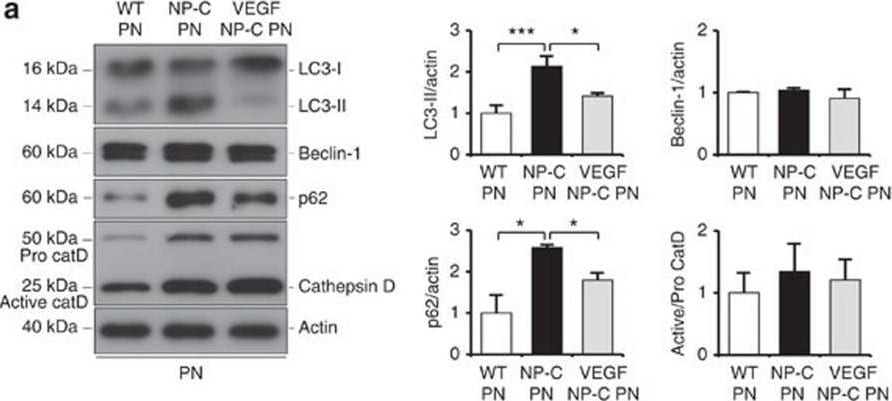
Detection of Mouse Cathepsin D by Western Blot
VEGF replenishment reverses defective autophagy in NP–C mice.(a) Western blot analysis of LC3, beclin-1, p62 and cathepsin D in primary cultured PNs derived from WT, NP–C and VEGF/NP–C mice (WT, n=5; NP–C, n=6; and VEGF/NP–C, n=6). (b) Immunocytochemistry of LC3 in WT, NP–C and VEGF/NP–C PNs (n=6 per group; scale bar, 20 μm). (c) Cathepsin D activity in primary cultured PNs (WT, n=5; NP–C, n=6; and VEGF/NP–C, n=6). (d) Western blot analysis of LC3, beclin-1, p62 and cathepsin D in the cerebellums of 6-week-old WT, NP–C and VEGF/NP–C mice (WT, n=6; NP–C, n=7; and VEGF/NP–C, n=7). (e) Cathepsin D activity in the cerebellums of WT, NP–C and VEGF/NP–C mice (WT, n=5; NP–C, n=6; and VEGF/NP–C, n=6). (f) EM images and quantification data of the cerebellum (n=5 per group; low-magnification scale bar, 1 μm; high-magnification scale bar, 200 nm). Arrow indicates autophagic vacuole. (g) Western blot analysis of Rab5 and Rab7 levels in the cerebellum (n=6 per group). (h) Cerebellar sections were immunostained with anti-active caspase-3 and the number of active caspase-3-positive cells in PCL was quantified (n=5 per group; scale bar, 50 μm). a–g, one-way analysis of variance, Tukey’s post hoc test. h, Student’s t-test. *P<0.05, **P<0.01, ***P<0.005. All error bars indicate s.e.m. Image collected and cropped by CiteAb from the following open publication (https://pubmed.ncbi.nlm.nih.gov/25417698), licensed under a CC-BY license. Not internally tested by R&D Systems.Applications for Mouse Cathepsin D Antibody [Biotin]
Immunohistochemistry
Sample: Perfusion fixed frozen sections of mouse kidney, liver, and thymus
Western Blot
Sample: Recombinant Mouse Cathepsin D (Catalog # 1029-AS)
Formulation, Preparation, and Storage
Purification
Reconstitution
Reconstitute at 0.2 mg/mL in sterile PBS.
Formulation
Shipping
Stability & Storage
- 12 months from date of receipt, -20 to -70 °C as supplied.
- 1 month, 2 to 8 °C under sterile conditions after reconstitution.
- 6 months, -20 to -70 °C under sterile conditions after reconstitution.
Calculators
Background: Cathepsin D
References
- Diedrich, et al. (1990) Nucl. Acid Res. 18:7184.
- Grusby, et al. (1990) Nucl. Acid Res. 18:4008.
- Hetman, et al. (1994) DNA Cell Biol. 13:419.
- Conner (2004) in Handbook of Proteolytic Enzymes (Barrett, et al. eds) Elsevier Academic Press, San Diego, p. 43.
- Rochefort, et al. (2000) Clin. Chim. Acta. 291:157.
- Tsukuba, et al. (2000) Mol. Cells 10:601.
Alternate Names
Gene Symbol
UniProt
Additional Cathepsin D Products
Product Documents for Mouse Cathepsin D Antibody [Biotin]
Certificate of Analysis
To download a Certificate of Analysis, please enter a lot or batch number in the search box below.
Note: Certificate of Analysis not available for kit components.
Product Specific Notices for Mouse Cathepsin D Antibody [Biotin]
For research use only
Citations for Mouse Cathepsin D Antibody [Biotin]
 Powered by Bioz
Customer Reviews for Mouse Cathepsin D Antibody [Biotin]
There are currently no reviews for this product. Be the first to review Mouse Cathepsin D Antibody [Biotin] and earn rewards!
Have you used Mouse Cathepsin D Antibody [Biotin]?
Submit a review and receive an Amazon gift card!
$25/€18/£15/$25CAN/¥2500 for a review with an image
$10/€7/£6/$10CAN/¥1110 for a review without an image
Submit a review
Protocols
Find general support by application which include: protocols, troubleshooting, illustrated assays, videos and webinars.
- Antigen Retrieval Protocol (PIER)
- Antigen Retrieval for Frozen Sections Protocol
- Appropriate Fixation of IHC/ICC Samples
- Cellular Response to Hypoxia Protocols
- Chromogenic IHC Staining of Formalin-Fixed Paraffin-Embedded (FFPE) Tissue Protocol
- Chromogenic Immunohistochemistry Staining of Frozen Tissue
- ClariTSA™ Fluorophore Kits
- Detection & Visualization of Antibody Binding
- Fluorescent IHC Staining of Frozen Tissue Protocol
- Graphic Protocol for Heat-induced Epitope Retrieval
- Graphic Protocol for the Preparation and Fluorescent IHC Staining of Frozen Tissue Sections
- Graphic Protocol for the Preparation and Fluorescent IHC Staining of Paraffin-embedded Tissue Sections
- Graphic Protocol for the Preparation of Gelatin-coated Slides for Histological Tissue Sections
- IHC Sample Preparation (Frozen sections vs Paraffin)
- Immunofluorescent IHC Staining of Formalin-Fixed Paraffin-Embedded (FFPE) Tissue Protocol
- Immunohistochemistry (IHC) and Immunocytochemistry (ICC) Protocols
- Immunohistochemistry Frozen Troubleshooting
- Immunohistochemistry Paraffin Troubleshooting
- Preparing Samples for IHC/ICC Experiments
- Preventing Non-Specific Staining (Non-Specific Binding)
- Primary Antibody Selection & Optimization
- Protocol for Heat-Induced Epitope Retrieval (HIER)
- Protocol for Making a 4% Formaldehyde Solution in PBS
- Protocol for VisUCyte™ HRP Polymer Detection Reagent
- Protocol for the Preparation & Fixation of Cells on Coverslips
- Protocol for the Preparation and Chromogenic IHC Staining of Frozen Tissue Sections
- Protocol for the Preparation and Chromogenic IHC Staining of Frozen Tissue Sections - Graphic
- Protocol for the Preparation and Chromogenic IHC Staining of Paraffin-embedded Tissue Sections
- Protocol for the Preparation and Chromogenic IHC Staining of Paraffin-embedded Tissue Sections - Graphic
- Protocol for the Preparation and Fluorescent IHC Staining of Frozen Tissue Sections
- Protocol for the Preparation and Fluorescent IHC Staining of Paraffin-embedded Tissue Sections
- Protocol for the Preparation of Gelatin-coated Slides for Histological Tissue Sections
- R&D Systems Quality Control Western Blot Protocol
- TUNEL and Active Caspase-3 Detection by IHC/ICC Protocol
- The Importance of IHC/ICC Controls
- Troubleshooting Guide: Immunohistochemistry
- Troubleshooting Guide: Western Blot Figures
- Western Blot Conditions
- Western Blot Protocol
- Western Blot Protocol for Cell Lysates
- Western Blot Troubleshooting
- Western Blot Troubleshooting Guide
- View all Protocols, Troubleshooting, Illustrated assays and Webinars
Associated Pathways
