

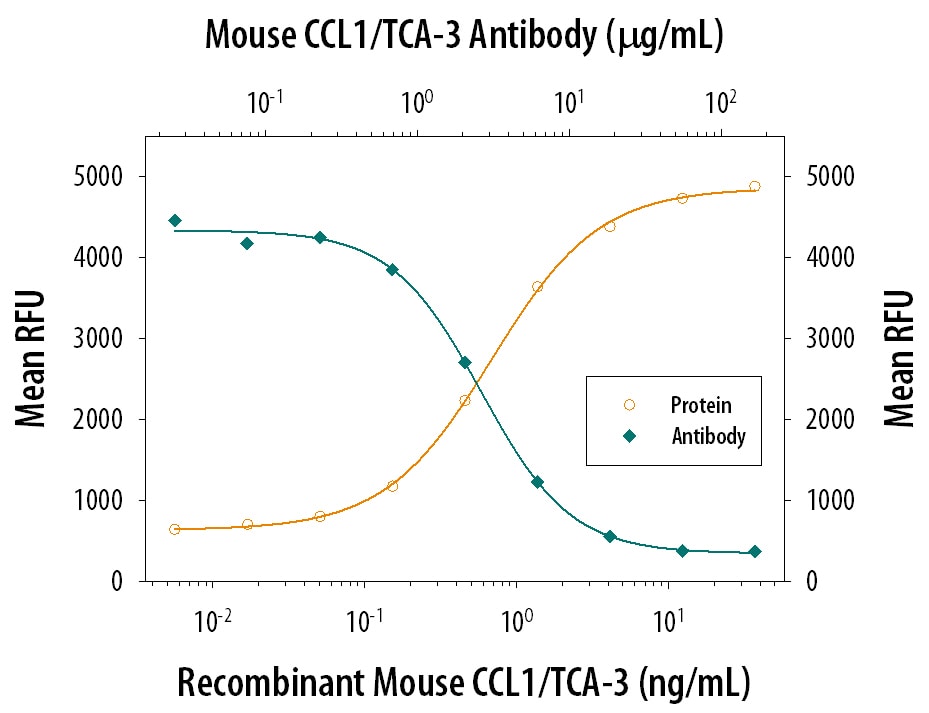
Mouse CCL1, also known as TCA-3, is a member of the CC beta family of chemokines. The human chemokine I-309, which shares approximately 42% amino acid (aa) sequence identity, has been assumed to be the homologue of mouse TCA-3. Mouse TCA-3 and human I-309 also share significant sequence homology in the 5' flanking region of their genes and each contain an extra pair of cysteine residues not found in most other chemokines.
CCL1 cDNA encodes a 92 aa residue precursor protein with a predicted 23 aa signal peptide that is cleaved to produce a 69 aa mature protein. The sequence of CCL1 contains one potential N-linked glycosylation site. Mouse CCL1 is found on the distal portion of mouse chromosome 11 in a cluster with MIP-1 alpha, MIP-1 beta and JE. CCL1 acts by binding to the seven transmembrane spanning G-protein-coupled receptor, CCR8. CCL1 has been shown to chemoattract T cells.
 Powered by Bioz

