


Key Product Details

Species Reactivity

Validated:

Mouse

Cited:

Human, Mouse

Applications

Validated:

Flow Cytometry, Immunocytochemistry, CyTOF-ready

Cited:

Immunohistochemistry, Flow Cytometry

Label

Unconjugated

Antibody Source

Polyclonal Sheep IgG
Loading...

Product Specifications

Immunogen

Chinese hamster ovary cell line CHO-derived recombinant mouse CD160
Gly28-Ser160
Accession # AAH21596

Specificity

Detects mouse CD160 in direct ELISAs. In direct ELISAs, less than 1% cross-reactivity with recombinant human CD160 is observed.

Clonality

Polyclonal

Host

Sheep

Isotype

IgG

Scientific Data Images for Mouse CD160 Antibody

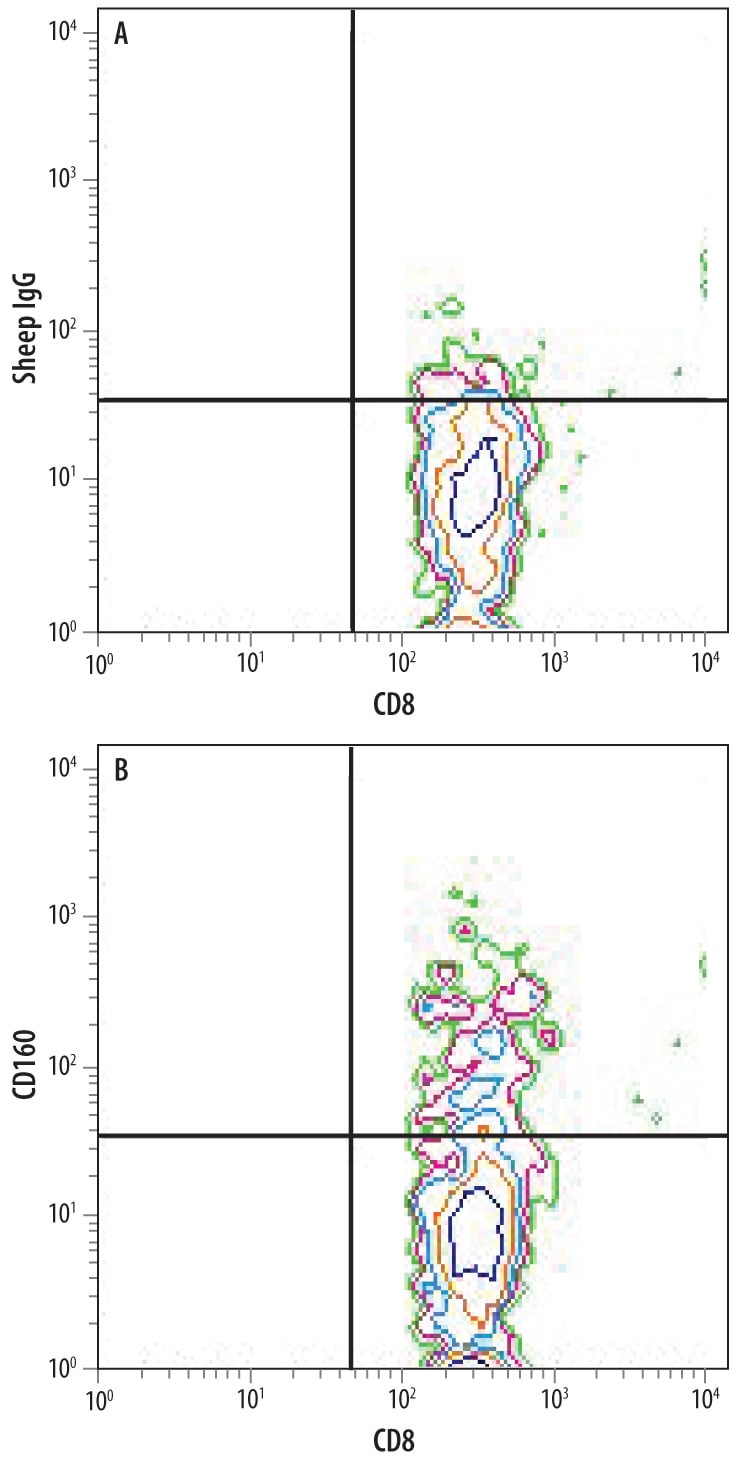
Detection of CD160 antibody in Mouse Splenocytes antibody by Flow Cytometry.

Detection of CD160 in Mouse Splenocytes by Flow Cytometry.

Mouse splenocytes (CD8-gated) stimulated with LPS for 3 hours were stained with Sheep Anti-Mouse CD160 Antigen Affinity-purified Polyclonal Antibody (Catalog # AF3899) followed by Phycoerythrin-conjugated Anti-Sheep IgG Secondary Antibody (Catalog # F0126) and Rat Anti-Mouse CD8a APC-conjugated Monoclonal Antibody (Catalog # FAB116A). Quadrant markers were set based on control antibody staining (Catalog # 5-001-A).

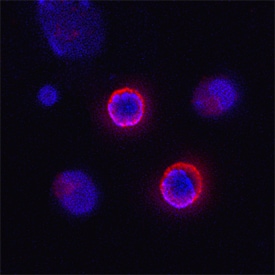
CD160 antibody in Mouse Splenocytes by Immunocytochemistry (ICC).

CD160 in Mouse Splenocytes.

CD160 was detected in immersion fixed mouse CD8+ splenocytes using Sheep Anti-Mouse CD160 Antigen Affinity-purified Polyclonal Antibody (Catalog # AF3899) at 15 µg/mL for 3 hours at room temperature. Cells were stained using the NorthernLights™ 557-conjugated Anti-Sheep IgG Secondary Antibody (red; Catalog # NL010) and counterstained with DAPI (blue). Specific staining was localized to plasma membranes. View our protocol for Fluorescent ICC Staining of Non-adherent Cells.

Applications for Mouse CD160 Antibody

Application
Recommended Usage

CyTOF-ready

Ready to be labeled using established conjugation methods. No BSA or other carrier proteins that could interfere with conjugation.

Flow Cytometry

2.5 µg/106 cells
Sample: Mouse splenocytes stimulated with LPS

Immunocytochemistry

5-15 µg/mL
Sample: Immersion fixed mouse CD8+ splenocytes

Flow Cytometry Panel Builder

Bio-Techne Knows Flow Cytometry

Save time and reduce costly mistakes by quickly finding compatible reagents using the Panel Builder Tool.

Advanced Features

  • Spectra Viewer - Custom analysis of spectra from multiple fluorochromes
  • Spillover Popups - Visualize the spectra of individual fluorochromes
  • Antigen Density Selector - Match fluorochrome brightness with antigen density
Build Your Panel Now

Formulation, Preparation, and Storage

Purification

Antigen Affinity-purified

Reconstitution

Sterile PBS to a final concentration of 0.2 mg/mL. For liquid material, refer to CoA for concentration.


Loading...

Formulation

Lyophilized from a 0.2 μm filtered solution in PBS with Trehalose. *Small pack size (SP) is supplied either lyophilized or as a 0.2 µm filtered solution in PBS.

Shipping

Lyophilized product is shipped at ambient temperature. Liquid small pack size (-SP) is shipped with polar packs. Upon receipt, store immediately at the temperature recommended below.

Stability & Storage

Use a manual defrost freezer and avoid repeated freeze-thaw cycles.
  • 12 months from date of receipt, -20 to -70 °C as supplied.
  • 1 month, 2 to 8 °C under sterile conditions after reconstitution.
  • 6 months, -20 to -70 °C under sterile conditions after reconstitution.

Calculators

The reconstitution calculator allows you to quickly calculate the volume of a reagent to reconstitute your vial. Simply enter the mass of reagent and the target concentration and the calculator will determine the rest.

=
÷

Background: CD160

‑CD160 (also Natural killer cell receptor BY55) is a 16 kDa (predicted) member of the Ig superfamily (1 ‑ 4). In mouse, it is expressed principally on nonmyeloid hematopoietic cells. These include CD3+ NK1.1 cells, CD8+ TEM and TCM T cells, CD8 alpha + IELs, NKT cells, CD8-gamma delta TCR T cells, and vascular endothelial cells (1, 5‑7). Mouse CD160 has been identified as a 20-21 kDa GPI-linked glycoprotein (4, 5). It is synthesized as a preproprotein that is 185 amino acids (aa) in length. The precursor contains a 27 aa signal sequence, a 133 aa mature molecule that shows one 98 aa V-type Ig-like domain (aa 28-125), and a 25 aa prosegment that is cleaved to generate a GPI-linkage at Ser160. Mouse GPI-linked CD160 is known to be cleaved by phospholipase C, and this generates a 40 kDa (presumably dimeric) band in SDS-PAGE (5). One alternative splice form for mouse CD160 is reported that appears to show a deletion of aa 137-180. This may generate a soluble molecule (5; GenBank Accession # NP_001156969). Mature mouse CD160 shares 63% and 88% aa identity with human and rat CD160, respectively.

In mouse, CD160 is reported to bind to bind to HVEM/TNFRSF14, and both classical and non‑classical MHC Class I molecules (5, 8). MHC‑I proteins recognized by CD160 include Dd, Kb, Qa-1b and CD1d (5). Upon engagement, the effects of CD160 ligation appear to be context dependent. When expressed on endothelial cells, CD160 binding to human HLA-G1 initiates apoptosis, and thus impacts angiogenesis (6). When expressed on NK1.1 cells, mouse CD160 ligation alone has no effect; when combined with NK1.1 antigen stimulation, CD160 decreases NK cell IFN-gamma secretion. Relative to cytotoxicity, NK cell activity is positively correlated with the presence of CD160 (5).

References

  1. Cai, G. & G.J. Freeman (2009) Immunol. Rev. 229:244.
  2. del Rio, M.L. et al. (2010) J. Leukoc. Biol. 87:223.
  3. Maiza, H. et al. (1993) J. Exp. Med. 178:1121.
  4. Anumanthan, A. et al. (1998) J. Immunol. 161:2780.
  5. Maeda, M. et al. (2005) J. Immunol. 175:4426.
  6. Fons, P. et al. (2006) Blood 108:2608.
  7. Tsujimura, K. et al. (2006) Immunol. Lett. 48:106.
  8. Cheung, T.C. et al. (2009) Proc. Natl. Acad. Sci USA 106:6244.
 

Alternate Names

BY55, CD160, NK1, NK28

Entrez Gene IDs

11126 (Human); 54215 (Mouse); 502585 (Rat); 102117412 (Cynomolgus Monkey)

Gene Symbol

CD160

UniProt

Additional CD160 Products

Product Documents for Mouse CD160 Antibody

Certificate of Analysis

To download a Certificate of Analysis, please enter a lot or batch number in the search box below.

Note: Certificate of Analysis not available for kit components.

Product Specific Notices for Mouse CD160 Antibody

For research use only

Citations for Mouse CD160 Antibody

Customer Reviews for Mouse CD160 Antibody

There are currently no reviews for this product. Be the first to review Mouse CD160 Antibody and earn rewards!

Have you used Mouse CD160 Antibody?

Submit a review and receive an Amazon gift card!

$25/€18/£15/$25CAN/¥2500 Yen for a review with an image

$10/€7/£6/$10CAN/¥1110 Yen for a review without an image

Submit a review
Amazon Gift Card

Protocols

Find general support by application which include: protocols, troubleshooting, illustrated assays, videos and webinars.

FAQs

No product specific FAQs exist for this product.

View all FAQs for Antibodies
