
Chitinase 3-like 1 (CHI3L1), also called breast regression protein 39 (BRP39) in mouse, or YKL-40 in humans, is a 39 kDa glycoprotein member of the glycosyl hydrolase 18 family (1-4). CHI3L1 was first identified as secreted from cultured articular chondrocytes, synovial cells, and activated monocyte-derived macrophages, but it is also secreted by neutrophils, endothelial cells, vascular smooth muscle cells, and some cancer cells (1, 2, 5-7). The mouse CHI3L1 cDNA encodes 381 amino acids (aa), including a 21 aa signal sequence and a 360 aa mature region with two intermolecular disulfides (3). Mature mouse CHI3L1 shares 73%, 75%, 72%, 71%, 70% and 69% aa sequence identity with human, rat, equine, porcine, canine and bovine CHI3L1, respectively. CHI3L1 does not show chitotriosidase activity, but binds chitin and is thus termed a chi-lectin (1-4). CHI3L1 can bind heparins, probably as heparan sulfate (3, 7). It has been found to enhance cell adhesion and promote cell signaling, proliferation and tumor angiogenesis (4, 6-9). Human elevated serum CHI3L1 levels occur in some conditions characterized by inflammation and connective tissue remodeling, such as arthritis, chronic obstructive pulmonary disease, diabetes, cardiovascular disease, inflammatory bowel disease, and liver cirrhosis (1, 9-12). Human single nucleotide polymorphisms that can increase serum CHI3L1 are associated with higher risk for asthma in childhood (13). CHI3L1 is frequently upregulated in glioblastoma, myxoid chondrosarcoma, melanoma and carcinomas of the breast, thyroid, colon, lung, kidney, and ovary (9). In asthma and cancer, serum CHI3L1 concentrations can correlate with prognosis (9, 14, 15). Mice lacking CHI3L1 have markedly diminished antigen-induced Th2 responses, which can be rescued by expression of human CHI3L1 (16).
Mouse Chitinase 3-like 1/YKL-40 Antibody
R&D Systems | Catalog # AF2649

Scientific images may be resized, cropped, or adjusted for brightness or contrast for presentation purposes. These updates are limited to presentation and do not affect the underlying scientific interpretation of the data. Where available, additional source data may be provided upon request.
Key Product Details
Validated by
Species Reactivity
Validated:
Cited:
Applications
Validated:
Cited:
Label
Antibody Source
Product Specifications
Immunogen
Tyr22-Ala381
Accession # Q61362
Specificity
Clonality
Host
Isotype
Scientific Data Images for Mouse Chitinase 3-like 1/YKL-40 Antibody
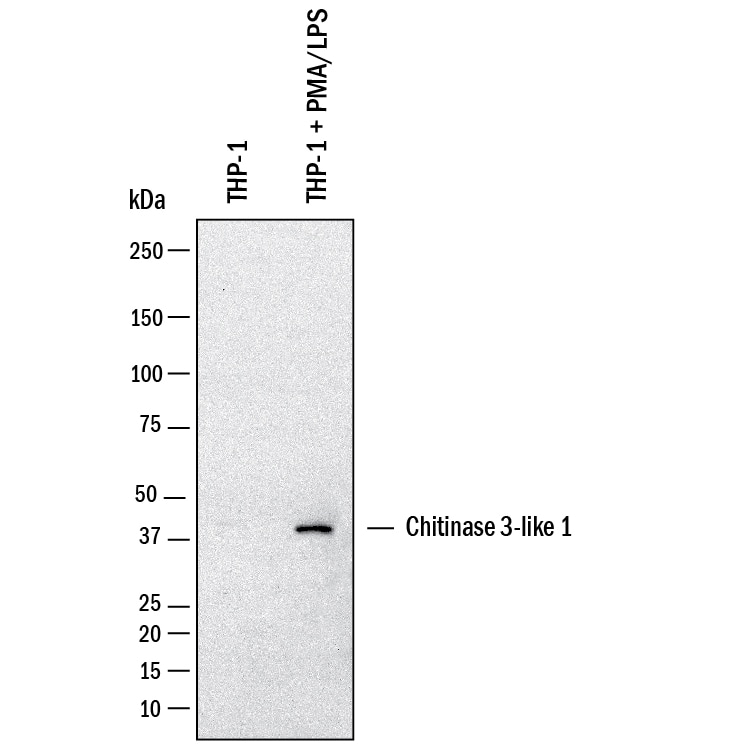
Detection of Mouse Chitinase 3‑like 1/YKL-40 by Western Blot.
Western blot shows lysates of THP‑1 human acute monocytic leukemia cell line, THP‑1 human acute monocytic leukemia cell line + PMA/LPS untreated (-) or treated (+) with 200 nm, 10 μg/ml PMA and LPS for 24hr, 3hr. PVDF membrane was probed with 1 µg/mL of Sheep Anti-Mouse Chitinase 3‑like 1/YKL-40 Antigen Affinity-purified Polyclonal Antibody (Catalog # AF2649) followed by HRP-conjugated Anti-Sheep IgG Secondary Antibody (Catalog # HAF016). A specific band was detected for Chitinase 3‑like 1/YKL-40 at approximately 40 kDa (as indicated). This experiment was conducted under reducing conditions and using Western Blot Buffer Group 1.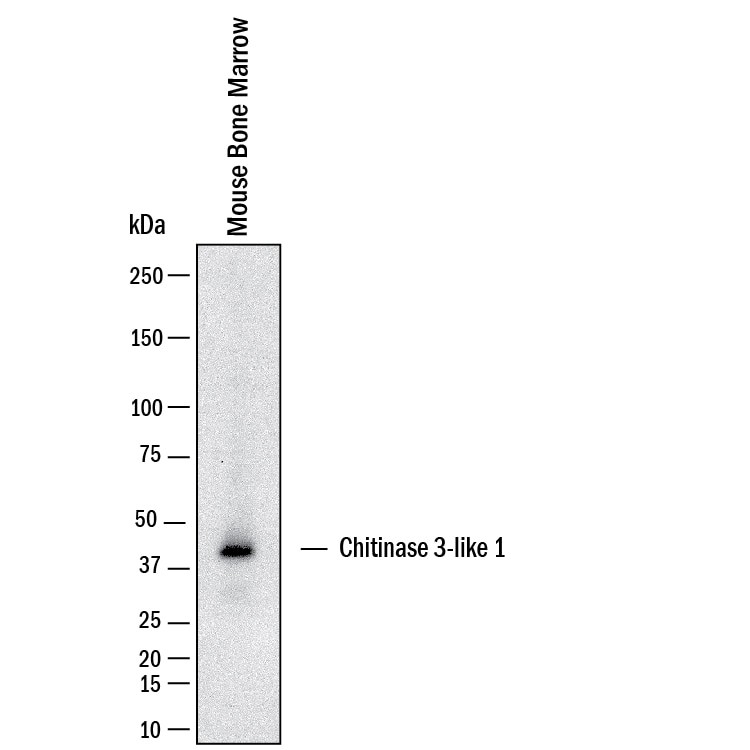
Detection of Mouse Chitinase 3‑like 1/YKL-40 by Western Blot.
Western blot shows lysates of mouse bone marrow. PVDF membrane was probed with 1 µg/mL of Sheep Anti-Mouse Chitinase 3‑like 1/YKL-40 Antigen Affinity-purified Polyclonal Antibody (Catalog # AF2649) followed by HRP-conjugated Anti-Sheep IgG Secondary Antibody (Catalog # HAF016). A specific band was detected for Chitinase 3‑like 1/YKL-40 at approximately 40 kDa (as indicated). This experiment was conducted under reducing conditions and using Western Blot Buffer Group 1.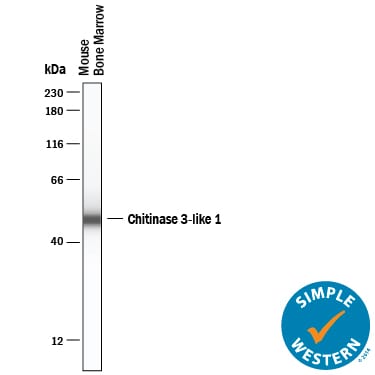
Detection of Mouse Chitinase 3‑like 1/YKL-40 by Simple WesternTM.
Simple Western lane view shows lysates of Mouse bone marrow, loaded at 0.2 mg/mL. A specific band was detected for Chitinase 3‑like 1/YKL-40 at approximately 50 kDa (as indicated) using 25 µg/mL of Sheep Anti-Mouse Chitinase 3‑like 1/YKL-40 Antigen Affinity-purified Polyclonal Antibody (Catalog # AF2649). This experiment was conducted under reducing conditions and using the 12-230 kDa separation system.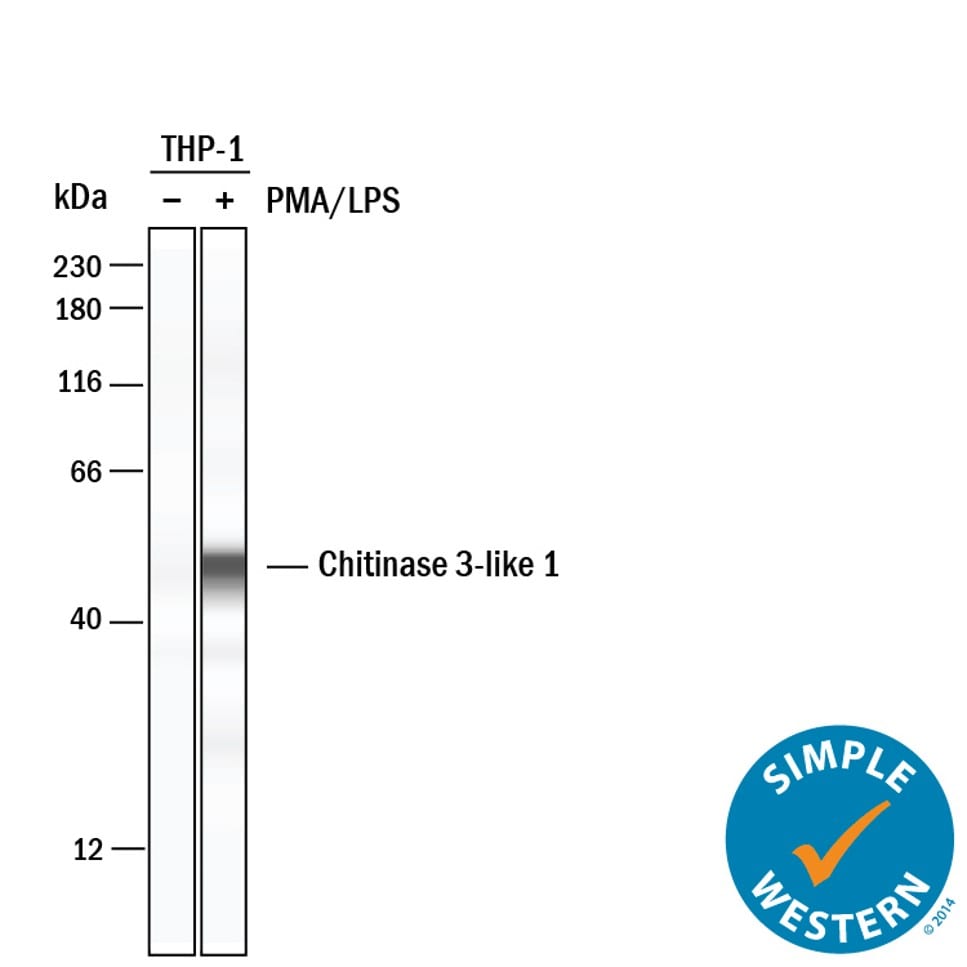
Detection of Mouse Chitinase 3‑like 1/YKL-40 by Simple WesternTM.
Simple Western lane view shows lysates of THP‑1 human acute monocytic leukemia cell line untreated (-) or treated (+) with 200 nm PMA for 24 hours and 10 μg/ml LPS for 3 hours, loaded at 0.2 mg/mL. A specific band was detected for Chitinase 3‑like 1/YKL-40 at approximately 50 kDa (as indicated) using 25 µg/mL of Sheep Anti-Mouse Chitinase 3‑like 1/YKL-40 Antigen Affinity-purified Polyclonal Antibody (Catalog # AF2649). This experiment was conducted under reducing conditions and using the 12-230 kDa separation system.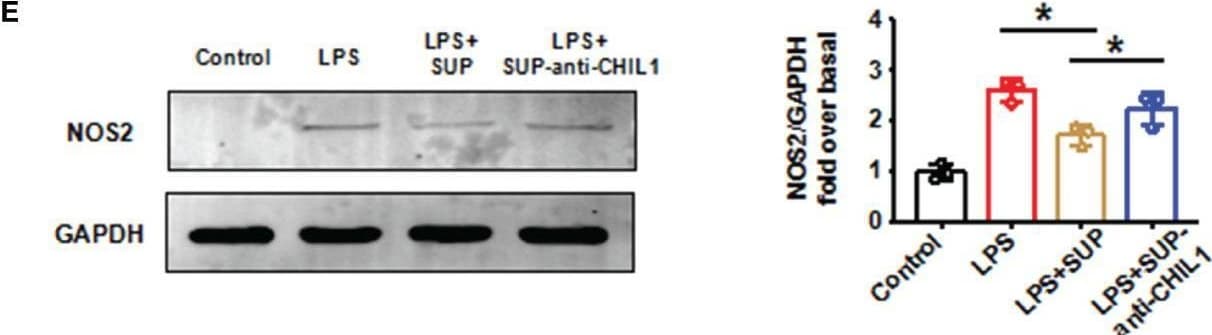
Detection of Mouse Chitinase 3-like 1/YKL-40 by Western Blot
Immunodepletion of CHIL1 in A-Neu supernatant attenuated the inhibitory effect on pro-inflammatory macrophages. (A) Schematic representation of the experimental design: bone marrow-derived macrophages were stimulated with LPS 10 ng/mL for 3 hours, washed with PBS, and then cultured in the presence of A-Neu supernatant (SUP) or A-Neu supernatant immunodepleted with anti-CHIL1 (SUP-anti-CHIL1). Expressions of CCL4, TNF and NOS2 in indicated groups were detected by RT-qPCR (B, n=6), CBA (C, D, n=4) and WB (E, n=3). The results were presented as mean ± SD. One-way ANOVA was used. *P < 0.05. A-Neu, activated neutrophil; N-Neu, non-activated neutrophil; SUP, activated neutrophil supernatant; SUP-anti-CHIL1, activated neutrophil supernatant immunodepletion CHIL1; Ccl4, C-C chemokine motif ligand 4; Tnf, tumor necrosis factor; Nos2, nitric oxide synthase 2; LPS, lipopolysaccharide. Image collected and cropped by CiteAb from the following open publication (https://pubmed.ncbi.nlm.nih.gov/35529851), licensed under a CC-BY license. Not internally tested by R&D Systems.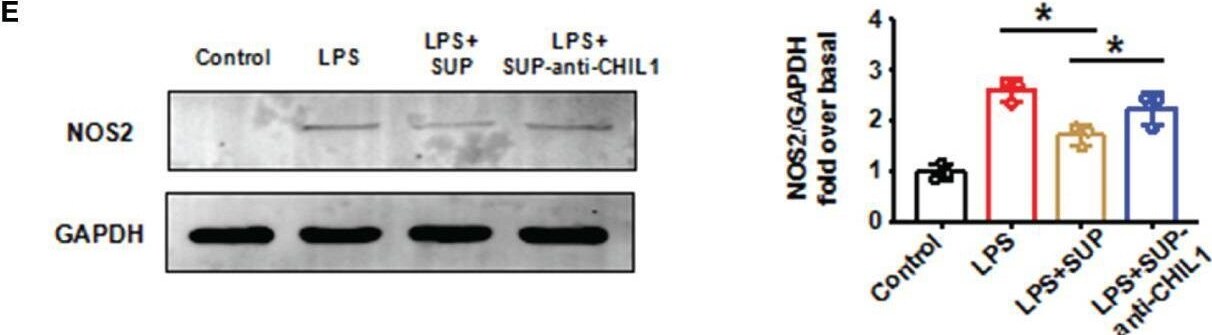
Detection of Mouse Chitinase 3-like 1/YKL-40 by Western Blot
Immunodepletion of CHIL1 in A-Neu supernatant attenuated the inhibitory effect on pro-inflammatory macrophages. (A) Schematic representation of the experimental design: bone marrow-derived macrophages were stimulated with LPS 10 ng/mL for 3 hours, washed with PBS, and then cultured in the presence of A-Neu supernatant (SUP) or A-Neu supernatant immunodepleted with anti-CHIL1 (SUP-anti-CHIL1). Expressions of CCL4, TNF and NOS2 in indicated groups were detected by RT-qPCR (B, n=6), CBA (C, D, n=4) and WB (E, n=3). The results were presented as mean ± SD. One-way ANOVA was used. *P < 0.05. A-Neu, activated neutrophil; N-Neu, non-activated neutrophil; SUP, activated neutrophil supernatant; SUP-anti-CHIL1, activated neutrophil supernatant immunodepletion CHIL1; Ccl4, C-C chemokine motif ligand 4; Tnf, tumor necrosis factor; Nos2, nitric oxide synthase 2; LPS, lipopolysaccharide. Image collected and cropped by CiteAb from the following open publication (https://pubmed.ncbi.nlm.nih.gov/35529851), licensed under a CC-BY license. Not internally tested by R&D Systems.Applications for Mouse Chitinase 3-like 1/YKL-40 Antibody
Immunoprecipitation
Sample: Conditioned cell culture medium spiked with Recombinant Mouse Chitinase 3-like 1/YKL-40 (Catalog # 2649-CH), see our available Western blot detection antibodies
Simple Western
Sample: Lysates of mouse bone marrow and THP-1 human acute monocytic leukemia cell line +/- PMA/LPS
Western Blot
Sample: Lysates of mouse bone marrow and THP‑1 human acute monocytic leukemia cell line, THP‑1 human acute monocytic leukemia cell line + PMA/LPS.
Formulation, Preparation, and Storage
Purification
Reconstitution
Reconstitute at 0.2 mg/mL in sterile PBS. For liquid material, refer to CoA for concentration.
Formulation
Shipping
Stability & Storage
- 12 months from date of receipt, -20 to -70 °C as supplied.
- 1 month, 2 to 8 °C under sterile conditions after reconstitution.
- 6 months, -20 to -70 °C under sterile conditions after reconstitution.
Calculators
Background: Chitinase 3-like 1/YKL-40
References
- Hakala, B.E. et al. (1993) J. Biol. Chem. 268:25803.
- Renkema, G.H. et al. (1998) Eur. J. Biochem. 251:504.
- Fusetti, F. et al. (2003) J. Biol. Chem. 278:37753.
- Houston, D.R. et al. (2003) J. Biol. Chem. 278:30206.
- Volck, B. et al. (1998) Proc. Assoc. Am. Physicians 110:351.
- Nishikawa, K.C. and A.J.T. Millis (2003) Exp. Cell Res. 287:79.
- Shao, R. et al. (2009) Oncogene 28:4456.
- Recklies, A.D. et al. (2002) Biochem. J. 365:119.
- Eurich, K. et al. (2009) World J. Gastroenterol. 15:5249.
- Letuve, S. et al. (2008) J Immunol. 181:5167.
- Rathke, C.N. and H. Vestergaard (2009) Cardiovasc. Diabetol. 8:61.
- Johansen, J.S. et al. (1997) Scand. J. Gastroenterol. 32:582.
- Ober, C. et al. (2008) N. Engl. J. Med. 358:1682.
- Johansen, J.S. et al. (1999) Rheumatology 38:618.
- Chupp, G.L. et al. (2007) N. Engl. J. Med. 357:2016.
- Lee, C.G. et al. (2009) J. Exp. Med. 206:1149.
Alternate Names
Gene Symbol
UniProt
Additional Chitinase 3-like 1/YKL-40 Products
- All Products for Chitinase 3-like 1/YKL-40
- Chitinase 3-like 1/YKL-40 cDNA Clones
- Chitinase 3-like 1/YKL-40 ELISA Kits
- Chitinase 3-like 1/YKL-40 Luminex Assays
- Chitinase 3-like 1/YKL-40 Lysates
- Chitinase 3-like 1/YKL-40 Primary Antibodies
- Chitinase 3-like 1/YKL-40 Proteins and Enzymes
- Chitinase 3-like 1/YKL-40 Simple Plex
Product Documents for Mouse Chitinase 3-like 1/YKL-40 Antibody
Certificate of Analysis
To download a Certificate of Analysis, please enter a lot or batch number in the search box below.
Note: Certificate of Analysis not available for kit components.
Product Specific Notices for Mouse Chitinase 3-like 1/YKL-40 Antibody
This product or the use of this product is covered by US Patent # 7,230,086 which is owned by The Regents of the University of California. This product is for research use only and is not to be used for commercial purposes.
For research use only
Related Research Areas
Citations for Mouse Chitinase 3-like 1/YKL-40 Antibody
 Powered by Bioz
Customer Reviews for Mouse Chitinase 3-like 1/YKL-40 Antibody
There are currently no reviews for this product. Be the first to review Mouse Chitinase 3-like 1/YKL-40 Antibody and earn rewards!
Have you used Mouse Chitinase 3-like 1/YKL-40 Antibody?
Submit a review and receive an Amazon gift card!
$25/€18/£15/$25CAN/¥2500 for a review with an image
$10/€7/£6/$10CAN/¥1110 for a review without an image
Submit a review
Protocols
Find general support by application which include: protocols, troubleshooting, illustrated assays, videos and webinars.
- Cellular Response to Hypoxia Protocols
- Immunoprecipitation Protocol
- R&D Systems Quality Control Western Blot Protocol
- Troubleshooting Guide: Western Blot Figures
- Western Blot Conditions
- Western Blot Protocol
- Western Blot Protocol for Cell Lysates
- Western Blot Troubleshooting
- Western Blot Troubleshooting Guide
- View all Protocols, Troubleshooting, Illustrated assays and Webinars