
Human IL-28A, IL-28B, and IL-29, also named interferon-lambda 2 (IFN-lambda 2), IFN-lambda 3, and IFN-lambda 1, respectively, are class II cytokine receptor ligands that are distantly related to members of the IL-10 family (11‑13% amino acid (aa) sequence identity) and the type I IFN family (15‑19% aa sequence identity) (1‑3). The genes encoding these three cytokines are localized to chromosome 19 and each is composed of multiple exons. The exon organization of these genes is also found in the IL-10 family genes but is distinct from the type I IFNs, which are encoded within a single exon. The expression of IL-28A, B, and IL-29 is induced by virus infection or double‑stranded RNA. All three cytokines exert bioactivities that overlap those of type I IFNs, including antiviral activity and up‑regulation of MHC class I antigen expression. The three proteins signal through the same heterodimeric receptor complex that is composed of the IL-10 receptor beta (IL-10 R beta ) and a novel IL-28 receptor alpha (IL-28 R alpha, also known as IFN-lambda R1). Ligand binding to the receptor complex induces Jak kinase activation and STAT1 and STAT2 tyrosine phosphorylation. The phosphorylated STAT1 and STAT2 complex with IFN-regulatory factor 9 (IRF-9) to form the IFN-stimulated regulatory factor 3 (ISGF-3) transcription factor complex that is translocated to the nucleus. ISGF-3 binds to the IFN-stimulated response element (ISRE) present in the regulatory regions of the target genes. Mouse IL-28B cDNA encodes a 193 amino acid residue precursor protein with a putative 15 aa signal peptide. It shares 61%, 62% and 52% aa sequence identity with human IL-28A, human IL-28B and human IL-29, respectively.
Mouse IL-28B/IFN-lambda 3 Antibody (244710)
R&D Systems | Catalog # MAB1789

Scientific images may be resized, cropped, or adjusted for brightness or contrast for presentation purposes. These updates are limited to presentation and do not affect the underlying scientific interpretation of the data. Where available, additional source data may be provided upon request.
Key Product Details
Species Reactivity
Validated:
Cited:
Applications
Validated:
Cited:
Label
Antibody Source
Product Specifications
Immunogen
Asp20-Val193
Accession # Q8CGK6
Specificity
Clonality
Host
Isotype
Endotoxin Level
Scientific Data Images for Mouse IL-28B/IFN-lambda 3 Antibody (244710)
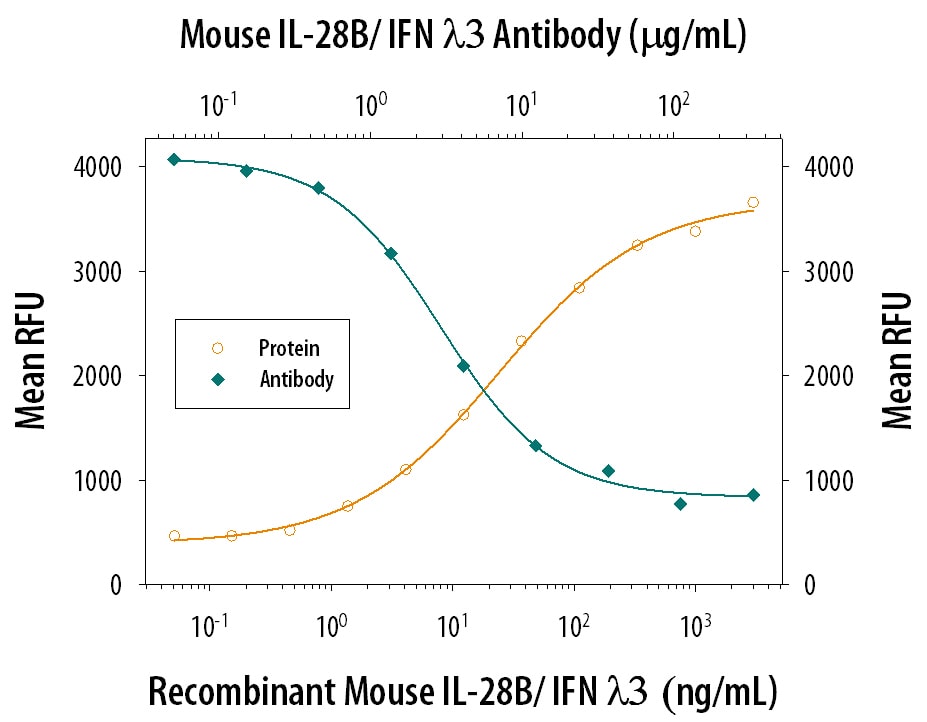
IL‑28B/IFN‑ lambda 3 Inhibition of EMCV-induced Cytopathy and Neutralization by Mouse IL‑28B/IFN‑ lambda 3 Antibody.
Recombinant Mouse IL-28B/ IFN-lambda 3 (Catalog # 1789-ML) reduces the Encephalo-myocarditis Virus (EMCV)-induced cytopathy in the HepG2 human hepatocellular carcinoma cell line in a dose-dependent manner (orange line). Inhibition of EMCV activity elicited by Recombinant Mouse IL-28B/IFN-lambda 3 (400 ng/mL) is neutralized (green line) by increasing concentrations of Rat Anti-Mouse IL-28B/IFN-lambda 3 Monoclonal Antibody (Cata-log # MAB1789). The ND50 is typically 1.5-6.0 µg/mL.Applications for Mouse IL-28B/IFN-lambda 3 Antibody (244710)
Western Blot
Sample: Recombinant Mouse IL‑28B/IFN-lambda 3 (Catalog # 1789-ML)
Neutralization
Formulation, Preparation, and Storage
Purification
Reconstitution
Reconstitute at 0.5 mg/mL in sterile PBS. For liquid material, refer to CoA for concentration.
Formulation
Shipping
Stability & Storage
- 12 months from date of receipt, -20 to -70 °C as supplied.
- 1 month, 2 to 8 °C under sterile conditions after reconstitution.
- 6 months, -20 to -70 °C under sterile conditions after reconstitution.
Calculators
Background: IL-28B/IFN-lambda 3
References
- Vilcek, J. (2003) Nature Immunol. 4:8.
- Sheppard, P. et al. (2003) Nature Immunol. 4:63.
- Kotenko, S.V. et al. (2003) Nature Immunol. 4:69.
Long Name
Alternate Names
Gene Symbol
UniProt
Additional IL-28B/IFN-lambda 3 Products
Product Documents for Mouse IL-28B/IFN-lambda 3 Antibody (244710)
Certificate of Analysis
To download a Certificate of Analysis, please enter a lot or batch number in the search box below.
Note: Certificate of Analysis not available for kit components.
Product Specific Notices for Mouse IL-28B/IFN-lambda 3 Antibody (244710)
For research use only
Related Research Areas
Citations for Mouse IL-28B/IFN-lambda 3 Antibody (244710)
 Powered by Bioz
Customer Reviews for Mouse IL-28B/IFN-lambda 3 Antibody (244710)
There are currently no reviews for this product. Be the first to review Mouse IL-28B/IFN-lambda 3 Antibody (244710) and earn rewards!
Have you used Mouse IL-28B/IFN-lambda 3 Antibody (244710)?
Submit a review and receive an Amazon gift card!
$25/€18/£15/$25CAN/¥2500 for a review with an image
$10/€7/£6/$10CAN/¥1110 for a review without an image
Submit a review
Protocols
Find general support by application which include: protocols, troubleshooting, illustrated assays, videos and webinars.
- Cellular Response to Hypoxia Protocols
- R&D Systems Quality Control Western Blot Protocol
- Troubleshooting Guide: Western Blot Figures
- Western Blot Conditions
- Western Blot Protocol
- Western Blot Protocol for Cell Lysates
- Western Blot Troubleshooting
- Western Blot Troubleshooting Guide
- View all Protocols, Troubleshooting, Illustrated assays and Webinars
Associated Pathways
