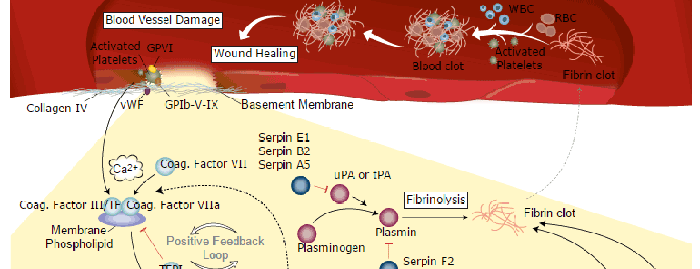
Tissue Factor Pathway Inhibitor (TFPI), also known as lipoprotein-associated coagulation inhibitor (LACI) and extrinsic pathway inhibitor (EPI), is a physiological inhibitor of extrinsic pathway of coagulation and has biological functions of anticoagulation and anti-inflammation (1). It is a secreted protein with a N-terminal acidic region, three Kunitz (K) domains separated by two linker regions, and a C-terminal basic region (2). The first K domain (residues 50 to 100) inhibits coagulation factor VIIa complexed to tissue factor (TF). The second K domain (residues 121 to 171) inhibits factor Xa. The third K domain (residues 225 to 275) binds to heparin (3). The C‑terminal basic region may have several functions. For example, it plays an important role in the binding of TFPI to cell surfaces (2). The purified recombinant mouse TFPI ends at residue 289 and does not contain the last 17 residues (residues 290 to 306) in the C‑terminal region. It inhibits the activity of recombinant human Coagulation Factor VII (R&D Systems, Catalog # 2338-SE) in the presence of recombinant human Tissue Factor (R&D Systems, Catalog # 2339-PA).


Key Product Details
Species Reactivity
Mouse
Applications
Western Blot
Label
Unconjugated
Antibody Source
Monoclonal Rat IgG2A Clone # 372311
Loading...
Product Specifications
Immunogen
Mouse myeloma cell line NS0-derived recombinant mouse TFPI
Leu29-Lys289
Accession # O54819
Leu29-Lys289
Accession # O54819
Specificity
Detects mouse TFPI in direct ELISAs and Western blots. In direct ELISAs and Western blots, this antibody shows no cross‑reactivity with recombinant human (rh) TFPI or rmTFPI-2.
Clonality
Monoclonal
Host
Rat
Isotype
IgG2A
Applications for Mouse TFPI Antibody (372311)
Application
Recommended Usage
Western Blot
1 µg/mL
Sample: Recombinant Mouse TFPI (Catalog # 2975-PI)
under non-reducing conditions only
Sample: Recombinant Mouse TFPI (Catalog # 2975-PI)
under non-reducing conditions only
Formulation, Preparation, and Storage
Purification
Protein A or G purified from hybridoma culture supernatant
Reconstitution
Reconstitute at 0.5 mg/mL in sterile PBS. For liquid material, refer to CoA for concentration.
Loading...
Formulation
Lyophilized from a 0.2 μm filtered solution in PBS with Trehalose. *Small pack size (SP) is supplied either lyophilized or as a 0.2 µm filtered solution in PBS.
Shipping
Lyophilized product is shipped at ambient temperature. Liquid small pack size (-SP) is shipped with polar packs. Upon receipt, store immediately at the temperature recommended below.
Stability & Storage
Use a manual defrost freezer and avoid repeated freeze-thaw cycles.
- 12 months from date of receipt, -20 to -70 °C as supplied.
- 1 month, 2 to 8 °C under sterile conditions after reconstitution.
- 6 months, -20 to -70 °C under sterile conditions after reconstitution.
Calculators
Background: TFPI
References
- Bai, H. et al. (2005) Thromb Haemost. 93:1055.
- Bajaj, M.S. et al. (2001) Thromb Haemost. 86:959.
- Mine, S. et al. (2002) Biochemistry 41:78.
Long Name
Tissue Factor Pathway Inhibitor
Alternate Names
EPI, LACI
Gene Symbol
TFPI
UniProt
Additional TFPI Products
Product Documents for Mouse TFPI Antibody (372311)
Certificate of Analysis
To download a Certificate of Analysis, please enter a lot or batch number in the search box below.
Note: Certificate of Analysis not available for kit components.
Product Specific Notices for Mouse TFPI Antibody (372311)
For research use only
Related Research Areas
Customer Reviews for Mouse TFPI Antibody (372311)
There are currently no reviews for this product. Be the first to review Mouse TFPI Antibody (372311) and earn rewards!
Have you used Mouse TFPI Antibody (372311)?
Submit a review and receive an Amazon gift card!
$25/€18/£15/$25CAN/¥2500 for a review with an image
$10/€7/£6/$10CAN/¥1110 for a review without an image
Submit a review
Protocols
Find general support by application which include: protocols, troubleshooting, illustrated assays, videos and webinars.
- Cellular Response to Hypoxia Protocols
- R&D Systems Quality Control Western Blot Protocol
- Troubleshooting Guide: Western Blot Figures
- Western Blot Conditions
- Western Blot Protocol
- Western Blot Protocol for Cell Lysates
- Western Blot Troubleshooting
- Western Blot Troubleshooting Guide
- View all Protocols, Troubleshooting, Illustrated assays and Webinars
Loading...
Associated Pathways