
MSX1 Antibody (1E2) - Azide and BSA Free
Novus Biologicals | Catalog # H00004487-M11

![Western Blot: MSX1 Antibody (1E2) [H00004487-M11]](https://resources.rndsystems.com/images/products/MSX1-Antibody-1E2-Western-Blot-H00004487-M11-img0005.jpg "Western Blot: MSX1 Antibody (1E2) [H00004487-M11]")
Scientific images may be resized, cropped, or adjusted for brightness or contrast for presentation purposes. These updates are limited to presentation and do not affect the underlying scientific interpretation of the data. Where available, additional source data may be provided upon request.
Key Product Details
Species Reactivity
Applications
Label
Antibody Source
Format
Product Specifications
Immunogen
Reactivity Notes
Specificity
Clonality
Host
Isotype
Description
Scientific Data Images for MSX1 Antibody (1E2) - Azide and BSA Free
Western Blot: MSX1 Antibody (1E2) [H00004487-M11]
Western Blot: MSX1 Antibody (1E2) [H00004487-M11] - Analysis of MSX1 expression in Raw 264.7.![Immunocytochemistry/ Immunofluorescence: MSX1 Antibody (1E2) [H00004487-M11]](https://resources.rndsystems.com/images/products/MSX1-Antibody-1E2-Immunocytochemistry-Immunofluorescence-H00004487-M11-img0002.jpg "Immunocytochemistry/ Immunofluorescence: MSX1 Antibody (1E2) [H00004487-M11]")
Immunocytochemistry/ Immunofluorescence: MSX1 Antibody (1E2) [H00004487-M11]
Immunocytochemistry/Immunofluorescence: MSX1 Antibody (1E2) [H00004487-M11] - Analysis of monoclonal antibody to MSX1 on HeLa cell. Antibody concentration 10 ug/ml![Western Blot: MSX1 Antibody (1E2) [H00004487-M11]](https://resources.rndsystems.com/images/products/MSX1-Antibody-1E2-Western-Blot-H00004487-M11-img0004.jpg "Western Blot: MSX1 Antibody (1E2) [H00004487-M11]")
Western Blot: MSX1 Antibody (1E2) [H00004487-M11]
Western Blot: MSX1 Antibody (1E2) [H00004487-M11] - Analysis of MSX1 expression in U-2 OS.![Immunoprecipitation: MSX1 Antibody (1E2) [H00004487-M11]](https://resources.rndsystems.com/images/products/MSX1-Antibody-1E2-Immunoprecipitation-H00004487-M11-img0003.jpg "Immunoprecipitation: MSX1 Antibody (1E2) [H00004487-M11]")
Immunoprecipitation: MSX1 Antibody (1E2) [H00004487-M11]
Immunoprecipitation: MSX1 Antibody (1E2) [H00004487-M11] - Analysis of MSX1 transfected lysate using anti-MSX1 monoclonal antibody and Protein A Magnetic Bead, and immunoblotted with MSX1 rabbit polyclonal antibody.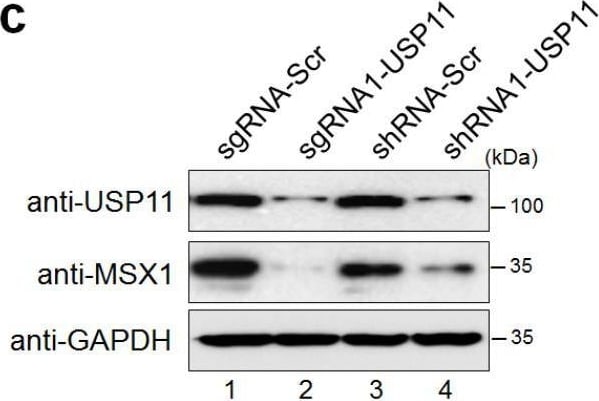
Western Blot: MSX1 Antibody (1E2) - Azide and BSA Free [H00004487-M11] -
USP11 increases MSX1 protein level. (a) The efficiencies of sgRNA1 and sgRNA2 targeting the USP11 gene and regulating endogenous MSX1 protein levels were determined in hMSCs. (b) The efficiencies of shRNA1 and shRNA2 targeting the USP11 gene and regulating endogenous MSX1 protein levels were determined in hMSCs. (c) hMSCs were transfected with the best sgRNA (sgRNA1) and shRNA (shRNA1) targeting USP11 for the evaluation of endogenous USP11 and MSX1 levels using the respective endogenous antibodies. (d) hMSCs were transfected with an increasing amount of HA-USP11 (0, 1, 2, and 3 ug), and the endogenous expression of MSX1 protein was analyzed using Western blot. The protein band intensities were estimated using ImageJ software with reference to the GAPDH control band (MSX1/GAPDH). (e) hMSCs were transfected with increasing amounts of catalytically inactive HA-USP11CS (0, 1, 2, and 3 ug), and the endogenous expression of MSX1 protein was analyzed using Western blot. The protein band intensities were estimated using ImageJ software with reference to the GAPDH control band (MSX1/GAPDH). (f) Reconstitution effect of USP11 on endogenous MSX1 in USP11-depleted cells. Protein expression was analyzed by Western blotting using the indicated antibodies. GAPDH was used as the loading control. Image collected and cropped by CiteAb from the following open publication (https://pubmed.ncbi.nlm.nih.gov/35055037), licensed under a CC-BY license. Not internally tested by Novus Biologicals.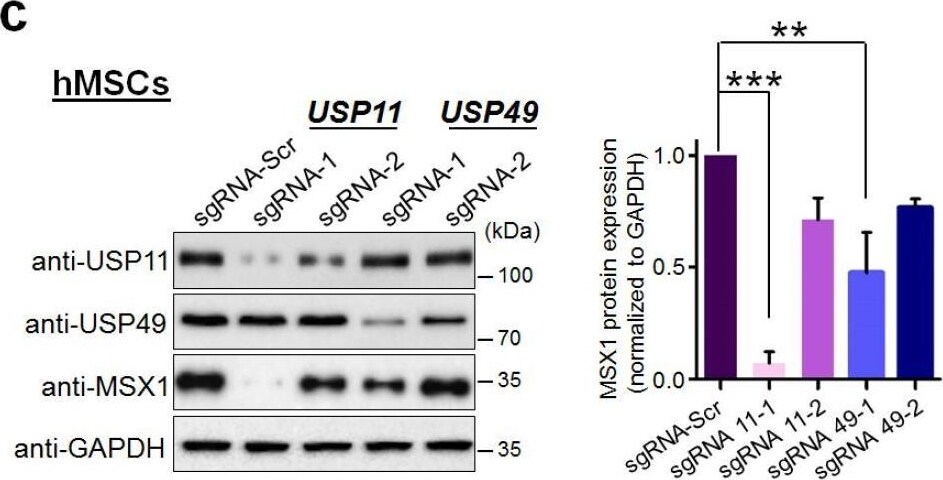
Western Blot: MSX1 Antibody (1E2) - Azide and BSA Free [H00004487-M11] -
CRISPR-based genome-scale screening of USP sub-family proteins exhibiting a reduction in MSX1 protein levels. (a) Screening for DUBs regulating MSX1 was performed using a CRISPR/Cas9-based DUBKO sgRNA kit. HEK293 cells were transfected with Myc-MSX1 and the indicated sgRNAs along with Cas9. Equal concentrations of proteins from the sgRNA kit transfected HEK293 cells were subjected to Western blot analyses. The protein band intensities were estimated using ImageJ software with reference to the GAPDH control band for each individual sgRNA (Myc-MSX1/GAPDH). The loss of USPs leading to the downregulation of the MSX1 protein level is marked in red. (b) Myc-MSX1, sgRNAs targeting USP11, or sgRNAs targeting USP49 were transfected in HEK293 cells. The protein band intensity of HEK293 cells transfected with sgRNA1 targeting USP11 showed the highest reduction in MSX1. This experiment was performed in triplicates and band intensities were estimated using ImageJ software with reference to the GAPDH control band and are graphically represented. One-way ANOVA followed by Tukey’s post hoc test was used. Error bars represent +/- SD, ** p < 0.001 and *** p < 0.0001. (c) The sgRNAs targeting USP11 or sgRNAs targeting USP49, which potentially regulate endogenous MSX1 protein levels, were transfected in hMSCs along with Cas9. The protein band intensity of hMSCs transfected with sgRNA1 targeting USP11 showed the highest reduction in MSX1. This experiment was performed in triplicates and band intensities were estimated using ImageJ software with reference to the GAPDH control band and are graphically represented. One-way ANOVA followed by Tukey’s post hoc test was used. Error bars represent +/- SD, ** p < 0.001, and *** p < 0.0001. Image collected and cropped by CiteAb from the following open publication (https://pubmed.ncbi.nlm.nih.gov/35055037), licensed under a CC-BY license. Not internally tested by Novus Biologicals.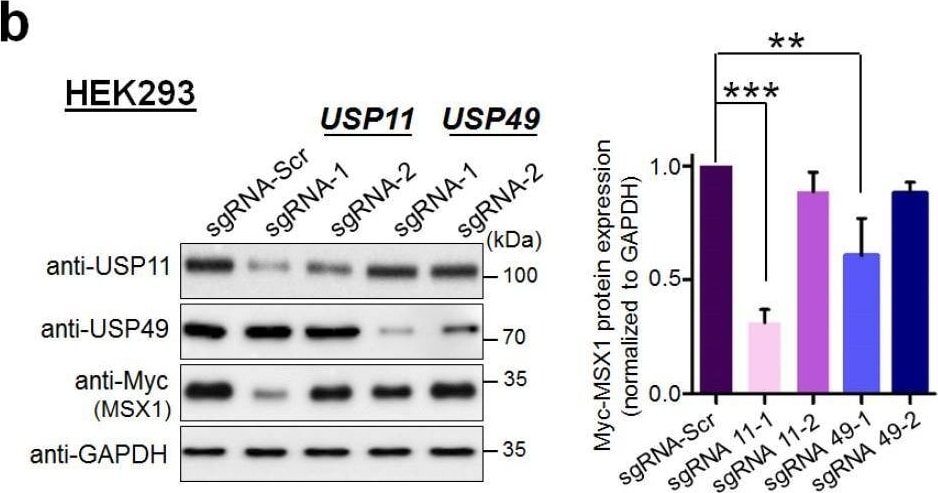
Western Blot: MSX1 Antibody (1E2) - Azide and BSA Free [H00004487-M11] -
CRISPR-based genome-scale screening of USP sub-family proteins exhibiting a reduction in MSX1 protein levels. (a) Screening for DUBs regulating MSX1 was performed using a CRISPR/Cas9-based DUBKO sgRNA kit. HEK293 cells were transfected with Myc-MSX1 and the indicated sgRNAs along with Cas9. Equal concentrations of proteins from the sgRNA kit transfected HEK293 cells were subjected to Western blot analyses. The protein band intensities were estimated using ImageJ software with reference to the GAPDH control band for each individual sgRNA (Myc-MSX1/GAPDH). The loss of USPs leading to the downregulation of the MSX1 protein level is marked in red. (b) Myc-MSX1, sgRNAs targeting USP11, or sgRNAs targeting USP49 were transfected in HEK293 cells. The protein band intensity of HEK293 cells transfected with sgRNA1 targeting USP11 showed the highest reduction in MSX1. This experiment was performed in triplicates and band intensities were estimated using ImageJ software with reference to the GAPDH control band and are graphically represented. One-way ANOVA followed by Tukey’s post hoc test was used. Error bars represent +/- SD, ** p < 0.001 and *** p < 0.0001. (c) The sgRNAs targeting USP11 or sgRNAs targeting USP49, which potentially regulate endogenous MSX1 protein levels, were transfected in hMSCs along with Cas9. The protein band intensity of hMSCs transfected with sgRNA1 targeting USP11 showed the highest reduction in MSX1. This experiment was performed in triplicates and band intensities were estimated using ImageJ software with reference to the GAPDH control band and are graphically represented. One-way ANOVA followed by Tukey’s post hoc test was used. Error bars represent +/- SD, ** p < 0.001, and *** p < 0.0001. Image collected and cropped by CiteAb from the following open publication (https://pubmed.ncbi.nlm.nih.gov/35055037), licensed under a CC-BY license. Not internally tested by Novus Biologicals.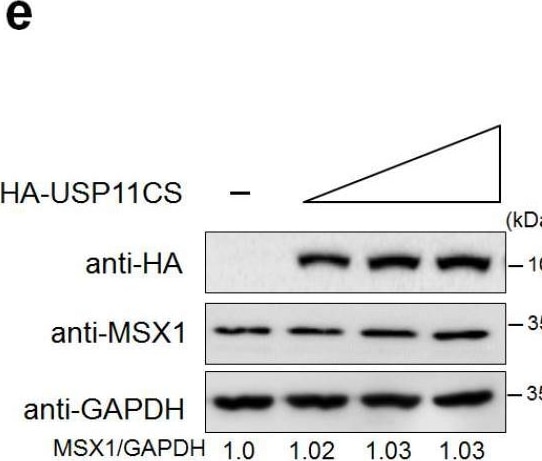
Western Blot: MSX1 Antibody (1E2) - Azide and BSA Free [H00004487-M11] -
USP11 increases MSX1 protein level. (a) The efficiencies of sgRNA1 and sgRNA2 targeting the USP11 gene and regulating endogenous MSX1 protein levels were determined in hMSCs. (b) The efficiencies of shRNA1 and shRNA2 targeting the USP11 gene and regulating endogenous MSX1 protein levels were determined in hMSCs. (c) hMSCs were transfected with the best sgRNA (sgRNA1) and shRNA (shRNA1) targeting USP11 for the evaluation of endogenous USP11 and MSX1 levels using the respective endogenous antibodies. (d) hMSCs were transfected with an increasing amount of HA-USP11 (0, 1, 2, and 3 ug), and the endogenous expression of MSX1 protein was analyzed using Western blot. The protein band intensities were estimated using ImageJ software with reference to the GAPDH control band (MSX1/GAPDH). (e) hMSCs were transfected with increasing amounts of catalytically inactive HA-USP11CS (0, 1, 2, and 3 ug), and the endogenous expression of MSX1 protein was analyzed using Western blot. The protein band intensities were estimated using ImageJ software with reference to the GAPDH control band (MSX1/GAPDH). (f) Reconstitution effect of USP11 on endogenous MSX1 in USP11-depleted cells. Protein expression was analyzed by Western blotting using the indicated antibodies. GAPDH was used as the loading control. Image collected and cropped by CiteAb from the following open publication (https://pubmed.ncbi.nlm.nih.gov/35055037), licensed under a CC-BY license. Not internally tested by Novus Biologicals.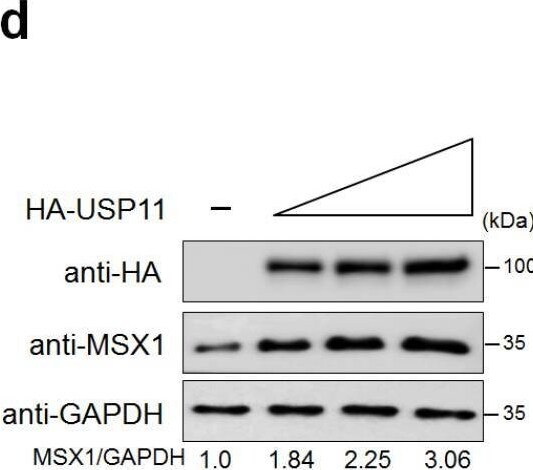
Western Blot: MSX1 Antibody (1E2) - Azide and BSA Free [H00004487-M11] -
USP11 increases MSX1 protein level. (a) The efficiencies of sgRNA1 and sgRNA2 targeting the USP11 gene and regulating endogenous MSX1 protein levels were determined in hMSCs. (b) The efficiencies of shRNA1 and shRNA2 targeting the USP11 gene and regulating endogenous MSX1 protein levels were determined in hMSCs. (c) hMSCs were transfected with the best sgRNA (sgRNA1) and shRNA (shRNA1) targeting USP11 for the evaluation of endogenous USP11 and MSX1 levels using the respective endogenous antibodies. (d) hMSCs were transfected with an increasing amount of HA-USP11 (0, 1, 2, and 3 ug), and the endogenous expression of MSX1 protein was analyzed using Western blot. The protein band intensities were estimated using ImageJ software with reference to the GAPDH control band (MSX1/GAPDH). (e) hMSCs were transfected with increasing amounts of catalytically inactive HA-USP11CS (0, 1, 2, and 3 ug), and the endogenous expression of MSX1 protein was analyzed using Western blot. The protein band intensities were estimated using ImageJ software with reference to the GAPDH control band (MSX1/GAPDH). (f) Reconstitution effect of USP11 on endogenous MSX1 in USP11-depleted cells. Protein expression was analyzed by Western blotting using the indicated antibodies. GAPDH was used as the loading control. Image collected and cropped by CiteAb from the following open publication (https://pubmed.ncbi.nlm.nih.gov/35055037), licensed under a CC-BY license. Not internally tested by Novus Biologicals.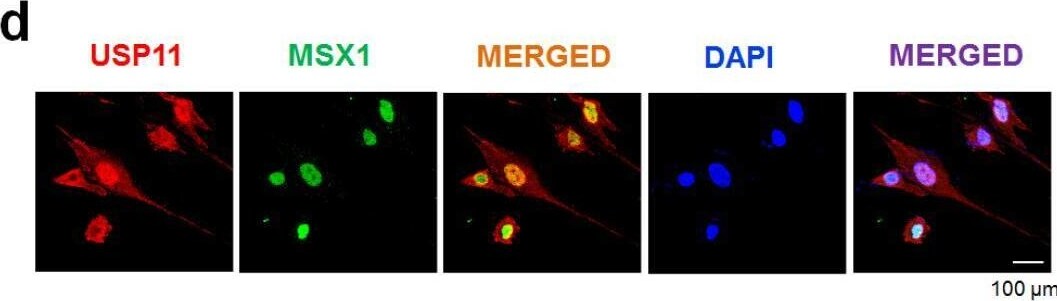
Immunocytochemistry/ Immunofluorescence: MSX1 Antibody (1E2) - Azide and BSA Free [H00004487-M11] -
USP11 interacts and deubiquitinates MSX1 protein. (a,b) Interaction between endogenous USP11 and MSX1 proteins was evaluated in hMSCs. Cell lysates from hMSCs were immunoprecipitated with specific MSX1 (a) or USP11 antibodies (b) and immunoblotted with the indicated antibodies. (c) Myc-MSX1 and HA-USP11 were co-transfected in HEK293 cells. Samples were immunoprecipitated using anti-Myc or anti-HA antibodies and immunoblotted using the indicated antibodies. GAPDH was used as a loading control. (d) An immunofluorescence assay was performed to determine the localization of MSX1 and USP11 proteins. DAPI was used as a nuclear stain. (e) The endogenous deubiquitination of MSX1 was analyzed by transfecting hMSCs with Flag-USP11, Flag-USP11CS, and sgRNA targeting USP11, followed by immunoprecipitation with anti-MSX1 antibody and immunoblotting with anti-MSX1 or anti-ubiquitin antibodies. The cells were treated with MG132 for 6 h prior to harvest for all experiments. Image collected and cropped by CiteAb from the following open publication (https://pubmed.ncbi.nlm.nih.gov/35055037), licensed under a CC-BY license. Not internally tested by Novus Biologicals.Applications for MSX1 Antibody (1E2) - Azide and BSA Free
Western Blot
Formulation, Preparation, and Storage
Purification
Formulation
Format
Preservative
Concentration
Shipping
Stability & Storage
Background: MSX1
Long Name
Alternate Names
Entrez Gene IDs
Gene Symbol
UniProt
Additional MSX1 Products
Product Documents for MSX1 Antibody (1E2) - Azide and BSA Free
Certificate of Analysis
To download a Certificate of Analysis, please enter a lot or batch number in the search box below.
Product Specific Notices for MSX1 Antibody (1E2) - Azide and BSA Free
This product is produced by and distributed for Abnova, a company based in Taiwan.
This product is for research use only and is not approved for use in humans or in clinical diagnosis. Primary Antibodies are guaranteed for 1 year from date of receipt.
Citations for MSX1 Antibody (1E2) - Azide and BSA Free
 Powered by Bioz
Customer Reviews for MSX1 Antibody (1E2) - Azide and BSA Free
There are currently no reviews for this product. Be the first to review MSX1 Antibody (1E2) - Azide and BSA Free and earn rewards!
Have you used MSX1 Antibody (1E2) - Azide and BSA Free?
Submit a review and receive an Amazon gift card!
$25/€18/£15/$25CAN/¥2500 for a review with an image
$10/€7/£6/$10CAN/¥1110 for a review without an image
Submit a review
Protocols
Find general support by application which include: protocols, troubleshooting, illustrated assays, videos and webinars.
- Appropriate Fixation of IHC/ICC Samples
- Cellular Response to Hypoxia Protocols
- ClariTSA™ Fluorophore Kits
- Detection & Visualization of Antibody Binding
- ELISA Sample Preparation & Collection Guide
- ELISA Troubleshooting Guide
- How to Run an R&D Systems DuoSet ELISA
- How to Run an R&D Systems Quantikine ELISA
- How to Run an R&D Systems Quantikine™ QuicKit™ ELISA
- ICC Cell Smear Protocol for Suspension Cells
- ICC Immunocytochemistry Protocol Videos
- ICC for Adherent Cells
- Immunocytochemistry (ICC) Protocol
- Immunocytochemistry Troubleshooting
- Immunofluorescence of Organoids Embedded in Cultrex Basement Membrane Extract
- Immunohistochemistry (IHC) and Immunocytochemistry (ICC) Protocols
- Immunoprecipitation Protocol
- Preparing Samples for IHC/ICC Experiments
- Preventing Non-Specific Staining (Non-Specific Binding)
- Primary Antibody Selection & Optimization
- Protocol for VisUCyte™ HRP Polymer Detection Reagent
- Protocol for the Fluorescent ICC Staining of Cell Smears - Graphic
- Protocol for the Fluorescent ICC Staining of Cultured Cells on Coverslips - Graphic
- Protocol for the Preparation and Fluorescent ICC Staining of Cells on Coverslips
- Protocol for the Preparation and Fluorescent ICC Staining of Non-adherent Cells
- Protocol for the Preparation and Fluorescent ICC Staining of Stem Cells on Coverslips
- Protocol for the Preparation of a Cell Smear for Non-adherent Cell ICC - Graphic
- Quantikine HS ELISA Kit Assay Principle, Alkaline Phosphatase
- Quantikine HS ELISA Kit Principle, Streptavidin-HRP Polymer
- R&D Systems Quality Control Western Blot Protocol
- Sandwich ELISA (Colorimetric) – Biotin/Streptavidin Detection Protocol
- Sandwich ELISA (Colorimetric) – Direct Detection Protocol
- TUNEL and Active Caspase-3 Detection by IHC/ICC Protocol
- The Importance of IHC/ICC Controls
- Troubleshooting Guide: ELISA
- Troubleshooting Guide: Western Blot Figures
- Western Blot Conditions
- Western Blot Protocol
- Western Blot Protocol for Cell Lysates
- Western Blot Troubleshooting
- Western Blot Troubleshooting Guide
- View all Protocols, Troubleshooting, Illustrated assays and Webinars
Associated Pathways
