
Nbs1 Antibody (1D7) - Azide and BSA Free
Novus Biologicals | Catalog # NB100-221

![Knockdown Validated: Nbs1 Antibody (1D7) [NB100-221]](https://resources.rndsystems.com/images/products/Nbs1-Antibody-1D7-Western-Blot-NB100-221-img0010.jpg "Western Blot: Nbs1 Antibody (1D7) [NB100-221]")
Scientific images may be resized, cropped, or adjusted for brightness or contrast for presentation purposes. These updates are limited to presentation and do not affect the underlying scientific interpretation of the data. Where available, additional source data may be provided upon request.
Loading...
Key Product Details
Validated by
Knockout/Knockdown
Species Reactivity
Validated:
Human, Mouse, Rat
Cited:
Human, Mouse
Applications
Validated:
Immunohistochemistry, Western Blot, Immunocytochemistry/ Immunofluorescence, Simple Western, Immunoprecipitation, Knockdown Validated
Cited:
Western Blot, Immunocytochemistry/ Immunofluorescence, IF/IHC, Knockdown Validated
Label
Unconjugated
Antibody Source
Monoclonal Mouse IgG1 Clone # 1D7
Format
Azide and BSA Free
Loading...
Product Specifications
Immunogen
The complete coding region of the human p95/Nbs1 expressed in E. coli.
Reactivity Notes
Human reactivity reported in (PMID:30699358). Please note that this antibody is reactive to Mouse and derived from the same host, Mouse. Mouse-On-Mouse blocking reagent may be needed for IHC and ICC experiments to reduce high background signal. You can find these reagents under catalog numbers PK-2200-NB and MP-2400-NB. Please contact Technical Support if you have any questions.
Localization
Nuclear
Specificity
Nijmegen breakage syndrome (NBS, nibrin) is an autosomal recessive chromosomal instability syndrome characterized by microcephaly, growth retardation, immunodeficiency, and cancer predisposition. Nbs1 Antibody (1D7) recognizes the 95kDa NBS protein which contains a fork FHA head-associated domain that is adjacent to BRCT, a breast cancer C terminal domain, that has been implicated in protein-protein interactions. NBS is member of the Mre11/Rad50, p400 double-strand break repair complex involved in double-strand break repair and cell-cycle checkpoint functions.
Clonality
Monoclonal
Host
Mouse
Isotype
IgG1
Theoretical MW
85 kDa.
Disclaimer note: The observed molecular weight of the protein may vary from the listed predicted molecular weight due to post translational modifications, post translation cleavages, relative charges, and other experimental factors.
Disclaimer note: The observed molecular weight of the protein may vary from the listed predicted molecular weight due to post translational modifications, post translation cleavages, relative charges, and other experimental factors.
Scientific Data Images for Nbs1 Antibody (1D7) - Azide and BSA Free
Western Blot: Nbs1 Antibody (1D7) [NB100-221]
Western Blot: Nbs1 Antibody (1D7) [NB100-221] - Non-transfected (-) and transfected (+) 293T whole cell extracts (30 ug) were separated by 7.5% SDS-PAGE, and the membrane was blotted with NBS1 antibody (1D7) [NB100-221] diluted at 1:500. The HRP-conjugated anti-mouse IgG antibody [NBP2-19382] was used to detect the primary antibody.![Western Blot: Nbs1 Antibody (1D7) [NB100-221]](https://resources.rndsystems.com/images/products/Nbs1-Antibody-1D7-Western-Blot-NB100-221-img0008.jpg "Western Blot: Nbs1 Antibody (1D7) [NB100-221]")
Western Blot: Nbs1 Antibody (1D7) [NB100-221]
Western Blot: Nbs1 Antibody (1D7) [NB100-221] - Sample (30 ug of whole cell lysate). A: HepG2. 7.5% SDS PAGE. Nbs1 Antibody (1D7) [NB100-221] diluted at 1:1000. The HRP-conjugated anti-mouse IgG antibody (NBP2-19382) was used to detect the primary antibody. Observed Molecular Weight at ~97 kDa.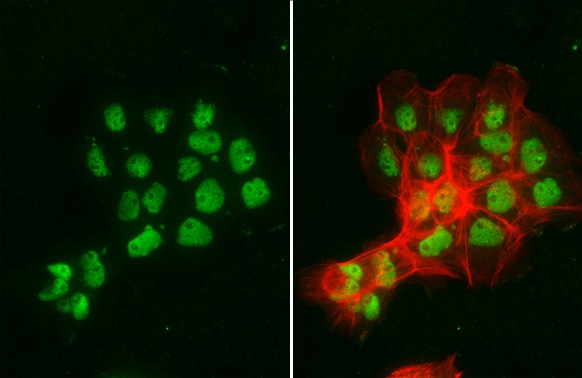
Immunocytochemistry/ Immunofluorescence: Nbs1 Antibody (1D7) [NB100-221] -
Immunocytochemistry/ Immunofluorescence: Nbs1 Antibody (1D7) [NB100-221] - Nbs1 antibody [1D7] detects Nbs1 protein at nucleus by immunofluorescent analysis.Sample: A431 cells were fixed in 4% paraformaldehyde at RT for 15 min.
Green: Nbs1 stained by Nbs1 antibody [1D7] (NB100-221) diluted at 1:500.
Red: phalloidin, a cytoskeleton marker, diluted at 1:200.
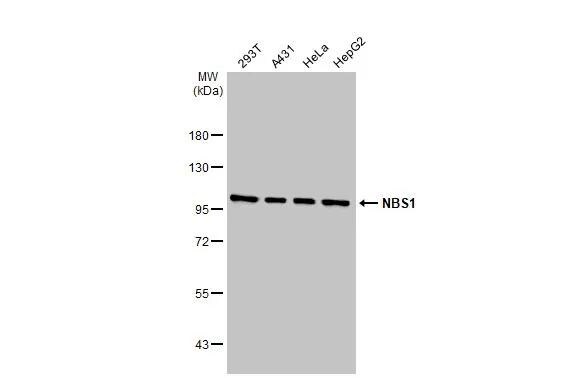
Western Blot: Nbs1 Antibody (1D7) [NB100-221] -
Various whole cell extracts (30 ?g) were separated by 7.5% SDS-PAGE, and the membrane was blotted with Nbs1 antibody [1D7] (NB100-221) diluted at 1:500. The HRP-conjugated anti-mouse IgG antibody was used to detect the primary antibody.Applications for Nbs1 Antibody (1D7) - Azide and BSA Free
Application
Recommended Usage
Immunocytochemistry/ Immunofluorescence
1:100
Western Blot
1:500-1:3000
Application Notes
Use in IHC, ICC/IF, and Western Blot reported in (PMID:22075984). IP Assay dependent.
See Simple Western Antibody Database for Simple Western validation: separated by size
See Simple Western Antibody Database for Simple Western validation: separated by size
Reviewed Applications
Read 3 reviews rated 5 using NB100-221 in the following applications:
Formulation, Preparation, and Storage
Purification
Protein G purified
Formulation
PBS, 20% Glycerol
Format
Azide and BSA Free
Preservative
No Preservative
Concentration
Concentrations vary lot to lot. See vial label for concentration. If unlisted please contact technical services.
Shipping
The product is shipped with polar packs. Upon receipt, store it immediately at the temperature recommended below.
Stability & Storage
Store at 4C short term. Aliquot and store at -20C long term. Avoid freeze-thaw cycles.
Background: Nbs1
In DNA double strand break repair, the FHA/BRCT domains bind DNA damage sensor proteins including gamma H2AX (phospho Ser139), phosphorylated MDC1 and CtIP (CtBP-interacting protein). NBS1 then recruits the other members of the MRN complex, Mre11 and Rad50, to the proximity of DNA DSBs. The MRN complex has also been shown to interact with ATM or ATR kinases in the presence of DSBs or replication fork stalling, respectively. Phosphorylation of NBS1 at Ser 278 and Ser343 in response to ionizing radiation (IR) is dependent on ATM and is important for activation of the S phase checkpoint. The activation of ATM in response to DNA damage is also facilitated by MRN and may lead to induction of apoptosis (2, 3).
References
1. Bian L, Meng Y, Zhang M, Li D. (2019) MRE11-RAD50-NBS1 complex alterations and DNA damage response: implications for cancer treatment. Mol Cancer. 26;18(1):169. PMID: 31767017
2. Zhang Y, Zhou J, Lim CU. (2006) The role of NBS1 in DNA double strand break repair, telomere stability, and cell cycle checkpoint control. Cell Res. 16(1):45-54. PMID: 16467875
3. Komatsu K. NBS1 and multiple regulations of DNA damage response. (2016) J Radiat Res. 57 Suppl 1:i11-i17. PMID: 27068998
Long Name
Nijmegen Breakage Syndrome 1
Alternate Names
NBN, Nibrin, p95
Entrez Gene IDs
4683 (Human)
Gene Symbol
NBN
UniProt
Additional Nbs1 Products
Product Documents for Nbs1 Antibody (1D7) - Azide and BSA Free
Certificate of Analysis
To download a Certificate of Analysis, please enter a lot or batch number in the search box below.
Product Specific Notices for Nbs1 Antibody (1D7) - Azide and BSA Free
This product is for research use only and is not approved for use in humans or in clinical diagnosis. Primary Antibodies are guaranteed for 1 year from date of receipt.
Related Research Areas
Citations for Nbs1 Antibody (1D7) - Azide and BSA Free
 Powered by Bioz
Customer Reviews for Nbs1 Antibody (1D7) - Azide and BSA Free (3)
5 out of 5
3 Customer Ratings
Have you used Nbs1 Antibody (1D7) - Azide and BSA Free?
Submit a review and receive an Amazon gift card!
$25/€18/£15/$25CAN/¥2500 for a review with an image
$10/€7/£6/$10CAN/¥1110 for a review without an image
Submit a review
Customer Images
-(01-ml)_NB100-221_7246.png)
Showing
1
-
3 of
3 reviews
Showing All
Filter By:
-
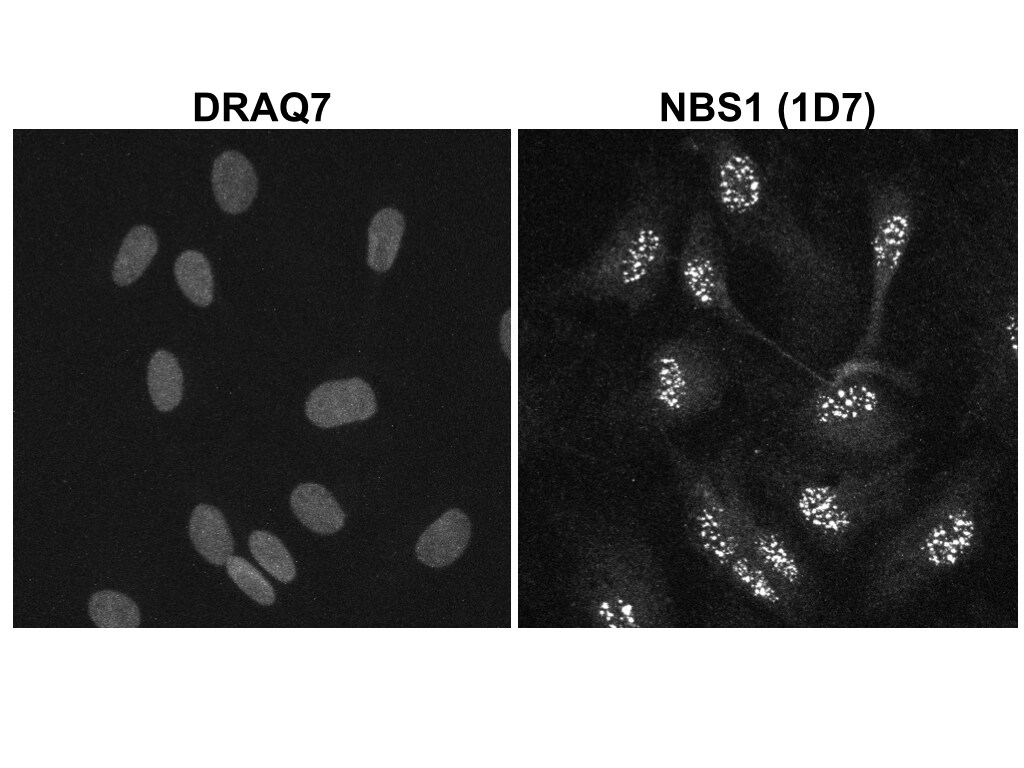
Application: ImmunocytochemistrySample Tested: primary human cellsSpecies: HumanVerified Customer | Posted 12/22/2016Primary cells fixed in methanol:acetone (1:1) and stained with NBS1 (1D7), 1:60.

-
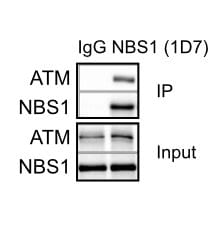
Application: ImmunoprecipitationSample Tested: Nuclear fraction, Human cell lineSpecies: HumanVerified Customer | Posted 12/22/2016IP with NBS1 (1D7) antibody from 293T nuclear extracts.
-
Application: Western BlotSample Tested: HEK293 whole cell lysatesSpecies: HumanVerified Customer | Posted 04/30/2014Western Blot: NBS1 Antibody (1D7) [NB100-221] - Detection of Human NBS1 on HEK293 whole cell lysate using NB100-221. Dilution: 1
There are no reviews that match your criteria.
Protocols
Find general support by application which include: protocols, troubleshooting, illustrated assays, videos and webinars.
- Antigen Retrieval Protocol (PIER)
- Antigen Retrieval for Frozen Sections Protocol
- Appropriate Fixation of IHC/ICC Samples
- Cellular Response to Hypoxia Protocols
- Chromogenic IHC Staining of Formalin-Fixed Paraffin-Embedded (FFPE) Tissue Protocol
- Chromogenic Immunohistochemistry Staining of Frozen Tissue
- ClariTSA™ Fluorophore Kits
- Detection & Visualization of Antibody Binding
- Fluorescent IHC Staining of Frozen Tissue Protocol
- Graphic Protocol for Heat-induced Epitope Retrieval
- Graphic Protocol for the Preparation and Fluorescent IHC Staining of Frozen Tissue Sections
- Graphic Protocol for the Preparation and Fluorescent IHC Staining of Paraffin-embedded Tissue Sections
- Graphic Protocol for the Preparation of Gelatin-coated Slides for Histological Tissue Sections
- ICC Cell Smear Protocol for Suspension Cells
- ICC Immunocytochemistry Protocol Videos
- ICC for Adherent Cells
- IHC Sample Preparation (Frozen sections vs Paraffin)
- Immunocytochemistry (ICC) Protocol
- Immunocytochemistry Troubleshooting
- Immunofluorescence of Organoids Embedded in Cultrex Basement Membrane Extract
- Immunofluorescent IHC Staining of Formalin-Fixed Paraffin-Embedded (FFPE) Tissue Protocol
- Immunohistochemistry (IHC) and Immunocytochemistry (ICC) Protocols
- Immunohistochemistry Frozen Troubleshooting
- Immunohistochemistry Paraffin Troubleshooting
- Immunoprecipitation Protocol
- Preparing Samples for IHC/ICC Experiments
- Preventing Non-Specific Staining (Non-Specific Binding)
- Primary Antibody Selection & Optimization
- Protocol for Heat-Induced Epitope Retrieval (HIER)
- Protocol for Making a 4% Formaldehyde Solution in PBS
- Protocol for VisUCyte™ HRP Polymer Detection Reagent
- Protocol for the Fluorescent ICC Staining of Cell Smears - Graphic
- Protocol for the Fluorescent ICC Staining of Cultured Cells on Coverslips - Graphic
- Protocol for the Preparation & Fixation of Cells on Coverslips
- Protocol for the Preparation and Chromogenic IHC Staining of Frozen Tissue Sections
- Protocol for the Preparation and Chromogenic IHC Staining of Frozen Tissue Sections - Graphic
- Protocol for the Preparation and Chromogenic IHC Staining of Paraffin-embedded Tissue Sections
- Protocol for the Preparation and Chromogenic IHC Staining of Paraffin-embedded Tissue Sections - Graphic
- Protocol for the Preparation and Fluorescent ICC Staining of Cells on Coverslips
- Protocol for the Preparation and Fluorescent ICC Staining of Non-adherent Cells
- Protocol for the Preparation and Fluorescent ICC Staining of Stem Cells on Coverslips
- Protocol for the Preparation and Fluorescent IHC Staining of Frozen Tissue Sections
- Protocol for the Preparation and Fluorescent IHC Staining of Paraffin-embedded Tissue Sections
- Protocol for the Preparation of Gelatin-coated Slides for Histological Tissue Sections
- Protocol for the Preparation of a Cell Smear for Non-adherent Cell ICC - Graphic
- R&D Systems Quality Control Western Blot Protocol
- TUNEL and Active Caspase-3 Detection by IHC/ICC Protocol
- The Importance of IHC/ICC Controls
- Troubleshooting Guide: Immunohistochemistry
- Troubleshooting Guide: Western Blot Figures
- Western Blot Conditions
- Western Blot Protocol
- Western Blot Protocol for Cell Lysates
- Western Blot Troubleshooting
- Western Blot Troubleshooting Guide
- View all Protocols, Troubleshooting, Illustrated assays and Webinars
FAQs for Nbs1 Antibody (1D7) - Azide and BSA Free
Showing
1
-
5 of
5 FAQs
Showing All
-
Q: If this product is used in an application or species as a part of a customer review, will that validate this product in the application/species?
A: Yes, if this product is used in an untested application or species and it is shown to work through images from customer reviews or through publications, this validates the application/species for this product.
-
Q: We are looking for an NBS mouse monoclonal antibody that would work for IF. NBS1 Antibody (NB100-221) might be ideal, except we need to use it in mouse cells, and the data sheet says it is reactive with human cells. Could you tell us if it has been tested in mouse cells? If it has not, we would be willing to test it, and send you verifying images. However, if we test it and it does not work in mouse cells, would we be able to receive another antibody in exchange? We would also like to purchase a STAT1 mouse monoclonal antibody that would work for IF. STAT1 Antibody (NBP1-48011). The species reactivity of the antibody indicates that it is reactive with human, canine, and primate cells. Has it been tested in mouse cells?
A: I have a couple of thoughts after reading through your needs for this antibody. This antibody is validated for mouse reactivity. I assume you realize that if you want to use a mouse mAb on mouse tissue, you will need to do a mouse on mouse block to prevent non-specific staining with your secondary. If you would like to test an antibody in an unvalidated species or application, please consider our Innovators Reward Program. STAT1, NBP1-48011, has not been validated for mouse reactivity so this would qualify for the Innovators Reward Program.
-
Q: What is NBS1?
A: NBS1 is Nijmegen breakage syndrome protein 1, or Nibrin. Please refer to the background listed in the datasheet for a full summary of this common name.
-
Q: What is the theoretical molecular weight of Nbs1 antibodies?
A: In general, there is only one isoform described for this target. The TMW of the human form of the target protein is 85kDa. The mouse form is 84kDa. However, the observed molecular weight may vary.
-
Q: What research areas can this product be used in?
A: All Nbs1 products can be used in Breast Cancer, Cancer, Checkpoint signaling, Chromatin Research, DNA Double Strand Break Repair, DNA Repair, Homologous Recombination, Non-homologous end-joining, Tumor Suppressors, and Cell Cycle and Replication.
-
Q: If this product is used in an application or species as a part of a customer review, will that validate this product in the application/species?
A: Yes, if this product is used in an untested application or species and it is shown to work through images from customer reviews or through publications, this validates the application/species for this product.
-
Q: We are looking for an NBS mouse monoclonal antibody that would work for IF. NBS1 Antibody (NB100-221) might be ideal, except we need to use it in mouse cells, and the data sheet says it is reactive with human cells. Could you tell us if it has been tested in mouse cells? If it has not, we would be willing to test it, and send you verifying images. However, if we test it and it does not work in mouse cells, would we be able to receive another antibody in exchange? We would also like to purchase a STAT1 mouse monoclonal antibody that would work for IF. STAT1 Antibody (NBP1-48011). The species reactivity of the antibody indicates that it is reactive with human, canine, and primate cells. Has it been tested in mouse cells?
A: I have a couple of thoughts after reading through your needs for this antibody. This antibody is validated for mouse reactivity. I assume you realize that if you want to use a mouse mAb on mouse tissue, you will need to do a mouse on mouse block to prevent non-specific staining with your secondary. If you would like to test an antibody in an unvalidated species or application, please consider our Innovators Reward Program. STAT1, NBP1-48011, has not been validated for mouse reactivity so this would qualify for the Innovators Reward Program.
-
Q: What is NBS1?
A: NBS1 is Nijmegen breakage syndrome protein 1, or Nibrin. Please refer to the background listed in the datasheet for a full summary of this common name.
-
Q: What is the theoretical molecular weight of Nbs1 antibodies?
A: In general, there is only one isoform described for this target. The TMW of the human form of the target protein is 85kDa. The mouse form is 84kDa. However, the observed molecular weight may vary.
-
Q: What research areas can this product be used in?
A: All Nbs1 products can be used in Breast Cancer, Cancer, Checkpoint signaling, Chromatin Research, DNA Double Strand Break Repair, DNA Repair, Homologous Recombination, Non-homologous end-joining, Tumor Suppressors, and Cell Cycle and Replication.
-
Q: If this product is used in an application or species as a part of a customer review, will that validate this product in the application/species?
A: Yes, if this product is used in an untested application or species and it is shown to work through images from customer reviews or through publications, this validates the application/species for this product.
-
Q: We are looking for an NBS mouse monoclonal antibody that would work for IF. NBS1 Antibody (NB100-221) might be ideal, except we need to use it in mouse cells, and the data sheet says it is reactive with human cells. Could you tell us if it has been tested in mouse cells? If it has not, we would be willing to test it, and send you verifying images. However, if we test it and it does not work in mouse cells, would we be able to receive another antibody in exchange? We would also like to purchase a STAT1 mouse monoclonal antibody that would work for IF. STAT1 Antibody (NBP1-48011). The species reactivity of the antibody indicates that it is reactive with human, canine, and primate cells. Has it been tested in mouse cells?
A: I have a couple of thoughts after reading through your needs for this antibody. This antibody is validated for mouse reactivity. I assume you realize that if you want to use a mouse mAb on mouse tissue, you will need to do a mouse on mouse block to prevent non-specific staining with your secondary. If you would like to test an antibody in an unvalidated species or application, please consider our Innovators Reward Program. STAT1, NBP1-48011, has not been validated for mouse reactivity so this would qualify for the Innovators Reward Program.
-
Q: What is NBS1?
A: NBS1 is Nijmegen breakage syndrome protein 1, or Nibrin. Please refer to the background listed in the datasheet for a full summary of this common name.
-
Q: What is the theoretical molecular weight of Nbs1 antibodies?
A: In general, there is only one isoform described for this target. The TMW of the human form of the target protein is 85kDa. The mouse form is 84kDa. However, the observed molecular weight may vary.
-
Q: What research areas can this product be used in?
A: All Nbs1 products can be used in Breast Cancer, Cancer, Checkpoint signaling, Chromatin Research, DNA Double Strand Break Repair, DNA Repair, Homologous Recombination, Non-homologous end-joining, Tumor Suppressors, and Cell Cycle and Replication.
-
Q: If this product is used in an application or species as a part of a customer review, will that validate this product in the application/species?
A: Yes, if this product is used in an untested application or species and it is shown to work through images from customer reviews or through publications, this validates the application/species for this product.
-
Q: We are looking for an NBS mouse monoclonal antibody that would work for IF. NBS1 Antibody (NB100-221) might be ideal, except we need to use it in mouse cells, and the data sheet says it is reactive with human cells. Could you tell us if it has been tested in mouse cells? If it has not, we would be willing to test it, and send you verifying images. However, if we test it and it does not work in mouse cells, would we be able to receive another antibody in exchange? We would also like to purchase a STAT1 mouse monoclonal antibody that would work for IF. STAT1 Antibody (NBP1-48011). The species reactivity of the antibody indicates that it is reactive with human, canine, and primate cells. Has it been tested in mouse cells?
A: I have a couple of thoughts after reading through your needs for this antibody. This antibody is validated for mouse reactivity. I assume you realize that if you want to use a mouse mAb on mouse tissue, you will need to do a mouse on mouse block to prevent non-specific staining with your secondary. If you would like to test an antibody in an unvalidated species or application, please consider our Innovators Reward Program. STAT1, NBP1-48011, has not been validated for mouse reactivity so this would qualify for the Innovators Reward Program.
-
Q: What is NBS1?
A: NBS1 is Nijmegen breakage syndrome protein 1, or Nibrin. Please refer to the background listed in the datasheet for a full summary of this common name.
-
Q: What is the theoretical molecular weight of Nbs1 antibodies?
A: In general, there is only one isoform described for this target. The TMW of the human form of the target protein is 85kDa. The mouse form is 84kDa. However, the observed molecular weight may vary.
-
Q: What research areas can this product be used in?
A: All Nbs1 products can be used in Breast Cancer, Cancer, Checkpoint signaling, Chromatin Research, DNA Double Strand Break Repair, DNA Repair, Homologous Recombination, Non-homologous end-joining, Tumor Suppressors, and Cell Cycle and Replication.
-
Q: If this product is used in an application or species as a part of a customer review, will that validate this product in the application/species?
A: Yes, if this product is used in an untested application or species and it is shown to work through images from customer reviews or through publications, this validates the application/species for this product.
-
Q: We are looking for an NBS mouse monoclonal antibody that would work for IF. NBS1 Antibody (NB100-221) might be ideal, except we need to use it in mouse cells, and the data sheet says it is reactive with human cells. Could you tell us if it has been tested in mouse cells? If it has not, we would be willing to test it, and send you verifying images. However, if we test it and it does not work in mouse cells, would we be able to receive another antibody in exchange? We would also like to purchase a STAT1 mouse monoclonal antibody that would work for IF. STAT1 Antibody (NBP1-48011). The species reactivity of the antibody indicates that it is reactive with human, canine, and primate cells. Has it been tested in mouse cells?
A: I have a couple of thoughts after reading through your needs for this antibody. This antibody is validated for mouse reactivity. I assume you realize that if you want to use a mouse mAb on mouse tissue, you will need to do a mouse on mouse block to prevent non-specific staining with your secondary. If you would like to test an antibody in an unvalidated species or application, please consider our Innovators Reward Program. STAT1, NBP1-48011, has not been validated for mouse reactivity so this would qualify for the Innovators Reward Program.
-
Q: What is NBS1?
A: NBS1 is Nijmegen breakage syndrome protein 1, or Nibrin. Please refer to the background listed in the datasheet for a full summary of this common name.
-
Q: What is the theoretical molecular weight of Nbs1 antibodies?
A: In general, there is only one isoform described for this target. The TMW of the human form of the target protein is 85kDa. The mouse form is 84kDa. However, the observed molecular weight may vary.
-
Q: What research areas can this product be used in?
A: All Nbs1 products can be used in Breast Cancer, Cancer, Checkpoint signaling, Chromatin Research, DNA Double Strand Break Repair, DNA Repair, Homologous Recombination, Non-homologous end-joining, Tumor Suppressors, and Cell Cycle and Replication.
Loading...