
NSFL1C Antibody - BSA Free
Novus Biologicals | Catalog # NBP2-13677

![Immunohistochemistry-Paraffin: NSFL1C Antibody [NBP2-13677]](https://resources.rndsystems.com/images/products/NSFL1C-Antibody-Immunohistochemistry-Paraffin-NBP2-13677-img0005.jpg "Immunohistochemistry-Paraffin: NSFL1C Antibody [NBP2-13677]")
Scientific images may be resized, cropped, or adjusted for brightness or contrast for presentation purposes. These updates are limited to presentation and do not affect the underlying scientific interpretation of the data. Where available, additional source data may be provided upon request.
Key Product Details
Validated by
Species Reactivity
Validated:
Cited:
Predicted:
Applications
Validated:
Cited:
Label
Antibody Source
Format
Product Specifications
Immunogen
Clonality
Host
Isotype
Scientific Data Images for NSFL1C Antibody - BSA Free
Immunohistochemistry-Paraffin: NSFL1C Antibody [NBP2-13677]
Immunohistochemistry-Paraffin: NSFL1C Antibody [NBP2-13677] - Staining of human cerebral cortex, kidney, lymph node and testis using Anti-NSFL1C antibody NBP2-13677 (A) shows similar protein distribution across tissues to independent antibody NBP2-13676 (B).![Western Blot: NSFL1C Antibody [NBP2-13677]](https://resources.rndsystems.com/images/products/NSFL1C-Antibody-Western-Blot-NBP2-13677-img0011.jpg "Western Blot: NSFL1C Antibody [NBP2-13677]")
Western Blot: NSFL1C Antibody [NBP2-13677]
NSFL1C-Antibody-Western-Blot-NBP2-13677-img0011.jpg![Immunocytochemistry/ Immunofluorescence: NSFL1C Antibody [NBP2-13677]](https://resources.rndsystems.com/images/products/NSFL1C-Antibody-Immunocytochemistry-Immunofluorescence-NBP2-13677-img0004.jpg "Immunocytochemistry/ Immunofluorescence: NSFL1C Antibody [NBP2-13677]")
Immunocytochemistry/ Immunofluorescence: NSFL1C Antibody [NBP2-13677]
Immunocytochemistry/Immunofluorescence: NSFL1C Antibody [NBP2-13677] - Staining of human cell line A-431 shows localization to nucleoplasm & cytosol. Antibody staining is shown in green.![Immunohistochemistry-Paraffin: NSFL1C Antibody [NBP2-13677]](https://resources.rndsystems.com/images/products/NSFL1C-Antibody-Immunohistochemistry-Paraffin-NBP2-13677-img0010.jpg "Immunohistochemistry-Paraffin: NSFL1C Antibody [NBP2-13677]")
Immunohistochemistry-Paraffin: NSFL1C Antibody [NBP2-13677]
Immunohistochemistry-Paraffin: NSFL1C Antibody [NBP2-13677] - Staining of human testis.![Immunohistochemistry-Paraffin: NSFL1C Antibody [NBP2-13677]](https://resources.rndsystems.com/images/products/NSFL1C-Antibody-Immunohistochemistry-Paraffin-NBP2-13677-img0007.jpg "Immunohistochemistry-Paraffin: NSFL1C Antibody [NBP2-13677]")
Immunohistochemistry-Paraffin: NSFL1C Antibody [NBP2-13677]
Immunohistochemistry-Paraffin: NSFL1C Antibody [NBP2-13677] - Staining of human kidney.![Immunohistochemistry-Paraffin: NSFL1C Antibody [NBP2-13677]](https://resources.rndsystems.com/images/products/NSFL1C-Antibody-Immunohistochemistry-Paraffin-NBP2-13677-img0008.jpg "Immunohistochemistry-Paraffin: NSFL1C Antibody [NBP2-13677]")
Immunohistochemistry-Paraffin: NSFL1C Antibody [NBP2-13677]
Immunohistochemistry-Paraffin: NSFL1C Antibody [NBP2-13677] - Staining of human cerebral cortex.![Immunohistochemistry-Paraffin: NSFL1C Antibody [NBP2-13677]](https://resources.rndsystems.com/images/products/NSFL1C-Antibody-Immunohistochemistry-Paraffin-NBP2-13677-img0009.jpg "Immunohistochemistry-Paraffin: NSFL1C Antibody [NBP2-13677]")
Immunohistochemistry-Paraffin: NSFL1C Antibody [NBP2-13677]
Immunohistochemistry-Paraffin: NSFL1C Antibody [NBP2-13677] - Staining of human lymph node.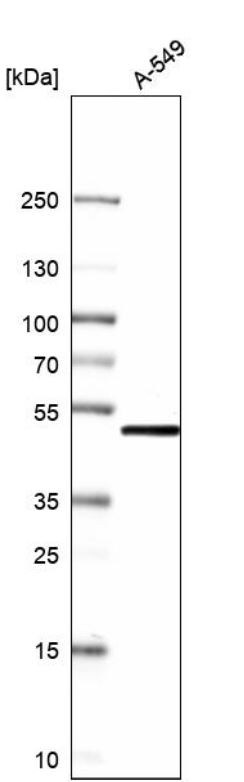
Western Blot: NSFL1C Antibody [NBP2-13677] -
Western Blot: NSFL1C Antibody [NBP2-13677] - Analysis in human cell line A-549.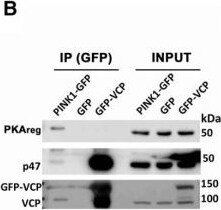
Western Blot: NSFL1C Antibody [NBP2-13677] -
Western Blot: NSFL1C Antibody [NBP2-13677] - PINK1 phosphorylates the activation loop of PKA. A, IP products of HEK293 cell lysates expressing GFP or PINK1-GFP reveal that PINK1 pulls down the PKA holoenzyme (PKAcat & PKAreg) in addition to VCP & p47. B, IP products of HEK293 lysates expressing PINK1-GFP, GFP or GFP-VCP reveal that either PINK1 or VCP pull down p47, but only PINK1 pulls down PKAreg. C, IP products of HEK293 lystates expressing Vector or MYC-p47 reveals that p47 does not interact w/ PKAcat or PKAreg. D, 2-D analysis of endogenous PKA subunits in control (M14) & PINK1-3xFlag (#24) stable SH-SY5Y lines reveal an acidic shift of PKAcat (arrow), but not PKAreg, in PINK1-overexpressing cells. E, Structural model for the MD-equilibrated (100 ns) complex between hPINK1 (pink) & PKAcat (green). PKA-T197 (cyan balls) & PINK1-D362 (orange balls) are shown in relation to PINK1-bound ATP w/ two Mg2+ (purple). Red, tan, white, cyan, & blue represent O, P, H, C, & N atoms, respectively, of ATP. F, Immunoblot analysis of HEK293 cells transfected w/ GFP or PINK1-GFP reveals that PINK1-GFP increases PKAcat phosphorylation at T197, but has no effect on PKAreg phosphorylation at S99 (mean ± SD, three independent experiments, p = 0.014). G, Recombinant PKAcat purified from E. coli, which is already phosphorylated at T197, dephosphorylated by incubation w/ lambda phosphatase (PP) at 30°C × 1 h. Successful dephosphorylation verified by immunoblot. H, In vitro kinase assay of human GST-PINK1 w/ dephosphorylated recombinant PKAcat in the presence or absence of the PKA inhibitor H89 reveals that hPINK1 phosphorylates PKA at T197. I, In vitro kinase assay of GST-TcPINK1 w/ dephosphorylated recombinant PKAcat reveals that TcPINK1 is also capable of directly phosphorylating PKAcat. Image collected & cropped by CiteAb from the following publication (https://pubmed.ncbi.nlm.nih.gov/30783609), licensed under a CC-BY license. Not internally tested by Novus Biologicals.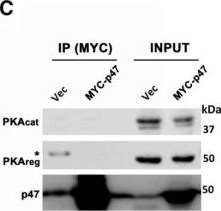
Western Blot: NSFL1C Antibody [NBP2-13677] -
Western Blot: NSFL1C Antibody [NBP2-13677] - PINK1 phosphorylates the activation loop of PKA. A, IP products of HEK293 cell lysates expressing GFP or PINK1-GFP reveal that PINK1 pulls down the PKA holoenzyme (PKAcat & PKAreg) in addition to VCP & p47. B, IP products of HEK293 lysates expressing PINK1-GFP, GFP or GFP-VCP reveal that either PINK1 or VCP pull down p47, but only PINK1 pulls down PKAreg. C, IP products of HEK293 lystates expressing Vector or MYC-p47 reveals that p47 does not interact w/ PKAcat or PKAreg. D, 2-D analysis of endogenous PKA subunits in control (M14) & PINK1-3xFlag (#24) stable SH-SY5Y lines reveal an acidic shift of PKAcat (arrow), but not PKAreg, in PINK1-overexpressing cells. E, Structural model for the MD-equilibrated (100 ns) complex between hPINK1 (pink) & PKAcat (green). PKA-T197 (cyan balls) & PINK1-D362 (orange balls) are shown in relation to PINK1-bound ATP w/ two Mg2+ (purple). Red, tan, white, cyan, & blue represent O, P, H, C, & N atoms, respectively, of ATP. F, Immunoblot analysis of HEK293 cells transfected w/ GFP or PINK1-GFP reveals that PINK1-GFP increases PKAcat phosphorylation at T197, but has no effect on PKAreg phosphorylation at S99 (mean ± SD, three independent experiments, p = 0.014). G, Recombinant PKAcat purified from E. coli, which is already phosphorylated at T197, dephosphorylated by incubation w/ lambda phosphatase (PP) at 30°C × 1 h. Successful dephosphorylation verified by immunoblot. H, In vitro kinase assay of human GST-PINK1 w/ dephosphorylated recombinant PKAcat in the presence or absence of the PKA inhibitor H89 reveals that hPINK1 phosphorylates PKA at T197. I, In vitro kinase assay of GST-TcPINK1 w/ dephosphorylated recombinant PKAcat reveals that TcPINK1 is also capable of directly phosphorylating PKAcat. Image collected & cropped by CiteAb from the following publication (https://pubmed.ncbi.nlm.nih.gov/30783609), licensed under a CC-BY license. Not internally tested by Novus Biologicals.Applications for NSFL1C Antibody - BSA Free
Immunocytochemistry/ Immunofluorescence
Immunohistochemistry
Immunohistochemistry-Paraffin
Western Blot
Formulation, Preparation, and Storage
Purification
Formulation
Format
Preservative
Concentration
Shipping
Stability & Storage
Background: NSFL1C
Alternate Names
Gene Symbol
Additional NSFL1C Products
Product Documents for NSFL1C Antibody - BSA Free
Certificate of Analysis
To download a Certificate of Analysis, please enter a lot or batch number in the search box below.
Product Specific Notices for NSFL1C Antibody - BSA Free
This product is for research use only and is not approved for use in humans or in clinical diagnosis. Primary Antibodies are guaranteed for 1 year from date of receipt.
Citations for NSFL1C Antibody - BSA Free
 Powered by Bioz
Customer Reviews for NSFL1C Antibody - BSA Free
There are currently no reviews for this product. Be the first to review NSFL1C Antibody - BSA Free and earn rewards!
Have you used NSFL1C Antibody - BSA Free?
Submit a review and receive an Amazon gift card!
$25/€18/£15/$25CAN/¥2500 for a review with an image
$10/€7/£6/$10CAN/¥1110 for a review without an image
Submit a review
Protocols
Find general support by application which include: protocols, troubleshooting, illustrated assays, videos and webinars.
- Antigen Retrieval Protocol (PIER)
- Antigen Retrieval for Frozen Sections Protocol
- Appropriate Fixation of IHC/ICC Samples
- Cellular Response to Hypoxia Protocols
- Chromogenic IHC Staining of Formalin-Fixed Paraffin-Embedded (FFPE) Tissue Protocol
- Chromogenic Immunohistochemistry Staining of Frozen Tissue
- ClariTSA™ Fluorophore Kits
- Detection & Visualization of Antibody Binding
- Fluorescent IHC Staining of Frozen Tissue Protocol
- Graphic Protocol for Heat-induced Epitope Retrieval
- Graphic Protocol for the Preparation and Fluorescent IHC Staining of Frozen Tissue Sections
- Graphic Protocol for the Preparation and Fluorescent IHC Staining of Paraffin-embedded Tissue Sections
- Graphic Protocol for the Preparation of Gelatin-coated Slides for Histological Tissue Sections
- ICC Cell Smear Protocol for Suspension Cells
- ICC Immunocytochemistry Protocol Videos
- ICC for Adherent Cells
- IHC Sample Preparation (Frozen sections vs Paraffin)
- Immunocytochemistry (ICC) Protocol
- Immunocytochemistry Troubleshooting
- Immunofluorescence of Organoids Embedded in Cultrex Basement Membrane Extract
- Immunofluorescent IHC Staining of Formalin-Fixed Paraffin-Embedded (FFPE) Tissue Protocol
- Immunohistochemistry (IHC) and Immunocytochemistry (ICC) Protocols
- Immunohistochemistry Frozen Troubleshooting
- Immunohistochemistry Paraffin Troubleshooting
- Preparing Samples for IHC/ICC Experiments
- Preventing Non-Specific Staining (Non-Specific Binding)
- Primary Antibody Selection & Optimization
- Protocol for Heat-Induced Epitope Retrieval (HIER)
- Protocol for Making a 4% Formaldehyde Solution in PBS
- Protocol for VisUCyte™ HRP Polymer Detection Reagent
- Protocol for the Fluorescent ICC Staining of Cell Smears - Graphic
- Protocol for the Fluorescent ICC Staining of Cultured Cells on Coverslips - Graphic
- Protocol for the Preparation & Fixation of Cells on Coverslips
- Protocol for the Preparation and Chromogenic IHC Staining of Frozen Tissue Sections
- Protocol for the Preparation and Chromogenic IHC Staining of Frozen Tissue Sections - Graphic
- Protocol for the Preparation and Chromogenic IHC Staining of Paraffin-embedded Tissue Sections
- Protocol for the Preparation and Chromogenic IHC Staining of Paraffin-embedded Tissue Sections - Graphic
- Protocol for the Preparation and Fluorescent ICC Staining of Cells on Coverslips
- Protocol for the Preparation and Fluorescent ICC Staining of Non-adherent Cells
- Protocol for the Preparation and Fluorescent ICC Staining of Stem Cells on Coverslips
- Protocol for the Preparation and Fluorescent IHC Staining of Frozen Tissue Sections
- Protocol for the Preparation and Fluorescent IHC Staining of Paraffin-embedded Tissue Sections
- Protocol for the Preparation of Gelatin-coated Slides for Histological Tissue Sections
- Protocol for the Preparation of a Cell Smear for Non-adherent Cell ICC - Graphic
- R&D Systems Quality Control Western Blot Protocol
- TUNEL and Active Caspase-3 Detection by IHC/ICC Protocol
- The Importance of IHC/ICC Controls
- Troubleshooting Guide: Immunohistochemistry
- Troubleshooting Guide: Western Blot Figures
- Western Blot Conditions
- Western Blot Protocol
- Western Blot Protocol for Cell Lysates
- Western Blot Troubleshooting
- Western Blot Troubleshooting Guide
- View all Protocols, Troubleshooting, Illustrated assays and Webinars