
ORF73/HHV8 Antibody (4C11) - BSA Free
Novus Biologicals | Catalog # NBP1-30176

![Western Blot: ORF73/HHV8 Antibody (4C11)BSA Free [NBP1-30176]](https://resources.rndsystems.com/images/products/ORF73-HHV8-Antibody-4C11-Western-Blot-NBP1-30176-img0008.jpg "Western Blot: ORF73/HHV8 Antibody (4C11)BSA Free [NBP1-30176]")
Scientific images may be resized, cropped, or adjusted for brightness or contrast for presentation purposes. These updates are limited to presentation and do not affect the underlying scientific interpretation of the data. Where available, additional source data may be provided upon request.
Key Product Details
Validated by
Species Reactivity
Applications
Validated:
Cited:
Label
Antibody Source
Format
Product Specifications
Immunogen
Reactivity Notes
Clonality
Host
Isotype
Scientific Data Images for ORF73/HHV8 Antibody (4C11) - BSA Free
Western Blot: ORF73/HHV8 Antibody (4C11)BSA Free [NBP1-30176]
Western Blot: ORF73/HHV8 Antibody (4C11) [NBP1-30176] - The cell lysates were resolved by SDS-PAGE, transferred to PVDF membrane and probed with NBP1-30176. Proteins were visualized using a goat anti-mouse secondary antibody conjugated to HRP and an ECL detection system. Lane 1.: 293T cell lysate (40ug). Lane 2.: ORF73/HHV8-MBP tag Transfected 293T cell lysate (5ug)![Immunocytochemistry/ Immunofluorescence: ORF73/HHV8 Antibody (4C11) - BSA Free [NBP1-30176]](https://resources.rndsystems.com/images/products/ORF73-HHV8-Antibody-4C11-Immunocytochemistry-Immunofluorescence-NBP1-30176-img0007.jpg "Immunocytochemistry/ Immunofluorescence: ORF73/HHV8 Antibody (4C11) - BSA Free [NBP1-30176]")
![Immunohistochemistry-Paraffin: ORF73/HHV8 Antibody (4C11) - BSA Free [NBP1-30176]](https://resources.rndsystems.com/images/products/ORF73-HHV8-Antibody-4C11-Immunohistochemistry-Paraffin-NBP1-30176-img0004.jpg "Immunohistochemistry-Paraffin: ORF73/HHV8 Antibody (4C11) - BSA Free [NBP1-30176]")
Immunohistochemistry-Paraffin: ORF73/HHV8 Antibody (4C11) - BSA Free [NBP1-30176]
Immunohistochemistry-Paraffin: ORF73/HHV8 Antibody (4C11) [NBP1-30176] - IHC analysis of Kaposi's sarcoma tissue using antibody (1:50) for 2 hours at room temperature. Antigen retrieval was performed in 0.1M sodium citrate buffer and detected using Diaminobenzidine (DAB).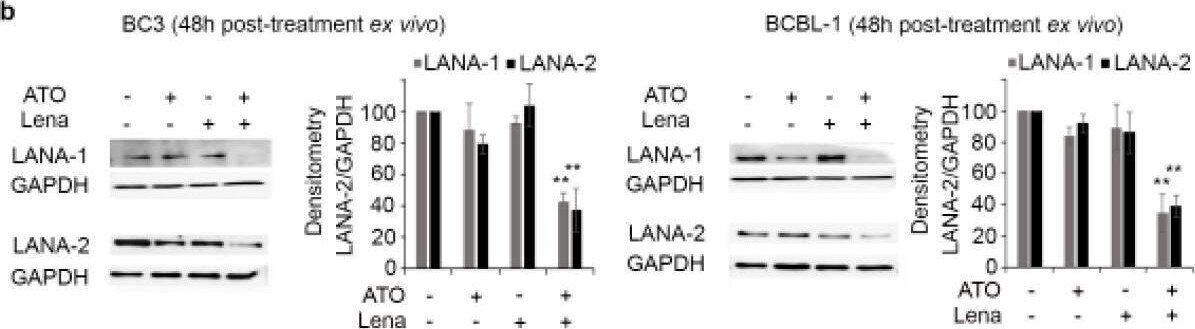
Western Blot: ORF73/HHV8 Antibody (4C11) - BSA Free [NBP1-30176] -
ATO/Lena inhibited proliferation and downregulated Kaposi sarcoma herpes virus (KSHV) latent transcripts and proteins in ex vivo treated ascites-derived BC-3 and BCBL-1 cells. (a) Cell proliferation of ascites-derived BC-3 (left) or BCBL-1 cells (right) following ex vivo treatment with ATO and/or Lena for 24, 48, 72, and 96 h. Results are presented as percent of control, plotted as mean +/- SD, and represent an average of three independent experiments. (b) Immunoblot analysis of KSHV latent proteins LANA-1 and LANA-2 in ascites-derived BC-3 (left) or BCBL-1(right) cells treated ex vivo for 48 h with ATO, Lena, or their combination. Densitometry histograms represent an average of 3 independent experiments. Uncropped blots of Figure 2b are shown in Figure S5 (c) Real-time quantitative PCR analysis of transcript levels of KSHV latent genes v-FLIP and v-Cyclin in ascites-derived BC-3 (left) or BCBL-1(right), 48 h post treatment with ATO, Lena, or the ATO/Lena combination. Results represent the average of 3 independent experiments. (*) indicates p < 0.05; (**) indicates p < 0.01. Image collected and cropped by CiteAb from the following open publication (https://pubmed.ncbi.nlm.nih.gov/32883022), licensed under a CC-BY license. Not internally tested by Novus Biologicals.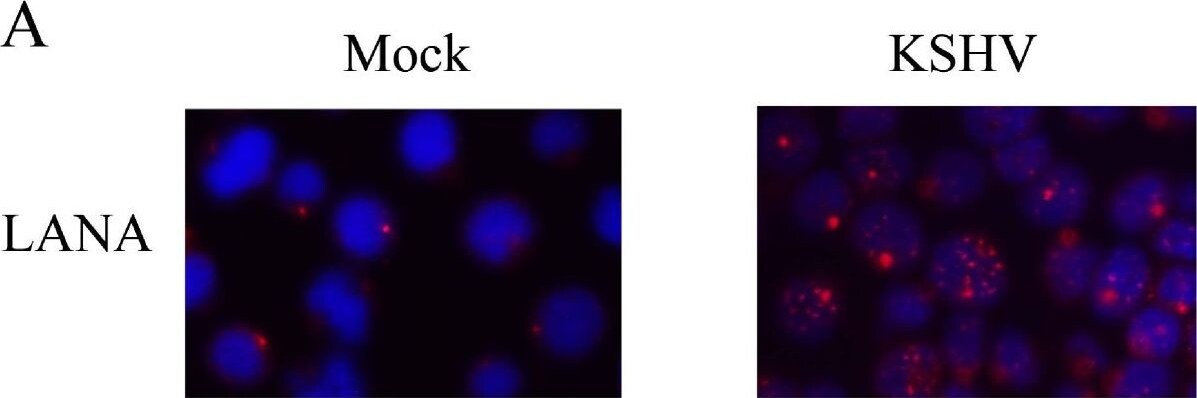
Immunocytochemistry/ Immunofluorescence: ORF73/HHV8 Antibody (4C11) - BSA Free [NBP1-30176] -
Hyperphosphorylation of Akt induced by KSHV in THP-1 infected cells is resistant to Bortezomib treatment. A) Immunofluorescence of mock and KSHV-infected THP-1 cells with anti-LANA antibodies. Typical LANA staining (intranuclear red punctuation) is visible in cells latently infected by KSHV. The counterstaining of THP-1 DNA with DAPI (blue) is shown. B) Western blot analysis of phospho-Akt (p-AKT) and total AKT (AKT) in mock and KSHV-infected THP-1 cells, untreated or treated with Bortezomib (Bz, 10 nM), or LY294002 (Ly, 1μM) or combination of both (Bz, 10 nM plus Ly, 1μM). beta -actin is included as protein loading control. Image collected and cropped by CiteAb from the following open publication (https://pubmed.ncbi.nlm.nih.gov/24422998), licensed under a CC-BY license. Not internally tested by Novus Biologicals.Applications for ORF73/HHV8 Antibody (4C11) - BSA Free
ELISA
Immunohistochemistry
Immunohistochemistry-Paraffin
Western Blot
Formulation, Preparation, and Storage
Purification
Formulation
Format
Preservative
Concentration
Shipping
Stability & Storage
Background: ORF73 HHV8
Long Name
Alternate Names
Gene Symbol
UniProt
Additional ORF73 HHV8 Products
Product Documents for ORF73/HHV8 Antibody (4C11) - BSA Free
Certificate of Analysis
To download a Certificate of Analysis, please enter a lot or batch number in the search box below.
Product Specific Notices for ORF73/HHV8 Antibody (4C11) - BSA Free
This product is for research use only and is not approved for use in humans or in clinical diagnosis. Primary Antibodies are guaranteed for 1 year from date of receipt.
Related Research Areas
Citations for ORF73/HHV8 Antibody (4C11) - BSA Free
 Powered by Bioz
Customer Reviews for ORF73/HHV8 Antibody (4C11) - BSA Free
There are currently no reviews for this product. Be the first to review ORF73/HHV8 Antibody (4C11) - BSA Free and earn rewards!
Have you used ORF73/HHV8 Antibody (4C11) - BSA Free?
Submit a review and receive an Amazon gift card!
$25/€18/£15/$25CAN/¥2500 for a review with an image
$10/€7/£6/$10CAN/¥1110 for a review without an image
Submit a review
Protocols
Find general support by application which include: protocols, troubleshooting, illustrated assays, videos and webinars.
- Antigen Retrieval Protocol (PIER)
- Antigen Retrieval for Frozen Sections Protocol
- Appropriate Fixation of IHC/ICC Samples
- Cellular Response to Hypoxia Protocols
- Chromogenic IHC Staining of Formalin-Fixed Paraffin-Embedded (FFPE) Tissue Protocol
- Chromogenic Immunohistochemistry Staining of Frozen Tissue
- ClariTSA™ Fluorophore Kits
- Detection & Visualization of Antibody Binding
- ELISA Sample Preparation & Collection Guide
- ELISA Troubleshooting Guide
- Fluorescent IHC Staining of Frozen Tissue Protocol
- Graphic Protocol for Heat-induced Epitope Retrieval
- Graphic Protocol for the Preparation and Fluorescent IHC Staining of Frozen Tissue Sections
- Graphic Protocol for the Preparation and Fluorescent IHC Staining of Paraffin-embedded Tissue Sections
- Graphic Protocol for the Preparation of Gelatin-coated Slides for Histological Tissue Sections
- How to Run an R&D Systems DuoSet ELISA
- How to Run an R&D Systems Quantikine ELISA
- How to Run an R&D Systems Quantikine™ QuicKit™ ELISA
- IHC Sample Preparation (Frozen sections vs Paraffin)
- Immunofluorescent IHC Staining of Formalin-Fixed Paraffin-Embedded (FFPE) Tissue Protocol
- Immunohistochemistry (IHC) and Immunocytochemistry (ICC) Protocols
- Immunohistochemistry Frozen Troubleshooting
- Immunohistochemistry Paraffin Troubleshooting
- Preparing Samples for IHC/ICC Experiments
- Preventing Non-Specific Staining (Non-Specific Binding)
- Primary Antibody Selection & Optimization
- Protocol for Heat-Induced Epitope Retrieval (HIER)
- Protocol for Making a 4% Formaldehyde Solution in PBS
- Protocol for VisUCyte™ HRP Polymer Detection Reagent
- Protocol for the Preparation & Fixation of Cells on Coverslips
- Protocol for the Preparation and Chromogenic IHC Staining of Frozen Tissue Sections
- Protocol for the Preparation and Chromogenic IHC Staining of Frozen Tissue Sections - Graphic
- Protocol for the Preparation and Chromogenic IHC Staining of Paraffin-embedded Tissue Sections
- Protocol for the Preparation and Chromogenic IHC Staining of Paraffin-embedded Tissue Sections - Graphic
- Protocol for the Preparation and Fluorescent IHC Staining of Frozen Tissue Sections
- Protocol for the Preparation and Fluorescent IHC Staining of Paraffin-embedded Tissue Sections
- Protocol for the Preparation of Gelatin-coated Slides for Histological Tissue Sections
- Quantikine HS ELISA Kit Assay Principle, Alkaline Phosphatase
- Quantikine HS ELISA Kit Principle, Streptavidin-HRP Polymer
- R&D Systems Quality Control Western Blot Protocol
- Sandwich ELISA (Colorimetric) – Biotin/Streptavidin Detection Protocol
- Sandwich ELISA (Colorimetric) – Direct Detection Protocol
- TUNEL and Active Caspase-3 Detection by IHC/ICC Protocol
- The Importance of IHC/ICC Controls
- Troubleshooting Guide: ELISA
- Troubleshooting Guide: Immunohistochemistry
- Troubleshooting Guide: Western Blot Figures
- Western Blot Conditions
- Western Blot Protocol
- Western Blot Protocol for Cell Lysates
- Western Blot Troubleshooting
- Western Blot Troubleshooting Guide
- View all Protocols, Troubleshooting, Illustrated assays and Webinars
FAQs for ORF73/HHV8 Antibody (4C11) - BSA Free
-
Q: I have conjugated the ORF 73/HHV8 4C11 antibody (NBP1-30176) using an AlexaFluor 647 Antibody Labeling Kit. All absorbance calculations indicate that the labeling was successful. However, upon attempting IF with the newly conjugated antibody, it no longer
A: For product NBP1-30176, we have not yet tried conjugating this antibody to a fluor or other dye. Depending on the labeling chemistry, it is possible that the fluor is binding or blocking the antigen binding region of the antibody. Since you were not able to detect any signal when using a conjugated secondary with the directly conjugated product, this would suggest that the conjugated antibody is not binding to your sample. With our conjugations, we typically use a free amine labeling chemistry to bind our fluors to the antibodies. We have, in some cases, found that the antibody binding efficiency has been compromised by this labeling. In such cases, we resort to using a conjugated secondary for detection. Therefore, I do not have any additional troubleshooting advice to offer in this case. I am sorry for any inconvenience.
-
Q: I need to do Viral IL-6 (HHV8) ELISA. I was wondering if you have the kit if not would it be possible to make it for us? I would appreciate if you inform me with all the details.
A: We do not have an HHV8 kit, but we have two HHV8 antibodies that may be used for an ELISA: NBP1-30176 and NBP1-47357.
-
Q: Why does the image for WB shows a band at 75 kDa, when the molecular weight for ORF73 is actually a lot higher? Do you have a different image for WB or any other information regarding this?
A: The Western blot image on our site was generated using a cell lysate from 293T cells transfected with the partial recombinant protein used to generate the antibody. That is, the image on the site is not for a Western blot against the full-length protein. This is why it shows up at a lower molecular weight.
-
Q: I have conjugated the ORF 73/HHV8 4C11 antibody (NBP1-30176) using an AlexaFluor 647 Antibody Labeling Kit. All absorbance calculations indicate that the labeling was successful. However, upon attempting IF with the newly conjugated antibody, it no longer
A: For product NBP1-30176, we have not yet tried conjugating this antibody to a fluor or other dye. Depending on the labeling chemistry, it is possible that the fluor is binding or blocking the antigen binding region of the antibody. Since you were not able to detect any signal when using a conjugated secondary with the directly conjugated product, this would suggest that the conjugated antibody is not binding to your sample. With our conjugations, we typically use a free amine labeling chemistry to bind our fluors to the antibodies. We have, in some cases, found that the antibody binding efficiency has been compromised by this labeling. In such cases, we resort to using a conjugated secondary for detection. Therefore, I do not have any additional troubleshooting advice to offer in this case. I am sorry for any inconvenience.
-
Q: I need to do Viral IL-6 (HHV8) ELISA. I was wondering if you have the kit if not would it be possible to make it for us? I would appreciate if you inform me with all the details.
A: We do not have an HHV8 kit, but we have two HHV8 antibodies that may be used for an ELISA: NBP1-30176 and NBP1-47357.
-
Q: Why does the image for WB shows a band at 75 kDa, when the molecular weight for ORF73 is actually a lot higher? Do you have a different image for WB or any other information regarding this?
A: The Western blot image on our site was generated using a cell lysate from 293T cells transfected with the partial recombinant protein used to generate the antibody. That is, the image on the site is not for a Western blot against the full-length protein. This is why it shows up at a lower molecular weight.
-
Q: I have conjugated the ORF 73/HHV8 4C11 antibody (NBP1-30176) using an AlexaFluor 647 Antibody Labeling Kit. All absorbance calculations indicate that the labeling was successful. However, upon attempting IF with the newly conjugated antibody, it no longer
A: For product NBP1-30176, we have not yet tried conjugating this antibody to a fluor or other dye. Depending on the labeling chemistry, it is possible that the fluor is binding or blocking the antigen binding region of the antibody. Since you were not able to detect any signal when using a conjugated secondary with the directly conjugated product, this would suggest that the conjugated antibody is not binding to your sample. With our conjugations, we typically use a free amine labeling chemistry to bind our fluors to the antibodies. We have, in some cases, found that the antibody binding efficiency has been compromised by this labeling. In such cases, we resort to using a conjugated secondary for detection. Therefore, I do not have any additional troubleshooting advice to offer in this case. I am sorry for any inconvenience.
-
Q: I need to do Viral IL-6 (HHV8) ELISA. I was wondering if you have the kit if not would it be possible to make it for us? I would appreciate if you inform me with all the details.
A: We do not have an HHV8 kit, but we have two HHV8 antibodies that may be used for an ELISA: NBP1-30176 and NBP1-47357.
-
Q: Why does the image for WB shows a band at 75 kDa, when the molecular weight for ORF73 is actually a lot higher? Do you have a different image for WB or any other information regarding this?
A: The Western blot image on our site was generated using a cell lysate from 293T cells transfected with the partial recombinant protein used to generate the antibody. That is, the image on the site is not for a Western blot against the full-length protein. This is why it shows up at a lower molecular weight.