p38 alpha Antibody

Novus Biologicals | Catalog # NBP3-23232

Novus Biologicals
Loading...

Key Product Details

Species Reactivity

Human, Mouse, Rat, Chicken

Applications

Western Blot

Label

Unconjugated

Antibody Source

Polyclonal Rabbit IgG
Loading...

Product Specifications

Immunogen

p38a MAP Kinase synthetic peptide (coupled to KLH) corresponding to amino acid residues from the C-terminus of mouse p38a. This peptide sequence is highly conserved in human and rat p38a, and has high homology to the conserved site in p38 beta. [UniProt# P47811]

Specificity

The antibody detects a 38 kDa band corresponding to p38 alpha on SDS-PAGE immunoblots of human Jurkat and K562, as well as mouse macrophage (J774A.1) cells.

Clonality

Polyclonal

Host

Rabbit

Isotype

IgG

Theoretical MW

38 kDa.
Disclaimer note: The observed molecular weight of the protein may vary from the listed predicted molecular weight due to post translational modifications, post translation cleavages, relative charges, and other experimental factors.

Description

Stable for at least 1 year at -20°C.

Scientific Data Images for p38 alpha Antibody

p38 alpha Antibody

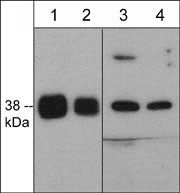
Western Blot: p38 alpha Antibody [NBP3-23232] -

Western Blot: p38 alpha Antibody [NBP3-23232] - Western blot analysis of p38 MAP kinase in mouse macrophage (J774A.1) cell lysate (lanes 1-4). The blots were probed with mouse monoclonal anti-p38 alpha (C-terminal) at 1:500 (lane 1) and 1:2000 (lane 2) or rabbit polyclonal anti-p38 alpha (a.a. 319-328) at 1:250 (lane 3) and 1:1000 (lane 4).

Applications for p38 alpha Antibody

Application
Recommended Usage

Western Blot

1:1000

Formulation, Preparation, and Storage

Purification

Antigen Affinity-purified

Formulation

PBS, 1 mg/ml BSA and 50% glycerol

Preservative

0.05% Sodium Azide

Concentration

Please see the vial label for concentration. If unlisted please contact technical services.

Shipping

The product is shipped with polar packs. Upon receipt, store it immediately at the temperature recommended below.

Stability & Storage

Store at -20C.

Background: p38 alpha

The p38 Mitogen-activated Protein Kinases (MAPKs) are a family of four related Ser/Thr kinases activated by proinflammatory cytokines and environmental stresses. All four p38 family members, alpha, beta, gamma, and delta, are phosphorylated by MKK3 and/or MKK6 at dual Thr and Tyr positions within the phosphoacceptor sequence Thr-Gly-Tyr. Once activated, p38 phosphorylates a number of targets, including the nuclear transcription factors ATF2 and Max.

The most frequently analyzed family member, p38 alpha, also known as SAPK2a and MAPK14, was initially purified as a kinase critical to the signaling cascade linking IL-1 to MAPKAPK-2 and the small heat shock protein HSP27. Ubiquitously expressed, p38 alpha is dually phosphorylated by MKK3 and MKK6 at Thr180 and Tyr182. Once activated, p38 alpha phosphorylates a number of targets, including the cytoplasmic kinases MNK 4 and PRAK5 and the nuclear transcription factors ATF2 1 and STAT1. Several promising compounds that inhibit p38 alpha are being investigated as potential therapies for arthritic and inflammatory diseases.

Alternate Names

MAPK14, SAPK2a

Gene Symbol

MAPK14

Additional p38 alpha Products

Product Documents for p38 alpha Antibody

Certificate of Analysis

To download a Certificate of Analysis, please enter a lot or batch number in the search box below.

Product Specific Notices for p38 alpha Antibody

This product is for research use only and is not approved for use in humans or in clinical diagnosis. Primary Antibodies are guaranteed for 1 year from date of receipt.

Customer Reviews for p38 alpha Antibody

There are currently no reviews for this product. Be the first to review p38 alpha Antibody and earn rewards!

Have you used p38 alpha Antibody?

Submit a review and receive an Amazon gift card!

$25/€18/£15/$25CAN/¥2500 Yen for a review with an image

$10/€7/£6/$10CAN/¥1110 Yen for a review without an image

Submit a review
Amazon Gift Card

FAQs

No product specific FAQs exist for this product.

View all FAQs for Antibodies