

![Immunocytochemistry/ Immunofluorescence: PMCA4 Antibody (JA9) [NB300-569]](https://resources.rndsystems.com/images/products/PMCA4-Antibody-JA9-Immunocytochemistry-Immunofluorescence-NB300-569-img0005.jpg "Immunocytochemistry/ Immunofluorescence: PMCA4 Antibody (JA9) [NB300-569]")
Loading...
Key Product Details
Species Reactivity
Validated:
Human, Mouse, Rat, Porcine, Amphibian, Bovine, Rabbit
Cited:
Human, Mouse
Applications
Validated:
Immunohistochemistry, Immunohistochemistry-Paraffin, Immunohistochemistry-Frozen, Western Blot, ELISA, Flow Cytometry, Immunocytochemistry/ Immunofluorescence, Knockdown Validated
Cited:
Western Blot, Immunocytochemistry/ Immunofluorescence, Immunoprecipitation, Knockdown Validated
Label
Unconjugated
Antibody Source
Monoclonal Mouse IgG1 Clone # JA9
Loading...
Product Specifications
Immunogen
Purified human erythrocyte PMCA.
Reactivity Notes
Mouse reactivity reported in scientific literature (PMID: 23845592). Rabbit reactivity reported in scientific literature (PMID: 21139678). Bovine reactivity reported in scientific literature (PMID: 23715721). Amphibian reactivity reported in scientific literature (PMID: 15236230). Please note that this antibody is reactive to Mouse and derived from the same host, Mouse. Additional Mouse on Mouse blocking steps may be required for IHC and ICC experiments. Please contact Technical Support for more information.
Specificity
This is specific to the PMCA4 isoform.
Clonality
Monoclonal
Host
Mouse
Isotype
IgG1
Scientific Data Images for PMCA4 Antibody (JA9)
Immunocytochemistry/ Immunofluorescence: PMCA4 Antibody (JA9) [NB300-569]
Immunocytochemistry/Immunofluorescence: PMCA4 Antibody (JA9) [NB300-569] - Immunolocalization of (A) PMCA4 (green), (B) CaSRO (red), and (C) Merged image.![Immunohistochemistry-Paraffin: PMCA4 Antibody (JA9) [NB300-569]](https://resources.rndsystems.com/images/products/PMCA4-Antibody-JA9-Immunohistochemistry-Paraffin-NB300-569-img0006.jpg "Immunohistochemistry-Paraffin: PMCA4 Antibody (JA9) [NB300-569]")
Immunohistochemistry-Paraffin: PMCA4 Antibody (JA9) [NB300-569]
Immunohistochemistry-Paraffin: PMCA4 Antibody (JA9) [NB300-569] - Normal biopsies of deparaffinized Human brain tissue.![Immunocytochemistry/ Immunofluorescence: PMCA4 Antibody (JA9) [NB300-569]](https://resources.rndsystems.com/images/products/PMCA4-Antibody-JA9-Immunocytochemistry-Immunofluorescence-NB300-569-img0002.jpg "Immunocytochemistry/ Immunofluorescence: PMCA4 Antibody (JA9) [NB300-569]")
Immunocytochemistry/ Immunofluorescence: PMCA4 Antibody (JA9) [NB300-569]
Immunocytochemistry/Immunofluorescence: PMCA4 Antibody (JA9) [NB300-569] - Figure 1 illustrates immunolocalization of PMCA4 and CaSRO in human corneal epithelium. (A) Immunolocalization of PMCA4 (green) using NB300-569 on cell membranes of all cells in each layer of hCE. (B) Immunolocalization of CaSRO (red)on cell membranes of hCE. (C) Merged image. Figure 2 illustrates immunolocalization of PMCA4 and CaSRO in bovine corneal epithelium (bCE). (A) Immunolocalization of PMCA4 (green) on cell membranes of all cells in each layer of bCE. (B) Immunolocalization of CaSRO (red) on cell membranes of bCE mostly in wing- and squamous cell layers. (C) Merged image.![Immunocytochemistry/ Immunofluorescence: PMCA4 Antibody (JA9) [NB300-569]](https://resources.rndsystems.com/images/products/PMCA4-Antibody-JA9-Immunocytochemistry-Immunofluorescence-NB300-569-img0004.jpg "Immunocytochemistry/ Immunofluorescence: PMCA4 Antibody (JA9) [NB300-569]")
Immunocytochemistry/ Immunofluorescence: PMCA4 Antibody (JA9) [NB300-569]
Immunocytochemistry/Immunofluorescence: PMCA4 Antibody (JA9) [NB300-569] - Immunolocalization of (A) PMCA4 (green), (B) CaSRO (red), and (C) Merged image.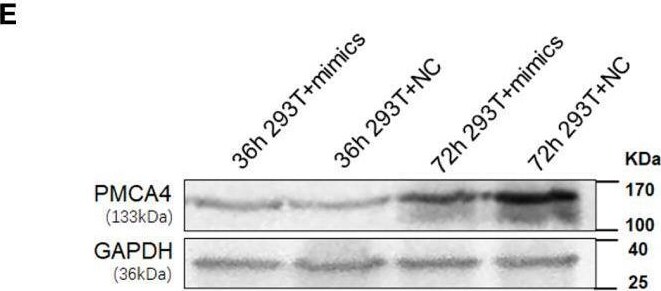
Western Blot: PMCA4 Antibody (JA9) [NB300-569] -
MiR-4261 can target and regulate the ATP2B4 gene and reduce the expression of PMCA4 protein. (A) Schematic diagram of the predicted miR-4261 binding site in the 3’-UTR of ATP2B4 mRNA. (B) Dual-luciferase reporter assay. The 3’-UTR fragments (wild-type and mutant sequences) of ATP2B4 were cloned into the psiCHECK-2 vector and then cotransfected with miR-4261 mimics or NC. Comparison of relative firefly/Renilla luciferase activity between the wild-type (WT) and negative control (NC) groups (PWT+mimics vs. WT+NC = 1.9E-4, and PWT+mimics vs. MUT+mimics = 1.4E-3). (C) The content of miR-4261 in HEK293T cells 36, 48, and 72 hours after transfection of miR-4261 mimics (P = 2.7E-2) and the endogenous content of miR-4261 in H929 cells and RPMI8226 cells. (D) The mRNA level of ATP2B4 was reduced by miR-4261, and the relative expression decreased most significantly at 72 hours after transfection (GAPDH was used as an internal control) (P = 3.6E-2). (E, F) MiR-4261 reduced the protein level of ATP2B4 (GAPDH was used as an internal control) (P = 4.7E-2). (Error bars represent the mean +/- SEM, *P < 0.05). Image collected and cropped by CiteAb from the following open publication (https://pubmed.ncbi.nlm.nih.gov/36091107), licensed under a CC-BY license. Not internally tested by Novus Biologicals.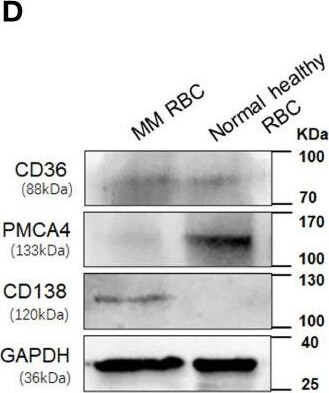
Western Blot: PMCA4 Antibody (JA9) [NB300-569] -
Reduced expression of PMCA4 in RBCs of MM. (A, B) Indirect cellular immunofluorescence labeling of the surface of RBCs with PMCA4 (blue), RBC membrane with Did labeling (red), PMCA4 expression in MM RBCs is significantly reduced (P = 5.1E-03). The white arrow indicates the stacking of RBCs (rouleaux formation) in MM (magnification, 60×). (C) Relative mRNA expression of ATPase plasma membrane Ca2+ transport 4 (ATP2B4) in nucleated RBCs of MM bone marrow is significantly lower than that in the normal control group (GAPDH was used as an internal control) (P = 5.1E-03). (D, E) The expression of PMCA4 in MM RBCs was significantly reduced (P = 5.1E-03), and CD138 was expressed. (F) After the antibody-labeled RBCs reacted with the substrate BCIP/NBT, the dark blue NBT-formazan deposits in the erythrocyte membrane of MM reacting with PMCA4 protein content were significantly lower than those of the normal control group. (Error bars represent the mean +/- SEM, *P < 0.05). Image collected and cropped by CiteAb from the following open publication (https://pubmed.ncbi.nlm.nih.gov/36091107), licensed under a CC-BY license. Not internally tested by Novus Biologicals.Applications for PMCA4 Antibody (JA9)
Application
Recommended Usage
ELISA
1:15000
Flow Cytometry
2 ug / 10^6 cells
Immunocytochemistry/ Immunofluorescence
1:10 - 1:500
Immunohistochemistry
1:100 - 1:500
Immunohistochemistry-Frozen
1:100 - 1:500
Immunohistochemistry-Paraffin
1:100 - 1:500
Western Blot
1:1000
Application Notes
WB: Detects an approx. 133 and 129 kDA protein representing PMCA4a and PMCA4b ATPase respectively. May be useful in Flow.
Reviewed Applications
Read 1 review rated 4 using NB300-569 in the following applications:
Flow Cytometry Panel Builder
Bio-Techne Knows Flow Cytometry
Save time and reduce costly mistakes by quickly finding compatible reagents using the Panel Builder Tool.
Advanced Features
- Spectra Viewer - Custom analysis of spectra from multiple fluorochromes
- Spillover Popups - Visualize the spectra of individual fluorochromes
- Antigen Density Selector - Match fluorochrome brightness with antigen density

Formulation, Preparation, and Storage
Purification
Immunogen affinity purified
Formulation
PBS with 1 mg/ml BSA
Preservative
0.05% Sodium Azide
Concentration
1 mg/ml
Shipping
The product is shipped with polar packs. Upon receipt, store it immediately at the temperature recommended below.
Stability & Storage
Store at -20C. Avoid freeze-thaw cycles.
Background: PMCA4
Alternate Names
ATP2B2plasma membrane calcium ATPase, ATPase, Ca++ transporting, plasma membrane 4, DKFZp686G08106, DKFZp686M088, EC 3.6.3, EC 3.6.3.8, Matrix-remodeling-associated protein 1, matrix-remodelling associated 1, MXRA1, Plasma membrane calcium ATPase isoform 4, plasma membrane calcium pump, Plasma membrane calcium pump isoform 4, plasma membrane calcium-transporting ATPase 4, PMCA4b, PMCA4PMCA4x, sarcolemmal calcium pump
Gene Symbol
ATP2B4
UniProt
Additional PMCA4 Products
Product Documents for PMCA4 Antibody (JA9)
Certificate of Analysis
To download a Certificate of Analysis, please enter a lot or batch number in the search box below.
Product Specific Notices for PMCA4 Antibody (JA9)
This product is for research use only and is not approved for use in humans or in clinical diagnosis. Primary Antibodies are guaranteed for 1 year from date of receipt.
Citations for PMCA4 Antibody (JA9)
 Powered by Bioz
Customer Reviews for PMCA4 Antibody (JA9) (1)
4 out of 5
1 Customer Rating
Have you used PMCA4 Antibody (JA9)?
Submit a review and receive an Amazon gift card!
$25/€18/£15/$25CAN/¥2500 for a review with an image
$10/€7/£6/$10CAN/¥1110 for a review without an image
Submit a review
Showing
1
-
1 of
1 review
Showing All
Filter By:
-
Application: Western BlotSample Tested: HumanSpecies: HumanVerified Customer | Posted 11/23/2011
There are no reviews that match your criteria.
Protocols
Find general support by application which include: protocols, troubleshooting, illustrated assays, videos and webinars.
- 7-Amino Actinomycin D (7-AAD) Cell Viability Flow Cytometry Protocol
- Antigen Retrieval Protocol (PIER)
- Antigen Retrieval for Frozen Sections Protocol
- Appropriate Fixation of IHC/ICC Samples
- Cellular Response to Hypoxia Protocols
- Chromogenic IHC Staining of Formalin-Fixed Paraffin-Embedded (FFPE) Tissue Protocol
- Chromogenic Immunohistochemistry Staining of Frozen Tissue
- ClariTSA™ Fluorophore Kits
- Detection & Visualization of Antibody Binding
- ELISA Sample Preparation & Collection Guide
- ELISA Troubleshooting Guide
- Extracellular Membrane Flow Cytometry Protocol
- Flow Cytometry Protocol for Cell Surface Markers
- Flow Cytometry Protocol for Staining Membrane Associated Proteins
- Flow Cytometry Staining Protocols
- Flow Cytometry Troubleshooting Guide
- Fluorescent IHC Staining of Frozen Tissue Protocol
- Graphic Protocol for Heat-induced Epitope Retrieval
- Graphic Protocol for the Preparation and Fluorescent IHC Staining of Frozen Tissue Sections
- Graphic Protocol for the Preparation and Fluorescent IHC Staining of Paraffin-embedded Tissue Sections
- Graphic Protocol for the Preparation of Gelatin-coated Slides for Histological Tissue Sections
- How to Run an R&D Systems DuoSet ELISA
- How to Run an R&D Systems Quantikine ELISA
- How to Run an R&D Systems Quantikine™ QuicKit™ ELISA
- ICC Cell Smear Protocol for Suspension Cells
- ICC Immunocytochemistry Protocol Videos
- ICC for Adherent Cells
- IHC Sample Preparation (Frozen sections vs Paraffin)
- Immunocytochemistry (ICC) Protocol
- Immunocytochemistry Troubleshooting
- Immunofluorescence of Organoids Embedded in Cultrex Basement Membrane Extract
- Immunofluorescent IHC Staining of Formalin-Fixed Paraffin-Embedded (FFPE) Tissue Protocol
- Immunohistochemistry (IHC) and Immunocytochemistry (ICC) Protocols
- Immunohistochemistry Frozen Troubleshooting
- Immunohistochemistry Paraffin Troubleshooting
- Intracellular Flow Cytometry Protocol Using Alcohol (Methanol)
- Intracellular Flow Cytometry Protocol Using Detergents
- Intracellular Nuclear Staining Flow Cytometry Protocol Using Detergents
- Intracellular Staining Flow Cytometry Protocol Using Alcohol Permeabilization
- Intracellular Staining Flow Cytometry Protocol Using Detergents to Permeabilize Cells
- Preparing Samples for IHC/ICC Experiments
- Preventing Non-Specific Staining (Non-Specific Binding)
- Primary Antibody Selection & Optimization
- Propidium Iodide Cell Viability Flow Cytometry Protocol
- Protocol for Heat-Induced Epitope Retrieval (HIER)
- Protocol for Liperfluo
- Protocol for Making a 4% Formaldehyde Solution in PBS
- Protocol for VisUCyte™ HRP Polymer Detection Reagent
- Protocol for the Characterization of Human Th22 Cells
- Protocol for the Characterization of Human Th9 Cells
- Protocol for the Fluorescent ICC Staining of Cell Smears - Graphic
- Protocol for the Fluorescent ICC Staining of Cultured Cells on Coverslips - Graphic
- Protocol for the Preparation & Fixation of Cells on Coverslips
- Protocol for the Preparation and Chromogenic IHC Staining of Frozen Tissue Sections
- Protocol for the Preparation and Chromogenic IHC Staining of Frozen Tissue Sections - Graphic
- Protocol for the Preparation and Chromogenic IHC Staining of Paraffin-embedded Tissue Sections
- Protocol for the Preparation and Chromogenic IHC Staining of Paraffin-embedded Tissue Sections - Graphic
- Protocol for the Preparation and Fluorescent ICC Staining of Cells on Coverslips
- Protocol for the Preparation and Fluorescent ICC Staining of Non-adherent Cells
- Protocol for the Preparation and Fluorescent ICC Staining of Stem Cells on Coverslips
- Protocol for the Preparation and Fluorescent IHC Staining of Frozen Tissue Sections
- Protocol for the Preparation and Fluorescent IHC Staining of Paraffin-embedded Tissue Sections
- Protocol for the Preparation of Gelatin-coated Slides for Histological Tissue Sections
- Protocol for the Preparation of a Cell Smear for Non-adherent Cell ICC - Graphic
- Protocol: Annexin V and PI Staining by Flow Cytometry
- Protocol: Annexin V and PI Staining for Apoptosis by Flow Cytometry
- Quantikine HS ELISA Kit Assay Principle, Alkaline Phosphatase
- Quantikine HS ELISA Kit Principle, Streptavidin-HRP Polymer
- R&D Systems Quality Control Western Blot Protocol
- Sandwich ELISA (Colorimetric) – Biotin/Streptavidin Detection Protocol
- Sandwich ELISA (Colorimetric) – Direct Detection Protocol
- TUNEL and Active Caspase-3 Detection by IHC/ICC Protocol
- The Importance of IHC/ICC Controls
- Troubleshooting Guide: ELISA
- Troubleshooting Guide: Fluorokine Flow Cytometry Kits
- Troubleshooting Guide: Immunohistochemistry
- Troubleshooting Guide: Western Blot Figures
- Western Blot Conditions
- Western Blot Protocol
- Western Blot Protocol for Cell Lysates
- Western Blot Troubleshooting
- Western Blot Troubleshooting Guide
- View all Protocols, Troubleshooting, Illustrated assays and Webinars
Loading...