
Recombinant Human Active Heparanase/HPSE Protein, CF
R&D Systems | Catalog # 7570-GH

Key Product Details
- R&D Systems CHO-derived Recombinant Human Active Heparanase/HPSE Protein (7570-GH)
- Quality control testing to verify active proteins with lot specific assays by in-house scientists
- All R&D Systems proteins are covered with a 100% guarantee
Source
Accession Number
Applications
Product Specifications
Source
Gln36-Ile543 with N-terminal 6-His tag
The linker peptide from Ser110-Gln157 is removed by protease treatment
Purity
Endotoxin Level
N-terminal Sequence Analysis
Predicted Molecular Mass
SDS-PAGE
Activity
20 ng of Recombinant Human Active Heparanase/HPSE digestion will result in >50% of OD reduction compared with the Negative Control, as measured under the described conditions.
Scientific Data Images for Recombinant Human Active Heparanase/HPSE Protein, CF
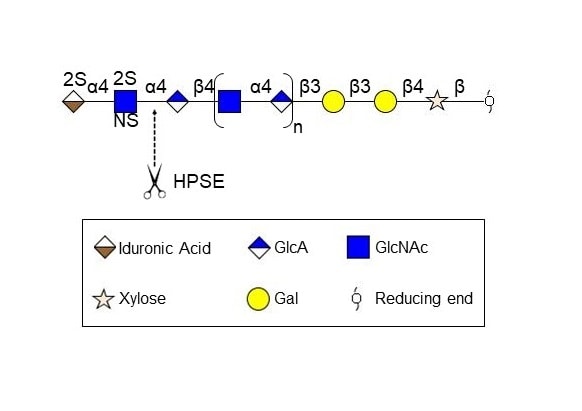
Recombinant Human Active Heparanse/HPSE Protein Enzyme Activity Diagram.
Recombinant Human Active Heparanse/HPSE Protein, CF (Catalog # 7570-GH) selectively cleaves the linkage between a GlcA and an N-sulfo GlcNAc (NS) carrying either a 3-O-sulfo or a 6-O-sulfo group. Can also cleave the linkage between a GlcA and an N-sulfo GlcNAc carrying a 2-O-sulfo group (2S), but not linkages between a GlcA unit and a 2-O-sulfated iduronic acid moiety as depicted in the diagram.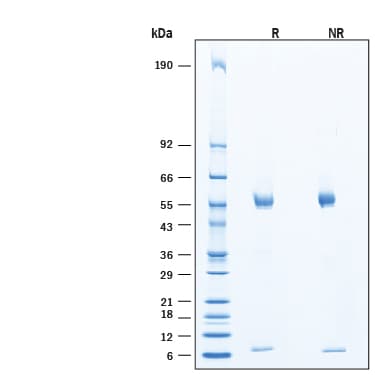
Recombinant Human Active Heparanase/HPSE Protein SDS-PAGE.
2 μg/lane of Recombinant Human Active Heparanase/HPSE Protein (Catalog # 7570-GH) was resolved with SDS-PAGE under reducing (R) and non-reducing (NR) conditions and visualized by Coomassie® Blue staining, showing bands at 50-60 kDa & 7-9 kDa under reducing conditions.Formulation, Preparation, and Storage
7570-GH
| Formulation | Supplied as a 0.2 μm filtered solution in Tris, NaCl and E64. |
| Shipping | The product is shipped with polar packs. Upon receipt, store it immediately at the temperature recommended below. |
| Stability & Storage | Use a manual defrost freezer and avoid repeated freeze-thaw cycles.
|
Background: Heparanase/HPSE
References
- Vlodavsky, I. et al. (1999) Nat. Med. 5:793.
- Hulett, M.D. et al. (1999) Nat. Med. 5:803.
- Gong, F. et al. (2003) J. Biol. Chem. 278:35152.
- Peterson, S.B. and Liu, J. (2010) J. Biol. Chem. 285:14504.
- Nadav L. et al. (2002) J. Cell Sci. 115:2179.
- Gingis-Velitski, S. et al. (2004) J. Biol. Chem. 279:44084.
- Abboud-Jarrous, G. et al. (2008) J. Biol. Chem. 283:18167.
- Zetser, A. et al. (2004) J. Cell Sci. 117:2249.
- Zcharia E. et al. (2001) J. Mammary Gland Biol. Neoplasia 6:311.
- Fux, L. et al. (2009) Trends Biochem. Sci. 34:511.
- Cohen-Kaplan, V. et al. (2008) Int. J. Cancer 123:2566.
- Purushothaman, A. et al. (2010) Blood 115:2449.
- Nadir, Y. et al. (2010) Haematologica 95:1927.
- Goldshmidt, O. et al. (2003) FASEB J. 17:1015.
- Kussie, P.H. et al. (1999) Biochem. Biophys. Res. Commun. 261:183.
- Wu, Z.L. et al. (2017) Glycobiology 27:518.
Alternate Names
Gene Symbol
UniProt
Additional Heparanase/HPSE Products
Product Documents for Recombinant Human Active Heparanase/HPSE Protein, CF
Certificate of Analysis
To download a Certificate of Analysis, please enter a lot or batch number in the search box below.
Note: Certificate of Analysis not available for kit components.
Product Specific Notices for Recombinant Human Active Heparanase/HPSE Protein, CF
For research use only
Related Research Areas
Citations for Recombinant Human Active Heparanase/HPSE Protein, CF
 Powered by Bioz
Customer Reviews for Recombinant Human Active Heparanase/HPSE Protein, CF
There are currently no reviews for this product. Be the first to review Recombinant Human Active Heparanase/HPSE Protein, CF and earn rewards!
Have you used Recombinant Human Active Heparanase/HPSE Protein, CF?
Submit a review and receive an Amazon gift card!
$25/€18/£15/$25CAN/¥2500 for a review with an image
$10/€7/£6/$10CAN/¥1110 for a review without an image
Submit a review
Protocols
View specific protocols for Recombinant Human Active Heparanase/HPSE Protein, CF (7570-GH):
- Assay Buffer: 50 mM Sodium Acetate, pH 5.0
- Recombinant Human HPSE (rhHPSE) (7570-GH)
- HPSE Substrate (Catalog # ES020)
- Human Syndecan-4 DuoSet Kit (Catalog # DY2918)
- 96-well Clear Plate (Catalog # DY990)
- Plate Reader (Model: SpectraMax Plus by Molecular Devices) or equivalent
And the following materials that are routinely used in ELISA:
- Coating Buffer (Catalog # DY006)
- Wash Buffer (25X) (Catalog # WA126)
- Reagent Diluent (10X) (Catalog # DY995)
- Substrate Reagent Pack (Catalog # DY999)
- Stop Solution (Catalog # DY994)
- Prepare an ELISA plate by following the DuoSet kit protocol.
- Dilution factor determination:
a. Dilute the HPSE Substrate stock 100-fold in Reagent Diluent (this will be the first dilution point).
b. Further prepare a 2-fold serial dilution series of the above diluted HPSE Substrate with Reagent Diluent for 6 points.
c. Load 100 µL of each point onto the prepared ELISA plate in duplicate. Load 100 µL of Reagent Diluent to 2 separate wells for blank control.
d. Cover the plate and incubate at room temperature for 2 hours.
e. Follow the DuoSet Assay Procedure from step 4 to step 9 to complete the assay.
f. Determine the dilution factor (n) that achieves an OD between 1.8-3.0. - rhHPSE Activity Detection:
a. Dilute the HPSE Substrate stock by n/10-fold in Assay Buffer, diute rhHPSE to 2 μg/mL in assay buffer.
b. Combine 10 µL of rhHPSE with 10 µL of the diluted HPSE Substrate in a vial. For negative control, combine 10 µL of Assay Buffer and 10 µL of the diluted HPSE Substrate in a vial.
c. Incubate reactions and negative control at 37 °C for 2 hours.
d. After incubation, heat all reactions and negative control at 95 °C for 2 minutes to inactivate rhHPSE.
e. Add 220 µL of Reagent Diluent to each reaction and negative control. Mix well.
f. Load 100 µL of each sample onto the prepared ELISA plate in duplicate.
g. Cover the plate and incubate for 2 hours at room temperature.
h. Follow the DuoSet Assay Procedure form step 4 to step 9 to complete the assay. - Calculate % OD reduction compared with the negative control:
[1-(OD of rhHPSE sample/OD of negative control)] x 100 = % OD reduction
Per Reaction:
rhHPSE: 20 ng
FAQs for Recombinant Human Active Heparanase/HPSE Protein, CF
-
Q: What is the best practice for storage of 7570-GH at -20 oC to -70 oC?
A: 7570-GH should be stored at -20 oC to -70 oC undiluted in the vial received or undiluted as 5 µL aliquots. 7570-GH could also be diluted 5-fold in the formulation buffer (specified on the Certificate of Analysis) and stored diluted as 5 µL or larger aliquots at -20 oC to -70 oC.
Associated Pathways
