Recombinant Human CD19 Protein, Atto 488 Conjugate
R&D Systems | Catalog # ATJ9269
Fc Chimera

Loading...
Key Product Details
- Recombinant Human CD19 Protein supports development of CD19-targeted therapeutics, including CAR-T cell therapies, bispecific T cell engagers, and monoclonal antibodies. This biologically active protein enables antigen validation, binding affinity characterization, and functional assay development for B‑cell malignancy drug discovery workflows.
- R&D Systems CHO-derived Recombinant Human CD19 Protein, Atto 488 Conjugate (ATJ9269)
- Quality control testing to verify active proteins with lot specific assays by in-house scientists
- All R&D Systems proteins are covered with a 100% guarantee
Source
CHO
Accession Number
Structure / Form
Disulfide-linked homodimer, labeled with Atto 488 via amines
Excitation Wavelength: 501 nm
Emission Wavelength: 523 nm
Excitation Wavelength: 501 nm
Emission Wavelength: 523 nm
Conjugate
ATTO 488 (Excitation= 501 nm, Emission= 523 nm)
Applications
Bioactivity
Loading...
Learn more about FluorokinesTM Fluorescent-Labeled Proteins
Product Specifications
Source
Chinese Hamster Ovary cell line, CHO-derived human CD19 protein
| Human CD19 (Glu21-Lys291) Accession # P15391 |
IEGRMD | Human IgG1 (Pro100-Lys330) |
| N-terminus | C-terminus |
Purity
>90%, by SDS-PAGE visualized with Silver Staining and quantitative densitometry by Coomassie® Blue Staining.
Endotoxin Level
<1.0 EU per 1 μg of the protein by the LAL method.
N-terminal Sequence Analysis
Glu21
Predicted Molecular Mass
57 kDa
SDS-PAGE
77-92 kDa, under reducing conditions
Activity
Measured by flow cytometry for its ability to bind
anti-Human CD19 Monoclonal Antibody conjugated fluorescent beads.
Scientific Data Images for Recombinant Human CD19 Protein, Atto 488 Conjugate
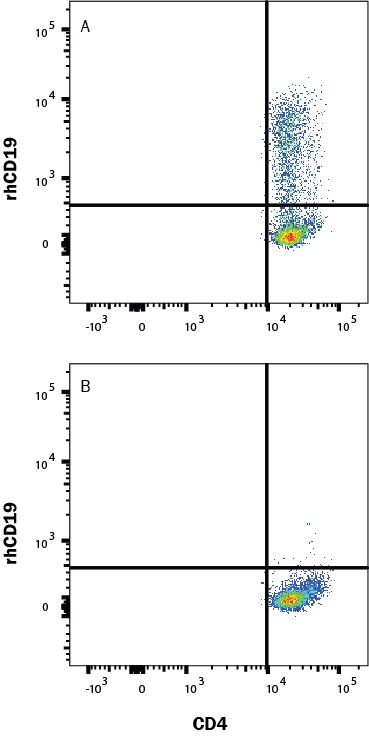
Detection of CD19 construct on human CART cells
Human PBMC CD4+ and CD8+ T cells were either (A) transduced or (B) not transduced (negative control) with a Human CD19 CAR and then cultured for 11 days. Cells were washed twice with 2mL 1x PBS then stained with a viability dye for 15-30 min at room temp in the dark. Human block (1-001-A) was added during the viability stain to block Fc receptors. Cells were washed twice with Flow Cytometry Staining Buffer (FC001) then stained with Human CD4 PE-Cy7-conjugated Antibody and rhCD19 Atto 488-conjugated protein (ATJ9269) for 25 min at room temp in the dark. Staining was performed using our staining membrane proteins protocol.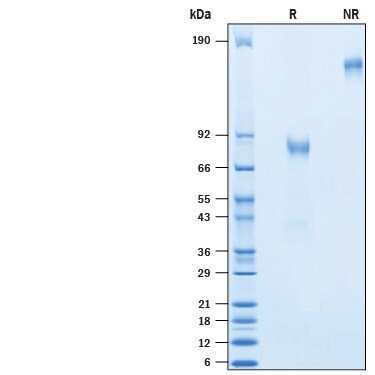
Recombinant Human CD19 Protein, Atto 488 Conjugate SDS-PAGE.
2 μg/lane of Recombinant Human CD19 Fc Chimera Atto 488 (ATJ9269) was resolved with SDS-PAGE under reducing (R) and non-reducing (NR) conditions and visualized by Coomassie® Blue staining, showing bands at 77-92 kD and 154-184 kDa, respectively.Formulation, Preparation, and Storage
ATJ9269
| Formulation | Supplied as a 0.2 μm filtered solution in PBS with BSA as a carrier protein. |
| Shipping | The product is shipped with dry ice or equivalent. Upon receipt, store it immediately at the temperature recommended below. |
| Stability & Storage | Protect from light. Use a manual defrost freezer and avoid repeated freeze-thaw cycles.
|
Background: CD19
References
- Wang, K. et al. (2012) Exp. Hematol. Oncol. 1:36.
- Tedder, T.F. et al. (1997) Immunity 6:107.
- Tedder, T.F. and C.M. Isaacs (1989) J. Immunol. 143:712.
- Rickert, R.C. et al. (1995) Nature 376:352.
- Engel, P. et al. (1995) Immunity 3:39.
- Vences-Catalan, F. et al. (2012) J. Immunol. 137:48.
- Deaglio, S. et al. (2007) Blood 109:5390.
- Bradbury, L. et al. (1992) J. Immunol. 149:2841.
- Krop, I. et al. (1996) J. Immunol. 157:48.
- O'Rourke, L.M. et al. (1998) Immunity 8:635.
- Buhl, A.M. et al. (1997) J. Exp. Med. 186:1897.
- Sato, S. et al. (1995) Proc. Natl. Acad. Sci. USA 92:11558.
- Carter, R.H. and D.T. Fearon (1992) Science 256:105.
Alternate Names
CD19, CVID3, Leu-12
Entrez Gene IDs
Gene Symbol
CD19
UniProt
Additional CD19 Products
Product Documents for Recombinant Human CD19 Protein, Atto 488 Conjugate
Certificate of Analysis
To download a Certificate of Analysis, please enter a lot or batch number in the search box below.
Note: Certificate of Analysis not available for kit components.
Product Specific Notices for Recombinant Human CD19 Protein, Atto 488 Conjugate
For research use only
Related Research Areas
Customer Reviews for Recombinant Human CD19 Protein, Atto 488 Conjugate
There are currently no reviews for this product. Be the first to review Recombinant Human CD19 Protein, Atto 488 Conjugate and earn rewards!
Have you used Recombinant Human CD19 Protein, Atto 488 Conjugate?
Submit a review and receive an Amazon gift card!
$25/€18/£15/$25CAN/¥2500 for a review with an image
$10/€7/£6/$10CAN/¥1110 for a review without an image
Submit a review