
FGF-9 (fibroblast growth factor-9), also called HBGF-9 (heparin-binding growth factor-9) and GAF (glia-activating factor), is an approximately 26 kDa secreted glycoprotein of the FGF family (1-3). FGFs exhibit heparin-dependent regulation of cell proliferation, differentiation, and function, and are characterized by a core heparin-binding FGF domain of approximately 120 amino acids (aa) that exhibits a beta -trefoil structure (1). FGF-9, -16 and -20 form a subfamily that shares 65-71% aa sequence identity, binds FGF R3 (IIIb), and are efficiently secreted despite having an uncleavable, bipartite signal sequence (1-3). Secreted human FGF-9 is a
205-207 aa protein that lacks the N-terminal 1-3 aa and shares 98% sequence identity with mouse, rat, equine, porcine and bovine FGF-9. In addition to FGF R3 (IIIb), FGF-9 binding to the IIIc splice forms of FGF R1, R2 and R3 are variably reported (3-5). An unusual constitutive dimerization of FGF-9 buries receptor interaction sites which lowers its activity, and increases heparin affinity which inhibits diffusion (4-6). A spontaneous mouse mutant, Eks, interferes with dimerization, resulting monomeric, diffusible FGF-9 that causes elbow and knee synostoses (joint fusions) due to FGF-9 misexpression in developing joints (6). In humans, FGF-9 mutations that lower receptor binding cause multiple synostoses syndrome (SYNS) (7). Expression in brain and kidney are reported in the adult rat (2, 8). In the mouse embryo the location and timing of FGF-9 expression affects development of the skeleton, cerebellum, lungs, heart, vasculature, digestive tract, and testes (1, 6-11). Deletion of mouse FGF-9 is lethal at birth due to lung hypoplasia, and causes rhizomelia, or shortening of the proximal skeleton (1, 10, 11). Altered FGF-9 expression or function is reported in human colon, endometrial, and ovarian cancers, correlating with progression, invasiveness, and survival (12-15).
Recombinant Human FGF-9 Protein
R&D Systems | Catalog # 273-F9

Key Product Details
- R&D Systems Sf 21 (baculovirus)-derived Recombinant Human FGF-9 Protein (273-F9)
- Quality control testing to verify active proteins with lot specific assays by in-house scientists
- All R&D Systems proteins are covered with a 100% guarantee
Source
Accession Number
Applications
Product Specifications
Source
Met1-Ser208 & Ala2-Ser208
Purity
Endotoxin Level
N-terminal Sequence Analysis
Predicted Molecular Mass
SDS-PAGE
Activity
The ED50 for this effect is 1-5 ng/mL.
Scientific Data Images for Recombinant Human FGF-9 Protein
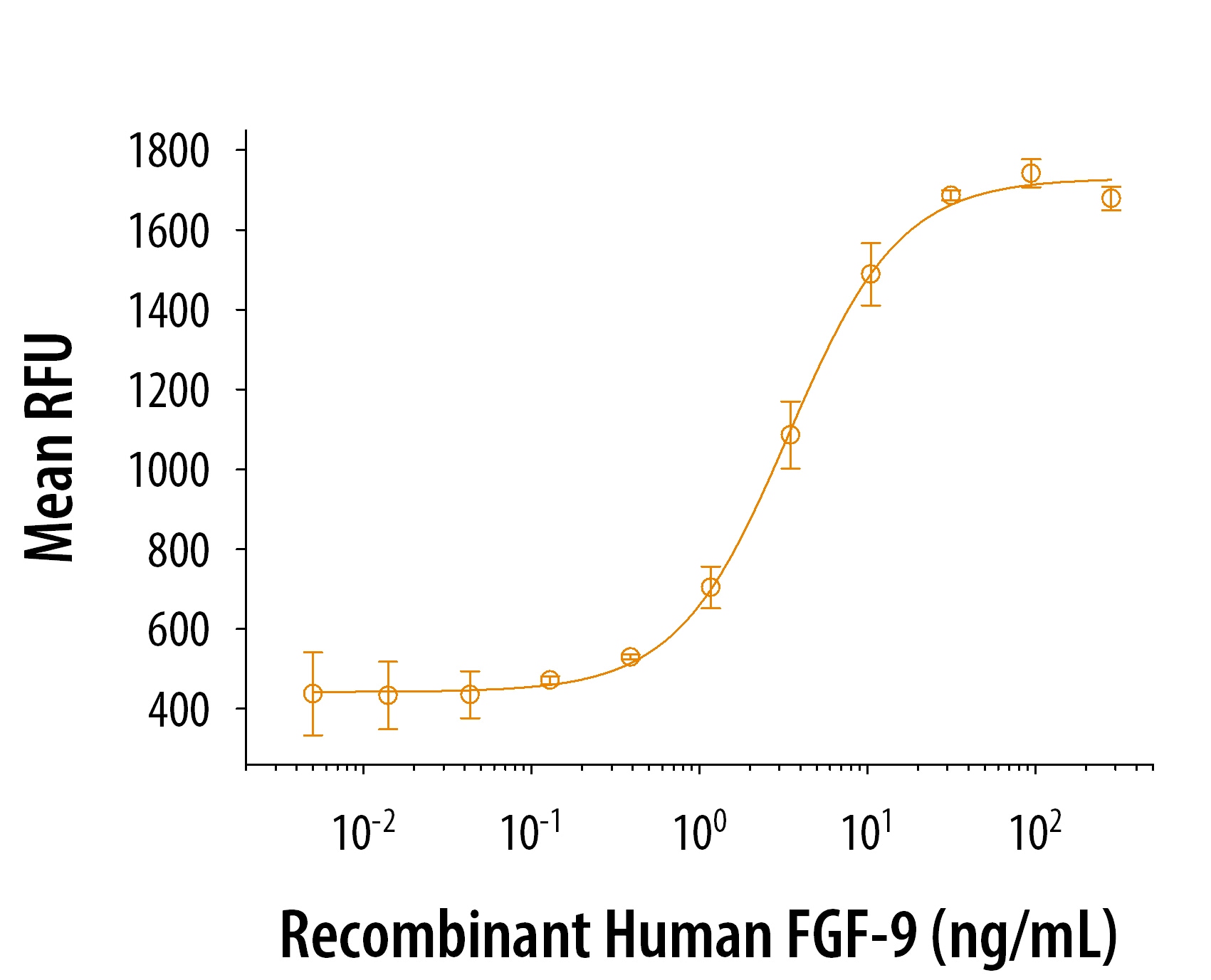
Bioactivity of Human FGF-9
Recombinant human FGF-9 (273-F9) induces proliferation in the Balb/3T3 mouse embryonic fibroblast cell line. The ED50 for this effect is 1-5 ng/mL.Formulation, Preparation, and Storage
Carrier Free
What does CF mean?CF stands for Carrier Free (CF). We typically add Bovine Serum Albumin (BSA) as a carrier protein to our recombinant proteins. Adding a carrier protein enhances protein stability, increases shelf-life, and allows the recombinant protein to be stored at a more dilute concentration. The carrier free version does not contain BSA.
What formulation is right for me?In general, we advise purchasing the recombinant protein with BSA for use in cell or tissue culture, or as an ELISA standard. In contrast, the carrier free protein is recommended for applications, in which the presence of BSA could interfere.
Carrier: 273-F9
| Formulation | Lyophilized from a 0.2 μm filtered solution in MOPS, Na2SO4 and EDTA with BSA as a carrier protein. |
| Reconstitution | Reconstitute at 100 μg/mL in sterile PBS containing at least 0.1% human or bovine serum albumin. |
| Shipping | The product is shipped at ambient temperature. Upon receipt, store it immediately at the temperature recommended below. |
| Stability & Storage | Use a manual defrost freezer and avoid repeated freeze-thaw cycles.
|
Carrier Free: 273-F9/CF
| Formulation | Lyophilized from a 0.2 μm filtered solution in MOPS, Na2SO4 and EDTA. |
| Reconstitution | Reconstitute at 100 μg/mL in sterile PBS. |
| Shipping | The product is shipped at ambient temperature. Upon receipt, store it immediately at the temperature recommended below. |
| Stability & Storage | Use a manual defrost freezer and avoid repeated freeze-thaw cycles.
|
Calculators
Background: FGF-9
References
- Itoh, N. and D.M. Ornitz (2008) Dev. Dyn. 237:18.
- Miyamoto, M. et al. (1993) Mol. Cell. Biol. 13:4251.
- Santos-Ocampo, S. et al. (1996) J. Biol. Chem. 271:1726.
- Mohammadi, M. et al. (2005) Cytokine Growth Factor Rev. 16:107.
- Plotnikov, A.N. et al. (2001) J. Biol. Chem. 276:4322.
- Harada, M. et al. (2009) Nat. Genet. 41:289.
- Wu, X.L. et al. (2009) Am. J. Hum. Genet. 85:53.
- Colvin, J.S. et al. (1999) Dev. Dyn. 216:72.
- Lin, Y. et al. (2009) Dev. Biol. 329:44.
- Hung, I.H. et al. (2007) Dev. Biol. 307:300.
- Colvin, J.S. et al. (2001) Dev. Dyn 128:2095.
- Krejci, P. et al. (2009) Hum. Mutat. 30:1245.
- Leushacke, M. et al. (2011) PLoS ONE 6:e23381.
- Hendrix, N.D. et al. (2006) Cancer Res. 66:1354.
- Abdel-Rahman, W.M. et al. (2008) Hum. Mutat. 29:390.
Long Name
Alternate Names
Gene Symbol
UniProt
Additional FGF-9 Products
Product Documents for Recombinant Human FGF-9 Protein
Certificate of Analysis
To download a Certificate of Analysis, please enter a lot or batch number in the search box below.
Note: Certificate of Analysis not available for kit components.
Product Specific Notices for Recombinant Human FGF-9 Protein
For research use only
Related Research Areas
Citations for Recombinant Human FGF-9 Protein
 Powered by Bioz
Customer Reviews for Recombinant Human FGF-9 Protein
There are currently no reviews for this product. Be the first to review Recombinant Human FGF-9 Protein and earn rewards!
Have you used Recombinant Human FGF-9 Protein?
Submit a review and receive an Amazon gift card!
$25/€18/£15/$25CAN/¥2500 for a review with an image
$10/€7/£6/$10CAN/¥1110 for a review without an image
Submit a review