Product Specifications
Source
E. coli-derived human IL-15 protein
Asn49-Ser162
Produced using non-animal reagents in an animal-free laboratory.
Manufactured and tested under cGMP guidelines.
Purity
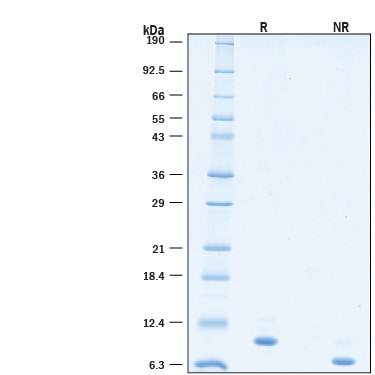
>97%, by SDS-PAGE with quantitative densitometry by Coomassie® Blue Staining. The dominant mass peak by mass spectrometry is 12761
Da ± 5 Da.
Endotoxin Level
<0.10 EU per 1 μg of the protein by the LAL method.
N-terminal Sequence Analysis
Asn49-Trp-Val-Asn-Val-Ile-Ser-Asp-Leu-Lys
Predicted Molecular Mass
13 kDa
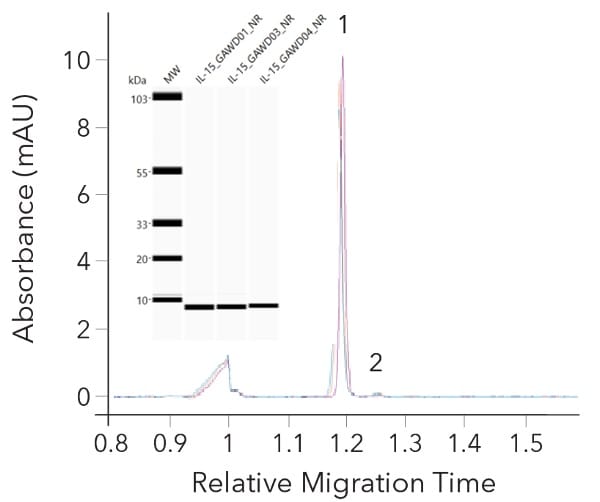
SDS-PAGE
9 kDa, under reducing conditions
Activity
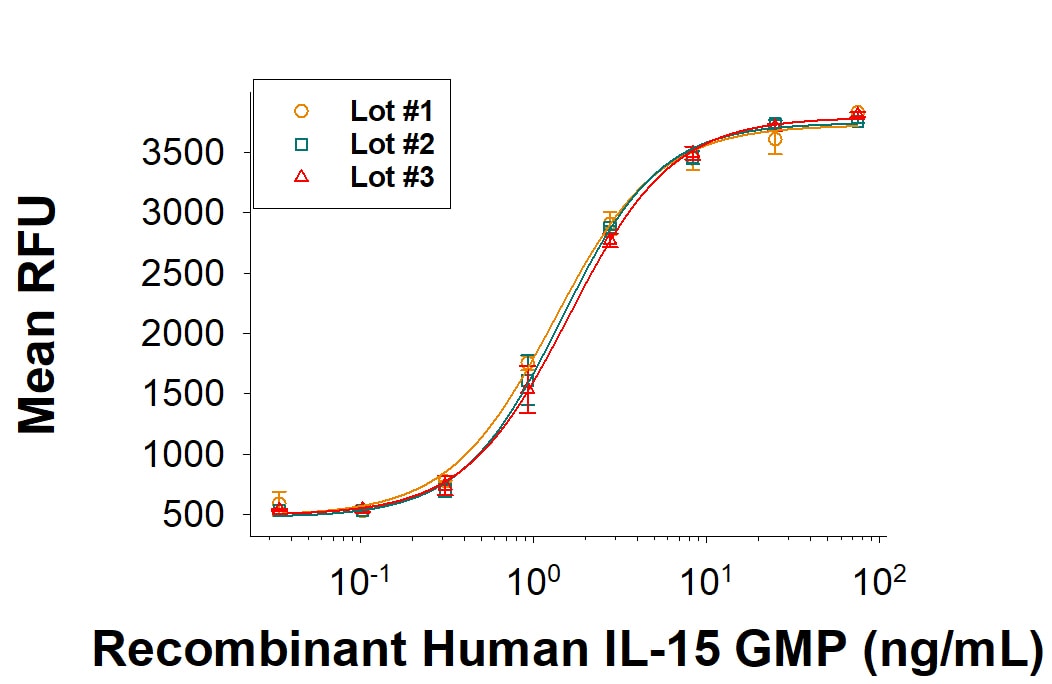
Measured in a cell proliferation assay using MO7e human megakaryocytic leukemic cells.
The ED50 for this effect is 0.300-2.60 ng/mL. The specific activity of recombinant human IL-15 is >2.00 x 10⁸ units/mg, which is calibrated against the human IL-15 reference standard (NIBSC code: 95/554).
Host Cell Protein
<1.00 ng per μg of protein when tested by ELISA.
Mycoplasma
Negative for Mycoplasma.
Host Cell DNA
<0.0100 ng per µg of protein when tested by PCR.
Background: IL-15
Interleukin 15 (IL-15) is a widely expressed 14 kDa cytokine that is structurally and functionally related to IL-2 and plays an important role in many immunological diseases (1, 2). Mature human IL-15 shares 70% amino acid sequence identity with mouse and rat IL-15. Alternative splicing generates isoforms of IL-15 with either a long or short signal peptide (LSP or SSP), and the SSP isoform is retained intracellularly (3). IL-15 binds with high affinity to IL-15 R alpha (4). It binds with lower affinity to a complex of IL-2 R beta and the common gamma chain ( gamma c) which are also subunits of the IL-2 receptor complex (5). IL-15 associates with IL-15 R alpha in the endoplasmic reticulum, and this complex is expressed on the cell surface (6).
The dominant mechanism of IL-15 action is known as transpresentation in which IL-15 and IL-15 R alpha are coordinately expressed on the surface of one cell and interact with complexes of IL-2 R beta / gamma c on adjacent cells (7). This enables cells to respond to IL-15 even if they do not express IL-15 R alpha (6). In human and mouse, soluble IL-15-binding forms of IL-15 R alpha can be generated by proteolytic shedding and bind up nearly all the IL-15 in circulation (8-10). Soluble IL-15 R alpha functions as an inhibitor that limits IL-15 action (4, 9). Ligation of membrane-associated IL-15/IL-15 R alpha complexes also induces reverse signaling that promotes activation of the IL-15/IL-15 R alpha expressing cells (11). IL-15 induces or enhances the differentiation, maintenance, or activation of multiple T cell subsets including NK, NKT, Th17, Treg, and CD8+ memory cells (12 - 16). An important component of these functions is the ability of IL‑15 to induce dendritic cell differentiation and inflammatory activation (11, 14). IL-15 exhibits anti-tumor activity independent of its actions on NK cells or CD8+ T cells (17). It also inhibits the deposition of lipid in adipocytes, and its circulating levels are decreased in obesity (18).
Immunotherapy treatment with recombinant IL-15 has the
advantage of not stimulating Treg cells like IL-2 does but has the drawback of
associated toxicity at higher doses. This has led to increased investigation on
mitigating IL-15 toxicity and combination immunotherapy approaches using immune
checkpoint inhibitors (19, 20). Preclinical and
early clinical studies have shown the potential of also using IL-15 in
combination with cancer vaccines to improve their anti-tumor response (20).
IL-15 can also be used for the preconditioning of CAR T cells or for
engineering cells to express IL-15 in vivo. Adoptive cell transfer of NK cells
engineered to express CD19 and IL-15 were well tolerated in patients with
CD19-positive cancers (20).
IL-15 can be used in combination with other cytokines like
IL-21 to increase the efficiency of NK cell expansion and maturation in stem
cell culture protocols (21). The combination of IL-15 with IL-7 also promotes
expansion of early-differentiated CD8+ T cells in culture with the added benefit
of decreasing Treg cell generation, unlike IL-2, for adoptive cell transfer in
cancer immunotherapy (22). GMP IL-7 and GMP IL-15 are commonly used in
combination for ex vivo expansion of T cells for cellular therapies.
References
- De Sabatino, A. et al. (2011) Cytokine Growth Factor Rev. 22:19.
- Grabstein, K. et al. (1994) Science 264:965.
- Tagaya, Y. et al. (1997) Proc. Natl. Acad. Sci. USA 94:14444.
- Giri, J.G. et al. (1995) EMBO J. 14:3654.
- Giri, J. et al. (1994) EMBO J. 13:2822.
- Dubois, S. et al. (2002) Immunity 17:537.
- Castillo, E.F. and K.S. Schluns (2012) Cytokine 59:479.
- Budagian, V. et al. (2004) J. Biol. Chem. 279:40368.
- Mortier, E. et al. (2004) J. Immunol. 173:1681.
- Bergamaschi, C. et al. (2012) Blood 120:e1.
- Budagian, V. et al. (2004) J. Biol. Chem. 279:42192.
- Mortier, E. et al. (2003) J. Exp. Med. 205:1213.
- Gordy, L.E. et al. (2011) J. Immunol. 187:6335.
- Harris, K.M. (2011) J. Leukoc. Biol. 90:727.
- Xia, J. et al. (2010) Clin. Immunol. 134:130.
- Schluns, K.S. et al. (2002) J. Immunol. 168:4827.
- Davies, E. et al. (2010) J. Leukoc. Biol. 88:529.
- Barra, N.G. et al. (2010) Obesity 18:1601.
- Xue, D. et al. (2021) Antib
Ther. 4:123.
- Wolfarth, A.A. et al. (2022) Immune Netw. 22:e5.
- Oberoi, P. et al. (2020) Cells. 9:811.
- Chamucero-Millares,
J.A. et al. (2021) Cellular Immunol. 360:104257.
Additional IL-15 Products
Manufacturing Specifications
GMP Proteins
R&D Systems, a Bio-Techne Brand's GMP proteins are produced according to relevant sections of the following documents: USP Chapter 1043, Ancillary Materials for Cell, Gene and Tissue-Engineered Products and Eu. Ph. 5.2.12, Raw Materials of Biological Origin for the Production of Cell-based and Gene Therapy Medicinal Products.
R&D Systems' quality focus includes:
- Designed, manufactured and tested under an ISO 9001:2015 and ISO 13485:2016 certified quality system
- Documented and controlled manufacturing process
- Control of documentation and process changes by QA
- Personnel training programs
- Raw material inspection and vendor qualification/monitoring program
- Validated equipment, processes and test methods
- Equipment calibration and maintenance schedules using a Regulatory Asset Manager
- Facility/Utilities maintenance, contamination controls, safety and pest control programs
- Material review process for variances
- Robust product stability program following relevant ICH guidelines
R&D Systems strives to provide our customers with the analytical characteristics of each product so that customers may determine whether our products are appropriate for their application. Each product is provided with a lot-specific Certificate of Analysis that contains the product's specifications and test results. Quality control testing may include, but is not limited to:
- N-terminal amino acid analysis
- SDS-PAGE purity analysis
- Molecular weight analysis via mass spectrometry
- Endotoxin assessment per USP <85> and Ph. Eur. 2.6.14 guidelines
- Bioassay analysis
- Microbial testing per USP <71> and Ph. Eur. 2.6.1 guidelines
- Host cell protein assessment
- Host cell DNA assessment
- Mycoplasma assessment
Additional testing and documentation requested by the customer can be arranged at an additional cost.
Production records and facilities are available for examination by appropriate personnel on-site at R&D Systems in Minneapolis and St. Paul, Minnesota USA.
R&D Systems sells GMP grade products for preclinical or clinical
ex vivo use. They are not for
in vivo use. Please read the following End User Terms prior to using this product.
Animal-Free Manufacturing Conditions
Our dedicated controlled-access animal-free laboratories ensure that at no point in production are the products exposed to potential contamination by animal components or byproducts. Every stage of manufacturing is conducted in compliance with R&D Systems' stringent Standard Operating Procedures (SOPs). Production and purification procedures use equipment and media that are confirmed animal-free.
Production
- All molecular biology procedures use animal-free media and dedicated labware.
- Dedicated fermentors are utilized in committed animal-free areas.
Purification
- Protein purification columns are animal-free.
- Bulk proteins are filtered using animal-free filters.
- Purified proteins are stored in animal-free containers.
Please read our complete Animal-Free Statement
Product Specific Notices for Recombinant Human IL-15 GMP Protein, CF
Full terms and conditions of sale can be found online in the Protein Sciences Segment T&Cs at: Terms & Conditions.
For preclinical, or clinical ex vivo use