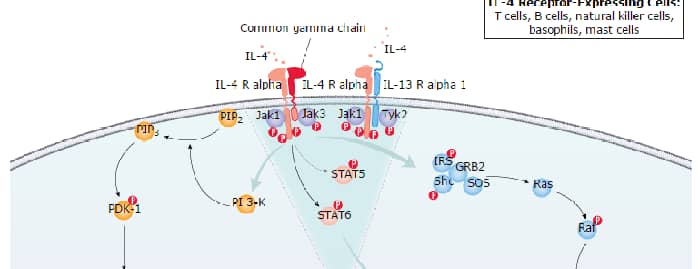
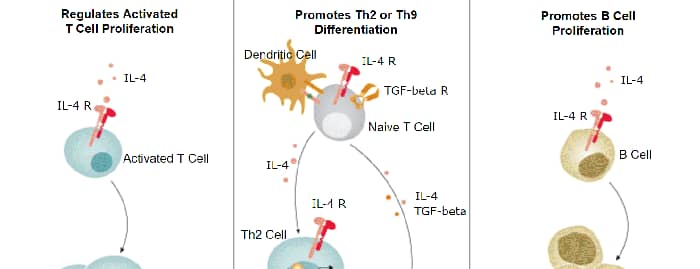
Interleukin-4 (IL-4), also known as B cell-stimulatory factor-1, is a monomeric, approximately 13 kDa ‑ 18 kDa Th2 cytokine that shows pleiotropic effects during immune responses (1 ‑ 3). It is a glycosylated polypeptide that contains three intrachain disulfide bridges and adopts a bundled four alpha -helix structure (4). Human IL-4 is synthesized with a 24 aa signal sequence. Alternate splicing generates an isoform with a 16 aa internal deletion. Mature human IL-4 shares 55%, 39% and 43% aa sequence identity with bovine, mouse, and rat IL-4, respectively. Human, mouse, and rat IL-4 are species-specific in their activities (5 - 7). IL-4 exerts its effects through two receptor complexes (8, 9). The type I receptor, which is expressed on hematopoietic cells, is a heterodimer of the ligand binding IL-4 R alpha and the common gamma chain (a shared subunit of the receptors for IL-2, -7, -9, -15, and ‑21). The type II receptor on nonhematopoietic cells consists of IL-4 R alpha and IL-13 R alpha 1. The type II receptor also transduces IL-13 mediated signals. IL-4 is primarily expressed by Th2-biased CD4+ T cells, mast cells, basophils, and eosinophils (1, 2). It promotes cell proliferation, survival, and immunoglobulin class switch to IgG4 and IgE in human B cells, acquisition of the Th2 phenotype by naïve CD4+ T cells, priming and chemotaxis of mast cells, eosinophils, and basophils, and the proliferation and activation of epithelial cells (10 ‑ 13). IL-4 plays a dominant role in the development of allergic inflammation and asthma (12, 14).
Recombinant Human IL-4 (CHO-expressed) Protein
R&D Systems | Catalog # 6507-IL

Key Product Details
- R&D Systems CHO-derived Recombinant Human IL-4 (CHO-expressed) Protein (6507-IL)
- Quality control testing to verify active proteins with lot specific assays by in-house scientists
- All R&D Systems proteins are covered with a 100% guarantee
Source
Accession Number
Structure / Form
Applications
Product Specifications
Source
His25-Ser153
Purity
Endotoxin Level
N-terminal Sequence Analysis
Predicted Molecular Mass
SDS-PAGE
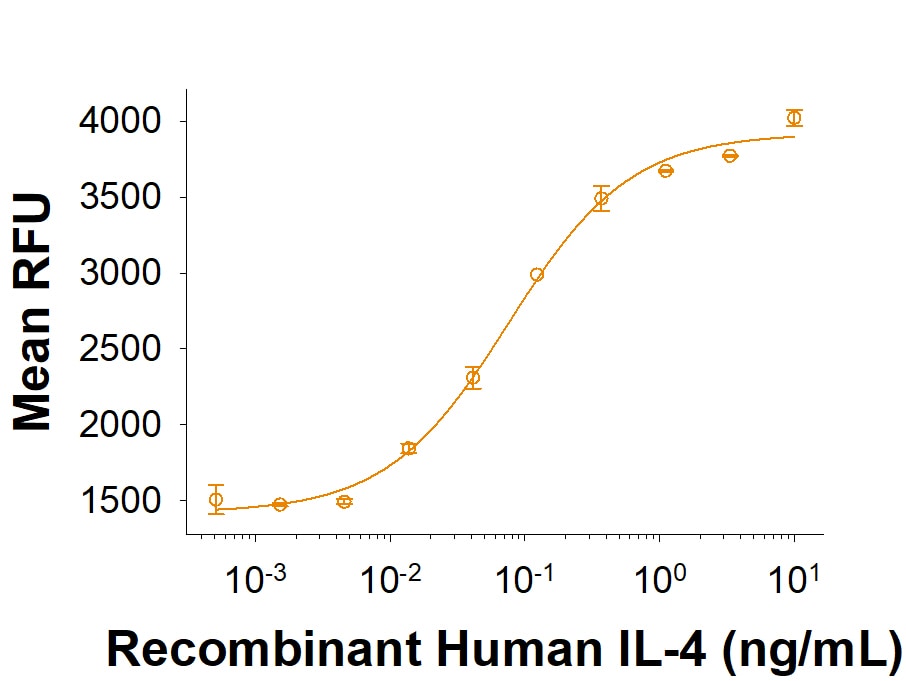
Activity
The ED50 for this effect is 0.05-0.2 ng/mL.
Reviewed Applications
Read 3 reviews rated 4.7 using 6507-IL in the following applications:
Scientific Data Images for Recombinant Human IL-4 (CHO-expressed) Protein
Recombinant Human IL-4 (CHO-expressed) Protein Bioactivity
Measured in a cell proliferation assay using TF‑1 human erythroleukemic cells. The ED50 for this effect is 0.05-0.2 ng/mL.Formulation, Preparation, and Storage
Carrier Free
What does CF mean?CF stands for Carrier Free (CF). We typically add Bovine Serum Albumin (BSA) as a carrier protein to our recombinant proteins. Adding a carrier protein enhances protein stability, increases shelf-life, and allows the recombinant protein to be stored at a more dilute concentration. The carrier free version does not contain BSA.
What formulation is right for me?In general, we advise purchasing the recombinant protein with BSA for use in cell or tissue culture, or as an ELISA standard. In contrast, the carrier free protein is recommended for applications, in which the presence of BSA could interfere.
Carrier: 6507-IL
| Formulation | Lyophilized from a 0.2 μm filtered solution in PBS with BSA as a carrier protein. |
| Reconstitution | Reconstitute at 100 μg/mL in PBS containing at least 0.1% human or bovine serum albumin. |
| Shipping | The product is shipped at ambient temperature. Upon receipt, store it immediately at the temperature recommended below. |
| Stability & Storage | Use a manual defrost freezer and avoid repeated freeze-thaw cycles.
|
Carrier Free: 6507-IL/CF
| Formulation | Lyophilized from a 0.2 μm filtered solution in PBS. |
| Reconstitution | Reconstitute at 100 μg/mL in PBS. |
| Shipping | The product is shipped at ambient temperature. Upon receipt, store it immediately at the temperature recommended below. |
| Stability & Storage | Use a manual defrost freezer and avoid repeated freeze-thaw cycles.
|
Calculators
Background: IL-4
References
- Benczik, M. and S.L. Gaffen (2004) Immunol. Invest. 33:109.
- Chomarat, P. and J. Banchereau (1998) Int. Rev. Immunol. 17:1.
- Yokota, T. et al. (1986) Proc. Natl. Acad. Sci. 83:5894.
- Redfield, C. et al. (1991) Biochemistry 30:11029.
- Ramirez, F. et al. (1988) J. Immunol. Meth. 221:141.
- Leitenberg, D. and T.L. Feldbush (1988) Cell. Immunol. 111:451.
- Mosman, T.R. et al. (1987) J. Immunol. 138:1813.
- Mueller, T.D. et al. (2002) Biochim. Biophys. Acta 1592:237.
- Nelms, K. et al. (1999) Annu. Rev. Immunol. 17:701.
- Paludan, S.R. (1998) Scand. J. Immunol. 48:459.
- Corthay, A. (2006) Scand. J. Immunol. 64:93.
- Ryan, J.J. et al. (2007) Crit. Rev. Immunol. 27:15.
- Grone, A. (2002) Vet. Immunol. Immunopathol. 88:1.
- Rosenberg, H.F. et al. (2007) J. Allergy Clin. Immunol. 119:1303.
Long Name
Alternate Names
Entrez Gene IDs
Gene Symbol
UniProt
Additional IL-4 Products
Product Documents for Recombinant Human IL-4 (CHO-expressed) Protein
Certificate of Analysis
To download a Certificate of Analysis, please enter a lot or batch number in the search box below.
Note: Certificate of Analysis not available for kit components.
Product Specific Notices for Recombinant Human IL-4 (CHO-expressed) Protein
For research use only
Related Research Areas
Citations for Recombinant Human IL-4 (CHO-expressed) Protein
 Powered by Bioz
Customer Reviews for Recombinant Human IL-4 (CHO-expressed) Protein (3)
Have you used Recombinant Human IL-4 (CHO-expressed) Protein?
Submit a review and receive an Amazon gift card!
$25/€18/£15/$25CAN/¥2500 for a review with an image
$10/€7/£6/$10CAN/¥1110 for a review without an image
Submit a review
Customer Images
-
Application: In vitro bioactivity in cell cultureVerified Customer | Posted 06/29/2023
-
Application: Stem/Immune cell maintenance or differentiationVerified Customer | Posted 10/01/2020

-
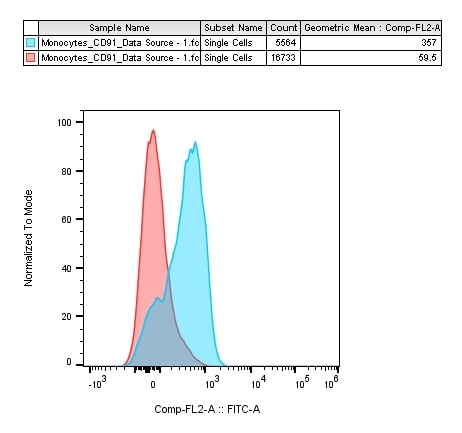
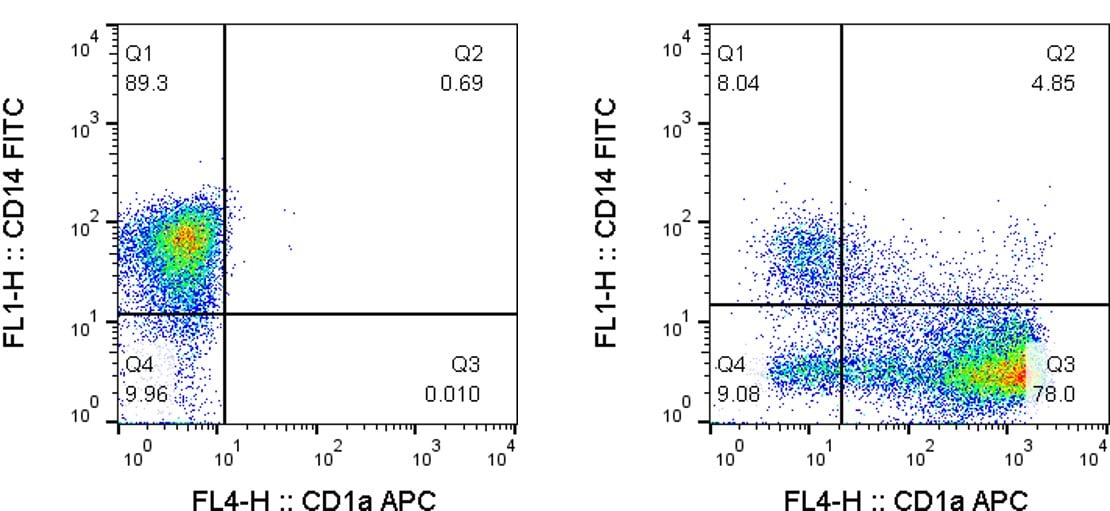
Application: In vitro bioactivity in cell cultureVerified Customer | Posted 09/29/2020Flow cytometric of human monocytes (left) before and after differentiation into dendritic cells (right). CD1a-CD14+ monocytes are in the upper left quadrant, whereas CD1a+CD14- dendritic cells are in the lower right quadrant.
There are no reviews that match your criteria.
Associated Pathways