
Klotho beta, a divergent structural member of the glycosidase I superfamily, is expressed primarily in the liver and pancreas, with lower expression in adipose tissue (1, 2). Like Klotho, Klotho beta facilitates binding between FGF19 subfamily members and their receptors via formation of a ternary complex (3). The Klotho beta mediated interaction of human FGF19 (mouse FGF15) with FGF Receptor 4 in the liver negatively regulates bile acid synthesis by controlling the secretion of two key bile acid synthase genes, cholesterol 7-alpha hydroxylase (Cyp7a1) and sterol 12-alpha hydroxylase (Cyp8b1) (2-5). Klotho beta is also a cofactor for the interaction of FGF21 with FGF Receptor 1c in adipocytes, which allows FGF21 to stimulate GLUT1 expression, upregulating adipocyte insulin-dependent glucose uptake (2-4, 6). The 1043 amino acid (aa) type I transmembrane protein is composed of a 51 aa signal sequence, a 943 aa extracellular domain (ECD) containing two glycosidase-like regions, a 21 aa transmembrane domain, and 28 aa intracellular tail. Since Klotho-related proteins lack critical active site Glu residues present in beta -glycosidases, it was initially unclear whether they were functional enzymes (1, 7). However, glucuronidase activity has since been demonstrated for Klotho, indicating that physiologically relevant enzymatic activity for Klotho beta is also possible (8). The extracellular domain shares 79%, 87%, 87% and 67% identity with mouse, equine, canine and rat Klotho beta, respectively. The low identity with rat reflects aa discordance within rodent ECD.
Recombinant Human Klotho beta Protein, CF
R&D Systems | Catalog # 5889-KB

Key Product Details
- R&D Systems NS0-derived Recombinant Human Klotho beta Protein (5889-KB)
- Quality control testing to verify active proteins with lot specific assays by in-house scientists
- All R&D Systems proteins are covered with a 100% guarantee
Source
Accession Number
Applications
Product Specifications
Source
Phe53-Leu997, with a C-terminal 10-His tag
Purity
Endotoxin Level
N-terminal Sequence Analysis
Predicted Molecular Mass
SDS-PAGE
Activity
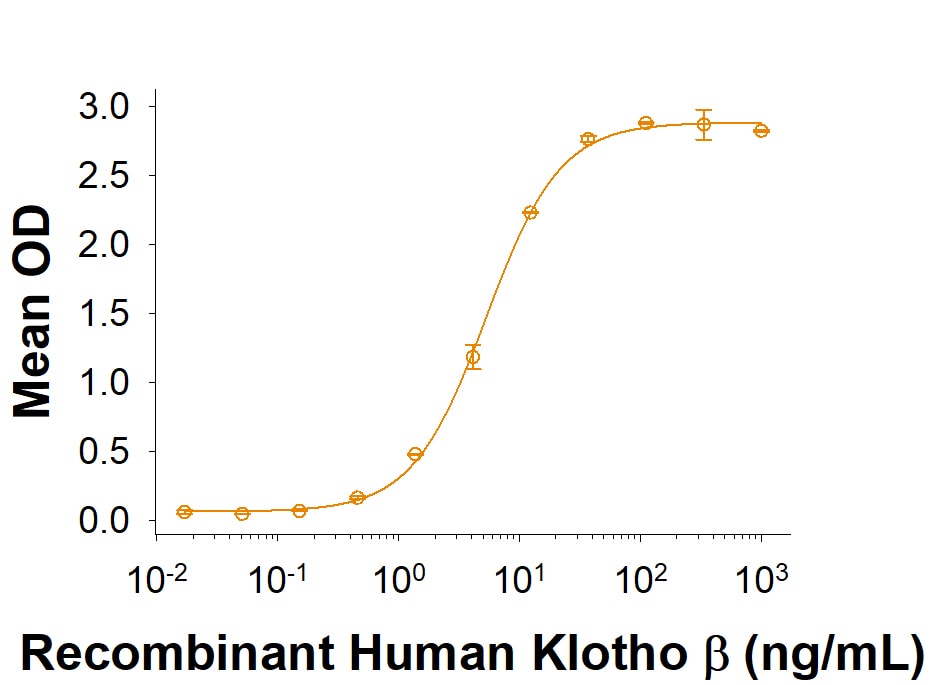
When Recombinant Human FGF-21 (Catalog # 2539-FG) is immobilized at 1 µg/mL (100 µL/well), Recombinant Human Klotho beta His-tag (Catalog # 5889-KB) binds with an ED50 of 2.5-20 ng/mL.
Reviewed Applications
Read 3 reviews rated 5 using 5889-KB in the following applications:
Scientific Data Images for Recombinant Human Klotho beta Protein, CF
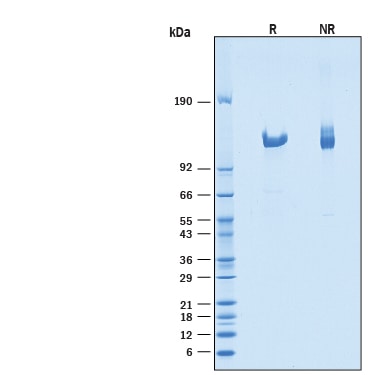
Recombinant Human Klotho beta Protein SDS-PAGE
1 μg/lane of Recombinant Human Klotho beta was resolved with SDS-PAGE under reducing (R) and non-reducing (NR) conditions and visualized by Coomassie® Blue staining, showing a single band at 113-125 kDa.Formulation, Preparation, and Storage
5889-KB
| Formulation | Supplied as a 0.2 μm filtered solution in PBS, Glycerol and EDTA. |
| Shipping | The product is shipped with dry ice or equivalent. Upon receipt, store it immediately at the temperature recommended below. |
| Stability & Storage | Use a manual defrost freezer and avoid repeated freeze-thaw cycles.
|
Background: Klotho beta
References
- Mian, I. S. (1998) Blood Cells Mol. Dis. 24:83.
- Kurosu, H. and M. Kuro-o (2009) Mol. Cell. Endocrinol. 299:72.
- Ito, S. et al. (2005) J. Clin. Invest. 115:2202.
- Kurosu, H. et al. (2007) J. Biol. Chem. 282:26687.
- Lin, B. C. et al. (2007) J. Biol. Chem. 282:27277.
- Ogawa, Y. et al. (2007) Proc. Natl. Acad. Sci USA 104:7432.
- Chang, Q. et al. (2005) Science 310:490.
- Goetz, R. et al. (2007) Mol. Cell. Biol. 27:3417.
Alternate Names
Gene Symbol
UniProt
Additional Klotho beta Products
Product Documents for Recombinant Human Klotho beta Protein, CF
Certificate of Analysis
To download a Certificate of Analysis, please enter a lot or batch number in the search box below.
Note: Certificate of Analysis not available for kit components.
Product Specific Notices for Recombinant Human Klotho beta Protein, CF
For research use only
Related Research Areas
Citations for Recombinant Human Klotho beta Protein, CF
 Powered by Bioz
Customer Reviews for Recombinant Human Klotho beta Protein, CF (3)
Have you used Recombinant Human Klotho beta Protein, CF?
Submit a review and receive an Amazon gift card!
$25/€18/£15/$25CAN/¥2500 for a review with an image
$10/€7/£6/$10CAN/¥1110 for a review without an image
Submit a review
Customer Images

-
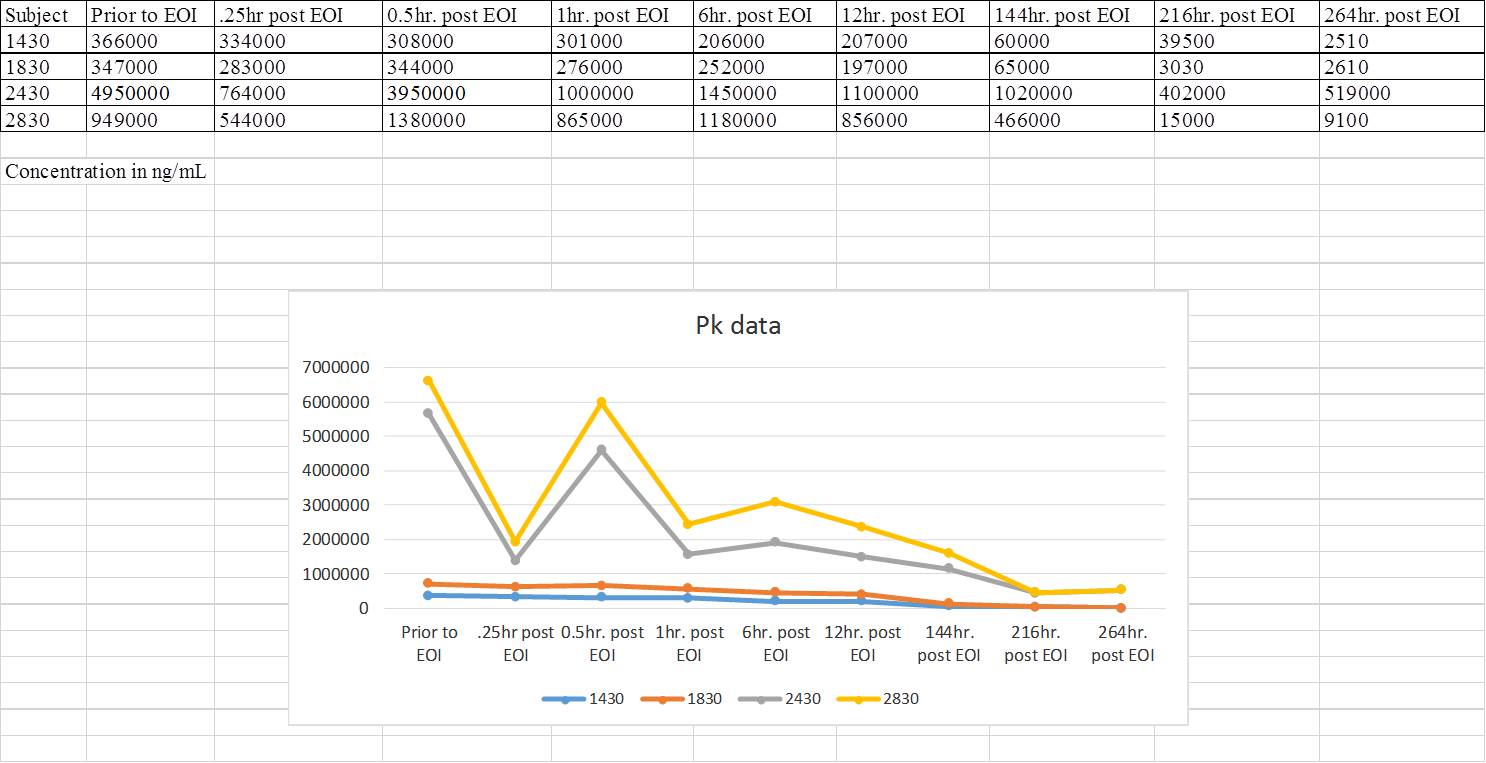
Application: Binding assay/Protein-protein interactionVerified Customer | Posted 12/20/2020

-
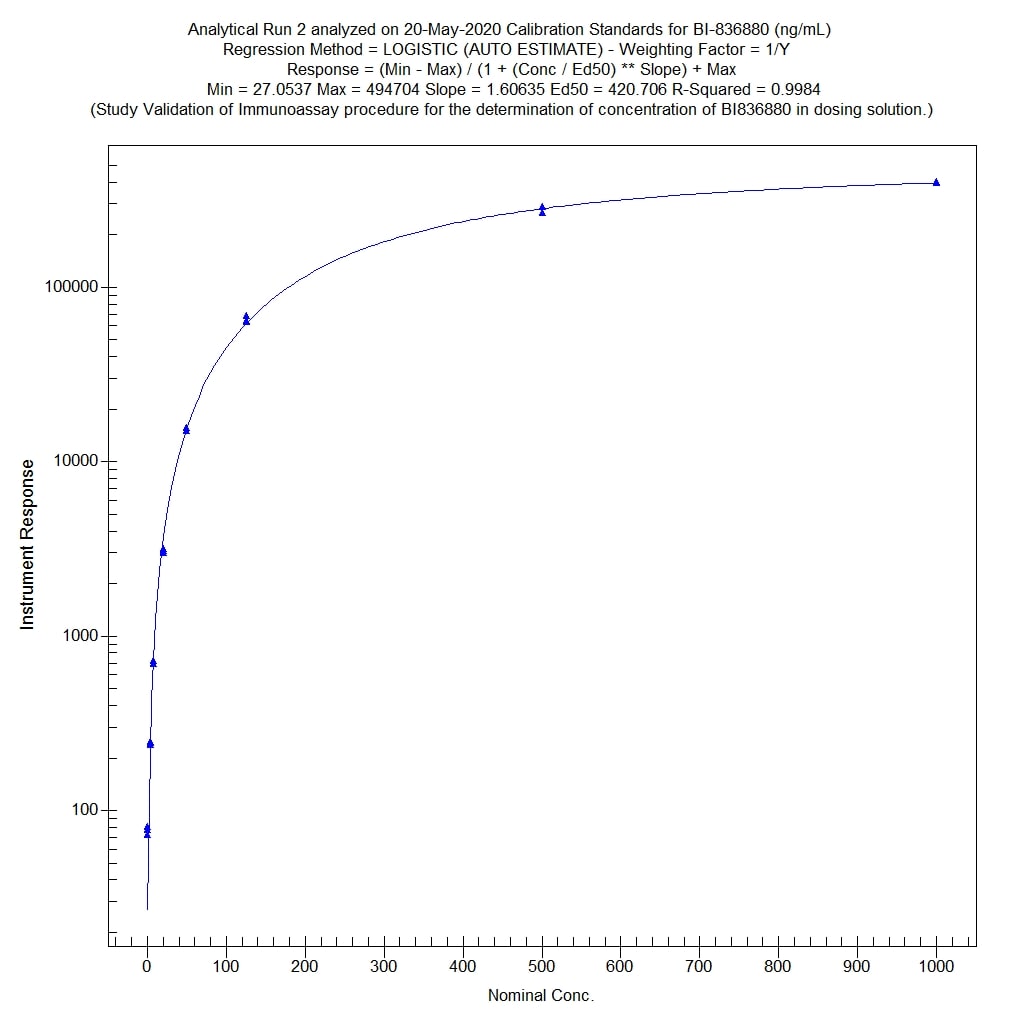
Application: Immunoassay StandardVerified Customer | Posted 12/06/2020
-
Application: Binding assay/Protein-protein interactionVerified Customer | Posted 07/27/2020
There are no reviews that match your criteria.
FAQs for Recombinant Human Klotho beta Protein, CF
-
Q: Why is an antibody used to immobilize Recombinant Human Klotho-beta protein, Catalog # 5889-KB, in the binding assay as described in the insert?
A: The Recombinant Human Klotho-beta protein is formulated in PBS, 50%(v/v) Glycerol and 0.1 mM EDTA, pH 6.8. This formulation results in lower efficiency of binding of the protein by itself and therefore an antibdy is used to immobilize the protein. Additionally, the protocol as described is more sensitive for detection of FGF-21 binding.