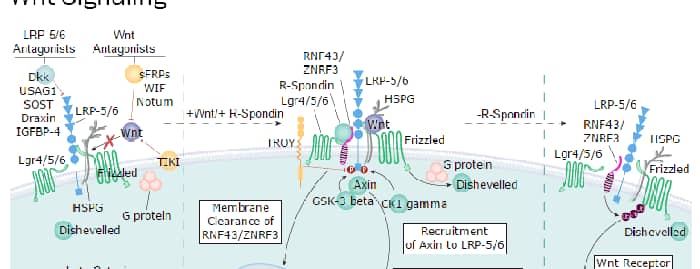
Syndecan-1, designated CD138, is a dimeric type I transmembrane (TM) protein that belongs to the syndecan family of Type 1 transmembrane proteins (1, 2). The four syndecan family members are major carriers of heparan sulfate (HS) and chondroitin sulfate glycosaminoglycans (GAGs) that have different expression patterns and extracellular sequences. Syndecan-1 forms weak non-covalent homodimers, or heterodimers with Syndecan-2 or -3, through interactions of the transmembrane domain (3). It is synthesized as a 310 amino acid (aa) precursor with a 17 aa signal sequence, a 234 aa extracellular domain (ECD) that includes three closely-spaced consensus Ser-Gly HS attachment sites near the N-terminus, a 25 aa TM segment, and a 34 aa cytoplasmic region that includes a PDZ binding motif with a tyrosine phosphorylation site. The ECD is variably modified by GAGs, producing molecular weights of 120 - 200 kDa for native Syndecan-1. Soluble forms are shed via proteolytic cleavage. Human Syndecan-1 ECD shares 65 - 71% aa identity with the ECD of rat, mouse, canine, equine and bovine Syndecan-1. Syndecan-1 shows highest expression on epithelial cells such as keratinocytes, and terminally differentiated B cells such as plasma cells (4, 5). It aids wound healing in skin, cornea, and heart following myocardial infarction by promoting re-epithelialization, migration, and collagen deposition (4 - 8). It binds chemokines, creating chemotactic gradients when shed, but also binds and modulates integrins to control the influx of leukocytes (5, 7, 9). The net effect is to allow, but limit, inflammation. In myeloma and other cancers, shedding of Syndecan-1 can facilitate growth, angiogenesis and metastasis (10 - 12). Growth factors, such as FGFs and HGF, bind GAG chains and use Syndecan-1 as a coreceptor (12, 13). The GAG chains may also be used by a variety of viruses and bacteria for cell adhesion and uptake (4).
Recombinant Human Syndecan-1 Protein, CF
R&D Systems | Catalog # 2780-SD


Loading...
Key Product Details
- R&D Systems NS0-derived Recombinant Human Syndecan-1 Protein (2780-SD)
- Quality control testing to verify active proteins with lot specific assays by in-house scientists
- All R&D Systems proteins are covered with a 100% guarantee
Source
NS0
Accession Number
Applications
Bioactivity
Loading...
Product Specifications
Source
Mouse myeloma cell line, NS0-derived human Syndecan-1/CD138 protein
Gln18-Glu251, with a C-terminal 6-His tag
Gln18-Glu251, with a C-terminal 6-His tag
Purity
>95%, by SDS-PAGE visualized with Silver Staining and quantitative densitometry by Coomassie® Blue Staining.
Endotoxin Level
<0.10 EU per 1 μg of the protein by the LAL method.
N-terminal Sequence Analysis
No results obtained: Gln18 predicted
Predicted Molecular Mass
24.9 kDa
SDS-PAGE
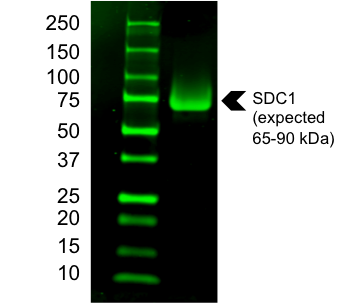
60-90 kDa, reducing conditions
Activity
Measured by the ability of the immobilized protein to enhance the adhesion of Saos‑2 human osteosarcoma cells to human Fibronectin.
Measured by the ability of the immobilized protein to enhance the adhesion of Saos‑2 human osteosarcoma cells to human Fibronectin (0.5 μg/mL, Catalog # 4305-FNB). The ED50 for this effect is 2.5‑10 μg/mL.
Measured by the ability of the immobilized protein to enhance the adhesion of Saos‑2 human osteosarcoma cells to human Fibronectin (0.5 μg/mL, Catalog # 4305-FNB). The ED50 for this effect is 2.5‑10 μg/mL.
Reviewed Applications
Read 4 reviews rated 4.8 using 2780-SD in the following applications:
Formulation, Preparation, and Storage
2780-SD
| Formulation | Lyophilized from a 0.2 μm filtered solution in PBS. |
| Reconstitution | Reconstitute at 500 μg/mL in PBS.
Loading...
|
| Shipping | The product is shipped at ambient temperature. Upon receipt, store it immediately at the temperature recommended below. |
| Stability & Storage | Use a manual defrost freezer and avoid repeated freeze-thaw cycles.
|
Calculators
Background: Syndecan-1/CD138
References
- Tkachenko, E. et al. (2005) Circ. Res. 96:488.
- Mali, M. et al. (1990) J. Biol. Chem. 265:6884.
- Dews, I.C. and K.R. MacKenzie (2007) Proc. Natl. Acad. Sci. USA 104:20782.
- Fears, C.Y. and A. Woods (2006) Matrix Biol. 25:443.
- Stepp, M.A. et al. (2002) J. Cell Sci. 115:4517.
- Ojeh, N. et al. (2008) J. Invest. Dermatol. 128:26.
- Stepp, M.A. et al. (2007) J. Cell Sci. 120:2851.
- Vanhoutte, D. et al. (2007) Circulation 115:475.
- Li, Q. et al. (2002) Cell 111:635.
- Beauvais, D.M. et al. (2009) J. Exp. Med. 206:691.
- Yang, Y. et al. (2007) J. Biol. Chem. 282:13326.
- Derksen, P.W.B. et al. (2002) Blood 99:1405.
- Su, G. et al. (2007) J. Biol. Chem. 282:14906.
Alternate Names
CD138, SDC1, Syndecan1
Gene Symbol
SDC1
UniProt
Additional Syndecan-1/CD138 Products
Product Documents for Recombinant Human Syndecan-1 Protein, CF
Certificate of Analysis
To download a Certificate of Analysis, please enter a lot or batch number in the search box below.
Note: Certificate of Analysis not available for kit components.
Product Specific Notices for Recombinant Human Syndecan-1 Protein, CF
For research use only
Related Research Areas
Citations for Recombinant Human Syndecan-1 Protein, CF
 Powered by Bioz
Customer Reviews for Recombinant Human Syndecan-1 Protein, CF (4)
4.8 out of 5
4 Customer Ratings
Have you used Recombinant Human Syndecan-1 Protein, CF?
Submit a review and receive an Amazon gift card!
$25/€18/£15/$25CAN/¥2500 for a review with an image
$10/€7/£6/$10CAN/¥1110 for a review without an image
Submit a review
Customer Images
Showing
1
-
4 of
4 reviews
Showing All
Filter By:
-
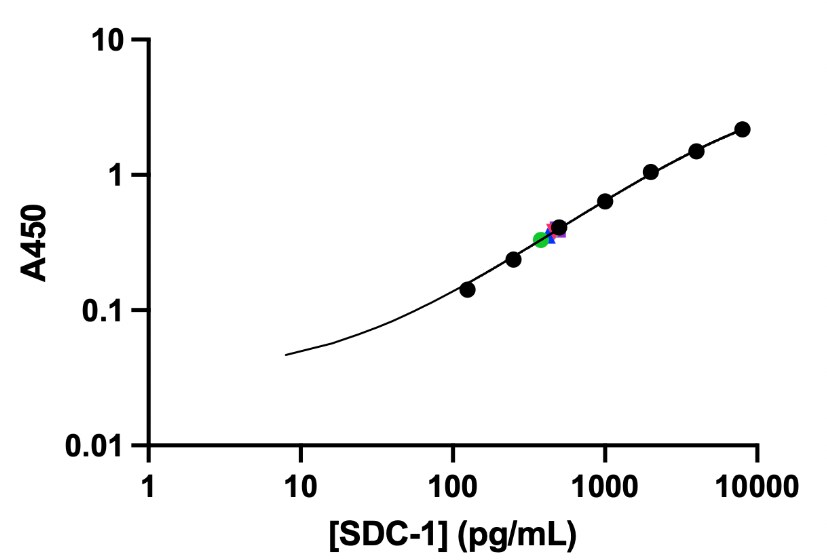
Application: Immunoassay StandardVerified Customer | Posted 05/21/2024

-
Application: Immunoassay StandardVerified Customer | Posted 05/15/2024
-
Application: Immunoassay StandardVerified Customer | Posted 10/09/2020
-
Application: SDS-PAGE ControlVerified Customer | Posted 09/14/2017Visualized using Simply Blue Safe Stain.
There are no reviews that match your criteria.