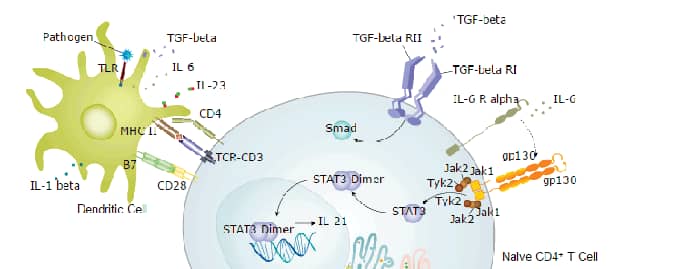
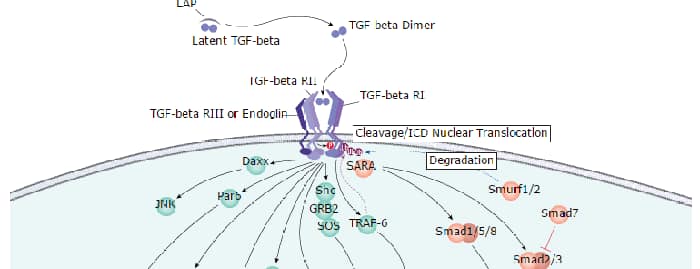
TGF-beta 1 (transforming growth factor beta 1) is one of three closely related mammalian members of the large TGF-beta superfamily that share a characteristic cystine knot structure (1-7). TGF-beta 1, -2 and -3 are highly pleiotropic cytokines that are proposed to act as cellular switches that regulate processes such as immune function, proliferation and epithelial‑mesenchymal transition (1-4). Each TGF-beta isoform has some non‑redundant functions; for TGF-beta 1, mice with targeted deletion show defects in hematopoiesis and endothelial differentiation, and die of overwhelming inflammation (2). Human TGF-beta 1 cDNA encodes a 390 amino acid (aa) precursor that contains a 29 aa signal peptide and a 361 aa proprotein (8). A furin‑like convertase processes the proprotein to generate an N‑terminal 249 aa latency‑associated peptide (LAP) and a C‑terminal 112 aa mature TGF-beta 1 (8, 9). Disulfide‑linked homodimers of LAP and TGF-beta 1 remain non‑covalently associated after secretion, forming the small latent TGF-beta 1 complex (8-10). Covalent linkage of LAP to one of three latent TGF‑ beta binding proteins (LTBPs) creates a large latent complex that may interact with the extracellular matrix (9, 10). TGF-beta is activated from latency by pathways that include actions of the protease plasmin, matrix metalloproteases, thrombospondin 1 and a subset of integrins (10). Mature human TGF-beta 1 shares 100% aa identity with pig, dog and cow TGF-beta 1, and 99% aa identity with mouse, rat and horse TGF‑ beta 1. It demonstrates cross-species activity (1). TGF-beta 1 signaling begins with high‑affinity binding to a type II ser/thr kinase receptor termed TGF-beta RII. This receptor then phosphorylates and activates a second ser/thr kinase receptor, TGF-beta RI (also called activin receptor-like kinase (ALK) -5), or alternatively, ALK‑1. This complex phosphorylates and activates Smad proteins that regulate transcription (3, 11, 12). Contributions of the accessory receptors betaglycan (also known as TGF-beta RIII) and endoglin, or use of Smad‑independent signaling pathways, allow for disparate actions observed in response to TGF-beta in different contexts (11).

Loading...
Key Product Details
Source
Sf 9 (baculovirus)
Accession Number
Structure / Form
Disulfide-linked homodimer
Applications
Bioactivity
Loading...
Product Specifications
Source
Spodoptera frugiperda, Sf 9 (baculovirus)-derived human TGF-beta 1 protein
Ala279-Ser390
Produced in an animal component free process (ACFP).
Ala279-Ser390
Produced in an animal component free process (ACFP).
Purity
>95%, by SDS-PAGE visualized with Silver Staining and quantitative densitometry by Coomassie® Blue Staining.
Endotoxin Level
<0.10 EU per 1 μg of the protein by the LAL method.
N-terminal Sequence Analysis
Ala279
Predicted Molecular Mass
12.8 kDa (monomer)
SDS-PAGE
11 kDa, reducing conditions
Activity
Measured by its ability to inhibit the IL-4-dependent proliferation of HT‑2 mouse T cells. Tsang, M. et al. (1995) Cytokine 7:389.
The ED50 for this effect is 0.0400-0.200 ng/mL.
The ED50 for this effect is 0.0400-0.200 ng/mL.
Reviewed Applications
Read 1 review rated 5 using ACFP240 in the following applications:
Formulation, Preparation, and Storage
ACFP240
| Formulation | Lyophilized from a 0.2 μm filtered solution in Acetonitrile and TFA. |
| Reconstitution | Reconstitute at 100 μg/mL in sterile 4 mM HCl. |
| Shipping | The product is shipped at ambient temperature. Upon receipt, store it immediately at the temperature recommended below. |
| Stability & Storage | Use a manual defrost freezer and avoid repeated freeze-thaw cycles.
|
Calculators
Background: TGF-beta 1
References
- Derynck, R. and K. Miyazono (2008) Cold Spring Harbor Laboratory Press, 29.
- Dunker, N. and K. Krieglstein (2000) Eur. J. Biochem. 267:6982.
- Wahl, S.M. (2006) Immunol. Rev. 213:213.
- Chang, H. et al. (2002) Endocr. Rev. 23:787.
- Lin, J.S. et al. (2006) Reproduction 132:179.
- Hinck, A.P. et al. (1996) Biochemistry 35:8517.
- Mittl, P.R.E. et al. (1996) Protein Sci. 5:1261.
- Derynck, R. et al. (1985) Nature 316:701.
- Miyazono, K. et al. (1988) J. Biol. Chem. 263:6407.
- Oklu, R. and R. Hesketh (2000) Biochem. J. 352:601.
- de Caestecker, M. et al. (2004) Cytokine Growth Factor Rev. 15:1.
- Zuniga, J.E. et al. (2005) J. Mol. Biol. 354:1052.
Long Name
Transforming Growth Factor beta 1
Alternate Names
TGF beta1, TGFB, TGFB1, TGFbeta 1
Gene Symbol
TGFB1
UniProt
Additional TGF-beta 1 Products
Product Documents for Recombinant Human TGF-beta 1, ACFP Protein
Certificate of Analysis
To download a Certificate of Analysis, please enter a lot or batch number in the search box below.
Note: Certificate of Analysis not available for kit components.
Product Specific Notices for Recombinant Human TGF-beta 1, ACFP Protein
For research use or further manufacturing only
Related Research Areas
Customer Reviews for Recombinant Human TGF-beta 1, ACFP Protein (1)
5 out of 5
1 Customer Rating
Have you used Recombinant Human TGF-beta 1, ACFP Protein?
Submit a review and receive an Amazon gift card!
$25/€18/£15/$25CAN/¥2500 for a review with an image
$10/€7/£6/$10CAN/¥1110 for a review without an image
Submit a review
Showing
1
-
1 of
1 review
Showing All
Filter By:
-
Application: Cell ProliferationVerified Customer | Posted 05/26/2018
There are no reviews that match your criteria.
Loading...
Associated Pathways
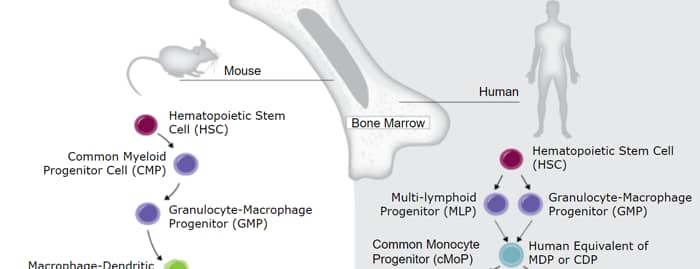


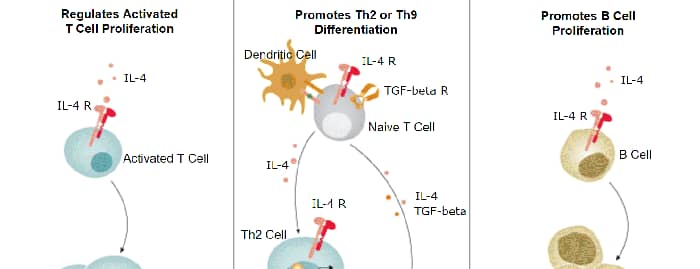
IL-21 Signaling Pathways and their Primary Biological Effects in Different Immune Cell Types
 Mesenchymal Stem Cell Differentiation Pathways & Lineage-specific Markers
 TGF-beta Signaling Pathways
 Th17 Differentiation Pathway