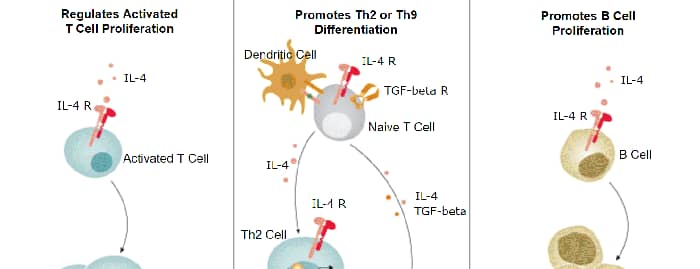
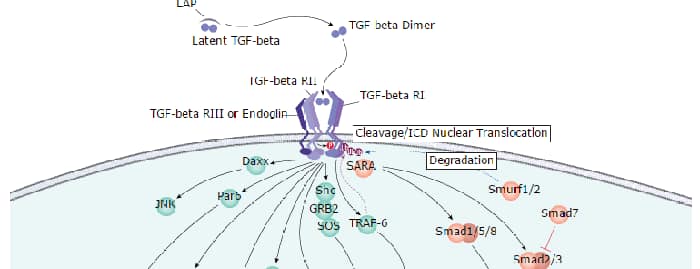
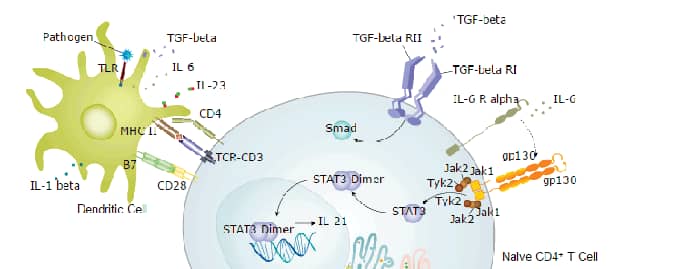
TGF-beta 3 (transforming growth factor-beta 3) is a member of a TGF-beta superfamily subgroup that is defined by their structural and functional similarities (1-5). TGF-beta 3 and its closely related proteins, TGF-beta 1 and beta 2, act as cellular switches to regulate immune function, cell proliferation, and epithelial-mesenchymal transition (4, 6, 7). The non-redundant biological effects of TGF- beta 3 include involvement in palatogenesis, chondrogenesis, and pulmonary development (1, 2, 7-9). Human TGF-beta 3 cDNA encodes a 412 amino acid (aa) precursor that contains a 20 aa signal peptide and a 392 aa proprotein. The proprotein is processed by a furin-like convertase to generate a 220 aa latency-associated peptide (LAP) and a 112 aa mature TGF-beta 3 (10, 11). Mature human TGF- beta 3 shows 100%, 99%, and 98% aa identity with mouse/dog/horse, rat, and pig TGF- beta 3, respectively. TGF-beta 3 is secreted as a latent complex. This latent form of TGF-beta 3 is activated by integrins, thrombospondin-1, plasmin, and matrix metalloproteases (12, 13). It can also be activated by extreme pH and reactive oxygen species (1-5, 12). TGF-beta 3 binds with high affinity to TGF-beta RII, a type II serine/threonine kinase receptor. This receptor then phosphorylates and activates type I serine/threonine kinase receptors, TGF- beta RI or ALK-1, to modulate transcription through Smad phosphorylation (14-16). The divergent biological effects exerted by individual TGF-beta isoforms is dependent upon the recruitment of co-receptors (TGF- beta RIII and endoglin) and the subsequent initiation of Smad-dependent or -independent signaling pathways (15, 17, 18).
Recombinant Human TGF-beta 3 (CHO-expressed) Protein
R&D Systems | Catalog # 8420-B3

Key Product Details
- Recombinant Human TGF-beta 3 protein is a multifunctional cytokine that regulates cell growth, differentiation, immune responses, and tissue remodeling
- Applications include cell culture and binding assays to study protein-protein interactions
- Quality control testing to verify active proteins with lot specific assays by in-house scientists
- All R&D Systems proteins are covered with a 100% guarantee
Source
Accession Number
Structure / Form
Applications
Product Specifications
Source
Ala301-Ser412
Purity
Endotoxin Level
N-terminal Sequence Analysis
Predicted Molecular Mass
SDS-PAGE
Activity
The ED50 for this effect is 0.01-0.04 ng/mL.
Reviewed Applications
Read 2 reviews rated 4.5 using 8420-B3 in the following applications:
Scientific Data Images for Recombinant Human TGF-beta 3 (CHO-expressed) Protein
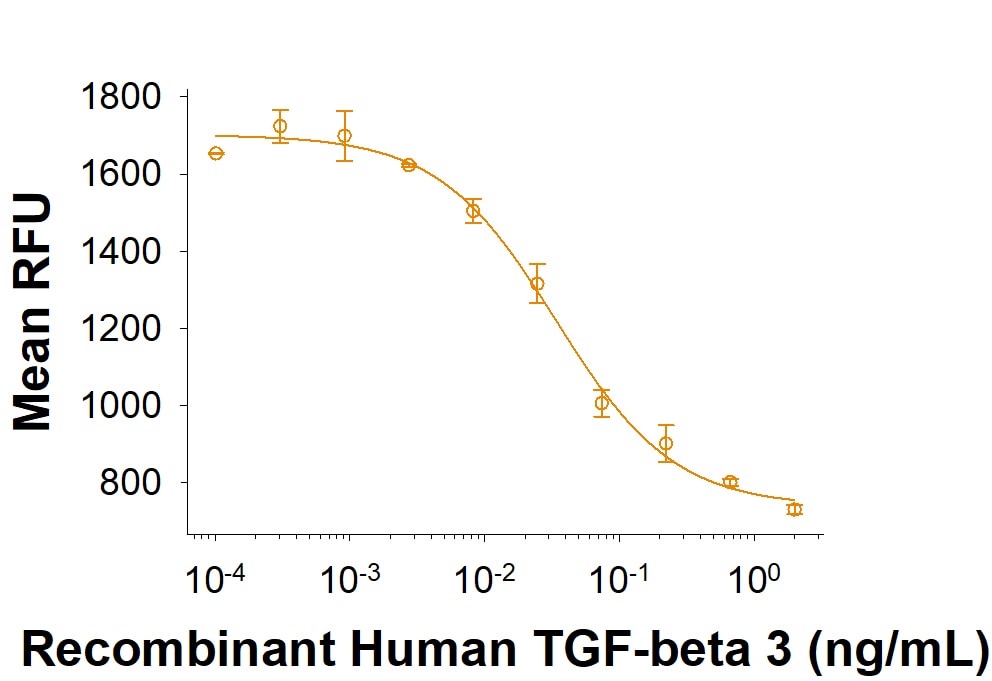
Recombinant Human TGF-beta 3 (CHO-expressed) Protein Bioactivity
Measured by its ability to inhibit the IL-4-dependent proliferation of HT‑2 mouse T cells. The ED50 for this effect is 0.01-0.04 ng/mL.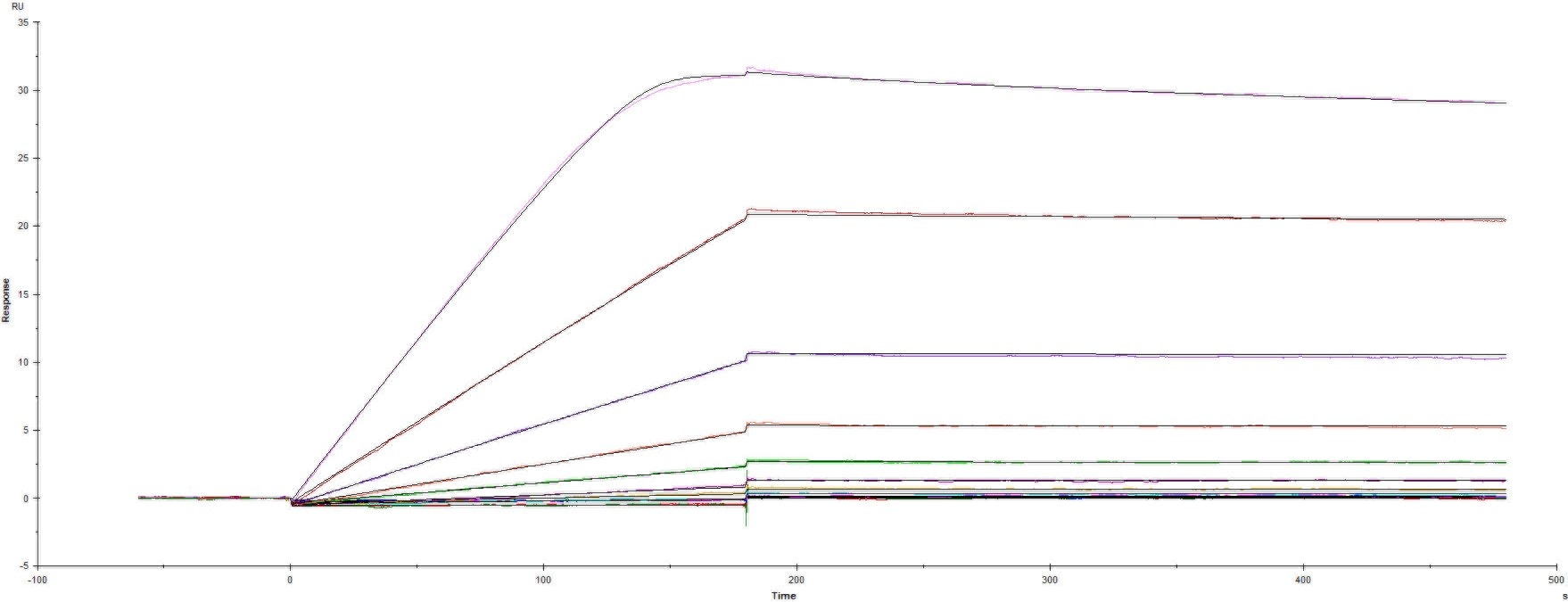
Affinity Measurements and Binding Kinetics of the Interaction between TGF-beta RII and TGF beta 3 by SPR
Recombinant Human TGF-beta RII Fc Chimera (341-BR) was captured on a Sensor Chip Protein AGL, and binding to Recombinant Human TGF beta 3 (8420-B3) was measured at a concentration range between 0.488 pM and 1000 pM. The double-referenced sensorgram was fit to a 1:1 binding model to determine the binding kinetics and affinity, with an affinity constant of KD=2.766 pM. (Biacore T200).Formulation, Preparation, and Storage
Carrier Free
What does CF mean?CF stands for Carrier Free (CF). We typically add Bovine Serum Albumin (BSA) as a carrier protein to our recombinant proteins. Adding a carrier protein enhances protein stability, increases shelf-life, and allows the recombinant protein to be stored at a more dilute concentration. The carrier free version does not contain BSA.
What formulation is right for me?In general, we advise purchasing the recombinant protein with BSA for use in cell or tissue culture, or as an ELISA standard. In contrast, the carrier free protein is recommended for applications, in which the presence of BSA could interfere.
Carrier: 8420-B3
| Formulation | Lyophilized from a 0.2 μm filtered solution in Acetonitrile and TFA with BSA as a carrier protein. |
| Reconstitution | Reconstitute at 50 μg/mL in 4 mM HCl. |
| Shipping | The product is shipped at ambient temperature. Upon receipt, store it immediately at the temperature recommended below. |
| Stability & Storage | Use a manual defrost freezer and avoid repeated freeze-thaw cycles.
|
Carrier Free: 8420-B3/CF
| Formulation | Lyophilized from a 0.2 μm filtered solution in Acetonitrile and TFA. |
| Reconstitution | Reconstitute at 50 μg/mL in 4 mM HCl. |
| Shipping | The product is shipped at ambient temperature. Upon receipt, store it immediately at the temperature recommended below. |
| Stability & Storage | Use a manual defrost freezer and avoid repeated freeze-thaw cycles.
|
Calculators
Background: TGF-beta 3
References
- Barrio, M.C. et al. (2014) Cells Tissues Organs. [Epub ahead of print; PMID 24861080].
- Doetschman, T. et al. (2012) Genesis 50:59.
- Mittl, P.R. et al. (1996) Protein Sci. 5:1261.
- Sporn, M.B. (2006) Cytokine Growth Factor Rev. 17:3.
- Wahl, S.M. et al. (2006) Immunol. Rev. 213:213.
- Chang, H. et al. (2002) Endocr. Rev. 23:787.
- Dunker, N. and K. Krieglstein (2000) Eur. J. Biochem. 267:6982.
- Jin, J.Z. et al. (2014) Dev. Dyn. [Epub ahead of print; PMID 25104574].
- Tang, Q.O. et al. (2009) Expert Opin. Biol Ther. 9:689.
- Derynck, R. et al. (1988) EMBO J. 7:3737.
- Miyazono, K. et al. (1988) J. Biol. Chem. 263:6407.
- Munger, J.S. et al. (1997) Kidney Int 51:1376.
- Wipff, P.J. and B. Hinz (2008) Eur J Cell Biol 87:601.
- Cui, X.M. and C.F. Shuler (2000) Int. J. Dev. Biol. 44:397.
- de Caestecker, M. (2004) Cytokine Growth Factor Rev. 15:1.
- Nakajima, A. et al. (2007) Dev. Dyn. 236:791.
- Iwata, J. et al. (2012) J. Clin. Invest. 122:873.
- Gatza, C.E. et al. (2010) Cell. Signal. 22:1163.
Long Name
Alternate Names
Gene Symbol
UniProt
Additional TGF-beta 3 Products
Product Documents for Recombinant Human TGF-beta 3 (CHO-expressed) Protein
Certificate of Analysis
To download a Certificate of Analysis, please enter a lot or batch number in the search box below.
Note: Certificate of Analysis not available for kit components.
Product Specific Notices for Recombinant Human TGF-beta 3 (CHO-expressed) Protein
For research use only
Citations for Recombinant Human TGF-beta 3 (CHO-expressed) Protein
 Powered by Bioz
Customer Reviews for Recombinant Human TGF-beta 3 (CHO-expressed) Protein (2)
Have you used Recombinant Human TGF-beta 3 (CHO-expressed) Protein?
Submit a review and receive an Amazon gift card!
$25/€18/£15/$25CAN/¥2500 for a review with an image
$10/€7/£6/$10CAN/¥1110 for a review without an image
Submit a review
Customer Images
-
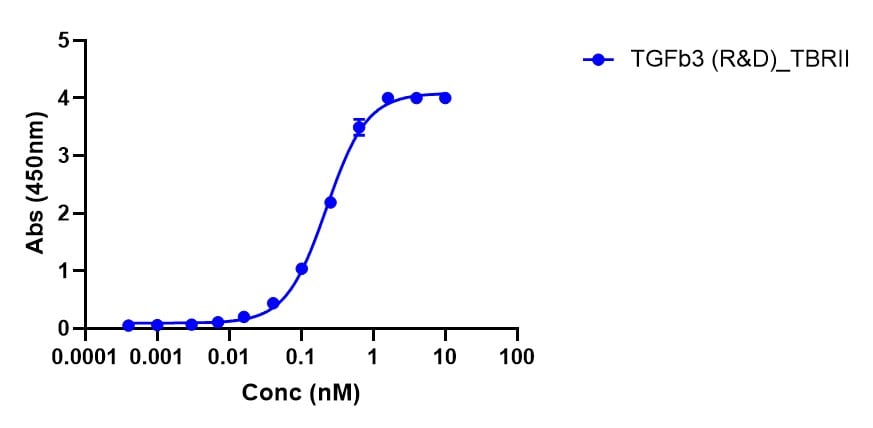
Application: Binding assay/Protein-protein interactionVerified Customer | Posted 03/16/2020TGFb3 binds TBRII in an ELISA assay. TBRII is immobilized on the plate and dose response of TGFb3 interaction is detected by anti-TGFb3.

-
Application: Cell ProliferationVerified Customer | Posted 05/07/2019
There are no reviews that match your criteria.
Associated Pathways