Recombinant Human TGF-beta RII Fc Chimera Protein, CF

R&D Systems | Catalog # 341-BR

R&D Systems
Loading...

Key Product Details

  • R&D Systems NS0-derived Recombinant Human TGF-beta RII Fc Chimera Protein (341-BR)
  • Quality control testing to verify active proteins with lot specific assays by in-house scientists
  • All R&D Systems proteins are covered with a 100% guarantee

Source

NS0

Accession Number

Structure / Form

Disulfide-linked homodimer

Applications

Bioactivity
Loading...

Product Specifications

Source

Mouse myeloma cell line, NS0-derived human TGF-beta RII protein
Human TGF-beta RII
(Thr23-Asp159)
Accession # P37173
MD Human IgG1
(Pro100-Lys330)
N-terminus C-terminus

Purity

>97%, by SDS-PAGE under reducing conditions and visualized by silver stain.

Endotoxin Level

<0.1 EU per 1 μg of the protein by the LAL method.

N-terminal Sequence Analysis

Thr23

Predicted Molecular Mass

41.7 kDa (monomer)

SDS-PAGE

59 kDa-66 kDa, reducing conditions

Activity

Measured by its binding ability in a functional ELISA.
When Recombinant Human TGF‑ beta 1 (Catalog # 240-B/CF) is immobilized at 0.5 µg/mL, the concentration of Recombinant Human TGF‑ beta RII Fc Chimera that produces 50% of the optimal binding response is found to be approximately 6-30 ng/mL.

Formulation, Preparation, and Storage

341-BR
Formulation Lyophilized from a 0.2 μm filtered solution in PBS.
Reconstitution

Reconstitute with PBS to prepare a stock solution of 100 μg/mL.


Loading...
Shipping The product is shipped at ambient temperature. Upon receipt, store it immediately at the temperature recommended below.
Stability & Storage Use a manual defrost freezer and avoid repeated freeze-thaw cycles.
  • 12 months from date of receipt, -20 to -70 °C as supplied.
  • 1 month, 2 to 8 °C under sterile conditions after reconstitution.
  • 3 months, -20 to -70 °C under sterile conditions after reconstitution.

Calculators

The reconstitution calculator allows you to quickly calculate the volume of a reagent to reconstitute your vial. Simply enter the mass of reagent and the target concentration and the calculator will determine the rest.

=
÷

Background: TGF-beta RII

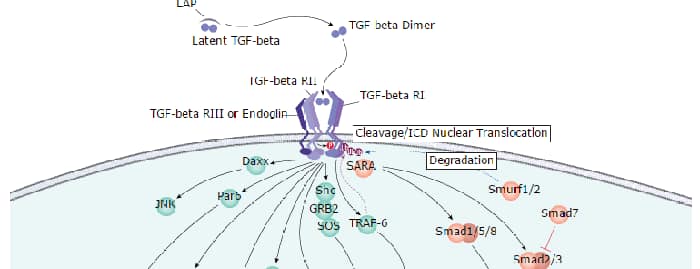
Most cell types express three sizes of receptors for TGF-beta. These are designated Type I (53 kDa), Type II (70-85 kDa), and Type III (250-350 kDa). The Type III receptor, a proteoglycan that exists in membrane-bound and soluble forms, binds TGF-beta 1, TGF-beta 2, and TGF-beta 3 but does not appear to be involved in signal transduction. The Type II receptor is a membrane-bound serine/threonine kinase that binds TGF-beta 1 and TGF-beta 3 with high affinity and TGF-beta 2 with a much lower affinity. The Type I receptor is also a membrane-bound serine/threonine kinase that apparently requires the presence of the Type II receptor to bind TGF-beta. Current evidence suggests that signal transduction requires the cytoplasmic domains of both the Type I and Type II receptors.

The recombinant soluble TGF-beta Type II receptor is capable of binding TGF-beta 1, TGF-beta 3, and TGF-beta 5 with sufficient affinity to act as an inhibitor of these isoforms at high concentrations. The soluble receptor also binds TGF-beta 2, but with an affinity at least two orders of magnitude lower. Binding of TGF-beta 1, TGF-beta 3, and TGF-beta 5 to the soluble TGF-beta Type II receptor can also be demonstrated by using the soluble receptor as a capture agent on ELISA plates and this observation has been used as the basis for the development of immunoassays for these isoforms of TGF-beta.

References

  1. Miyazono, K. et al. (1994) Adv. in Immunol. 55:181.

Long Name

Transforming Growth Factor beta Receptor II

Alternate Names

TGF-bRII, TGFbetaRII, TGFBR2

Entrez Gene IDs

7048 (Human); 21813 (Mouse)

Gene Symbol

TGFBR2

UniProt

Additional TGF-beta RII Products

Product Documents for Recombinant Human TGF-beta RII Fc Chimera Protein, CF

Certificate of Analysis

To download a Certificate of Analysis, please enter a lot or batch number in the search box below.

Note: Certificate of Analysis not available for kit components.

Product Specific Notices for Recombinant Human TGF-beta RII Fc Chimera Protein, CF

For research use only

Citations for Recombinant Human TGF-beta RII Fc Chimera Protein, CF

Customer Reviews for Recombinant Human TGF-beta RII Fc Chimera Protein, CF

There are currently no reviews for this product. Be the first to review Recombinant Human TGF-beta RII Fc Chimera Protein, CF and earn rewards!

Have you used Recombinant Human TGF-beta RII Fc Chimera Protein, CF?

Submit a review and receive an Amazon gift card!

$25/€18/£15/$25CAN/¥2500 Yen for a review with an image

$10/€7/£6/$10CAN/¥1110 Yen for a review without an image

Submit a review
Amazon Gift Card

FAQs for Recombinant Human TGF-beta RII Fc Chimera Protein, CF

Showing  1 - 2 of 2 FAQs Showing All
  • Q:

    Can Recombinant Human TGF-β RII (Catalog # 241-R2) be used as a capture reagent in an ELISA-like assay?

    A:

    Yes, it can, but Recombinant Human TGF-β RII Fc Chimera (Catalog # 341-BR) binds to the plate better and has a higher affinity for the ligand. Therefore, Catalog # 341-BR is recommended to use as a capture reagent in ELISA applications.

  • Q: In the sequence of Recombinant Human TGF-beta RII Fc Chimera Protein, CF (Catalog # 341-BR), what is the "MD" between the Human TGF-beta RII sequence and Human IgG1 sequence?

    A: The "MD" in the sequence of the protein refers to a Methionine residue followed by an Aspartic Acid residue. This is a short linker sequence that is between the extracellular domain of TGF-beta RII (aa23-159, Accession # P37173) and the Human IgG1 Fc region (aa100-330).

  • Q:

    Can Recombinant Human TGF-β RII (Catalog # 241-R2) be used as a capture reagent in an ELISA-like assay?

    A:

    Yes, it can, but Recombinant Human TGF-β RII Fc Chimera (Catalog # 341-BR) binds to the plate better and has a higher affinity for the ligand. Therefore, Catalog # 341-BR is recommended to use as a capture reagent in ELISA applications.

  • Q: In the sequence of Recombinant Human TGF-beta RII Fc Chimera Protein, CF (Catalog # 341-BR), what is the "MD" between the Human TGF-beta RII sequence and Human IgG1 sequence?

    A: The "MD" in the sequence of the protein refers to a Methionine residue followed by an Aspartic Acid residue. This is a short linker sequence that is between the extracellular domain of TGF-beta RII (aa23-159, Accession # P37173) and the Human IgG1 Fc region (aa100-330).

Showing  1 - 2 of 2 FAQs Showing All
View all FAQs for Proteins and Enzymes