Recombinant Mouse EpCAM/TROP1 Fc Chimera Protein, CF
R&D Systems | Catalog # 9364-EP

Key Product Details
- R&D Systems NS0-derived Recombinant Mouse EpCAM/TROP1 Fc Chimera Protein (9364-EP)
- Quality control testing to verify active proteins with lot specific assays by in-house scientists
- All R&D Systems proteins are covered with a 100% guarantee
Source
Accession Number
Structure / Form
Applications
Product Specifications
Source
| Mouse EpCAM/TROP1 (Gln24 & Arg81-Thr266) Accession # Q99JW5 |
IEGRMDP | Mouse IgG2a (Glu98-Lys330) |
| N-terminus | C-terminus |
Purity
Endotoxin Level
N-terminal Sequence Analysis
Predicted Molecular Mass
SDS-PAGE
Activity
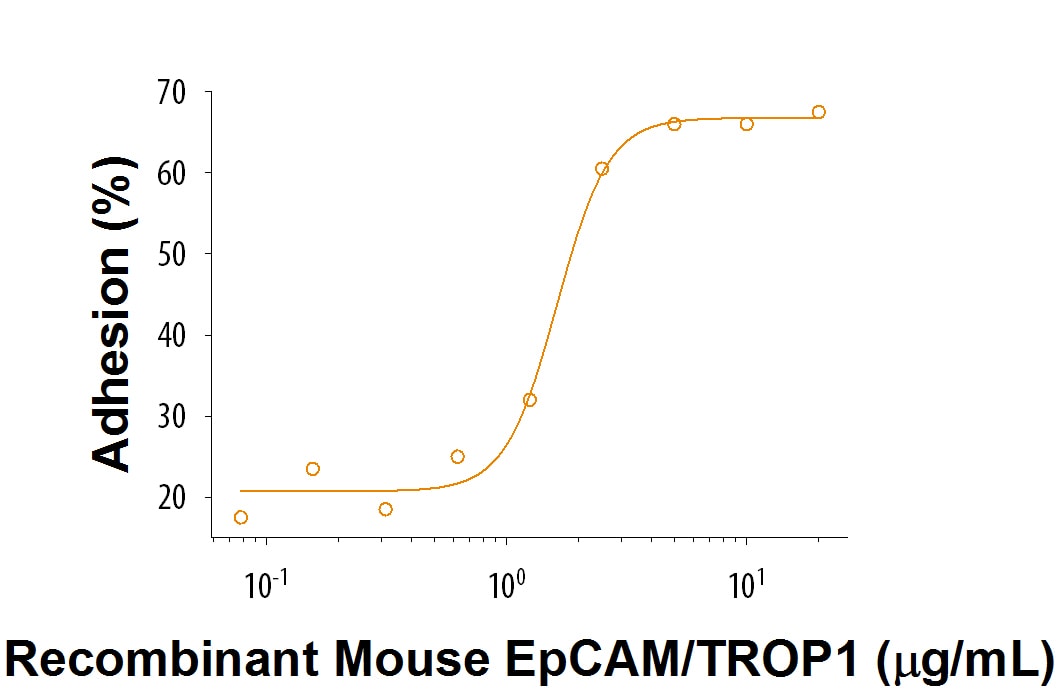
When 5 x 10⁴ cells/well are added to Recombinant Mouse EpCAM/TROP-1 and Human Fibronectin (0.5 μg/mL, Catalog # 1918-FN) coated plates, cell adhesion is enhanced in a dose dependent manner. The ED50 for this effect is 0.4-2.4 μg/mL
Scientific Data Images for Recombinant Mouse EpCAM/TROP1 Fc Chimera Protein, CF
Recombinant Mouse EpCAM/TROP1 Fc Chimera Protein Bioactivity
Immobilized Recombinant Mouse EpCAM/TROP1 (Catalog # 9364-EP) enhances L Cells mouse fibroblasts adhesion in the presence of Human Fibronectin (Catalog # 1918-FN). The ED50 for this effect is 0.4-2.4 µg/mL.Formulation, Preparation, and Storage
9364-EP
| Formulation | Lyophilized from a 0.2 μm filtered solution in PBS. |
| Reconstitution | Reconstitute at 500 μg/mL in PBS.
Loading...
|
| Shipping | The product is shipped at ambient temperature. Upon receipt, store it immediately at the temperature recommended below. |
| Stability & Storage | Use a manual defrost freezer and avoid repeated freeze-thaw cycles.
|
Calculators
Background: EpCAM/TROP1
References
- Balzar, M. et al. (1999) J. Mol. Med. 77:699.
- Keisuke, N. et al. (2009) PLoS One 4 :e8543
- Litvinov, S.V. et al. (1994) J. Cell Biol. 125:437.
- Balzar, M. et al. (2001) Mol. Cell. Biol. 21:2570.
- González, B. et al. (2009) Stem Cells, 27: 1782.
- Went, P. et al. (2006) Br. J. Cancer 94:128.
- Spizzo, G.S. et al. (2002) Int. J. Cancer 98:883.
Long Name
Alternate Names
Gene Symbol
UniProt
Additional EpCAM/TROP1 Products
Product Documents for Recombinant Mouse EpCAM/TROP1 Fc Chimera Protein, CF
Certificate of Analysis
To download a Certificate of Analysis, please enter a lot or batch number in the search box below.
Note: Certificate of Analysis not available for kit components.
Product Specific Notices for Recombinant Mouse EpCAM/TROP1 Fc Chimera Protein, CF
For research use only
Citations for Recombinant Mouse EpCAM/TROP1 Fc Chimera Protein, CF
 Powered by Bioz
Customer Reviews for Recombinant Mouse EpCAM/TROP1 Fc Chimera Protein, CF
There are currently no reviews for this product. Be the first to review Recombinant Mouse EpCAM/TROP1 Fc Chimera Protein, CF and earn rewards!
Have you used Recombinant Mouse EpCAM/TROP1 Fc Chimera Protein, CF?
Submit a review and receive an Amazon gift card!
$25/€18/£15/$25CAN/¥2500 for a review with an image
$10/€7/£6/$10CAN/¥1110 for a review without an image
Submit a review
FAQs for Recombinant Mouse EpCAM/TROP1 Fc Chimera Protein, CF
-
Q: Can you please provide the sequence of the Recombinant Mouse EpCAM/TROP1 Fc Chimera Protein, CF (Catalog # 9364-EP) and confirm that there is only one band in SDS-PAGE?
A: The sequence information of Recombinant Mouse EpCAM/TROP1 Fc Chimera Protein, CF (Catalog # 9364-EP) can be found under the Source section of the product datasheet. It is an NS0-derived mouse EpCAM/TROP1 protein with Gln24 & Arg81-Thr266 amino acid sequence that is fused to Mouse IgG2a via a linker sequence. Under reducing conditions in SDS-PAGE the protein migrates as a broad band at ~58-75 kDa and an 8 kDa band as well. More information can be requested by contacting techsupport@bio-techne.com.