
ROBO1 Antibody - BSA Free
Novus Biologicals | Catalog # NB600-1254

![Western Blot: ROBO1 Antibody [NB600-1254]](https://resources.rndsystems.com/images/products/ROBO1-Antibody-Western-Blot-NB600-1254-img0015.jpg "Western Blot: ROBO1 Antibody [NB600-1254]")
Scientific images may be resized, cropped, or adjusted for brightness or contrast for presentation purposes. These updates are limited to presentation and do not affect the underlying scientific interpretation of the data. Where available, additional source data may be provided upon request.
Key Product Details
Validated by
Species Reactivity
Applications
Label
Antibody Source
Format
Product Specifications
Immunogen
Reactivity Notes
Localization
Specificity
Clonality
Host
Isotype
Description
Store vial at -20C prior to opening. Aliquot contents and freeze at -20C or below for extended storage. Avoid cycles of freezing and thawing. Centrifuge product if not completely clear after standing at room temperature. This product is stable for several weeks at 4C as an undiluted liquid. Dilute only prior to immediate use.
Scientific Data Images for ROBO1 Antibody - BSA Free
Western Blot: ROBO1 Antibody [NB600-1254]
Western Blot: ROBO1 Antibody [NB600-1254] - Western Blot of ROBO1 antibody. Lane M: Super Signal Molecular Weight Marker.Lane 1: HeLa WCL. Load: 30 ug lysate.Primary antibody: ROBO1 antibody at 1:1,000 for overnight at 4C.Secondary antibody: Peroxidase rabbit secondary antibody at 1:40,000 for 30 min at RT.Block: Blocking Buffer for Fluorescent Western Blotting for 30 min at RT.Predicted/Observed size: 181 kDa, 181 kDa for ROBO1. Other band(s): lower bands not identified.![Immunocytochemistry/ Immunofluorescence: ROBO1 Antibody [NB600-1254]](https://resources.rndsystems.com/images/products/ROBO1-Antibody-Immunocytochemistry-Immunofluorescence-NB600-1254-img0005.jpg "Immunocytochemistry/ Immunofluorescence: ROBO1 Antibody [NB600-1254]")
Immunocytochemistry/ Immunofluorescence: ROBO1 Antibody [NB600-1254]
Immunocytochemistry/Immunofluorescence: ROBO1 Antibody [NB600-1254] - Staining of Robo1 in undifferentiated, immortalized human podocytes by Immunocytochemistry/ Immunofluorescence. Cells were fixed with 2% paraformaldehyde and 4% sucrose at room temperature for 10 minutes. The cells were then washed once with PBS, permeabilized with 0.3% Triton X-100 for 10 minutes and incubated with blocking solution (2% FCS, 2% BSA, 0.2% fish gelatin) for 30 minutes, before further incubation with primary Ab for 1 hour. An Alexa Fluor 488 goat anti-rabbit IgG secondary antibody was used at a dilution of 1/200. DAPI was used for nuclear counterstaining.![Immunohistochemistry: ROBO1 Antibody [NB600-1254]](https://resources.rndsystems.com/images/products/ROBO1-Antibody-Immunohistochemistry-NB600-1254-img0016.jpg "Immunohistochemistry: ROBO1 Antibody [NB600-1254]")
Immunohistochemistry: ROBO1 Antibody [NB600-1254]
Immunohistochemistry: ROBO1 Antibody [NB600-1254] - Affinity Purified ROBO1 antibody was used at a concentration of 5 ug/ml to detect ROBO1 in a variety of tissues including multi-human, multi-brain and multi-cancer slides. This image shows staining of human brain tissue. Tissue was formalin-fixed and paraffin embedded.![Western Blot: ROBO1 Antibody [NB600-1254]](https://resources.rndsystems.com/images/products/ROBO1-Antibody-Western-Blot-NB600-1254-img0012.jpg "Western Blot: ROBO1 Antibody [NB600-1254]")
Western Blot: ROBO1 Antibody [NB600-1254]
Western Blot: ROBO1 Antibody [NB600-1254] - Biotinylated human mTOR present in a 293T whole cell lysates. Cells were serum-starved for 24 hours prior to harvest. ~20ug of lysate was loaded per lane for SDS-PAGE. Untreated cells are shown in lane 1, whereas cells in lane 2 were treated with IGF-1 (100 ng/ml) for 20 min prior to harvest. Follow reaction of antibody with a 1:2000 dilution of HRP Goat-a-Rabbit IgG for visualization.![Western Blot: ROBO1 Antibody [NB600-1254]](https://resources.rndsystems.com/images/products/ROBO1-Antibody-Western-Blot-NB600-1254-img0013.jpg "Western Blot: ROBO1 Antibody [NB600-1254]")
Western Blot: ROBO1 Antibody [NB600-1254]
Western Blot: ROBO1 Antibody [NB600-1254] - Western blot using Affinity Purified ROBO1 antibody shows detection of a band at ~181 kDa corresponding to ROBO1 present in mouse brain lysate (arrowhead). Approximately 35 ug of lysate was separated by 4-8% SDS-PAGE and transferred onto nitrocellulose. After blocking the membrane was probed with the primary antibody diluted to 1:1,000. Reaction occurred 2h at room temperature followed by washes and reaction with a 1:10,000 dilution of IRDye(TM)800 conjugated Gt-a-Rabbit IgG [H&L] MX for 45 min at room temperature. IRDye(TM)800 fluorescence image was captured using the Odyssey(R) Infrared Imaging System developed by LI-COR. IRDye is a trademark of LI-COR, Inc. Other detection systems will yield similar results.![Western Blot: ROBO1 Antibody [NB600-1254]](https://resources.rndsystems.com/images/products/ROBO1-Antibody-Western-Blot-NB600-1254-img0014.jpg "Western Blot: ROBO1 Antibody [NB600-1254]")
Western Blot: ROBO1 Antibody [NB600-1254]
Western Blot: ROBO1 Antibody [NB600-1254] - Western Blot of ROBO1 antibody. Marker: Opal Pre-stained ladder. Lane 1: HEK293 lysate. Lane 2: HeLa Lysate. Lane 3: MCF-7 Lysate. Lane 4: Jurkat Lysate. Lane 5: A431 Lysate. Lane 6: A549 Lysate. Lane 7: LNCap Lysate. Lane 8: MOLT-4 Lysate. Lane 9: Ramos Lysate. Lane 10: Raji Lysate. Lane 11: A-172 Lysate. Lane 12: NIH/3T3 Lysate. Load: 35 ug per lane. Primary antibody: ROBO1 antibody at 1ug/mL overnight at 4C. Secondary antibody: Peroxidase rabbit secondary antibody at 1:30,000 for 60 min at RT. Blocking Buffer: 1% Casein-TTBS for 30 min at RT.Predicted/Observed size: 181kDa for ROBO1.![Immunohistochemistry: ROBO1 Antibody [NB600-1254]](https://resources.rndsystems.com/images/products/ROBO1-Antibody-Immunohistochemistry-NB600-1254-img0011.jpg "Immunohistochemistry: ROBO1 Antibody [NB600-1254]")
Immunohistochemistry: ROBO1 Antibody [NB600-1254]
Immunohistochemistry: ROBO1 Antibody [NB600-1254] - 1/50 staining mouse lung tissue sections (adult, frozen 100um wholemount sections) by IHC-Fr. The tissue was paraformaldehyde fixed and permeabilized with triton x-100 before incubation with the antibody for 16 hours at 4C.![ELISA: ROBO1 Antibody [NB600-1254]](https://resources.rndsystems.com/images/products/ROBO1-Antibody-ELISA-NB600-1254-img0017.jpg "ELISA: ROBO1 Antibody [NB600-1254]")
ELISA: ROBO1 Antibody [NB600-1254]
ELISA: ROBO1 Antibody [NB600-1254] - ELISA results of purified ROBO1 antibody tested against BSA-conjugated peptide of immunizing peptide. Each well was coated in duplicate with 0.1ug of conjugate. The starting dilution of antibody was 5ug/ml and the X-axis represents the Log10 of a 3-fold dilution. This titration is a 4-parameter curve fit where the IC50 is defined as the titer of the antibody. Assay performed using 3% fish gel, Goat anti-Rabbit IgG Antibody Peroxidase Conjugated (Min X Bv Ch Gt GP Ham Hs Hu Ms Rt & Sh Serum Proteins) and TMB ELISA Peroxidase Substrate.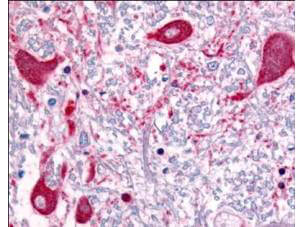
ROBO1 Antibody
Affinity Purified anti-ROBO1 antibody was used at a concentration of 5 ug/ml to detect ROBO1 in a variety of tissues including multi-human, multi-brain and multi-cancer slides. This image shows staining of human brain tissue. Tissue was formalin-fixed and paraffin embedded. Personal Communication, Tina Roush, LifeSpanBiosciences, Seattle, WA.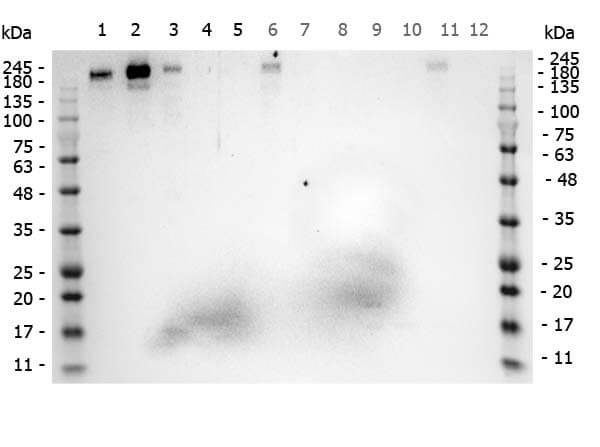
ROBO1 Antibody
Western Blot of ROBO1 Antibody antibody. Marker: Opal Pre-stained ladder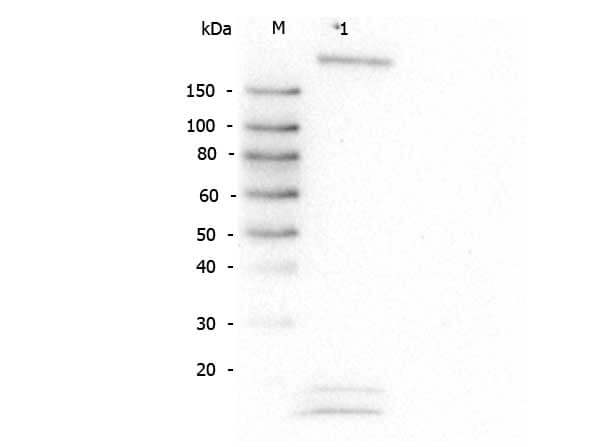
ROBO1 Antibody
Western Blot of Rabbit anti-Robo-1 antibody. Lane M: Super Signal Molecular Weight Marker. Lane 1: HeLa WCLApplications for ROBO1 Antibody - BSA Free
ELISA
Immunocytochemistry/ Immunofluorescence
Immunohistochemistry
Immunohistochemistry-Paraffin
Immunoprecipitation
Western Blot
Formulation, Preparation, and Storage
Purification
Formulation
Format
Preservative
Concentration
Shipping
Stability & Storage
Background: ROBO1
Long Name
Alternate Names
Entrez Gene IDs
Gene Symbol
UniProt
Additional ROBO1 Products
Product Documents for ROBO1 Antibody - BSA Free
Certificate of Analysis
To download a Certificate of Analysis, please enter a lot or batch number in the search box below.
Product Specific Notices for ROBO1 Antibody - BSA Free
This product is for research use only and is not approved for use in humans or in clinical diagnosis. Primary Antibodies are guaranteed for 1 year from date of receipt.
Customer Reviews for ROBO1 Antibody - BSA Free
There are currently no reviews for this product. Be the first to review ROBO1 Antibody - BSA Free and earn rewards!
Have you used ROBO1 Antibody - BSA Free?
Submit a review and receive an Amazon gift card!
$25/€18/£15/$25CAN/¥2500 for a review with an image
$10/€7/£6/$10CAN/¥1110 for a review without an image
Submit a review
Protocols
Find general support by application which include: protocols, troubleshooting, illustrated assays, videos and webinars.
- Antigen Retrieval Protocol (PIER)
- Antigen Retrieval for Frozen Sections Protocol
- Appropriate Fixation of IHC/ICC Samples
- Cellular Response to Hypoxia Protocols
- Chromogenic IHC Staining of Formalin-Fixed Paraffin-Embedded (FFPE) Tissue Protocol
- Chromogenic Immunohistochemistry Staining of Frozen Tissue
- ClariTSA™ Fluorophore Kits
- Detection & Visualization of Antibody Binding
- ELISA Sample Preparation & Collection Guide
- ELISA Troubleshooting Guide
- Fluorescent IHC Staining of Frozen Tissue Protocol
- Graphic Protocol for Heat-induced Epitope Retrieval
- Graphic Protocol for the Preparation and Fluorescent IHC Staining of Frozen Tissue Sections
- Graphic Protocol for the Preparation and Fluorescent IHC Staining of Paraffin-embedded Tissue Sections
- Graphic Protocol for the Preparation of Gelatin-coated Slides for Histological Tissue Sections
- How to Run an R&D Systems DuoSet ELISA
- How to Run an R&D Systems Quantikine ELISA
- How to Run an R&D Systems Quantikine™ QuicKit™ ELISA
- ICC Cell Smear Protocol for Suspension Cells
- ICC Immunocytochemistry Protocol Videos
- ICC for Adherent Cells
- IHC Sample Preparation (Frozen sections vs Paraffin)
- Immunocytochemistry (ICC) Protocol
- Immunocytochemistry Troubleshooting
- Immunofluorescence of Organoids Embedded in Cultrex Basement Membrane Extract
- Immunofluorescent IHC Staining of Formalin-Fixed Paraffin-Embedded (FFPE) Tissue Protocol
- Immunohistochemistry (IHC) and Immunocytochemistry (ICC) Protocols
- Immunohistochemistry Frozen Troubleshooting
- Immunohistochemistry Paraffin Troubleshooting
- Immunoprecipitation Protocol
- Preparing Samples for IHC/ICC Experiments
- Preventing Non-Specific Staining (Non-Specific Binding)
- Primary Antibody Selection & Optimization
- Protocol for Heat-Induced Epitope Retrieval (HIER)
- Protocol for Making a 4% Formaldehyde Solution in PBS
- Protocol for VisUCyte™ HRP Polymer Detection Reagent
- Protocol for the Fluorescent ICC Staining of Cell Smears - Graphic
- Protocol for the Fluorescent ICC Staining of Cultured Cells on Coverslips - Graphic
- Protocol for the Preparation & Fixation of Cells on Coverslips
- Protocol for the Preparation and Chromogenic IHC Staining of Frozen Tissue Sections
- Protocol for the Preparation and Chromogenic IHC Staining of Frozen Tissue Sections - Graphic
- Protocol for the Preparation and Chromogenic IHC Staining of Paraffin-embedded Tissue Sections
- Protocol for the Preparation and Chromogenic IHC Staining of Paraffin-embedded Tissue Sections - Graphic
- Protocol for the Preparation and Fluorescent ICC Staining of Cells on Coverslips
- Protocol for the Preparation and Fluorescent ICC Staining of Non-adherent Cells
- Protocol for the Preparation and Fluorescent ICC Staining of Stem Cells on Coverslips
- Protocol for the Preparation and Fluorescent IHC Staining of Frozen Tissue Sections
- Protocol for the Preparation and Fluorescent IHC Staining of Paraffin-embedded Tissue Sections
- Protocol for the Preparation of Gelatin-coated Slides for Histological Tissue Sections
- Protocol for the Preparation of a Cell Smear for Non-adherent Cell ICC - Graphic
- Quantikine HS ELISA Kit Assay Principle, Alkaline Phosphatase
- Quantikine HS ELISA Kit Principle, Streptavidin-HRP Polymer
- R&D Systems Quality Control Western Blot Protocol
- Sandwich ELISA (Colorimetric) – Biotin/Streptavidin Detection Protocol
- Sandwich ELISA (Colorimetric) – Direct Detection Protocol
- TUNEL and Active Caspase-3 Detection by IHC/ICC Protocol
- The Importance of IHC/ICC Controls
- Troubleshooting Guide: ELISA
- Troubleshooting Guide: Immunohistochemistry
- Troubleshooting Guide: Western Blot Figures
- Western Blot Conditions
- Western Blot Protocol
- Western Blot Protocol for Cell Lysates
- Western Blot Troubleshooting
- Western Blot Troubleshooting Guide
- View all Protocols, Troubleshooting, Illustrated assays and Webinars