
RPE65 Antibody (401.8B11.3D9) [DyLight 650]
Novus Biologicals | Catalog # NB100-355C

Key Product Details
Species Reactivity
Human, Mouse, Rat, Porcine, Bovine, Canine, Chicken, Primate, Xenopus
Applications
Knockout Validated, Immunohistochemistry, Immunohistochemistry-Paraffin, Immunohistochemistry-Frozen, Western Blot, Flow Cytometry, Immunofluorescence, Immunocytochemistry/ Immunofluorescence, Immunoprecipitation, In vivo assay, CyTOF-ready
Label
DyLight 650 (Excitation = 652 nm, Emission = 672 nm)
Antibody Source
Monoclonal Mouse IgG1 kappa Clone # 401.8B11.3D9
Loading...
Product Specifications
Immunogen
This RPE65 Antibody (401.8B11.3D9) was developed against bovine RPE65 microsomal membrane proteins. [UniProt# Q28175]
Reactivity Notes
Primate reactivity reported in scientific literature (PMID: 31660416).
Localization
Cytoplasmic, Microsomeal and Cell Membrane
Marker
Retinal Pigment Epithelium Marker
Clonality
Monoclonal
Host
Mouse
Isotype
IgG1 kappa
Description
This conjugate is made on demand and is not held in inventory. Each order represents a unique lot. All conjugates are generated using validated conjugation protocols and meet strict degree of labeling (F/P) specifications; additional information is available upon request. The antibody concentration is provided on the individual product label.
For specialized conjugation needs, like large quantities, specific concentrations, and defined F/P ratios, bulk and custom antibody conjugation services are available.
For specialized conjugation needs, like large quantities, specific concentrations, and defined F/P ratios, bulk and custom antibody conjugation services are available.
Applications for RPE65 Antibody (401.8B11.3D9) [DyLight 650]
Application
Recommended Usage
CyTOF-ready
Optimal dilutions of this antibody should be experimentally determined.
Flow Cytometry
Optimal dilutions of this antibody should be experimentally determined.
Immunocytochemistry/ Immunofluorescence
Optimal dilutions of this antibody should be experimentally determined.
Immunofluorescence
Optimal dilutions of this antibody should be experimentally determined.
Immunohistochemistry
Optimal dilutions of this antibody should be experimentally determined.
Immunohistochemistry-Frozen
Optimal dilutions of this antibody should be experimentally determined.
Immunohistochemistry-Paraffin
Optimal dilutions of this antibody should be experimentally determined.
Immunoprecipitation
Optimal dilutions of this antibody should be experimentally determined.
In vivo assay
Optimal dilutions of this antibody should be experimentally determined.
Knockout Validated
Optimal dilutions of this antibody should be experimentally determined.
Western Blot
Optimal dilutions of this antibody should be experimentally determined.
Application Notes
Recommended applications are based on validated applications from the unconjugated base product NB100-355. This conjugated antibody is not kept in inventory and is made to order using validated conjugation protocols.
Spectra Viewer
Plan Your Experiments
Use our spectra viewer to interactively plan your experiments, assessing multiplexing options. View the excitation and emission spectra for our fluorescent dye range and other commonly used dyes.
Spectra Viewer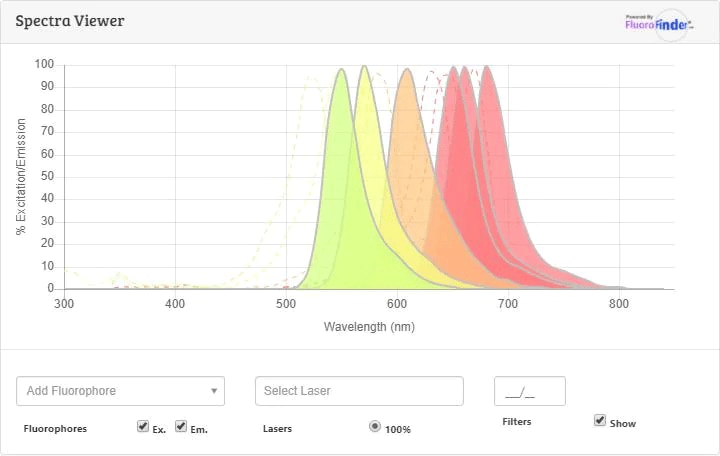
Flow Cytometry Panel Builder
Bio-Techne Knows Flow Cytometry
Save time and reduce costly mistakes by quickly finding compatible reagents using the Panel Builder Tool.
Advanced Features
- Spectra Viewer - Custom analysis of spectra from multiple fluorochromes
- Spillover Popups - Visualize the spectra of individual fluorochromes
- Antigen Density Selector - Match fluorochrome brightness with antigen density

Formulation, Preparation, and Storage
Purification
Protein G purified
Formulation
50mM Sodium Borate
Preservative
0.05% Sodium Azide
Concentration
Please see the vial label for concentration. If unlisted please contact technical services.
Shipping
The product is shipped with polar packs. Upon receipt, store it immediately at the temperature recommended below.
Stability & Storage
Store at 4C in the dark.
Background: RPE65
Given its essential role in the vision cycle, it is understandable that mutations in RPE65 are associated with a variety of inherited retinal dystrophies (1, 3-6). Leber Congenital Amaurosis (LCA) and retinitis pigmentosa (RP) are two of the most common retinal dystrophies associated with bi-allelic RPE65 gene mutations (5,6). In 2017 the FDA approved an in vivo gene therapy for treatment of RPE65-associated diseases (5,6). The drug Voretigene Neparvovec, also called Luxturna, is delivered sub-retinally and transduces RPE cells with cDNA encoding for normal RPE65 to help restore vision (5,6). There are several promising completed and ongoing clinical trials for treating RPE65-associated diseases using gene replacement therapy (5).
References
1. Kiser, P. D., & Palczewski, K. (2010). Membrane-binding and enzymatic properties of RPE65. Progress in retinal and eye research. https://doi.org/10.1016/j.preteyeres.2010.03.002
2. Uppal, S., Poliakov, E., Gentleman, S., & Redmond, T. M. (2019). RPE65 Palmitoylation: A Tale of Lipid Posttranslational Modification. Advances in experimental medicine and biology. https://doi.org/10.1007/978-3-030-27378-1_88
3. Redmond T. M. (2009). Focus on Molecules: RPE65, the visual cycle retinol isomerase. Experimental eye research. https://doi.org/10.1016/j.exer.2008.07.015
4. Saari J. C. (2016). Vitamin A and Vision. Sub-cellular biochemistry. https://doi.org/10.1007/978-94-024-0945-1_9
5. Miraldi Utz, V., Coussa, R. G., Antaki, F., & Traboulsi, E. I. (2018). Gene therapy for RPE65-related retinal disease. Ophthalmic genetics. https://doi.org/10.1080/13816810.2018.1533027
6. Apte R. S. (2018). Gene Therapy for Retinal Degeneration. Cell. https://doi.org/10.1016/j.cell.2018.03.021
Alternate Names
All-trans-retinyl-palmitate hydrolase, BCO family, member 3, BCO3, EC 3.1.1.64, EC:3.1.1.64, EC:5.3.3.22, LCA2, lutein isomerase, meso-zeaxanthin isomerase, mRPE65, p63, RBP-binding membrane protein, rd12, retinal pigment epithelium specific protein 65, Retinal pigment epithelium-specific 65 kDa protein, retinal pigment epithelium-specific protein 65kDa, retinitis pigmentosa 20 (autosomal recessive), retinoid isomerohydrolase, Retinol isomerase, RP20, RPE65, RPE65, retinoid isomerohydrolase, sRPE65
Gene Symbol
RPE65
Additional RPE65 Products
Product Documents for RPE65 Antibody (401.8B11.3D9) [DyLight 650]
Certificate of Analysis
To download a Certificate of Analysis, please enter a lot or batch number in the search box below.
Product Specific Notices for RPE65 Antibody (401.8B11.3D9) [DyLight 650]
DyLight (R) is a trademark of Thermo Fisher Scientific Inc. and its subsidiaries.
This product is for research use only and is not approved for use in humans or in clinical diagnosis. Primary Antibodies are guaranteed for 1 year from date of receipt.
Customer Reviews for RPE65 Antibody (401.8B11.3D9) [DyLight 650]
There are currently no reviews for this product. Be the first to review RPE65 Antibody (401.8B11.3D9) [DyLight 650] and earn rewards!
Have you used RPE65 Antibody (401.8B11.3D9) [DyLight 650]?
Submit a review and receive an Amazon gift card!
$25/€18/£15/$25CAN/¥2500 for a review with an image
$10/€7/£6/$10CAN/¥1110 for a review without an image
Submit a review
Protocols
Find general support by application which include: protocols, troubleshooting, illustrated assays, videos and webinars.
- 7-Amino Actinomycin D (7-AAD) Cell Viability Flow Cytometry Protocol
- Antigen Retrieval Protocol (PIER)
- Antigen Retrieval for Frozen Sections Protocol
- Appropriate Fixation of IHC/ICC Samples
- Cellular Response to Hypoxia Protocols
- Chromogenic IHC Staining of Formalin-Fixed Paraffin-Embedded (FFPE) Tissue Protocol
- Chromogenic Immunohistochemistry Staining of Frozen Tissue
- ClariTSA™ Fluorophore Kits
- Detection & Visualization of Antibody Binding
- Extracellular Membrane Flow Cytometry Protocol
- Flow Cytometry Protocol for Cell Surface Markers
- Flow Cytometry Protocol for Staining Membrane Associated Proteins
- Flow Cytometry Staining Protocols
- Flow Cytometry Troubleshooting Guide
- Fluorescent IHC Staining of Frozen Tissue Protocol
- Graphic Protocol for Heat-induced Epitope Retrieval
- Graphic Protocol for the Preparation and Fluorescent IHC Staining of Frozen Tissue Sections
- Graphic Protocol for the Preparation and Fluorescent IHC Staining of Paraffin-embedded Tissue Sections
- Graphic Protocol for the Preparation of Gelatin-coated Slides for Histological Tissue Sections
- ICC Cell Smear Protocol for Suspension Cells
- ICC Immunocytochemistry Protocol Videos
- ICC for Adherent Cells
- IHC Sample Preparation (Frozen sections vs Paraffin)
- Immunocytochemistry (ICC) Protocol
- Immunocytochemistry Troubleshooting
- Immunofluorescence of Organoids Embedded in Cultrex Basement Membrane Extract
- Immunofluorescent IHC Staining of Formalin-Fixed Paraffin-Embedded (FFPE) Tissue Protocol
- Immunohistochemistry (IHC) and Immunocytochemistry (ICC) Protocols
- Immunohistochemistry Frozen Troubleshooting
- Immunohistochemistry Paraffin Troubleshooting
- Immunoprecipitation Protocol
- Intracellular Flow Cytometry Protocol Using Alcohol (Methanol)
- Intracellular Flow Cytometry Protocol Using Detergents
- Intracellular Nuclear Staining Flow Cytometry Protocol Using Detergents
- Intracellular Staining Flow Cytometry Protocol Using Alcohol Permeabilization
- Intracellular Staining Flow Cytometry Protocol Using Detergents to Permeabilize Cells
- Preparing Samples for IHC/ICC Experiments
- Preventing Non-Specific Staining (Non-Specific Binding)
- Primary Antibody Selection & Optimization
- Propidium Iodide Cell Viability Flow Cytometry Protocol
- Protocol for Heat-Induced Epitope Retrieval (HIER)
- Protocol for Liperfluo
- Protocol for Making a 4% Formaldehyde Solution in PBS
- Protocol for VisUCyte™ HRP Polymer Detection Reagent
- Protocol for the Characterization of Human Th22 Cells
- Protocol for the Characterization of Human Th9 Cells
- Protocol for the Fluorescent ICC Staining of Cell Smears - Graphic
- Protocol for the Fluorescent ICC Staining of Cultured Cells on Coverslips - Graphic
- Protocol for the Preparation & Fixation of Cells on Coverslips
- Protocol for the Preparation and Chromogenic IHC Staining of Frozen Tissue Sections
- Protocol for the Preparation and Chromogenic IHC Staining of Frozen Tissue Sections - Graphic
- Protocol for the Preparation and Chromogenic IHC Staining of Paraffin-embedded Tissue Sections
- Protocol for the Preparation and Chromogenic IHC Staining of Paraffin-embedded Tissue Sections - Graphic
- Protocol for the Preparation and Fluorescent ICC Staining of Cells on Coverslips
- Protocol for the Preparation and Fluorescent ICC Staining of Non-adherent Cells
- Protocol for the Preparation and Fluorescent ICC Staining of Stem Cells on Coverslips
- Protocol for the Preparation and Fluorescent IHC Staining of Frozen Tissue Sections
- Protocol for the Preparation and Fluorescent IHC Staining of Paraffin-embedded Tissue Sections
- Protocol for the Preparation of Gelatin-coated Slides for Histological Tissue Sections
- Protocol for the Preparation of a Cell Smear for Non-adherent Cell ICC - Graphic
- Protocol: Annexin V and PI Staining by Flow Cytometry
- Protocol: Annexin V and PI Staining for Apoptosis by Flow Cytometry
- R&D Systems Quality Control Western Blot Protocol
- TUNEL and Active Caspase-3 Detection by IHC/ICC Protocol
- The Importance of IHC/ICC Controls
- Troubleshooting Guide: Fluorokine Flow Cytometry Kits
- Troubleshooting Guide: Immunohistochemistry
- Troubleshooting Guide: Western Blot Figures
- Western Blot Conditions
- Western Blot Protocol
- Western Blot Protocol for Cell Lysates
- Western Blot Troubleshooting
- Western Blot Troubleshooting Guide
- View all Protocols, Troubleshooting, Illustrated assays and Webinars
FAQs for RPE65 Antibody (401.8B11.3D9) [DyLight 650]
Showing
1
-
1 of
1 FAQ
Showing All
-
Q: I have a customer wanting to know if there is any data that we can send them for your prod #NB100-355C RPE65 Antibody Dylight 655.
A: NB100-355C is the same as NB100-355 it is just conjugated. You can send them the data on our website for NB100-355. NB100-355C should behave similarly.
Loading...