RUNX2/CBFA1 Antibody - BSA Free
Novus Biologicals | Catalog # NBP1-77461

![Immunohistochemistry-Paraffin: RUNX2/CBFA1 Antibody - BSA Free [NBP1-77461]](https://resources.rndsystems.com/images/products/RUNX2-CBFA1-Antibody-Immunohistochemistry-Paraffin-NBP1-77461-img0009.jpg "Immunohistochemistry-Paraffin: RUNX2/CBFA1 Antibody - BSA Free [NBP1-77461]")
Scientific images may be resized, cropped, or adjusted for brightness or contrast for presentation purposes. These updates are limited to presentation and do not affect the underlying scientific interpretation of the data. Where available, additional source data may be provided upon request.
Key Product Details
Species Reactivity
Validated:
Human, Mouse
Cited:
Human, Mouse
Applications
Validated:
Immunohistochemistry, Immunohistochemistry-Paraffin, Western Blot, Immunocytochemistry/ Immunofluorescence
Cited:
Immunohistochemistry-Paraffin, Western Blot, Immunocytochemistry/ Immunofluorescence, IF/IHC
Label
Unconjugated
Antibody Source
Polyclonal Rabbit IgG
Format
BSA Free
Loading...
Product Specifications
Immunogen
This RUNX2/CBFA1 Antibody was prepared from a synthetic peptide made to an internal region of the human RUNX2 protein (within residues 300-375). [Swiss-Prot Q13950]
Localization
Nucleus
Clonality
Polyclonal
Host
Rabbit
Isotype
IgG
Theoretical MW
56.6 kDa.
Disclaimer note: The observed molecular weight of the protein may vary from the listed predicted molecular weight due to post translational modifications, post translation cleavages, relative charges, and other experimental factors.
Disclaimer note: The observed molecular weight of the protein may vary from the listed predicted molecular weight due to post translational modifications, post translation cleavages, relative charges, and other experimental factors.
Scientific Data Images for RUNX2/CBFA1 Antibody - BSA Free
Immunohistochemistry-Paraffin: RUNX2/CBFA1 Antibody - BSA Free [NBP1-77461]
RUNX2-CBFA1-Antibody-Immunohistochemistry-Paraffin-NBP1-77461-img0009.jpg![Immunocytochemistry/ Immunofluorescence: RUNX2/CBFA1 Antibody - BSA Free [NBP1-77461]](https://resources.rndsystems.com/images/products/RUNX2-CBFA1-Antibody-Immunocytochemistry-Immunofluorescence-NBP1-77461-img0010.jpg "Immunocytochemistry/ Immunofluorescence: RUNX2/CBFA1 Antibody - BSA Free [NBP1-77461]")
Immunocytochemistry/ Immunofluorescence: RUNX2/CBFA1 Antibody - BSA Free [NBP1-77461]
Immunocytochemistry/Immunofluorescence: RUNX2/CBFA1 Antibody [NBP1-77461] - HeLa cells were fixed in 4% paraformaldehyde for 10 minutes and permeabilized in 0.5% Triton X-100 in PBS for 5 minutes. The cells were incubated with RUNX2/CBFA1 Antibody (NBP1-77461) at 1 ug/ml overnight at 4C and detected with an anti-rabbit Dylight 488 (Green) at a 1:1000 dilution for 60 minutes. Nuclei were counterstained with DAPI (Blue). Cells were imaged using a 100X objective and digitally deconvolved.![Immunohistochemistry-Paraffin: RUNX2/CBFA1 Antibody - BSA Free [NBP1-77461]](https://resources.rndsystems.com/images/products/RUNX2-CBFA1-Antibody-Immunohistochemistry-Paraffin-NBP1-77461-img0008.jpg "Immunohistochemistry-Paraffin: RUNX2/CBFA1 Antibody - BSA Free [NBP1-77461]")
Immunohistochemistry-Paraffin: RUNX2/CBFA1 Antibody - BSA Free [NBP1-77461]
RUNX2-CBFA1-Antibody-Immunohistochemistry-Paraffin-NBP1-77461-img0008.jpg![Immunohistochemistry: RUNX2/CBFA1 Antibody - BSA Free [NBP1-77461]](https://resources.rndsystems.com/images/products/RUNX2-CBFA1-Antibody-Immunohistochemistry-NBP1-77461-img0006.jpg "Immunohistochemistry: RUNX2/CBFA1 Antibody - BSA Free [NBP1-77461]")
Immunohistochemistry: RUNX2/CBFA1 Antibody - BSA Free [NBP1-77461]
Immunohistochemistry: RUNX2/CBFA1 Antibody [NBP1-77461] - Staining of RUNX2 in mouse prostate using DAB with hematoxylin counterstain.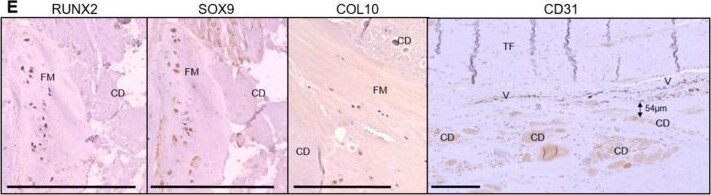
Immunohistochemistry: RUNX2/CBFA1 Antibody - BSA Free [NBP1-77461] -
Immunohistochemistry: RUNX2/CBFA1 Antibody - BSA Free [NBP1-77461] - Histological characterization of rotator cuff calcifications (N = 5). (A) Calcific deposits assessed by micro-computed tomography. (B) HE (hematoxylin & eosin) staining of decalcified samples (1 image for each patient). (C) Von Kossa staining on not decalcified samples & characterization of the fibrocartilaginous area with alcian blue staining, SOFG (Safranin O/Fast Green) staining, & immunohistochemical staining for COL2 (brown) with Gill hematoxylin counterstain. (D,E) Representative immunohistochemical staining for ENPP1 (ectonucleotide pyrophosphatase/phosphodiesterase 1), TNAP (tissue non-specific alkaline phosphatase), Runx2, Sox9, Col10 & CD31 (brown). TF: tendon fibers; CD: calcium deposits, FM: fibrocartilaginous metaplasia; OM: osseous metaplasia; CT: connective tissue; V: vessels. Scale bar = 200 µM. Image collected & cropped by CiteAb from the following publication (https://pubmed.ncbi.nlm.nih.gov/31561454), licensed under a CC-BY license. Not internally tested by Novus Biologicals.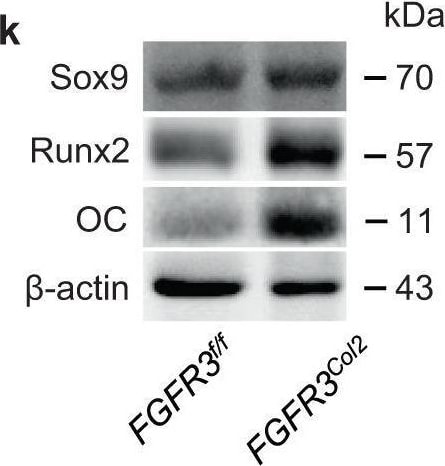
Western Blot: RUNX2/CBFA1 Antibody - BSA Free [NBP1-77461] -
FGFR3 deficiency in Col2+ lineage cells promotes acquired HO formation.a Experimental strategy of tamoxifen administration and acquired HO induction. b Representative X-ray (left) and μCT (right) images of ectopic bone in FGFR3f/f and FGFR3Col2 mice at 8 weeks after tenotomy. n = 8 per group. Scale bars, 2 mm for X-ray; 1 mm for μCT. c–e Representative H&E and SOFG images of ectopic bone in FGFR3f/f and FGFR3Col2 mice at 8 weeks after tenotomy and histomorphometry analysis. n = 8 per group. Scale bars, 200 μm. f–i Representative immunohistochemical staining of Runx2 (gFGFR3f/f = 6, FGFR3Col2 = 8) and OC (iFGFR3f/f = 6, FGFR3Col2 = 6) and relative quantitative analysis (g, i). Scale bars, 100 μm. j mRNA levels of ACAN and OC in the Achilles tendon of FGFR3f/f and FGFR3Col2 mice at 8 weeks post surgery. n = 3 per group. k Protein levels of Sox9, Runx2, and OC in the Achilles tendon of FGFR3f/f and FGFR3Col2 mice at 8 weeks post surgery. n = 3 per group. All data represent mean +/- SEM. ***P < 0.001 by unpaired two-tailed Student’s t-test. Image collected and cropped by CiteAb from the following open publication (https://pubmed.ncbi.nlm.nih.gov/34282140), licensed under a CC-BY license. Not internally tested by Novus Biologicals.Applications for RUNX2/CBFA1 Antibody - BSA Free
Application
Recommended Usage
Immunocytochemistry/ Immunofluorescence
1:100
Immunohistochemistry
1:200
Immunohistochemistry-Paraffin
1:200
Western Blot
reported in scientific literature (PMID 29208768)
Application Notes
Prior to immunostaining paraffin tissues antigen retrieval with sodium citrate buffer (pH 6.0) is recommended.
Formulation, Preparation, and Storage
Purification
Immunogen affinity purified
Formulation
PBS and 30% Glycerol
Format
BSA Free
Preservative
0.05% Sodium Azide
Concentration
1 mg/ml
Shipping
The product is shipped with polar packs. Upon receipt, store it immediately at the temperature recommended below.
Stability & Storage
Store at 4C short term. Aliquot and store at -20C long term. Avoid freeze-thaw cycles.
Background: RUNX2/CBFA1
Functionally, RUNX2 promotes the expression of osteoblast-specific genes vital for the osteoblast differentiation and proliferation process including type I collagen, osteocalcin (OCN), and alkaline phosphatase (APC) (1, 3). Further evidence for the role of RUNX2 is highlighted by a study of Runx2-/-mice which completely lack osteoblasts (4). Additionally, RUNX2 is also required for chondrocyte maturation, which are the cells responsible for cartilage formation (1, 3, 5). Given the role of RUNX2 in bone and cartilage maturation and formation, it is clear that defects or mutations in RUNX2 cause various bone and bone-related diseases (3, 6, 7). For instance, cleidocranial dysplasia (CCD), which presents with delayed cranial suture closure phenotypes, hypoplastic clavicles, extra teeth, and short stature, is caused by haploinsufficiency in RUNX2 (2, 3, 6). Furthermore, metaphyseal dysplasia with maxillary hypoplasia and brachydactyly (MDMHB) is a bone dysplasia disorder with a phenotype of abnormalities in the long bones, an underdeveloped jawbone, and short fingers that is caused by a duplication in RUNX2 (6). Finally, RUNX2 has been shown to be upregulated in mouse models of the joint disorder osteoarthritis (OA) and may be a potential molecular target for disease treatment (7).
Alternative names for RUNX2 include Acute myeloid leukemia 3 protein CBFA1, CBF-alpha-1, CCD1, CCDAML3, CLCD, Core-binding factor subunit alpha-1, MGC120023, ML3, oncogene AML-3, OSF2, osteoblast-specific transcription factor 2, PEA2aA, PEA2-alpha A, PEBP2A, polyomavirus enhancer-binding protein 2 alpha A subunit, runt related transcription factor 2, SL3/AKV core-binding factor alpha A subunit, and SL3-3 enhancer factor 1 alpha A subunit.
References
1. Ferreira, L. B., Gimba, E., Vinagre, J., Sobrinho-Simoes, M., & Soares, P. (2020). Molecular Aspects of Thyroid Calcification. International journal of molecular sciences. https://doi.org/10.3390/ijms21207718
2. Kim, W. J., Shin, H. L., Kim, B. S., Kim, H. J., & Ryoo, H. M. (2020). RUNX2-modifying enzymes: therapeutic targets for bone diseases. Experimental & molecular medicine. https://doi.org/10.1038/s12276-020-0471-4
3. Vimalraj, S., Arumugam, B., Miranda, P. J., & Selvamurugan, N. (2015). Runx2: Structure, function, and phosphorylation in osteoblast differentiation. International journal of biological macromolecules. https://doi.org/10.1016/j.ijbiomac.2015.04.008
4. Uniprot (Q13950)
5. Komori T. (2017). Roles of Runx2 in Skeletal Development. Advances in experimental medicine and biology. https://doi.org/10.1007/978-981-10-3233-2_6
6. Moffatt, P., Ben Amor, M., Glorieux, F. H., Roschger, P., Klaushofer, K., Schwartzentruber, J. A., Paterson, A. D., Hu, P., Marshall, C., FORGE Canada Consortium, Fahiminiya, S., Majewski, J., Beaulieu, C. L., Boycott, K. M., & Rauch, F. (2013). Metaphyseal dysplasia with maxillary hypoplasia and brachydactyly is caused by a duplication in RUNX2. American journal of human genetics. https://doi.org/10.1016/j.ajhg.2012.12.001
7. Chen, D., Kim, D. J., Shen, J., Zou, Z., & O'Keefe, R. J. (2019). Runx2 plays a central role in Osteoarthritis development. Journal of orthopaedic translation. https://doi.org/10.1016/j.jot.2019.11.008
Long Name
Runt-related Transcription Factor 2
Alternate Names
CBFA1
Gene Symbol
RUNX2
UniProt
Additional RUNX2/CBFA1 Products
Product Documents for RUNX2/CBFA1 Antibody - BSA Free
Certificate of Analysis
To download a Certificate of Analysis, please enter a lot or batch number in the search box below.
Product Specific Notices for RUNX2/CBFA1 Antibody - BSA Free
This product is for research use only and is not approved for use in humans or in clinical diagnosis. Primary Antibodies are guaranteed for 1 year from date of receipt.
Citations for RUNX2/CBFA1 Antibody - BSA Free
 Powered by Bioz
Customer Reviews for RUNX2/CBFA1 Antibody - BSA Free
There are currently no reviews for this product. Be the first to review RUNX2/CBFA1 Antibody - BSA Free and earn rewards!
Have you used RUNX2/CBFA1 Antibody - BSA Free?
Submit a review and receive an Amazon gift card!
$25/€18/£15/$25CAN/¥2500 for a review with an image
$10/€7/£6/$10CAN/¥1110 for a review without an image
Submit a review
Protocols
View specific protocols for RUNX2/CBFA1 Antibody - BSA Free (NBP1-77461):
RUNX2/CBFA1 Antibody:
Culture cells to appropriate density in 35 mm culture dishes or 6-well plates.
1. Remove culture medium and add 10% formalin to the dish. Fix at room temperature for 30 minutes.
2. Remove the formalin and add ice cold methanol. Incubate for 5-10 minutes.
3. Remove methanol and add washing solution (i.e. PBS). Be sure to not let the specimen dry out. Wash three times for 10 minutes.
4. To block nonspecific antibody binding incubate in 10% normal goat serum from 1 hour to overnight at room temperature.
5. Add primary antibody at appropriate dilution and incubate at room temperature from 2 hours to overnight at room temperature.
6. Remove primary antibody and replace with washing solution. Wash three times for 10 minutes.
7. Add secondary antibody at appropriate dilution. Incubate for 1 hour at room temperature.
8. Remove antibody and replace with wash solution, then wash for 10 minutes. Add Hoechst 33258 to wash solution at 1:25,0000 and incubate for 10 minutes. Wash a third time for 10 minutes.
9. Cells can be viewed directly after washing. The plates can also be stored in PBS containing Azide covered in Parafilm (TM). Cells can also be cover-slipped using Fluoromount, with appropriate sealing.
*The above information is only intended as a guide. The researcher should determine what protocol best meets their needs. Please follow safe laboratory procedures.
Culture cells to appropriate density in 35 mm culture dishes or 6-well plates.
1. Remove culture medium and add 10% formalin to the dish. Fix at room temperature for 30 minutes.
2. Remove the formalin and add ice cold methanol. Incubate for 5-10 minutes.
3. Remove methanol and add washing solution (i.e. PBS). Be sure to not let the specimen dry out. Wash three times for 10 minutes.
4. To block nonspecific antibody binding incubate in 10% normal goat serum from 1 hour to overnight at room temperature.
5. Add primary antibody at appropriate dilution and incubate at room temperature from 2 hours to overnight at room temperature.
6. Remove primary antibody and replace with washing solution. Wash three times for 10 minutes.
7. Add secondary antibody at appropriate dilution. Incubate for 1 hour at room temperature.
8. Remove antibody and replace with wash solution, then wash for 10 minutes. Add Hoechst 33258 to wash solution at 1:25,0000 and incubate for 10 minutes. Wash a third time for 10 minutes.
9. Cells can be viewed directly after washing. The plates can also be stored in PBS containing Azide covered in Parafilm (TM). Cells can also be cover-slipped using Fluoromount, with appropriate sealing.
*The above information is only intended as a guide. The researcher should determine what protocol best meets their needs. Please follow safe laboratory procedures.
RUNX2/CBFA1 Antibody:
Immunohistochemistry-Paraffin Embedded Sections
Antigen Unmasking:
Bring slides to a boil in 10 mM sodium citrate buffer (pH 6.0) then maintain at a sub-boiling temperature for 10 minutes. Cool slides on bench-top for 30 minutes.
Staining:
1. Wash sections in deionized water three times for 5 minutes each.
2. Wash sections in wash buffer for 5 minutes.
3. Block each section with 100-400 ul blocking solution for 1 hour at room temperature.
4. Remove blocking solution and add 100-400 ul diluted primary antibody. Incubate overnight at 4C.
5. Remove antibody solution and wash sections in wash buffer three times for 5 minutes each.
6. Add 100-400 ul biotinylated diluted secondary antibody. Incubate 30 minutes at room temperature.
7. Remove secondary antibody solution and wash sections three times with wash buffer for 5 minutes each.
8. Add 100-400 ul Streptavidin-HRP reagent to each section and incubate for 30 minutes at room temperature.
9. Wash sections three times in wash buffer for 5 minutes each.
10. Add 100-400 ul DAB substrate to each section and monitor staining closely.
11. As soon as the sections develop, immerse slides in deionized water.
12. Counterstain sections in hematoxylin.
13. Wash sections in deionized water two times for 5 minutes each.
14. Dehydrate sections.
15. Mount coverslips.
*The above information is only intended as a guide. The researcher should determine what protocol best meets their needs. Please follow safe laboratory procedures.
Immunohistochemistry-Paraffin Embedded Sections
Antigen Unmasking:
Bring slides to a boil in 10 mM sodium citrate buffer (pH 6.0) then maintain at a sub-boiling temperature for 10 minutes. Cool slides on bench-top for 30 minutes.
Staining:
1. Wash sections in deionized water three times for 5 minutes each.
2. Wash sections in wash buffer for 5 minutes.
3. Block each section with 100-400 ul blocking solution for 1 hour at room temperature.
4. Remove blocking solution and add 100-400 ul diluted primary antibody. Incubate overnight at 4C.
5. Remove antibody solution and wash sections in wash buffer three times for 5 minutes each.
6. Add 100-400 ul biotinylated diluted secondary antibody. Incubate 30 minutes at room temperature.
7. Remove secondary antibody solution and wash sections three times with wash buffer for 5 minutes each.
8. Add 100-400 ul Streptavidin-HRP reagent to each section and incubate for 30 minutes at room temperature.
9. Wash sections three times in wash buffer for 5 minutes each.
10. Add 100-400 ul DAB substrate to each section and monitor staining closely.
11. As soon as the sections develop, immerse slides in deionized water.
12. Counterstain sections in hematoxylin.
13. Wash sections in deionized water two times for 5 minutes each.
14. Dehydrate sections.
15. Mount coverslips.
*The above information is only intended as a guide. The researcher should determine what protocol best meets their needs. Please follow safe laboratory procedures.
Find general support by application which include: protocols, troubleshooting, illustrated assays, videos and webinars.
- Antigen Retrieval Protocol (PIER)
- Antigen Retrieval for Frozen Sections Protocol
- Appropriate Fixation of IHC/ICC Samples
- Cellular Response to Hypoxia Protocols
- Chromogenic IHC Staining of Formalin-Fixed Paraffin-Embedded (FFPE) Tissue Protocol
- Chromogenic Immunohistochemistry Staining of Frozen Tissue
- ClariTSA™ Fluorophore Kits
- Detection & Visualization of Antibody Binding
- Fluorescent IHC Staining of Frozen Tissue Protocol
- Graphic Protocol for Heat-induced Epitope Retrieval
- Graphic Protocol for the Preparation and Fluorescent IHC Staining of Frozen Tissue Sections
- Graphic Protocol for the Preparation and Fluorescent IHC Staining of Paraffin-embedded Tissue Sections
- Graphic Protocol for the Preparation of Gelatin-coated Slides for Histological Tissue Sections
- ICC Cell Smear Protocol for Suspension Cells
- ICC Immunocytochemistry Protocol Videos
- ICC for Adherent Cells
- IHC Sample Preparation (Frozen sections vs Paraffin)
- Immunocytochemistry (ICC) Protocol
- Immunocytochemistry Troubleshooting
- Immunofluorescence of Organoids Embedded in Cultrex Basement Membrane Extract
- Immunofluorescent IHC Staining of Formalin-Fixed Paraffin-Embedded (FFPE) Tissue Protocol
- Immunohistochemistry (IHC) and Immunocytochemistry (ICC) Protocols
- Immunohistochemistry Frozen Troubleshooting
- Immunohistochemistry Paraffin Troubleshooting
- Preparing Samples for IHC/ICC Experiments
- Preventing Non-Specific Staining (Non-Specific Binding)
- Primary Antibody Selection & Optimization
- Protocol for Heat-Induced Epitope Retrieval (HIER)
- Protocol for Making a 4% Formaldehyde Solution in PBS
- Protocol for VisUCyte™ HRP Polymer Detection Reagent
- Protocol for the Fluorescent ICC Staining of Cell Smears - Graphic
- Protocol for the Fluorescent ICC Staining of Cultured Cells on Coverslips - Graphic
- Protocol for the Preparation & Fixation of Cells on Coverslips
- Protocol for the Preparation and Chromogenic IHC Staining of Frozen Tissue Sections
- Protocol for the Preparation and Chromogenic IHC Staining of Frozen Tissue Sections - Graphic
- Protocol for the Preparation and Chromogenic IHC Staining of Paraffin-embedded Tissue Sections
- Protocol for the Preparation and Chromogenic IHC Staining of Paraffin-embedded Tissue Sections - Graphic
- Protocol for the Preparation and Fluorescent ICC Staining of Cells on Coverslips
- Protocol for the Preparation and Fluorescent ICC Staining of Non-adherent Cells
- Protocol for the Preparation and Fluorescent ICC Staining of Stem Cells on Coverslips
- Protocol for the Preparation and Fluorescent IHC Staining of Frozen Tissue Sections
- Protocol for the Preparation and Fluorescent IHC Staining of Paraffin-embedded Tissue Sections
- Protocol for the Preparation of Gelatin-coated Slides for Histological Tissue Sections
- Protocol for the Preparation of a Cell Smear for Non-adherent Cell ICC - Graphic
- R&D Systems Quality Control Western Blot Protocol
- TUNEL and Active Caspase-3 Detection by IHC/ICC Protocol
- The Importance of IHC/ICC Controls
- Troubleshooting Guide: Immunohistochemistry
- Troubleshooting Guide: Western Blot Figures
- Western Blot Conditions
- Western Blot Protocol
- Western Blot Protocol for Cell Lysates
- Western Blot Troubleshooting
- Western Blot Troubleshooting Guide
- View all Protocols, Troubleshooting, Illustrated assays and Webinars
FAQs for RUNX2/CBFA1 Antibody - BSA Free
Showing
1
-
2 of
2 FAQs
Showing All
-
Q: I want to chase Runx2/CBFA1 antibody (NBP1-77461). Does it work with frozen section?
A:
Our lab has never tested this antibody in IHC-Fr (frozen sections). NBP1-77461 has only be validated in ICC/IF and IHC-P. Therefore we don't know whether this antibody can produce the positive results in your experiments. However our experiences tell us that, as a general rule, the antibodies that can be used in IHC-P, they are likely to produce the positive results in IHC-Fr after some optimizing experiments. If you indeed use NBP1-77461 in IHC-Fr, you will be automatically qualified for our Innovator's Reward that earn a free antibody from us.
-
Q: We would like an anti-RUNX2 for IHC-P which share cross reactivity with Rat, but not with Human.
A: We don't have any data for our RUNX2 antibodies that confirms they will NOT detect the human protein. When we can confirm that an antibody will not react with a certain species, we display a (-) sign on the datasheet. Otherwise, if the species is not listed it means that it has not been tested.
-
Q: I want to chase Runx2/CBFA1 antibody (NBP1-77461). Does it work with frozen section?
A:
Our lab has never tested this antibody in IHC-Fr (frozen sections). NBP1-77461 has only be validated in ICC/IF and IHC-P. Therefore we don't know whether this antibody can produce the positive results in your experiments. However our experiences tell us that, as a general rule, the antibodies that can be used in IHC-P, they are likely to produce the positive results in IHC-Fr after some optimizing experiments. If you indeed use NBP1-77461 in IHC-Fr, you will be automatically qualified for our Innovator's Reward that earn a free antibody from us.
-
Q: We would like an anti-RUNX2 for IHC-P which share cross reactivity with Rat, but not with Human.
A: We don't have any data for our RUNX2 antibodies that confirms they will NOT detect the human protein. When we can confirm that an antibody will not react with a certain species, we display a (-) sign on the datasheet. Otherwise, if the species is not listed it means that it has not been tested.