Smad3 [p Thr179] Antibody - BSA Free
Novus Biologicals | Catalog # NBP2-19126

![Western Blot: Smad3 [p Thr179] Antibody [NBP2-19126]](https://resources.rndsystems.com/images/products/Smad3-[p-Thr179]-Antibody-Western-Blot-NBP2-19126-img0001.jpg "Western Blot: Smad3 [p Thr179] Antibody [NBP2-19126]")
Scientific images may be resized, cropped, or adjusted for brightness or contrast for presentation purposes. These updates are limited to presentation and do not affect the underlying scientific interpretation of the data. Where available, additional source data may be provided upon request.
Key Product Details
Validated by
Species Reactivity
Validated:
Cited:
Applications
Validated:
Cited:
Label
Antibody Source
Format
Product Specifications
Immunogen
Reactivity Notes
Modification
Specificity
Clonality
Host
Isotype
Description
Store vial at -20C prior to opening. Aliquot contents and freeze at -20C or below for extended storage. Avoid cycles of freezing and thawing. Centrifuge product if not completely clear after standing at room temperature. This product is stable for several weeks at 4C as an undiluted liquid. Dilute only prior to immediate use.
Scientific Data Images for Smad3 [p Thr179] Antibody - BSA Free
Western Blot: Smad3 [p Thr179] Antibody [NBP2-19126]
Western Blot: Smad3 [p Thr179] Antibody [NBP2-19126] - NMuMG mouse mammary epithelial cells were probed for the activation of Smad3 by detecting phosphorylation of threonine 179. The cells were either untreated or treated with TGF-beta, transferred to membranes and probed with Anti-SMAD3 pT179 Antibody. The antibody detects only Smad3 in stimulated cells suggesting detection of phosphorylated SMAD3 at T179.![ELISA: Smad3 [p Thr179] Antibody [NBP2-19126]](https://resources.rndsystems.com/images/products/Smad3%20[p%20Thr179]%20Antibody-ELISA-NBP2-19126-img0003.jpg "ELISA: Smad3 [p Thr179] Antibody [NBP2-19126]")
ELISA: Smad3 [p Thr179] Antibody [NBP2-19126]
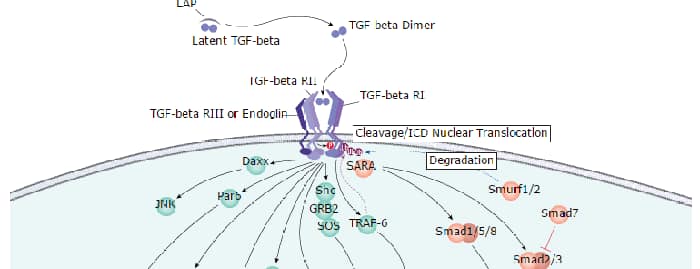
ELISA: Smad3 [p Thr179] Antibody [NBP2-19126] - The SMAD pathway follows the canonical TGF- Beta signaling pathway. TGF- Beta dimers bind to a receptor thereby activating the pathway. The type I receptor then recruits and phosphorylates a receptor regulated SMAD.i.e. SMAD2 or SMAD3. The R-SMAD then binds to the common SMAD i.e. SMAD4, and forms a heterodimeric complex. This complex then enters the cell nucleus and acts as a transcription factor.Applications for Smad3 [p Thr179] Antibody - BSA Free
ELISA
Western Blot
Use in Immunohistochemistry paraffin reported in scientific literature (PMID 28706886).
Formulation, Preparation, and Storage
Purification
Formulation
Format
Preservative
Concentration
Shipping
Stability & Storage
Background: Smad3
Long Name
Alternate Names
Gene Symbol
UniProt
Additional Smad3 Products
Product Documents for Smad3 [p Thr179] Antibody - BSA Free
Certificate of Analysis
To download a Certificate of Analysis, please enter a lot or batch number in the search box below.
Product Specific Notices for Smad3 [p Thr179] Antibody - BSA Free
This product is for research use only and is not approved for use in humans or in clinical diagnosis. Primary Antibodies are guaranteed for 1 year from date of receipt.
Related Research Areas
Citations for Smad3 [p Thr179] Antibody - BSA Free
 Powered by Bioz
Customer Reviews for Smad3 [p Thr179] Antibody - BSA Free
There are currently no reviews for this product. Be the first to review Smad3 [p Thr179] Antibody - BSA Free and earn rewards!
Have you used Smad3 [p Thr179] Antibody - BSA Free?
Submit a review and receive an Amazon gift card!
$25/€18/£15/$25CAN/¥2500 for a review with an image
$10/€7/£6/$10CAN/¥1110 for a review without an image
Submit a review
Protocols
Find general support by application which include: protocols, troubleshooting, illustrated assays, videos and webinars.
- Antigen Retrieval Protocol (PIER)
- Antigen Retrieval for Frozen Sections Protocol
- Appropriate Fixation of IHC/ICC Samples
- Cellular Response to Hypoxia Protocols
- Chromogenic IHC Staining of Formalin-Fixed Paraffin-Embedded (FFPE) Tissue Protocol
- Chromogenic Immunohistochemistry Staining of Frozen Tissue
- ClariTSA™ Fluorophore Kits
- Detection & Visualization of Antibody Binding
- ELISA Sample Preparation & Collection Guide
- ELISA Troubleshooting Guide
- Fluorescent IHC Staining of Frozen Tissue Protocol
- Graphic Protocol for Heat-induced Epitope Retrieval
- Graphic Protocol for the Preparation and Fluorescent IHC Staining of Frozen Tissue Sections
- Graphic Protocol for the Preparation and Fluorescent IHC Staining of Paraffin-embedded Tissue Sections
- Graphic Protocol for the Preparation of Gelatin-coated Slides for Histological Tissue Sections
- How to Run an R&D Systems DuoSet ELISA
- How to Run an R&D Systems Quantikine ELISA
- How to Run an R&D Systems Quantikine™ QuicKit™ ELISA
- IHC Sample Preparation (Frozen sections vs Paraffin)
- Immunofluorescent IHC Staining of Formalin-Fixed Paraffin-Embedded (FFPE) Tissue Protocol
- Immunohistochemistry (IHC) and Immunocytochemistry (ICC) Protocols
- Immunohistochemistry Frozen Troubleshooting
- Immunohistochemistry Paraffin Troubleshooting
- Preparing Samples for IHC/ICC Experiments
- Preventing Non-Specific Staining (Non-Specific Binding)
- Primary Antibody Selection & Optimization
- Protocol for Heat-Induced Epitope Retrieval (HIER)
- Protocol for Making a 4% Formaldehyde Solution in PBS
- Protocol for VisUCyte™ HRP Polymer Detection Reagent
- Protocol for the Preparation & Fixation of Cells on Coverslips
- Protocol for the Preparation and Chromogenic IHC Staining of Frozen Tissue Sections
- Protocol for the Preparation and Chromogenic IHC Staining of Frozen Tissue Sections - Graphic
- Protocol for the Preparation and Chromogenic IHC Staining of Paraffin-embedded Tissue Sections
- Protocol for the Preparation and Chromogenic IHC Staining of Paraffin-embedded Tissue Sections - Graphic
- Protocol for the Preparation and Fluorescent IHC Staining of Frozen Tissue Sections
- Protocol for the Preparation and Fluorescent IHC Staining of Paraffin-embedded Tissue Sections
- Protocol for the Preparation of Gelatin-coated Slides for Histological Tissue Sections
- Quantikine HS ELISA Kit Assay Principle, Alkaline Phosphatase
- Quantikine HS ELISA Kit Principle, Streptavidin-HRP Polymer
- R&D Systems Quality Control Western Blot Protocol
- Sandwich ELISA (Colorimetric) – Biotin/Streptavidin Detection Protocol
- Sandwich ELISA (Colorimetric) – Direct Detection Protocol
- TUNEL and Active Caspase-3 Detection by IHC/ICC Protocol
- The Importance of IHC/ICC Controls
- Troubleshooting Guide: ELISA
- Troubleshooting Guide: Immunohistochemistry
- Troubleshooting Guide: Western Blot Figures
- Western Blot Conditions
- Western Blot Protocol
- Western Blot Protocol for Cell Lysates
- Western Blot Troubleshooting
- Western Blot Troubleshooting Guide
- View all Protocols, Troubleshooting, Illustrated assays and Webinars
FAQs for Smad3 [p Thr179] Antibody - BSA Free
-
Q: I was wondering if you can recommend any primary polyclonal Smad3 antibody (reactivity: human) for gel supershifts?
A: We do provide a wide range of Smad3 antibodies, but unfortunately none of them have been tested for gel shift assay, so we can't guarantee they will work for an application never tested before.
Associated Pathways