
SR-BI Antibody - BSA Free
Novus Biologicals | Catalog # NB400-113

![Western Blot: SR-BI Antibody [NB400-113]](https://resources.rndsystems.com/images/products/SR-BI-Antibody-Western-Blot-NB400-113-img0009.jpg "Western Blot: SR-BI Antibody [NB400-113]")
Scientific images may be resized, cropped, or adjusted for brightness or contrast for presentation purposes. These updates are limited to presentation and do not affect the underlying scientific interpretation of the data. Where available, additional source data may be provided upon request.
Loading...
Key Product Details
Species Reactivity
Validated:
Human, Mouse, Rat
Cited:
Human, Mouse, Rat, Bovine
Applications
Validated:
Immunohistochemistry, Immunohistochemistry-Paraffin, Immunohistochemistry-Frozen, Western Blot, Block/Neutralize, Flow Cytometry, Immunocytochemistry/ Immunofluorescence, Immunoprecipitation
Cited:
Immunohistochemistry-Frozen, Western Blot, Neutralization, Block/Neutralize, Flow Cytometry, Immunocytochemistry/ Immunofluorescence, IF/IHC
Label
Unconjugated
Antibody Source
Polyclonal Rabbit IgG
Format
BSA Free
Loading...
Product Specifications
Immunogen
Adenovirus encoding mouse SR-BI. [UniProt# Q61009]
Clonality
Polyclonal
Host
Rabbit
Isotype
IgG
Scientific Data Images for SR-BI Antibody - BSA Free
Western Blot: SR-BI Antibody [NB400-113]
Western Blot: SR-BI Antibody [NB400-113] - Detection of SR-BI (80kDa) in mouse testis lysate total protein using NB400-113.![Immunocytochemistry/ Immunofluorescence: SR-BI Antibody [NB400-113]](https://resources.rndsystems.com/images/products/SR-BI-Antibody-Immunocytochemistry-Immunofluorescence-NB400-113-img0006.jpg "Immunocytochemistry/ Immunofluorescence: SR-BI Antibody [NB400-113]")
Immunocytochemistry/ Immunofluorescence: SR-BI Antibody [NB400-113]
Immunocytochemistry/Immunofluorescence: SR-BI Antibody [NB400-113] - Antibody was tested in HeLa cells with DyLight 488 (green). Nuclei and alpha-tubulin were counterstained with DAPI (blue) and DyLight 550 (red).![Immunohistochemistry-Paraffin: SR-BI Antibody [NB400-113]](https://resources.rndsystems.com/images/products/SR-BI-Antibody-Immunohistochemistry-Paraffin-NB400-113-img0008.jpg "Immunohistochemistry-Paraffin: SR-BI Antibody [NB400-113]")
Immunohistochemistry-Paraffin: SR-BI Antibody [NB400-113]
Immunohistochemistry-Paraffin: SR-BI Antibody [NB400-113] - Analysis of a FFPE section of human adrenal gland tissue using 1:100 dilution of SR-BI antibody. The staining was developed using HRP-DAB based detection method and the nuclei of the cells were counterstained with hematoxylin. This antibody generated a specific staining of SR-BI/SCARB1 in the glandular cells. The staining was membrane-cytoplasmic in the zona glomerulosa cells while the signal was primarily localized to the membranes of the cells in the zona fasciculata and zona reticularis layers of the adrenal cortex.![Immunohistochemistry-Paraffin: SR-BI Antibody [NB400-113]](https://resources.rndsystems.com/images/products/SR-BI-Antibody-Immunohistochemistry-Paraffin-NB400-113-img0007.jpg "Immunohistochemistry-Paraffin: SR-BI Antibody [NB400-113]")
Immunohistochemistry-Paraffin: SR-BI Antibody [NB400-113]
Immunohistochemistry-Paraffin: SR-BI Antibody [NB400-113] - Analysis of a FFPE section of human adrenal gland tissue using 1:100 dilution of SR-BI antibody. The staining was developed using HRP-DAB based detection method and the nuclei of the cells were counterstained using hematoxylin. The representative section shows SR-BI/SCARB1 positivity in the glandular cells and the staining was mainly localized to the membranes of the cells.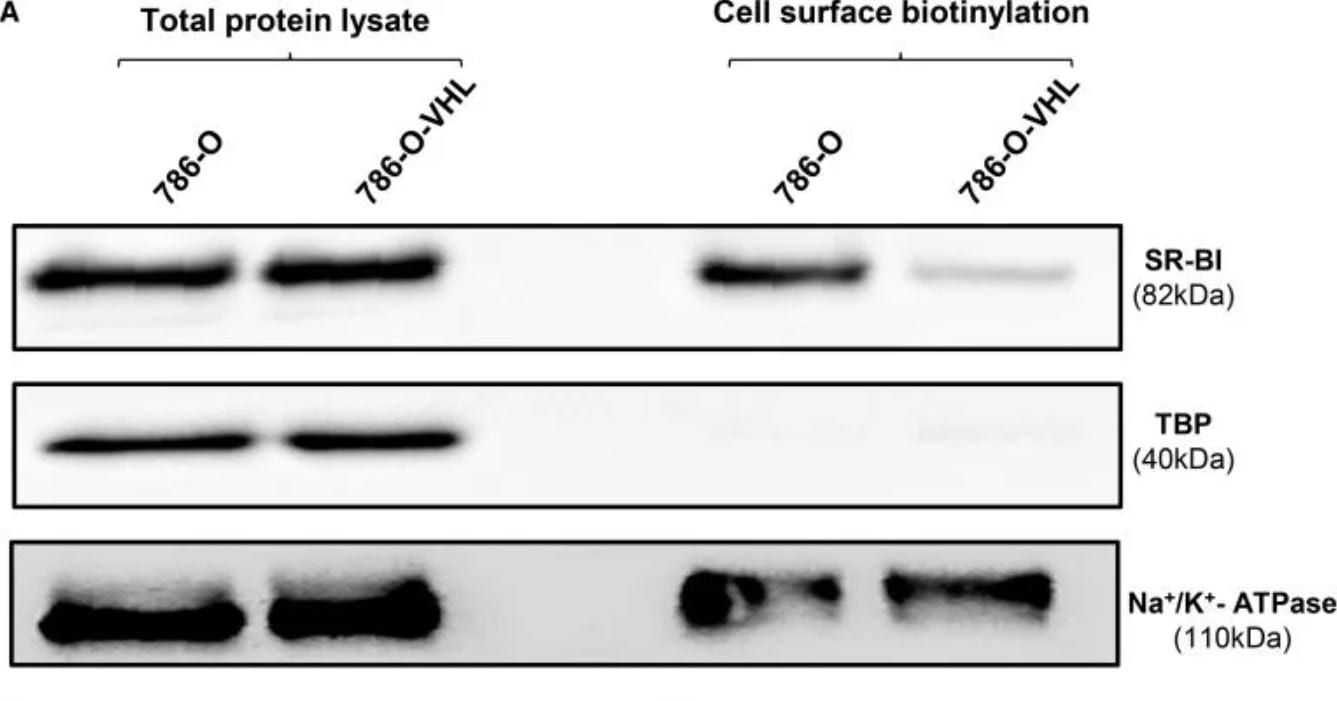
Western Blot: SR-BI Antibody [NB400-113] -
nb400-113_rabbit-polyclonal-sr-bi-antibody-2552023151494.jpgApplications for SR-BI Antibody - BSA Free
Application
Recommended Usage
Flow Cytometry
reported in scientific literature (PMID 22622498)
Immunocytochemistry/ Immunofluorescence
1:50-1:200
Immunohistochemistry
1:100
Immunohistochemistry-Frozen
reported in scientific literature
Immunohistochemistry-Paraffin
1:100
Immunoprecipitation
1:100
Western Blot
1:500
Application Notes
This SR-BI antibody is useful for Flow Cytometry, Immunocytochemistry/Immunofluorescence, Immunoprecipitation, Western blot and for blocking the binding of ligands to SR-BI.
Reviewed Applications
Read 1 review rated 4 using NB400-113 in the following applications:
Flow Cytometry Panel Builder
Bio-Techne Knows Flow Cytometry
Save time and reduce costly mistakes by quickly finding compatible reagents using the Panel Builder Tool.
Advanced Features
- Spectra Viewer - Custom analysis of spectra from multiple fluorochromes
- Spillover Popups - Visualize the spectra of individual fluorochromes
- Antigen Density Selector - Match fluorochrome brightness with antigen density

Formulation, Preparation, and Storage
Purification
Unpurified
Formulation
Whole antisera
Format
BSA Free
Preservative
0.05% Sodium Azide
Concentration
This product is unpurified. The exact concentration of antibody is not quantifiable.
Shipping
The product is shipped with polar packs. Upon receipt, store it immediately at the temperature recommended below.
Stability & Storage
Aliquot and store at -20C or -80C. Avoid freeze-thaw cycles.
Background: SR-BI
At least 5 different human splice variants have been identified with theoretical molecular weights ranging from 60.9 kDa for the canonical sequence to 45 kDa for an N-terminally truncated variant (SR-BII) (3). The extracellular domain of human SR-BI (CLA-1) shares 80%, 80%, 89%, 86% and 84% aa sequence identity with mouse, rat, porcine, rabbit, and bovine SR-BI, respectively. SR-BI is highly glycosylated and removal of N-linked glycosylation reduces lipid transport.
References
1. Linton MF, Tao H, Linton EF, Yancey PG. (2017) SR-BI: A Multifunctional Receptor in Cholesterol Homeostasis and Atherosclerosis. Trends Endocrinol Metab. 28(6):461-472. PMID: 28259375
2. Hoekstra M, Sorci-Thomas M. (2017) Rediscovering scavenger receptor type BI: surprising new roles for the HDL receptor. Curr Opin Lipidol. 28(3):255-260. PMID: 28301373
3. Shen WJ, Asthana S, Kraemer FB, Azhar S. (2018) Scavenger receptor B type 1: expression, molecular regulation, and cholesterol transport function.
Long Name
Scavenger Receptor Class B, Member I
Alternate Names
CD36L1, CLA1, HDLQTL6, SCARB1, SR-B1, SRBI
Gene Symbol
SCARB1
Additional SR-BI Products
Product Documents for SR-BI Antibody - BSA Free
Certificate of Analysis
To download a Certificate of Analysis, please enter a lot or batch number in the search box below.
Product Specific Notices for SR-BI Antibody - BSA Free
This product is for research use only and is not approved for use in humans or in clinical diagnosis. Primary Antibodies are guaranteed for 1 year from date of receipt.
Related Research Areas
Citations for SR-BI Antibody - BSA Free
 Powered by Bioz
Customer Reviews for SR-BI Antibody - BSA Free (1)
4 out of 5
1 Customer Rating
Have you used SR-BI Antibody - BSA Free?
Submit a review and receive an Amazon gift card!
$25/€18/£15/$25CAN/¥2500 for a review with an image
$10/€7/£6/$10CAN/¥1110 for a review without an image
Submit a review
Showing
1
-
1 of
1 review
Showing All
Filter By:
-
Application: Western BlotSample Tested: purified SR-BISpecies: MouseVerified Customer | Posted 08/07/2012
There are no reviews that match your criteria.
Protocols
View specific protocols for SR-BI Antibody - BSA Free (NB400-113):
Blocking Protocol
1) Transfect 293 cells or Cos cells or any easily transfectable cell line with SR-BI.
2) Next day, add DMEM with 0.2% BSA to the media plus 1:500 dilution (or 1:1000) dilution of the SR-BI blocking ab. Incubate for 30 minutes to 1 hour at 37 deg C.
3) Add 1 to 10ug/ml of radiolabeled or fluorescent HDL (labeled either on the lipid or protein) to cells for 1 to 2 hours (in the presence of the blocking antibody). For control cells, do not add blocking antibody.
4) Wash cells 3 to 4 times with ice cold PBS.
5) Measure HDL uptake by appropriate method (depending on label on HDL).
Note: As a positive control, you can add an excess (100-fold more) of unlabeled HDL to cells together with the label. This should block the uptake of labeled HDL by 80% or more. This positive control should tell you that your cells are expressing functional SR-BI. Also, cells not receiving either unlabeled HDL or no blocking ab should tell you that your cells are expressing functional SR-BI.
Immunocytochemistry Protocol
Culture cells to appropriate density on suitable glass coverslips in 35 mm culture dishes or 6-well plates.
1. Remove culture medium and add 10% formalin to the dish. Fix at room temperature for 5-10 minutes.
2. Remove the formalin and add 0.5% Triton-X 100 in TBS to permeabilize the cells. Incubate for 5-10 minutes.
3. Remove the permeabilization buffer and add wash buffer (i.e. PBS or PBS with 0.1% Tween-20). Be sure to not let the specimen dry out. Gently wash three times for 10 minutes.
4. Alternatively, cells can be fixed with -20C methanol for 10 min at room temperature. Remove the methanol and rehydrate in PBS for 10 min before proceeding.
5. To block nonspecific antibody binding incubate in 10% normal goat serum for 1 hour at room temperature.
6. Add primary antibody at appropriate dilution and incubate at room temperature for 1 hour or at 4 degrees C overnight.
7. Remove primary antibody and replace with wash buffer. Gently wash three times for 10 minutes.
8. Add secondary antibody at the appropriate dilution. Incubate for 1 hour at room temperature.
9. Remove antibody and replace with wash buffer. Gently wash three times for 10 minutes.
10. Nuclei can be staining with 4',6' diamino phenylindole (DAPI) at 0.1 ug/ml, or coverslips can be directly mounted in media containing DAPI.
11. Cells can now be viewed with a fluorescence microscope.
*The above information is only intended as a guide. The researcher should determine what protocol best meets their needs. Please follow proper laboratory procedures for the disposal of formalin.
Western Blot Protocol
1. Perform SDS-PAGE on samples to be analyzed, loading 30 ug of total protein per lane.
2. Transfer proteins to membrane according to the instructions provided by the manufacturer of the membrane and transfer apparatus.
3. Stain according to standard Ponceau S procedure (or similar product) to assess transfer success, and mark molecular weight standards where appropriate.
4. Rinse the blot.
5. Block the membrane using standard blocking buffer for at least 1 hour.
6. Wash the membrane in wash buffer three times for 10 minutes each.
7. Dilute anti-SR-BI rabbit primary antibody in blocking buffer and incubate 1 hour at room temperature.
8. Wash the membrane in wash buffer three times for 10 minutes each.
9. Apply the diluted HRP conjugated secondary antibody in blocking buffer (as per manufacturers instructions) and incubate 1 hour at room temperature.
10. Wash the blot in wash buffer three times for 10 minutes each (this step can be repeated as required to reduce background).
11. Apply the detection reagent of choice in accordance with the manufacturers instructions.
Note: Tween-20 can be added to the blocking or antibody dilution buffer at a final concentration of 0.05-0.2%.
Find general support by application which include: protocols, troubleshooting, illustrated assays, videos and webinars.
- 7-Amino Actinomycin D (7-AAD) Cell Viability Flow Cytometry Protocol
- Antigen Retrieval Protocol (PIER)
- Antigen Retrieval for Frozen Sections Protocol
- Appropriate Fixation of IHC/ICC Samples
- Cellular Response to Hypoxia Protocols
- Chromogenic IHC Staining of Formalin-Fixed Paraffin-Embedded (FFPE) Tissue Protocol
- Chromogenic Immunohistochemistry Staining of Frozen Tissue
- ClariTSA™ Fluorophore Kits
- Detection & Visualization of Antibody Binding
- Extracellular Membrane Flow Cytometry Protocol
- Flow Cytometry Protocol for Cell Surface Markers
- Flow Cytometry Protocol for Staining Membrane Associated Proteins
- Flow Cytometry Staining Protocols
- Flow Cytometry Troubleshooting Guide
- Fluorescent IHC Staining of Frozen Tissue Protocol
- Graphic Protocol for Heat-induced Epitope Retrieval
- Graphic Protocol for the Preparation and Fluorescent IHC Staining of Frozen Tissue Sections
- Graphic Protocol for the Preparation and Fluorescent IHC Staining of Paraffin-embedded Tissue Sections
- Graphic Protocol for the Preparation of Gelatin-coated Slides for Histological Tissue Sections
- ICC Cell Smear Protocol for Suspension Cells
- ICC Immunocytochemistry Protocol Videos
- ICC for Adherent Cells
- IHC Sample Preparation (Frozen sections vs Paraffin)
- Immunocytochemistry (ICC) Protocol
- Immunocytochemistry Troubleshooting
- Immunofluorescence of Organoids Embedded in Cultrex Basement Membrane Extract
- Immunofluorescent IHC Staining of Formalin-Fixed Paraffin-Embedded (FFPE) Tissue Protocol
- Immunohistochemistry (IHC) and Immunocytochemistry (ICC) Protocols
- Immunohistochemistry Frozen Troubleshooting
- Immunohistochemistry Paraffin Troubleshooting
- Immunoprecipitation Protocol
- Intracellular Flow Cytometry Protocol Using Alcohol (Methanol)
- Intracellular Flow Cytometry Protocol Using Detergents
- Intracellular Nuclear Staining Flow Cytometry Protocol Using Detergents
- Intracellular Staining Flow Cytometry Protocol Using Alcohol Permeabilization
- Intracellular Staining Flow Cytometry Protocol Using Detergents to Permeabilize Cells
- Preparing Samples for IHC/ICC Experiments
- Preventing Non-Specific Staining (Non-Specific Binding)
- Primary Antibody Selection & Optimization
- Propidium Iodide Cell Viability Flow Cytometry Protocol
- Protocol for Heat-Induced Epitope Retrieval (HIER)
- Protocol for Liperfluo
- Protocol for Making a 4% Formaldehyde Solution in PBS
- Protocol for VisUCyte™ HRP Polymer Detection Reagent
- Protocol for the Characterization of Human Th22 Cells
- Protocol for the Characterization of Human Th9 Cells
- Protocol for the Fluorescent ICC Staining of Cell Smears - Graphic
- Protocol for the Fluorescent ICC Staining of Cultured Cells on Coverslips - Graphic
- Protocol for the Preparation & Fixation of Cells on Coverslips
- Protocol for the Preparation and Chromogenic IHC Staining of Frozen Tissue Sections
- Protocol for the Preparation and Chromogenic IHC Staining of Frozen Tissue Sections - Graphic
- Protocol for the Preparation and Chromogenic IHC Staining of Paraffin-embedded Tissue Sections
- Protocol for the Preparation and Chromogenic IHC Staining of Paraffin-embedded Tissue Sections - Graphic
- Protocol for the Preparation and Fluorescent ICC Staining of Cells on Coverslips
- Protocol for the Preparation and Fluorescent ICC Staining of Non-adherent Cells
- Protocol for the Preparation and Fluorescent ICC Staining of Stem Cells on Coverslips
- Protocol for the Preparation and Fluorescent IHC Staining of Frozen Tissue Sections
- Protocol for the Preparation and Fluorescent IHC Staining of Paraffin-embedded Tissue Sections
- Protocol for the Preparation of Gelatin-coated Slides for Histological Tissue Sections
- Protocol for the Preparation of a Cell Smear for Non-adherent Cell ICC - Graphic
- Protocol: Annexin V and PI Staining by Flow Cytometry
- Protocol: Annexin V and PI Staining for Apoptosis by Flow Cytometry
- R&D Systems Quality Control Western Blot Protocol
- TUNEL and Active Caspase-3 Detection by IHC/ICC Protocol
- The Importance of IHC/ICC Controls
- Troubleshooting Guide: Fluorokine Flow Cytometry Kits
- Troubleshooting Guide: Immunohistochemistry
- Troubleshooting Guide: Western Blot Figures
- Western Blot Conditions
- Western Blot Protocol
- Western Blot Protocol for Cell Lysates
- Western Blot Troubleshooting
- Western Blot Troubleshooting Guide
- View all Protocols, Troubleshooting, Illustrated assays and Webinars
FAQs for SR-BI Antibody - BSA Free
Showing
1
-
5 of
5 FAQs
Showing All
-
Q: Could you please give me information about the molecular weight of SR-BI-antibody (NB400-113)?
A: Encoded by gene SCARB1, SR-BI is a plasma membrane receptor for high density lipoprotein cholesterol (HDL) and its expected molecular weight is 61kD. However, this protein undergoes post-translational modifications including N-glycosylation which causes a significant increase in the molecular mass from 61kD to up to approximately 82kD.
-
Q: Do you have information on epitope of NB400-113?
A: NB400-113 is not epitope mapped and was generating by using an immunogen of full-length mouse SR-BI expressed by adenovirus
-
Q: Is this Ab identical to the former Ab3811 - Ab 3811 was used by Liisanantti et al. (Alcoholism: Clinical and Experimental Research 2009) is the Ab3811 still available?
A: Yes, Ab3811 from Abcam and the antibody NB400-113 from Novus are one and the same. The Abcam catalog number is our antibody that they are distributing. NB400-113 should perform as indicated in the literature under Ab3811.
-
Q: Please provide an estimated concentration for NB400-113 Lot G7?
A: As mentioned on the datasheet, this product is an unpurified formulation (whole antiserum) and the exact concentration of antibody is not quantifiable.
However, the concentration of antibody in antisera can vary from 1-10 mg/ml. -
Q: We are interested in using this antibody to perform staining on cells and to detect cells with FACS (flow cytometry). It is indicated on the datasheet that it is possible to use this antibody for flow cytometry, however little information is provided. Could you please inform us on the isotype of the antibody and the concentration we need to use for our FACS experiments?
A: This antibody is a rabbit polyclonal, so the isotype is IgG. We have never tested in-house for flow cytometry. This antibody has been validated for use in Flow Cytometry by other researchers in publications. All the information we have regarding its use in flow cytometry comes from the publications on the datasheet (PMID: 20041149 and 22622498). We recommend 1:50-1:200 for ICC, so this is probably a good range to start your testing with.
-
Q: Could you please give me information about the molecular weight of SR-BI-antibody (NB400-113)?
A: Encoded by gene SCARB1, SR-BI is a plasma membrane receptor for high density lipoprotein cholesterol (HDL) and its expected molecular weight is 61kD. However, this protein undergoes post-translational modifications including N-glycosylation which causes a significant increase in the molecular mass from 61kD to up to approximately 82kD.
-
Q: Do you have information on epitope of NB400-113?
A: NB400-113 is not epitope mapped and was generating by using an immunogen of full-length mouse SR-BI expressed by adenovirus
-
Q: Is this Ab identical to the former Ab3811 - Ab 3811 was used by Liisanantti et al. (Alcoholism: Clinical and Experimental Research 2009) is the Ab3811 still available?
A: Yes, Ab3811 from Abcam and the antibody NB400-113 from Novus are one and the same. The Abcam catalog number is our antibody that they are distributing. NB400-113 should perform as indicated in the literature under Ab3811.
-
Q: Please provide an estimated concentration for NB400-113 Lot G7?
A: As mentioned on the datasheet, this product is an unpurified formulation (whole antiserum) and the exact concentration of antibody is not quantifiable.
However, the concentration of antibody in antisera can vary from 1-10 mg/ml. -
Q: We are interested in using this antibody to perform staining on cells and to detect cells with FACS (flow cytometry). It is indicated on the datasheet that it is possible to use this antibody for flow cytometry, however little information is provided. Could you please inform us on the isotype of the antibody and the concentration we need to use for our FACS experiments?
A: This antibody is a rabbit polyclonal, so the isotype is IgG. We have never tested in-house for flow cytometry. This antibody has been validated for use in Flow Cytometry by other researchers in publications. All the information we have regarding its use in flow cytometry comes from the publications on the datasheet (PMID: 20041149 and 22622498). We recommend 1:50-1:200 for ICC, so this is probably a good range to start your testing with.
-
Q: Could you please give me information about the molecular weight of SR-BI-antibody (NB400-113)?
A: Encoded by gene SCARB1, SR-BI is a plasma membrane receptor for high density lipoprotein cholesterol (HDL) and its expected molecular weight is 61kD. However, this protein undergoes post-translational modifications including N-glycosylation which causes a significant increase in the molecular mass from 61kD to up to approximately 82kD.
-
Q: Do you have information on epitope of NB400-113?
A: NB400-113 is not epitope mapped and was generating by using an immunogen of full-length mouse SR-BI expressed by adenovirus
-
Q: Is this Ab identical to the former Ab3811 - Ab 3811 was used by Liisanantti et al. (Alcoholism: Clinical and Experimental Research 2009) is the Ab3811 still available?
A: Yes, Ab3811 from Abcam and the antibody NB400-113 from Novus are one and the same. The Abcam catalog number is our antibody that they are distributing. NB400-113 should perform as indicated in the literature under Ab3811.
-
Q: Please provide an estimated concentration for NB400-113 Lot G7?
A: As mentioned on the datasheet, this product is an unpurified formulation (whole antiserum) and the exact concentration of antibody is not quantifiable.
However, the concentration of antibody in antisera can vary from 1-10 mg/ml. -
Q: We are interested in using this antibody to perform staining on cells and to detect cells with FACS (flow cytometry). It is indicated on the datasheet that it is possible to use this antibody for flow cytometry, however little information is provided. Could you please inform us on the isotype of the antibody and the concentration we need to use for our FACS experiments?
A: This antibody is a rabbit polyclonal, so the isotype is IgG. We have never tested in-house for flow cytometry. This antibody has been validated for use in Flow Cytometry by other researchers in publications. All the information we have regarding its use in flow cytometry comes from the publications on the datasheet (PMID: 20041149 and 22622498). We recommend 1:50-1:200 for ICC, so this is probably a good range to start your testing with.
-
Q: Could you please give me information about the molecular weight of SR-BI-antibody (NB400-113)?
A: Encoded by gene SCARB1, SR-BI is a plasma membrane receptor for high density lipoprotein cholesterol (HDL) and its expected molecular weight is 61kD. However, this protein undergoes post-translational modifications including N-glycosylation which causes a significant increase in the molecular mass from 61kD to up to approximately 82kD.
-
Q: Do you have information on epitope of NB400-113?
A: NB400-113 is not epitope mapped and was generating by using an immunogen of full-length mouse SR-BI expressed by adenovirus
-
Q: Is this Ab identical to the former Ab3811 - Ab 3811 was used by Liisanantti et al. (Alcoholism: Clinical and Experimental Research 2009) is the Ab3811 still available?
A: Yes, Ab3811 from Abcam and the antibody NB400-113 from Novus are one and the same. The Abcam catalog number is our antibody that they are distributing. NB400-113 should perform as indicated in the literature under Ab3811.
-
Q: Please provide an estimated concentration for NB400-113 Lot G7?
A: As mentioned on the datasheet, this product is an unpurified formulation (whole antiserum) and the exact concentration of antibody is not quantifiable.
However, the concentration of antibody in antisera can vary from 1-10 mg/ml. -
Q: We are interested in using this antibody to perform staining on cells and to detect cells with FACS (flow cytometry). It is indicated on the datasheet that it is possible to use this antibody for flow cytometry, however little information is provided. Could you please inform us on the isotype of the antibody and the concentration we need to use for our FACS experiments?
A: This antibody is a rabbit polyclonal, so the isotype is IgG. We have never tested in-house for flow cytometry. This antibody has been validated for use in Flow Cytometry by other researchers in publications. All the information we have regarding its use in flow cytometry comes from the publications on the datasheet (PMID: 20041149 and 22622498). We recommend 1:50-1:200 for ICC, so this is probably a good range to start your testing with.
-
Q: Could you please give me information about the molecular weight of SR-BI-antibody (NB400-113)?
A: Encoded by gene SCARB1, SR-BI is a plasma membrane receptor for high density lipoprotein cholesterol (HDL) and its expected molecular weight is 61kD. However, this protein undergoes post-translational modifications including N-glycosylation which causes a significant increase in the molecular mass from 61kD to up to approximately 82kD.
-
Q: Do you have information on epitope of NB400-113?
A: NB400-113 is not epitope mapped and was generating by using an immunogen of full-length mouse SR-BI expressed by adenovirus
-
Q: Is this Ab identical to the former Ab3811 - Ab 3811 was used by Liisanantti et al. (Alcoholism: Clinical and Experimental Research 2009) is the Ab3811 still available?
A: Yes, Ab3811 from Abcam and the antibody NB400-113 from Novus are one and the same. The Abcam catalog number is our antibody that they are distributing. NB400-113 should perform as indicated in the literature under Ab3811.
-
Q: Please provide an estimated concentration for NB400-113 Lot G7?
A: As mentioned on the datasheet, this product is an unpurified formulation (whole antiserum) and the exact concentration of antibody is not quantifiable.
However, the concentration of antibody in antisera can vary from 1-10 mg/ml. -
Q: We are interested in using this antibody to perform staining on cells and to detect cells with FACS (flow cytometry). It is indicated on the datasheet that it is possible to use this antibody for flow cytometry, however little information is provided. Could you please inform us on the isotype of the antibody and the concentration we need to use for our FACS experiments?
A: This antibody is a rabbit polyclonal, so the isotype is IgG. We have never tested in-house for flow cytometry. This antibody has been validated for use in Flow Cytometry by other researchers in publications. All the information we have regarding its use in flow cytometry comes from the publications on the datasheet (PMID: 20041149 and 22622498). We recommend 1:50-1:200 for ICC, so this is probably a good range to start your testing with.
Loading...