
Syntenin 1 Antibody (19C1) - BSA Free
Novus Biologicals | Catalog # NBP3-26333

Key Product Details
Validated by
Species Reactivity
Applications
Label
Antibody Source
Format
Product Specifications
Immunogen
Clonality
Host
Isotype
Scientific Data Images for Syntenin 1 Antibody (19C1) - BSA Free
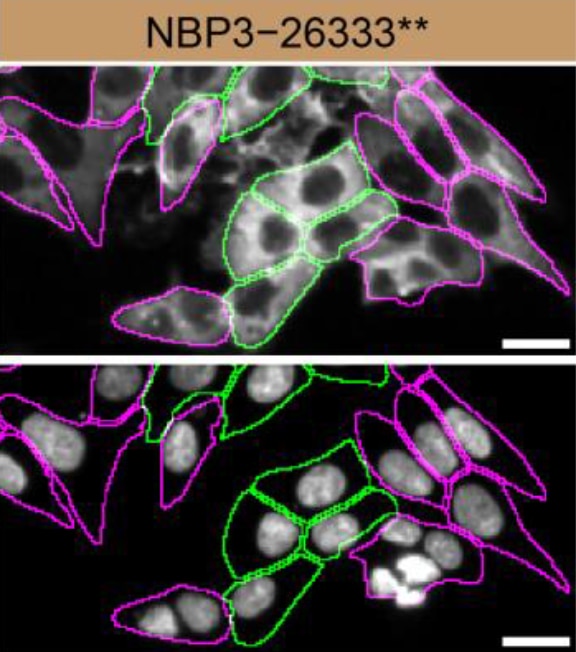
Syntenin 1 Specificity is Shown by Immunocytochemistry in Knockdown Cell Line.
HAP1 parental cell line WT and Syntenin 1 HAP1 KD cells were labelled with a green or a far-red fluorescent dye, respectively. Cells were stained with Syntenin 1 Antibody (19C1) (Catalog # NBP3-26333) followed by incubation with an Alexa-fluor 555 conjugated secondary antibody (upper panel). DAPI-only counterstained cells shown on a lower panel. Acquisition of the blue (nucleus-DAPI), green (identification of WT cells), red (antibody staining) and far-red (identification of KD cells) channels was performed. Representative images of the blue and red (grayscale) channels are shown. WT and KD cells are outlined with green and magenta dashed line, respectively. Primary antibody dilution used: 1/100. Image, protocol and testing courtesy of YCharOS Inc. (ycharos.com).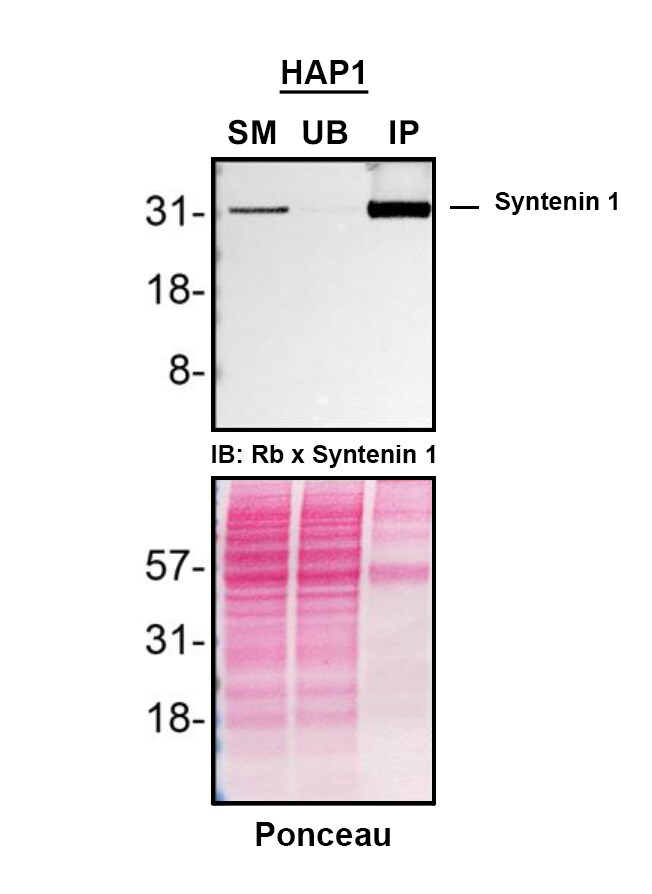
Detection of Syntenin 1 by Immunoprecipitation.
HAP1 cell line lysates were prepared and immunoprecipitation was performed using 2.0 μg of Syntenin 1 Antibody (19C1) (Catalog # NBP3-26333) pre-coupled to Dynabeads Protein A. Immunoprecipitated Syntenin 1 was detected in Western Blot with a rabbit anti-Syntenin 1 antibody used at 1/500. The Ponceau stained transfer of the blot is shown. SM=4% starting material; UB=4% unbound fraction; IP=immunoprecipitate; HC=antibody heavy chain. Image, protocol and testing courtesy of YCharOS Inc. (ycharos.com).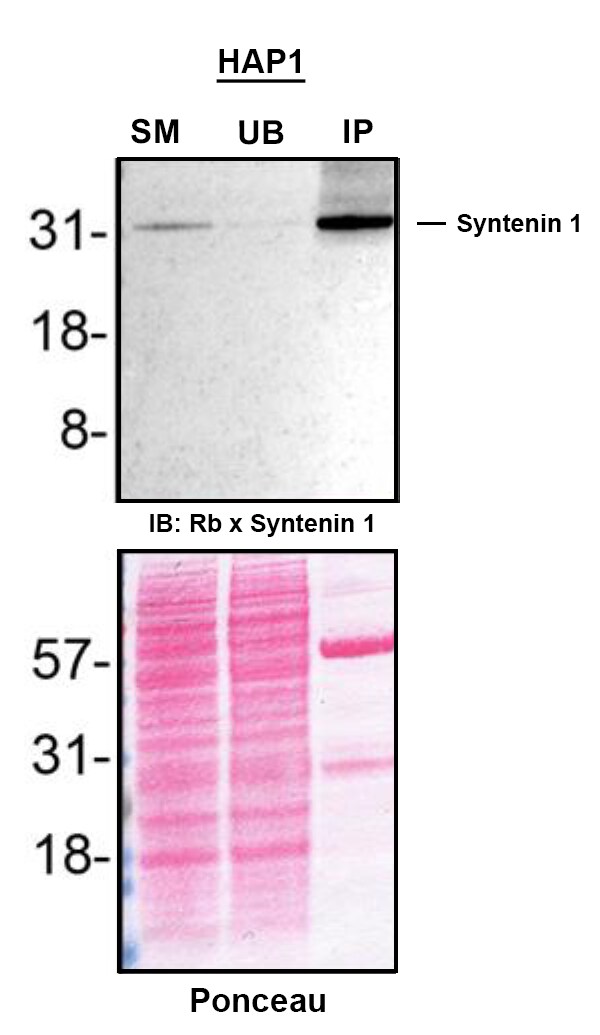
Detection of Syntenin 1 by Immunoprecipitation.
Culture medium from HAP1 cell line culture were prepared and immunoprecipitation was performed using 2.0 µg of Syntenin 1 Antibody (19C1) (Catalog # NBP3-26333) pre-coupled to Dynabeads Protein A. Immunoprecipitated Syntenin 1 was detected in Western Blot with a rabbit anti-Syntenin 1 antibody used at 1/1000. The Ponceau stained transfer of the blot is shown. SM=4% starting material; UB=4% unbound fraction; IP=immunoprecipitate; HC=antibody heavy chain. Image, protocol and testing courtesy of YCharOS Inc. (ycharos.com).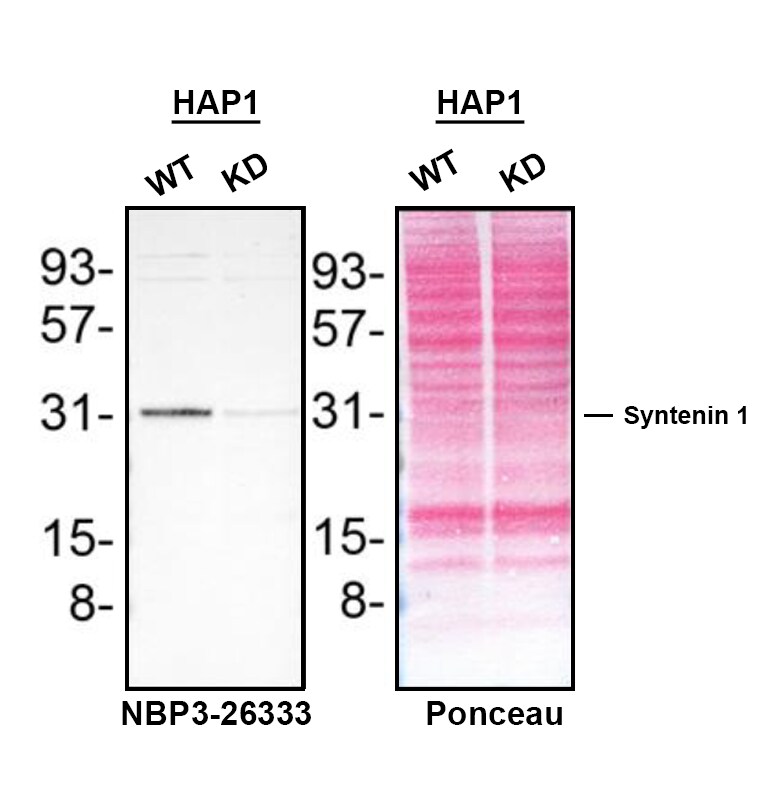
Western Blot Shows Syntenin 1 Specificity Using Knockdown Cell Line.
Western blot shows lysates of HAP1 parental cell line and Syntenin 1 knockdown HAP1 cell line (KD). Nitrocellulose membrane was probed with Syntenin 1 Antibody (19C1) (Catalog # NBP3-26333) followed by HRP-conjugated secondary antibody. A specific band was detected for Syntenin 1 at approximately 32.5 kDa (as indicated) in the parental HAP1 cell line, but is not detectable in knockdown HAP1 cell line. Primary antibody dilution used: 1/500. The Ponceau stained transfer of the blot is shown. This experiment was conducted under reducing conditions. Image, protocol, and testing courtesy of YCharOS Inc. See ycharos.com for additional details.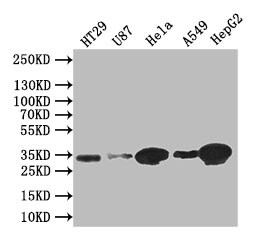
Western Blot: Syntenin 1 Antibody (19C1) [NBP3-26333] -
Western Blot: Syntenin 1 Antibody (19C1) [NBP3-26333] - Positive Western Blot detected in: HT29 whole cell lysate, U87 whole cell lysate, Hela whole cell lysate, A549 whole cell lysate, HEPG2 whole cell lysate.All lanes: Syntenin 1 Antibody at 1: 1000
Secondary: Goat polyclonal to rabbit IgG at 1/50000 dilution.
Predicted band size: 32 kDa
Observed band size: 32 kDa
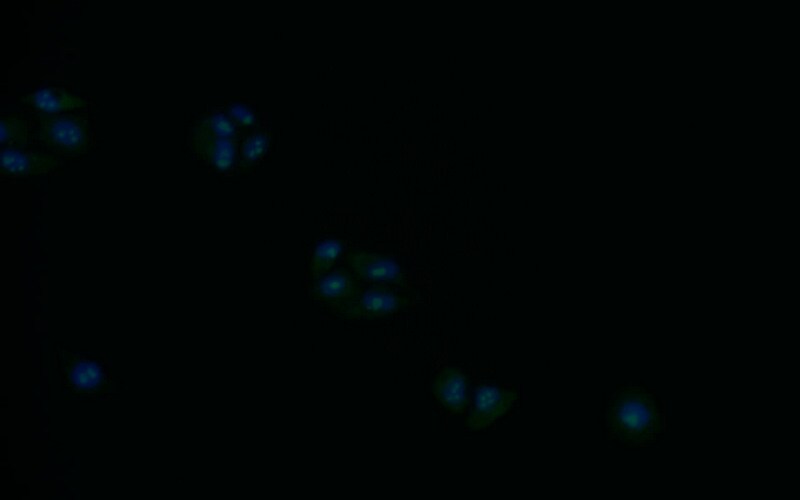
Immunocytochemistry/Immunofluorescence: Syntenin 1 Antibody (19C1) [NBP3-26333] -
Immunocytochemistry/Immunofluorescence: Syntenin 1 Antibody (19C1) [NBP3-26333] - Staining of Hela with Syntenin 1 Antibody (19C1) at 1:30, counter-stained with DAPI. The cells were fixed in 4% formaldehyde and blocked in 10% normal Goat Serum. The cells were then incubated with the antibody overnight at 4C. The secondary antibody was Alexa Fluor 521-conjugated Goat Anti-Rabbit IgG (H+L).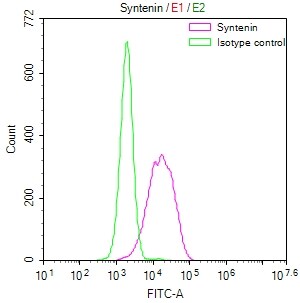
Flow Cytometry: Syntenin 1 Antibody (19C1) [NBP3-26333] -
Flow Cytometry: Syntenin 1 Antibody (19C1) [NBP3-26333] - Overlay Peak curve showing HepG2 cells stained with Syntenin 1 Antibody (19C1) (red line) at 1:50. The cells were fixed in 4% formaldehyde and permeated by 0.2% Triton X-100. Then 10% normal goat serum to block non-specific protein-protein interactions followed by the antibody (1ug/1*10^6 cells) for 45min at 4C. The secondary antibody used was FITC-conjugated Goat Anti-rabbit IgG (H+L) at 1:200 dilution for 35min at 4C. Control antibody (green line) was rabbit IgG (1ug/1*10^6 cells) used under the same conditions. Acquisition of >10,000 events was performed.Applications for Syntenin 1 Antibody (19C1) - BSA Free
Flow Cytometry
Immunocytochemistry/ Immunofluorescence
Immunoprecipitation
Knockdown Validated
Western Blot
Flow Cytometry Panel Builder
Bio-Techne Knows Flow Cytometry
Save time and reduce costly mistakes by quickly finding compatible reagents using the Panel Builder Tool.
Advanced Features
- Spectra Viewer - Custom analysis of spectra from multiple fluorochromes
- Spillover Popups - Visualize the spectra of individual fluorochromes
- Antigen Density Selector - Match fluorochrome brightness with antigen density

Formulation, Preparation, and Storage
Purification
Formulation
Format
Preservative
Concentration
Shipping
Stability & Storage
Background: Syntenin 1
Alternate Names
Gene Symbol
Additional Syntenin 1 Products
Product Documents for Syntenin 1 Antibody (19C1) - BSA Free
Certificate of Analysis
To download a Certificate of Analysis, please enter a lot or batch number in the search box below.
Product Specific Notices for Syntenin 1 Antibody (19C1) - BSA Free
This product is for research use only and is not approved for use in humans or in clinical diagnosis. Primary Antibodies are guaranteed for 1 year from date of receipt.
Customer Reviews for Syntenin 1 Antibody (19C1) - BSA Free
There are currently no reviews for this product. Be the first to review Syntenin 1 Antibody (19C1) - BSA Free and earn rewards!
Have you used Syntenin 1 Antibody (19C1) - BSA Free?
Submit a review and receive an Amazon gift card!
$25/€18/£15/$25CAN/¥2500 Yen for a review with an image
$10/€7/£6/$10CAN/¥1110 Yen for a review without an image
Submit a review
Protocols
Find general support by application which include: protocols, troubleshooting, illustrated assays, videos and webinars.
- 7-Amino Actinomycin D (7-AAD) Cell Viability Flow Cytometry Protocol
- Appropriate Fixation of IHC/ICC Samples
- Cellular Response to Hypoxia Protocols
- ClariTSA™ Fluorophore Kits
- Detection & Visualization of Antibody Binding
- ELISA Sample Preparation & Collection Guide
- ELISA Troubleshooting Guide
- Extracellular Membrane Flow Cytometry Protocol
- Flow Cytometry Protocol for Cell Surface Markers
- Flow Cytometry Protocol for Staining Membrane Associated Proteins
- Flow Cytometry Staining Protocols
- Flow Cytometry Troubleshooting Guide
- How to Run an R&D Systems DuoSet ELISA
- How to Run an R&D Systems Quantikine ELISA
- How to Run an R&D Systems Quantikine™ QuicKit™ ELISA
- ICC Cell Smear Protocol for Suspension Cells
- ICC Immunocytochemistry Protocol Videos
- ICC for Adherent Cells
- Immunocytochemistry (ICC) Protocol
- Immunocytochemistry Troubleshooting
- Immunofluorescence of Organoids Embedded in Cultrex Basement Membrane Extract
- Immunohistochemistry (IHC) and Immunocytochemistry (ICC) Protocols
- Immunoprecipitation Protocol
- Intracellular Flow Cytometry Protocol Using Alcohol (Methanol)
- Intracellular Flow Cytometry Protocol Using Detergents
- Intracellular Nuclear Staining Flow Cytometry Protocol Using Detergents
- Intracellular Staining Flow Cytometry Protocol Using Alcohol Permeabilization
- Intracellular Staining Flow Cytometry Protocol Using Detergents to Permeabilize Cells
- Preparing Samples for IHC/ICC Experiments
- Preventing Non-Specific Staining (Non-Specific Binding)
- Primary Antibody Selection & Optimization
- Propidium Iodide Cell Viability Flow Cytometry Protocol
- Protocol for Liperfluo
- Protocol for VisUCyte™ HRP Polymer Detection Reagent
- Protocol for the Characterization of Human Th22 Cells
- Protocol for the Characterization of Human Th9 Cells
- Protocol for the Fluorescent ICC Staining of Cell Smears - Graphic
- Protocol for the Fluorescent ICC Staining of Cultured Cells on Coverslips - Graphic
- Protocol for the Preparation and Fluorescent ICC Staining of Cells on Coverslips
- Protocol for the Preparation and Fluorescent ICC Staining of Non-adherent Cells
- Protocol for the Preparation and Fluorescent ICC Staining of Stem Cells on Coverslips
- Protocol for the Preparation of a Cell Smear for Non-adherent Cell ICC - Graphic
- Protocol: Annexin V and PI Staining by Flow Cytometry
- Protocol: Annexin V and PI Staining for Apoptosis by Flow Cytometry
- Quantikine HS ELISA Kit Assay Principle, Alkaline Phosphatase
- Quantikine HS ELISA Kit Principle, Streptavidin-HRP Polymer
- R&D Systems Quality Control Western Blot Protocol
- Sandwich ELISA (Colorimetric) – Biotin/Streptavidin Detection Protocol
- Sandwich ELISA (Colorimetric) – Direct Detection Protocol
- TUNEL and Active Caspase-3 Detection by IHC/ICC Protocol
- The Importance of IHC/ICC Controls
- Troubleshooting Guide: ELISA
- Troubleshooting Guide: Fluorokine Flow Cytometry Kits
- Troubleshooting Guide: Western Blot Figures
- Western Blot Conditions
- Western Blot Protocol
- Western Blot Protocol for Cell Lysates
- Western Blot Troubleshooting
- Western Blot Troubleshooting Guide
- View all Protocols, Troubleshooting, Illustrated assays and Webinars