TLR3 Antibody - BSA Free
Novus Biologicals | Catalog # NB100-56571

![Western Blot: TLR3 Antibody [NB100-56571]](https://resources.rndsystems.com/images/products/TLR3-Antibody-Western-Blot-NB100-56571-img0009.jpg "Western Blot: TLR3 Antibody [NB100-56571]")
Scientific images may be resized, cropped, or adjusted for brightness or contrast for presentation purposes. These updates are limited to presentation and do not affect the underlying scientific interpretation of the data. Where available, additional source data may be provided upon request.
Loading...
Key Product Details
Validated by
Knockout/Knockdown, Orthogonal Validation, Biological Validation
Species Reactivity
Validated:
Human, Mouse, Porcine
Cited:
Human, Mouse
Predicted:
Rat (91%). Backed by our 100% Guarantee.
Applications
Validated:
Immunohistochemistry, Immunohistochemistry-Paraffin, Immunohistochemistry-Frozen, Western Blot, Flow Cytometry, Flow (Cell Surface), Flow (Intracellular), Dot Blot, Knockdown Validated
Cited:
Immunohistochemistry-Frozen, Western Blot, Flow Cytometry, Flow (Cell Surface), Cytometric Bead Assay Standard, Flow Cytometry Control
Label
Unconjugated
Antibody Source
Polyclonal Rabbit IgG
Format
BSA Free
Loading...
Product Specifications
Immunogen
A mix of synthetic peptides corresponding to amino acids 135-150 (SIHKIKSNPFKNQKNL), 828-844 (CRRFKVHHAVQQAIEQN), and 876-891 (CILNWPVQKERINAFH) of mouse TLR3.
Reactivity Notes
Predicted to cross-react with Rat. Porcine data from customer review.
Clonality
Polyclonal
Host
Rabbit
Isotype
IgG
Theoretical MW
104 kDa.
Disclaimer note: The observed molecular weight of the protein may vary from the listed predicted molecular weight due to post translational modifications, post translation cleavages, relative charges, and other experimental factors.
Disclaimer note: The observed molecular weight of the protein may vary from the listed predicted molecular weight due to post translational modifications, post translation cleavages, relative charges, and other experimental factors.
Scientific Data Images for TLR3 Antibody - BSA Free
![Immunohistochemistry-Frozen: TLR3 Antibody [NB100-56571]](https://resources.rndsystems.com/images/products/TLR3-Antibody-Immunohistochemistry-Frozen-NB100-56571-img0002.jpg "Immunohistochemistry-Frozen: TLR3 Antibody [NB100-56571]")
Immunohistochemistry-Frozen: TLR3 Antibody [NB100-56571]
Immunohistochemistry-Frozen: TLR3 Antibody [NB100-56571] - Frozen mouse eye tissue sections stained with TLR3, a retinal pigment epithelium (RPE) marker and DAPI. Top panel: TLR3 (red) colocalized with the RPE (green) marker. Bottom panel: Tissue stained with isotype control (no TLR3 Ab), RPE and DAPI. Data courtesy of Kleinman et al.![Flow Cytometry: TLR3 Antibody [NB100-56571]](https://resources.rndsystems.com/images/products/TLR3-Antibody-Flow-Cytometry-NB100-56571-img0008.jpg "Flow Cytometry: TLR3 Antibody [NB100-56571]")
Flow Cytometry: TLR3 Antibody [NB100-56571]
Flow Cytometry: TLR3 Antibody [NB100-56571] - Analysis using the FITC conjugate of NB100-56571. Staining of TLR3 in Balb/c mouse splenocytes using this antibody at 1 ug/10^6 cells. Green represents rabbit IgG isotype control this antibody; red represents anti-TLR3 antibody.![Western Blot: TLR3 Antibody [NB100-56571]](https://resources.rndsystems.com/images/products/TLR3-Antibody-Western-Blot-NB100-56571-img0005.jpg "Western Blot: TLR3 Antibody [NB100-56571]")
Western Blot: TLR3 Antibody [NB100-56571]
Western Blot: TLR3 Antibody [NB100-56571] - Analysis of TLR3 in mouse spleen tissue lysate using NB100-56571 at 2 ug/ml.![Immunohistochemistry: TLR3 Antibody [NB100-56571]](https://resources.rndsystems.com/images/products/TLR3-Antibody-Immunohistochemistry-NB100-56571-img0006.jpg "Immunohistochemistry: TLR3 Antibody [NB100-56571]")
Immunohistochemistry: TLR3 Antibody [NB100-56571]
Immunohistochemistry: TLR3 Antibody [NB100-56571] - Pig lung poisoned through aspiration with gastric juice and organophosphate (dimethoate EC40) after 48 hours of IC ventilation. Image from verified customer review.![Flow Cytometry: TLR3 Antibody [NB100-56571]](https://resources.rndsystems.com/images/products/TLR3-Antibody-Flow-Cytometry-NB100-56571-img0001.jpg "Flow Cytometry: TLR3 Antibody [NB100-56571]")
Flow Cytometry: TLR3 Antibody [NB100-56571]
Flow Cytometry: TLR3 Antibody [NB100-56571] - Intracellular flow analysis of TLR3 in Balb/c mouse splenocytes and mouse RAW cells using TLR3 antibody (red) and isotype control antibody (green) at 1 ug/10^6 cells.![Knockdown Validated: TLR3 Antibody [NB100-56571]](https://resources.rndsystems.com/images/products/TLR3-Antibody-Knockdown-Validated-NB100-56571-img0010.jpg "Western Blot: TLR3 Antibody [NB100-56571]")
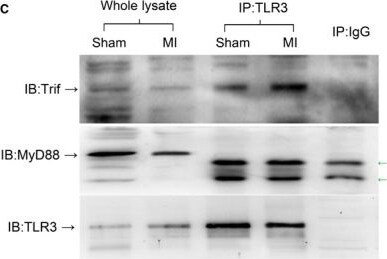
Western Blot: TLR3 Antibody [NB100-56571] -
Western Blot: TLR3 Antibody [NB100-56571] - Myocardial infarction (MI) increased TLR3 expression & its physical association with Trif in mouse myocardium. Heart samples were taken from infarct area at 4 weeks after MI. (A) & (B) show mRNA & protein levels of TLR3 in sham & MI hearts. n = 4 mice/group. Data are means ± S.D. AP < 0.01 versus sham. (C) Representative immunohistochemistry images of heart sections stained for TLR3 (brown colour). An isotype IgG control was performed to verify the specificity of TLR3 reactivity. (D) Lysates of heart tissue were immunoprecipitated with anti‐TLR3 antibodies (IP: TLR3), followed by SDS–PAGE & immunoblotting (IB) with indicated antibodies. IP with isotype IgG (IP: IgG) was performed as a control to exclude the non‐specific binding of antibodies to cellular proteins. Green arrows indicate non‐specific bands. The association between TLR3 & Trif, but not MyD88, was detectable in sham myocardium & was increased in infarct myocardium. Image collected & cropped by CiteAb from the following publication (https://pubmed.ncbi.nlm.nih.gov/28945004), licensed under a CC-BY license. Not internally tested by Novus Biologicals.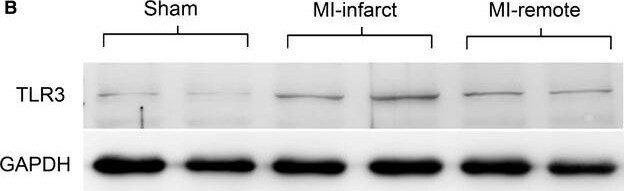
Western Blot: TLR3 Antibody [NB100-56571] -
Western Blot: TLR3 Antibody [NB100-56571] - Myocardial infarction (MI) increased TLR3 expression & its physical association with Trif in mouse myocardium. Heart samples were taken from infarct area at 4 weeks after MI. (A) & (B) show mRNA & protein levels of TLR3 in sham & MI hearts. n = 4 mice/group. Data are means ± S.D. AP < 0.01 versus sham. (C) Representative immunohistochemistry images of heart sections stained for TLR3 (brown colour). An isotype IgG control was performed to verify the specificity of TLR3 reactivity. (D) Lysates of heart tissue were immunoprecipitated with anti‐TLR3 antibodies (IP: TLR3), followed by SDS–PAGE & immunoblotting (IB) with indicated antibodies. IP with isotype IgG (IP: IgG) was performed as a control to exclude the non‐specific binding of antibodies to cellular proteins. Green arrows indicate non‐specific bands. The association between TLR3 & Trif, but not MyD88, was detectable in sham myocardium & was increased in infarct myocardium. Image collected & cropped by CiteAb from the following publication (https://pubmed.ncbi.nlm.nih.gov/28945004), licensed under a CC-BY license. Not internally tested by Novus Biologicals.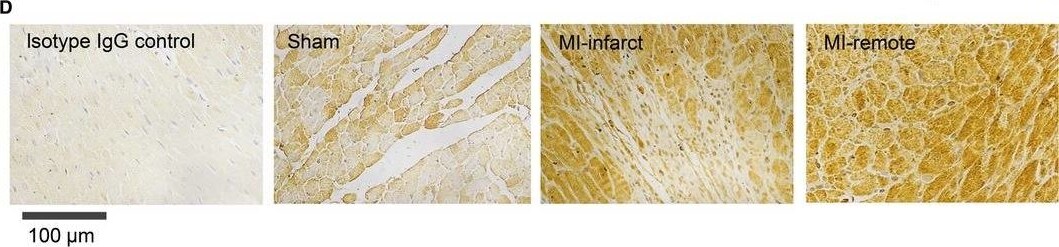
Immunohistochemistry: TLR3 Antibody [NB100-56571] -
Immunohistochemistry: TLR3 Antibody [NB100-56571] - Myocardial infarction (MI) increased TLR3 expression & its physical association with Trif in mouse myocardium. Heart samples were taken from infarct area at 4 weeks after MI. (A) & (B) show mRNA & protein levels of TLR3 in sham & MI hearts. n = 4 mice/group. Data are means ± S.D. AP < 0.01 versus sham. (C) Representative immunohistochemistry images of heart sections stained for TLR3 (brown colour). An isotype IgG control was performed to verify the specificity of TLR3 reactivity. (D) Lysates of heart tissue were immunoprecipitated with anti‐TLR3 antibodies (IP: TLR3), followed by SDS–PAGE & immunoblotting (IB) with indicated antibodies. IP with isotype IgG (IP: IgG) was performed as a control to exclude the non‐specific binding of antibodies to cellular proteins. Green arrows indicate non‐specific bands. The association between TLR3 & Trif, but not MyD88, was detectable in sham myocardium & was increased in infarct myocardium. Image collected & cropped by CiteAb from the following publication (https://pubmed.ncbi.nlm.nih.gov/28945004), licensed under a CC-BY license. Not internally tested by Novus Biologicals.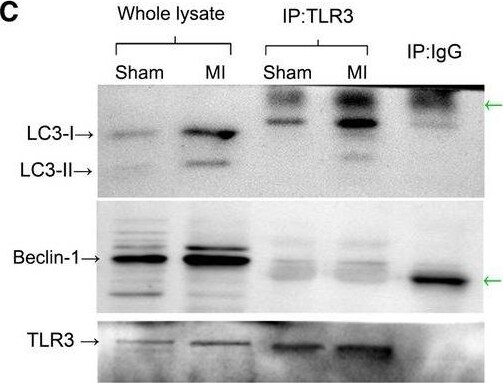
Western Blot: TLR3 Antibody [NB100-56571] -
Western Blot: TLR3 Antibody [NB100-56571] - TLR3‐knockout (TLR3‐KO) attenuated cardiac autophagy induced by MI. The infarct & remote tissues were separately sampled from the left ventricle after 4 weeks of MI. Accordingly, anterior & posterior tissues of the left ventricle were sampled from sham hearts as controls. (A) Representative Western blot images & quantitative analyses of autophagy markers. n = 4–8/group. Quantitative data are fold changes of WT‐sham. aP < 0.05, AP < 0.01 versus respective WT‐sham; bP < 0.05, BP < 0.01 versus respective WT‐MI. (B) Representative electron microphotographs of ultrathin sections of resin‐embedded heart biopsies. Arrows indicate autophagic vacuoles. (C) Lysates of infarct tissue were immunoprecipitated (IP), followed by SDS–PAGE & immunoblotting (IB) with indicated antibodies. IP with isotype IgG served as a control. Green arrows indicate non‐specific bands. Representative images were taken from four independent experiments. Image collected & cropped by CiteAb from the following publication (https://pubmed.ncbi.nlm.nih.gov/28945004), licensed under a CC-BY license. Not internally tested by Novus Biologicals.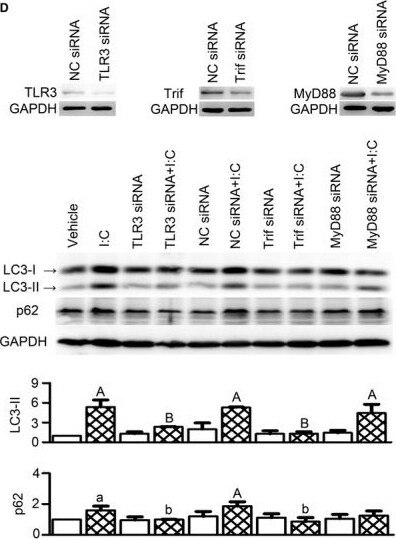
Western Blot: TLR3 Antibody [NB100-56571] -
Western Blot: TLR3 Antibody [NB100-56571] - A TLR3 agonist polyinosinic‐polycytidylic acid (poly(I:C)) induced autophagy in cultured cardiomyocytes through a TRIF‐dependent pathway. (A) Poly(I:C) increased autophagy markers in cultured H9c2 rat ventricular cells. (B) Poly(I:C) stimulated autophagosome formation but did not affect autophagic flux. Primary cultured neonatal rat ventricular myocytes (NRVMs) were transfected with a tandem mRFP‐GFP‐LC3 adenovirus for 24 hrs, followed by treatment with poly(I:C) (100 μg/ml, 4 hrs). Autophagosomes & autolysosomes were, respectively, visualized as yellow‐ & red‐only punctas under a confocal microscope. (C) An autophagic flux inhibitor chloroquine (CQ) induced accumulations of LC3‐II & p62/SQSTM1 proteins in H9c2 myocytes receiving poly(I:C) (100 μg/ml, 4 hrs). CQ was applied at 10 μM, immediately prior to poly(I:C). (D) Effects of indicated siRNA on poly(I:C)‐induced changes in autophagy markers in NRVMs. All the siRNAs were transfected at 50 nM for 48 hrs, & poly(I:C) was added at 100 μg/ml for 4 hrs before cell harvest. Negative control (NC) siRNA served as control. RNAiMAX transfection reagent was used in all the siRNA experiments. The upper panel shows the knockdown effects of siRNAs, & the lower panel shows representative Western blot images (presented from four independent experiments) & densitometry quantitative data (normalized into ‘fold of vehicle group’). All quantitative data are expressed as means ± S.D. aP < 0.05, AP < 0.01 versus vehicle; bP < 0.05, BP < 0.01 versus poly(I:C). Image collected & cropped by CiteAb from the following publication (https://pubmed.ncbi.nlm.nih.gov/28945004), licensed under a CC-BY license. Not internally tested by Novus Biologicals.Applications for TLR3 Antibody - BSA Free
Application
Recommended Usage
Dot Blot
reported in scientific literature (PMID 27248820)
Flow (Cell Surface)
reported in scientific literature (Pawar et al (2006))
Flow (Intracellular)
1 ug/1 million cells
Flow Cytometry
1 ug/10^6 cells
Immunohistochemistry
1:20-1:1000
Immunohistochemistry-Frozen
1:20-1:1000. Use reported in scientific literature (Pawar et al (2005))
Immunohistochemistry-Paraffin
1:100. Use reported in scientific literature (Patole et al (2005))
Western Blot
1-3 ug/ml
Application Notes
Use in Flow (Intracellular) reported in multiple pieces of scientific literature.
Reviewed Applications
Read 1 review rated 4 using NB100-56571 in the following applications:
Flow Cytometry Panel Builder
Bio-Techne Knows Flow Cytometry
Save time and reduce costly mistakes by quickly finding compatible reagents using the Panel Builder Tool.
Advanced Features
- Spectra Viewer - Custom analysis of spectra from multiple fluorochromes
- Spillover Popups - Visualize the spectra of individual fluorochromes
- Antigen Density Selector - Match fluorochrome brightness with antigen density

Formulation, Preparation, and Storage
Purification
Protein G purified
Formulation
PBS
Format
BSA Free
Preservative
0.05% Sodium Azide
Concentration
1.0 mg/ml
Shipping
The product is shipped with polar packs. Upon receipt, store it immediately at the temperature recommended below.
Stability & Storage
Store at 4C short term. Aliquot and store at -20C long term. Avoid freeze-thaw cycles.
Background: TLR3
Given the role of TLR3 in immune response, its expression or dysfunction has been associated with a number of pathologies from chronic inflammation to autoimmune disorders and cancer (1-5,7). TLR3 is expressed in many cancer types, often related to viral infection, such as cervical cancer, hepatocellular carcinoma (HCC), melanoma, breast cancer, and prostate cancer (1,5). TLR3 signaling has a dual role in cancer, either contributing to pro- or anti-tumor properties depending on the type of cancer (1,5). Therapeutic targeting the TLR3 signaling pathway is under investigation. TLR3 inhibitors or antagonists are being studied for the treatment autoimmune and inflammatory disorders such as of sepsis and atherosclerosis (2,8). TLR3 agonists, either alone or in combination with immune checkpoint inhibitors or therapeutic agents, are being studied as immunotherapeutic treatments of many cancers such as colorectal cancer, prostate cancer, and melanoma (7).
References
1. Zheng X, Li S, Yang H. Roles of Toll-Like Receptor 3 in Human Tumors. Front Immunol. 2021;12:667454. https://doi.org/10.3389/fimmu.2021.667454
2. Zhuang C, Chen R, Zheng Z, Lu J, Hong C. Toll-Like Receptor 3 in Cardiovascular Diseases. Heart Lung Circ. 2022;S1443-9506(22)00080-4. https://doi.org/10.1016/j.hlc.2022.02.012
3. Bianchi F, Pretto S, Tagliabue E, Balsari A, Sfondrini L. Exploiting poly(I:C) to induce cancer cell apoptosis. Cancer Biol Ther. 2017;18(10):747-756. https://doi.org/10.1080/15384047.2017.1373220
4. Matsumoto M, Seya T. TLR3: interferon induction by double-stranded RNA including poly(I:C). Adv Drug Deliv Rev. 2008;60(7):805-812. https://doi.org/10.1016/j.addr.2007.11.005
5. Muresan XM, Bouchal J, Culig Z, Soucek K. Toll-Like Receptor 3 in Solid Cancer and Therapy Resistance. Cancers (Basel). 2020;12(11):3227. https://doi.org/10.3390/cancers12113227
6. Uniprot (O15455)
7. Le Naour J, Galluzzi L, Zitvogel L, Kroemer G, Vacchelli E. Trial watch: TLR3 agonists in cancer therapy. Oncoimmunology. 2020;9(1):1771143. https://doi.org/10.1080/2162402X.2020.1771143
8. Gao W, Xiong Y, Li Q, Yang H. Inhibition of Toll-Like Receptor Signaling as a Promising Therapy for Inflammatory Diseases: A Journey from Molecular to Nano Therapeutics. Front Physiol. 2017;8:508. https://doi.org/10.3389/fphys.2017.00508
Long Name
Toll-like Receptor 3
Alternate Names
CD283
Gene Symbol
TLR3
UniProt
Additional TLR3 Products
Product Documents for TLR3 Antibody - BSA Free
Certificate of Analysis
To download a Certificate of Analysis, please enter a lot or batch number in the search box below.
Product Specific Notices for TLR3 Antibody - BSA Free
This product is for research use only and is not approved for use in humans or in clinical diagnosis. Primary Antibodies are guaranteed for 1 year from date of receipt.
Citations for TLR3 Antibody - BSA Free
 Powered by Bioz
Customer Reviews for TLR3 Antibody - BSA Free (1)
4 out of 5
1 Customer Rating
Have you used TLR3 Antibody - BSA Free?
Submit a review and receive an Amazon gift card!
$25/€18/£15/$25CAN/¥2500 for a review with an image
$10/€7/£6/$10CAN/¥1110 for a review without an image
Submit a review
Customer Images
-(01-mg)_NB100-56571_10201.jpg)
Showing
1
-
1 of
1 review
Showing All
Filter By:
-
Application: ImmunohistochemistrySample Tested:Species: OtherVerified Customer | Posted 09/18/2014pig lung poisoned through aspiration with gastric juice and organophosphate (dimethoate EC40) after 48 hours of IC ventilation.

There are no reviews that match your criteria.
Protocols
Find general support by application which include: protocols, troubleshooting, illustrated assays, videos and webinars.
- 7-Amino Actinomycin D (7-AAD) Cell Viability Flow Cytometry Protocol
- Antigen Retrieval Protocol (PIER)
- Antigen Retrieval for Frozen Sections Protocol
- Appropriate Fixation of IHC/ICC Samples
- Cellular Response to Hypoxia Protocols
- Chromogenic IHC Staining of Formalin-Fixed Paraffin-Embedded (FFPE) Tissue Protocol
- Chromogenic Immunohistochemistry Staining of Frozen Tissue
- ClariTSA™ Fluorophore Kits
- Detection & Visualization of Antibody Binding
- Extracellular Membrane Flow Cytometry Protocol
- Flow Cytometry Protocol for Cell Surface Markers
- Flow Cytometry Protocol for Staining Membrane Associated Proteins
- Flow Cytometry Staining Protocols
- Flow Cytometry Troubleshooting Guide
- Fluorescent IHC Staining of Frozen Tissue Protocol
- Graphic Protocol for Heat-induced Epitope Retrieval
- Graphic Protocol for the Preparation and Fluorescent IHC Staining of Frozen Tissue Sections
- Graphic Protocol for the Preparation and Fluorescent IHC Staining of Paraffin-embedded Tissue Sections
- Graphic Protocol for the Preparation of Gelatin-coated Slides for Histological Tissue Sections
- IHC Sample Preparation (Frozen sections vs Paraffin)
- Immunofluorescent IHC Staining of Formalin-Fixed Paraffin-Embedded (FFPE) Tissue Protocol
- Immunohistochemistry (IHC) and Immunocytochemistry (ICC) Protocols
- Immunohistochemistry Frozen Troubleshooting
- Immunohistochemistry Paraffin Troubleshooting
- Intracellular Flow Cytometry Protocol Using Alcohol (Methanol)
- Intracellular Flow Cytometry Protocol Using Detergents
- Intracellular Nuclear Staining Flow Cytometry Protocol Using Detergents
- Intracellular Staining Flow Cytometry Protocol Using Alcohol Permeabilization
- Intracellular Staining Flow Cytometry Protocol Using Detergents to Permeabilize Cells
- Preparing Samples for IHC/ICC Experiments
- Preventing Non-Specific Staining (Non-Specific Binding)
- Primary Antibody Selection & Optimization
- Propidium Iodide Cell Viability Flow Cytometry Protocol
- Protocol for Heat-Induced Epitope Retrieval (HIER)
- Protocol for Liperfluo
- Protocol for Making a 4% Formaldehyde Solution in PBS
- Protocol for VisUCyte™ HRP Polymer Detection Reagent
- Protocol for the Characterization of Human Th22 Cells
- Protocol for the Characterization of Human Th9 Cells
- Protocol for the Preparation & Fixation of Cells on Coverslips
- Protocol for the Preparation and Chromogenic IHC Staining of Frozen Tissue Sections
- Protocol for the Preparation and Chromogenic IHC Staining of Frozen Tissue Sections - Graphic
- Protocol for the Preparation and Chromogenic IHC Staining of Paraffin-embedded Tissue Sections
- Protocol for the Preparation and Chromogenic IHC Staining of Paraffin-embedded Tissue Sections - Graphic
- Protocol for the Preparation and Fluorescent IHC Staining of Frozen Tissue Sections
- Protocol for the Preparation and Fluorescent IHC Staining of Paraffin-embedded Tissue Sections
- Protocol for the Preparation of Gelatin-coated Slides for Histological Tissue Sections
- Protocol: Annexin V and PI Staining by Flow Cytometry
- Protocol: Annexin V and PI Staining for Apoptosis by Flow Cytometry
- R&D Systems Quality Control Western Blot Protocol
- TUNEL and Active Caspase-3 Detection by IHC/ICC Protocol
- The Importance of IHC/ICC Controls
- Troubleshooting Guide: Fluorokine Flow Cytometry Kits
- Troubleshooting Guide: Immunohistochemistry
- Troubleshooting Guide: Western Blot Figures
- Western Blot Conditions
- Western Blot Protocol
- Western Blot Protocol for Cell Lysates
- Western Blot Troubleshooting
- Western Blot Troubleshooting Guide
- View all Protocols, Troubleshooting, Illustrated assays and Webinars