
TRF-2 Antibody - BSA Free
Novus Biologicals | Catalog # NB100-56694

![Immunoprecipitation: TRF-2 Antibody [NB100-56694]](https://resources.rndsystems.com/images/products/TRF-2-Antibody-Immunoprecipitation-NB100-56694-img0006.jpg "Immunoprecipitation: TRF-2 Antibody [NB100-56694]")
Scientific images may be resized, cropped, or adjusted for brightness or contrast for presentation purposes. These updates are limited to presentation and do not affect the underlying scientific interpretation of the data. Where available, additional source data may be provided upon request.
Loading...
Key Product Details
Validated by
Knockout/Knockdown
Species Reactivity
Validated:
Human
Cited:
Human
Applications
Validated:
Immunohistochemistry, Immunohistochemistry-Paraffin, Western Blot, Flow Cytometry, Immunocytochemistry/ Immunofluorescence, Immunoprecipitation, Chromatin Immunoprecipitation (ChIP), Knockdown Validated
Cited:
Western Blot, Immunofluorescence, Immunocytochemistry/ Immunofluorescence, Immunoprecipitation, Chemotaxis
Label
Unconjugated
Antibody Source
Polyclonal Goat IgG
Format
BSA Free
Loading...
Product Specifications
Immunogen
This TRF-2 Antibody was developed against Baculovirus expressed His-tagged whole length TRF-2 protein used for immunizing goat (NP_005643).
Reactivity Notes
Immunogen displays the following percentage of sequence identity for non-tested species: rat (86%)
Marker
Telomeres marker
Clonality
Polyclonal
Host
Goat
Isotype
IgG
Theoretical MW
59.6 kDa.
Disclaimer note: The observed molecular weight of the protein may vary from the listed predicted molecular weight due to post translational modifications, post translation cleavages, relative charges, and other experimental factors.
Disclaimer note: The observed molecular weight of the protein may vary from the listed predicted molecular weight due to post translational modifications, post translation cleavages, relative charges, and other experimental factors.
Scientific Data Images for TRF-2 Antibody - BSA Free
Immunoprecipitation: TRF-2 Antibody [NB100-56694]
Immunoprecipitation: TRF-2 Antibody [NB100-56694] - Analysis of TRF-2 in HL60 cells. Lane 1. IP (mouse anti-TRF2). Lane 2. IP with control mouse IgG. Lane 3 IP with goat anti-TRF2. Lane 4. IP with pre-immune goat Ig. Lanes 1-4. WB. TRF2 is detected as a ~ 66 kD protein.![Immunohistochemistry-Paraffin: TRF-2 Antibody [NB100-56694]](https://resources.rndsystems.com/images/products/TRF-2-Antibody-Immunohistochemistry-Paraffin-NB100-56694-img0005.jpg "Immunohistochemistry-Paraffin: TRF-2 Antibody [NB100-56694]")
Immunohistochemistry-Paraffin: TRF-2 Antibody [NB100-56694]
Immunohistochemistry-Paraffin: TRF-2 Antibody [NB100-56694] - Analysis of Human Tonsil using TRF-2 antibody.![Knockdown Validated: TRF-2 Antibody [NB100-56694]](https://resources.rndsystems.com/images/products/TRF-2-Antibody-Knockdown-Validated-NB100-56694-img0007.jpg "Western Blot: TRF-2 Antibody [NB100-56694]")
![Knockdown Validated: TRF-2 Antibody [NB100-56694]](https://resources.rndsystems.com/images/products/TRF-2-Antibody-Knockdown-Validated-NB100-56694-img0008.jpg "Immunocytochemistry/ Immunofluorescence: TRF-2 Antibody [NB100-56694]")
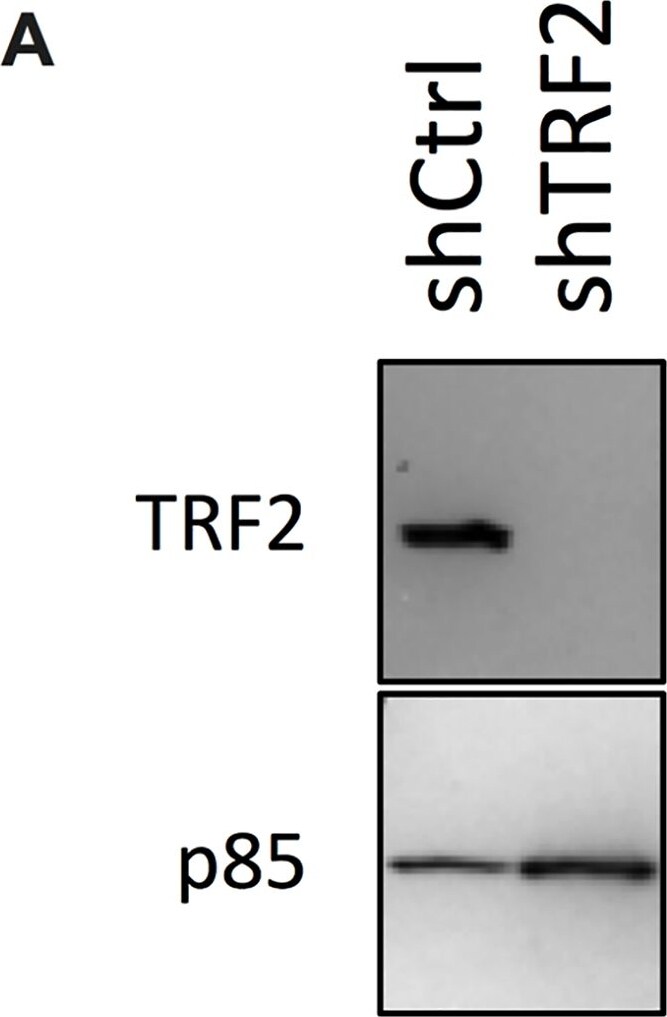
Western Blot: TRF-2 Antibody [NB100-56694] -
Western Blot: TRF-2 Antibody [NB100-56694] - TRF2 knockdown affect HHV-6A/B chromosomal integration.A) U2OS cells were transduced with lentiviral vectors expressing a scrambles shRNA (shCtrl) or a shTRF2. After a week of selection, cells were monitored for TRF2 expression by western blot. B) After a week of selection, shCtrl & shTRF2 treated cells were infected with HHV-6A or HHV-6B. After 30 days, DNA was isolated & the relative frequency of integration, relative to shCtrl set at 100%, estimated by ddPCR. *p<0.05. Image collected & cropped by CiteAb from the following publication (https://pubmed.ncbi.nlm.nih.gov/32320442), licensed under a CC-BY license. Not internally tested by Novus Biologicals.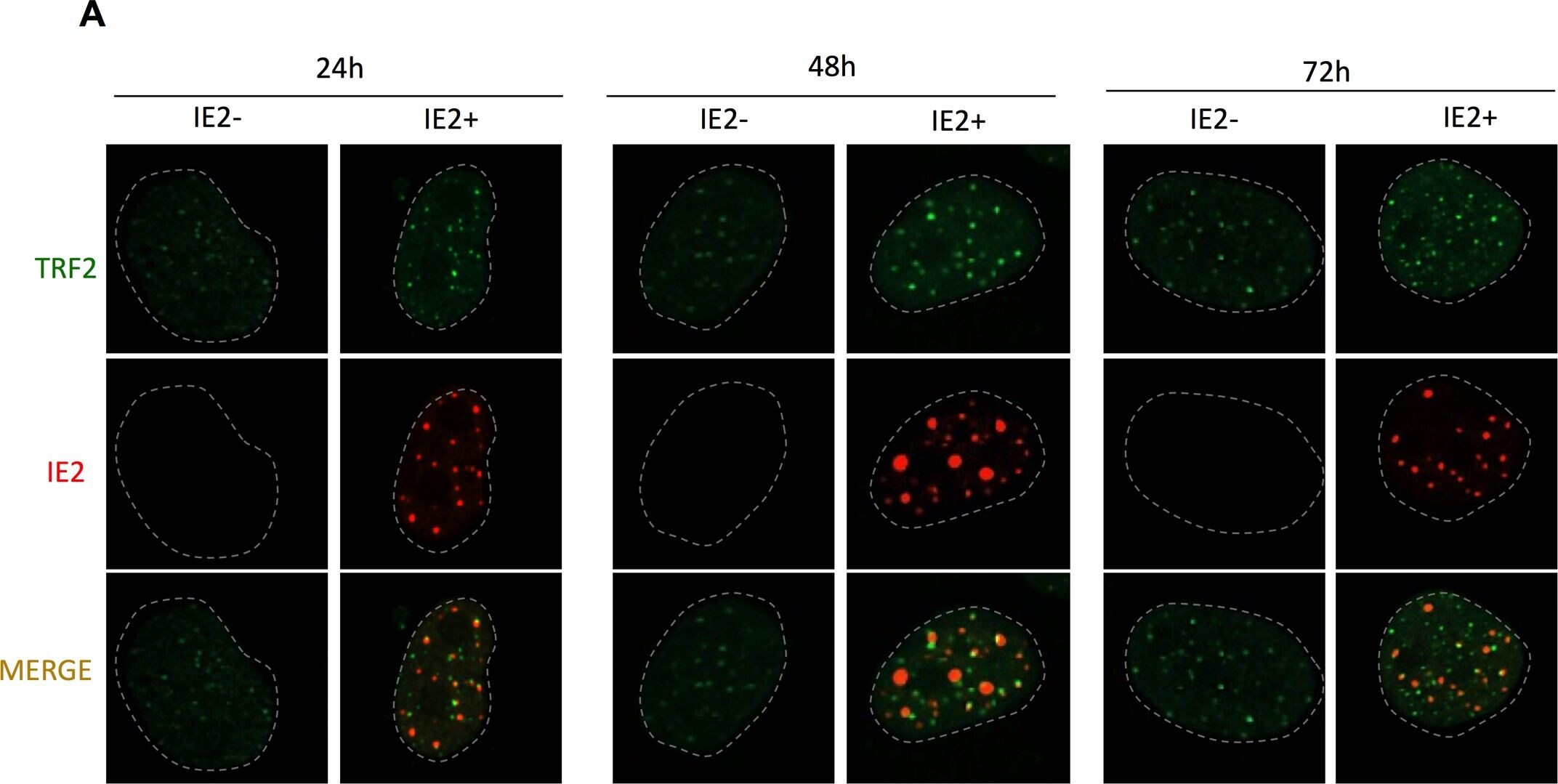
Immunocytochemistry/ Immunofluorescence: TRF-2 Antibody [NB100-56694] -
Immunocytochemistry/ Immunofluorescence: TRF-2 Antibody [NB100-56694] - TRF2 expression in HHV-6A-infected U2OS cells.U2OS cells were infected with HHV-6A & analyzed for TRF2 & IE2 expression at 24h, 48h & 72h post-infection by dual color immunofluorescence. A) Representative immunofluorescence of TRF2 & IE2 expression in bystander & IE2 expressing cells at 24, 48h & 72h post infection. B) Mean relative TRF2 expression ± SD in uninfected (blue), IE2- (green-uninfected bystander) or IE2+ (red-infected) cells at 24h, 48h & 72h post infection. Each symbol represents the relative TRF2 expression from a single nucleus. Image collected & cropped by CiteAb from the following publication (https://pubmed.ncbi.nlm.nih.gov/32320442), licensed under a CC-BY license. Not internally tested by Novus Biologicals.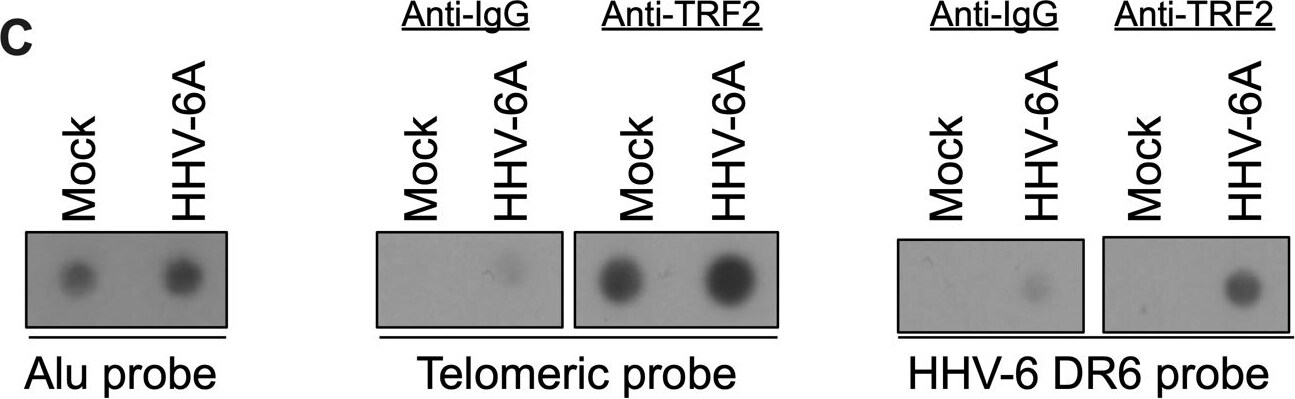
Immunocytochemistry/ Immunofluorescence: TRF-2 Antibody [NB100-56694] -
Immunocytochemistry/ Immunofluorescence: TRF-2 Antibody [NB100-56694] - Binding of TRF2 to viral DNA during HHV-6A/B infection.A) Schematic representation of the HHV-6A/B genome. The DR6 probe used for hybridization is shown in red. Uninfected & HHV-6A-infected HSB-2 cells (B-D) or uninfected & HHV-6B-infectd Molt-3 cells (E-F) were analyzed for TRF2 binding to viral DNA using ChIP. The input was hybridized with Alu probe to assess quantity of starting material. Anti-IgG (negative control), anti-PolII (positive control) or TRF2 antibodies were used for immunoprecipitation. B) QPCR detection of GAPDH DNA following ChIP. Results are expressed as fold increase over control IgG. C & E) Eluted DNA was hybridized with 32P-labeled Alu, telomeric (TTAGGG)3 or HHV-6A (DR6) probes. After hybridization the membranes were washed & exposed to X-ray films. D & F) Densitometric analysis of relative binding of TRF2 to telomeric & viral DNA. Results of one experiment representative of three are presented & are expressed as signal after normalization to input. Image collected & cropped by CiteAb from the following publication (https://pubmed.ncbi.nlm.nih.gov/32320442), licensed under a CC-BY license. Not internally tested by Novus Biologicals.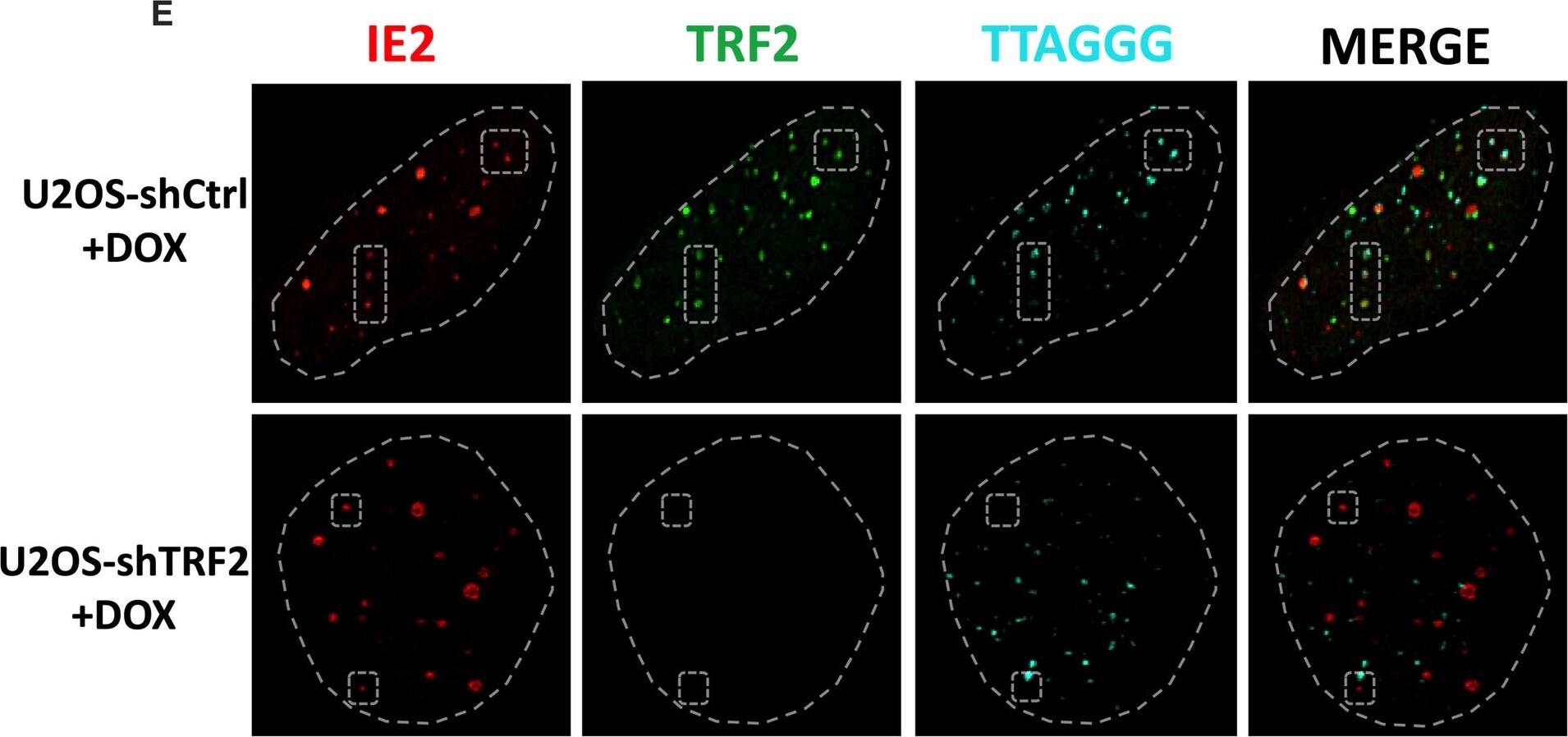
Immunocytochemistry/ Immunofluorescence: TRF-2 Antibody [NB100-56694] -
Immunocytochemistry/ Immunofluorescence: TRF-2 Antibody [NB100-56694] - TRF2 is required for IE2 localization with telomeres.U2OS cells were transduced with a lentiviral vector coding for a Dox inducible control shRNA (shCtrl) or a shRNA against TRF2 (shTRF2) & selected with puromycin +/- Dox for a week. A) Western blot analysis of TRF2 expression one week post selection. Membranes were also probed with anti-tubulin antibodies to show the input material loaded. B) One week post selection, +Dox cells were infected with HHV-6A for 48h & processed for IFA using anti-TRF2 (green) & anti-IE2 (red). Cells with IE2 in punctate form & cells with large patchy IE2, likely to represent VRC, are shown. Nuclei are outlined by dashed lines. C) The percentage of HHV-6A infected cells (from B) was estimated after counting a minimum of 700 cells & scoring the IE2+ ones. Results are expressed as mean %IE2+ cells ± SD. D) Mean percentage ± SD of IE2 localizing with telomeres in the presence (shCtrl +Dox) & absence (shTRF2 +Dox) of TRF2. Each dot represents the % of IE2 foci localizing with telomeres in one nucleus. ****p<0.0001. E) IF-FISH confocal images of shCtrl (+Dox) & shTRF2 (+Dox) cells analyzed for TRF2 (green), IE2 (red) & telomeres (cyan). Nuclei are outlined by dashed circles. Examples of IE2 localizing with telomeres (top row) or not found with telomeres (bottom row) are highlighted by the dashed polygons. Image collected & cropped by CiteAb from the following publication (https://pubmed.ncbi.nlm.nih.gov/32320442), licensed under a CC-BY license. Not internally tested by Novus Biologicals.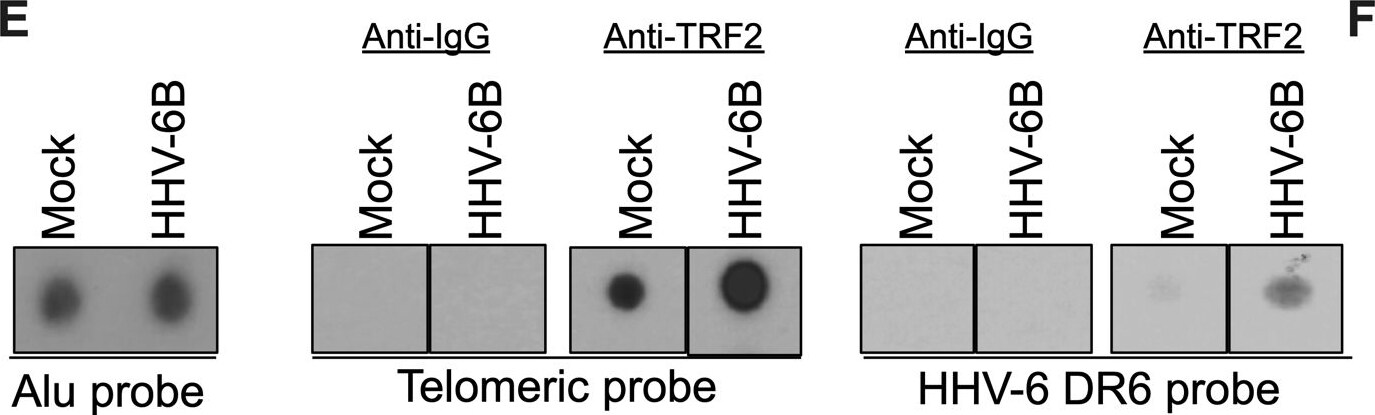
Immunocytochemistry/ Immunofluorescence: TRF-2 Antibody [NB100-56694] -
Immunocytochemistry/ Immunofluorescence: TRF-2 Antibody [NB100-56694] - Binding of TRF2 to viral DNA during HHV-6A/B infection.A) Schematic representation of the HHV-6A/B genome. The DR6 probe used for hybridization is shown in red. Uninfected & HHV-6A-infected HSB-2 cells (B-D) or uninfected & HHV-6B-infectd Molt-3 cells (E-F) were analyzed for TRF2 binding to viral DNA using ChIP. The input was hybridized with Alu probe to assess quantity of starting material. Anti-IgG (negative control), anti-PolII (positive control) or TRF2 antibodies were used for immunoprecipitation. B) QPCR detection of GAPDH DNA following ChIP. Results are expressed as fold increase over control IgG. C & E) Eluted DNA was hybridized with 32P-labeled Alu, telomeric (TTAGGG)3 or HHV-6A (DR6) probes. After hybridization the membranes were washed & exposed to X-ray films. D & F) Densitometric analysis of relative binding of TRF2 to telomeric & viral DNA. Results of one experiment representative of three are presented & are expressed as signal after normalization to input. Image collected & cropped by CiteAb from the following publication (https://pubmed.ncbi.nlm.nih.gov/32320442), licensed under a CC-BY license. Not internally tested by Novus Biologicals.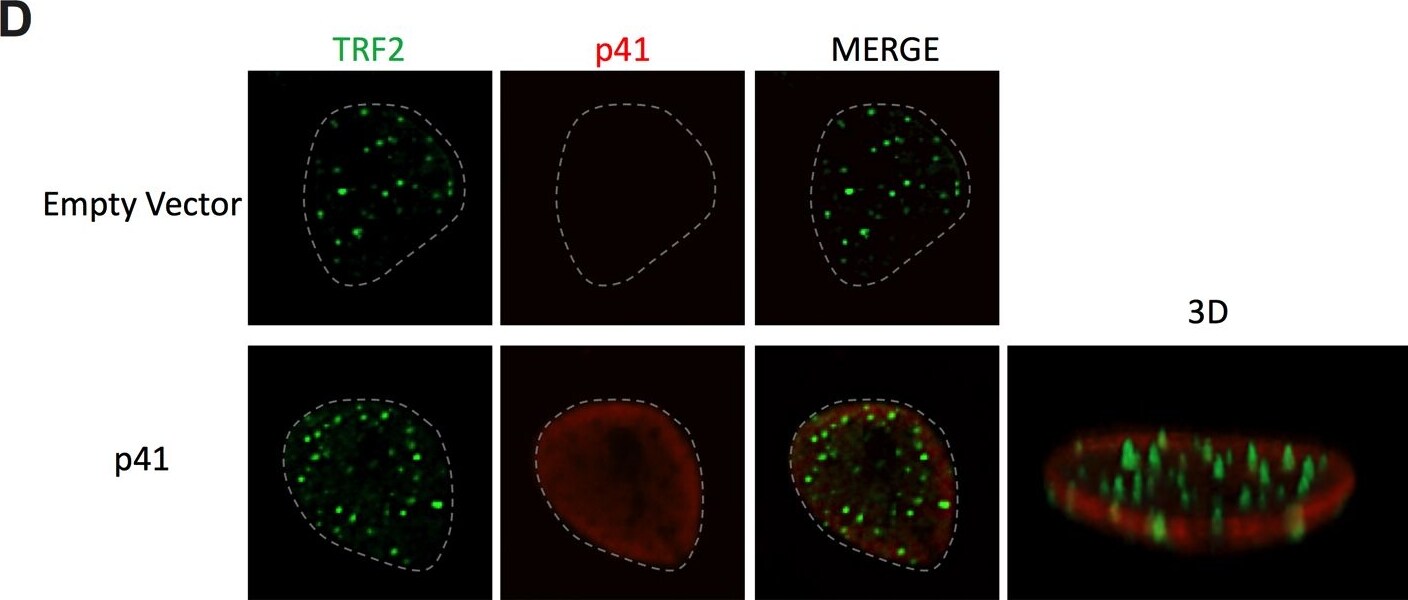
Immunocytochemistry/ Immunofluorescence: TRF-2 Antibody [NB100-56694] -
Immunocytochemistry/ Immunofluorescence: TRF-2 Antibody [NB100-56694] - A) A stick diagram of the IE2 protein with various domains identified is presented. B) Colocalization of HHV-6A IE2 protein with telomeres in the absence of viral DNA. U2OS cells were transfected with an empty vector, with IE2 expression vector or with IE2 delta 1290–1500 expression vector. Forty-eight hours later cells were processed for dual color immunofluorescence. Telomeres were labeled in cyan & IE2 in red. Nuclei are outlined by dashed lines. Examples of IE2 colocalizing with telomeres are presented in a 3D view (white arrows). C) The graph represents the mean ± SD % of WT IE2 & delta 1290–1500 IE2 localizing with telomeres. D) Lack of colocalization between HHV-6A p41 & telomeres in uninfected cells. U2OS cells were transfected with an empty vector or with a p41 expression vector. Forty-eight hours later cells were processed for dual color immunofluorescence. TRF2 was labeled green, p41 in red & nuclei outlined by a dashed line. Image collected & cropped by CiteAb from the following publication (https://pubmed.ncbi.nlm.nih.gov/32320442), licensed under a CC-BY license. Not internally tested by Novus Biologicals.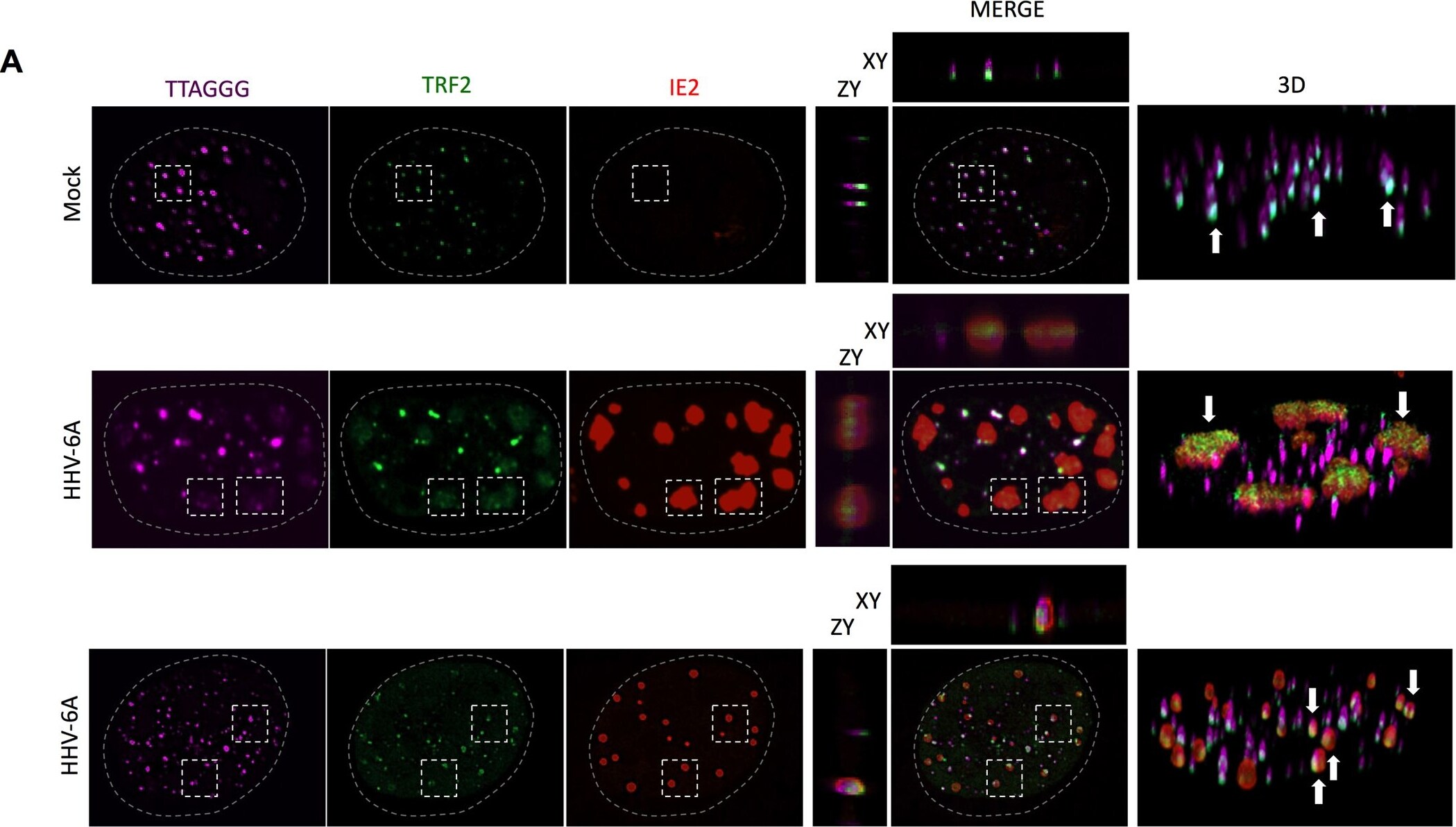
Immunocytochemistry/ Immunofluorescence: TRF-2 Antibody [NB100-56694] -
Immunocytochemistry/ Immunofluorescence: TRF-2 Antibody [NB100-56694] - Colocalization of shelterin complex proteins & HHV-6A IE2 protein at VRC & cellular telomeres.A) U2OS cells were mock-infected or infected with HHV-6A for 48h after which cells were processed for IF-FISH. Telomeres were labeled in magenta, TRF2 in green & IE2 in red. The panels in the middle row show images of cells with IE2 patches overlapping with large, diffuse TRF2 & telomeric staining (rectangles). The panels in the third row represent infected cells with punctate IE2 pattern colocalizing with TRF2 & telomeres (dashed squares). The colocalization of IE2, TRF2 & telomeres are shown in both 2D & 3D images. B) Uninfected & HHV-6A-infected U2OS cells were transfected with an empty vector, a myc-tagged-TRF1 expression vector. Forty-eight hours later cells were processed for IF-FISH. TRF1 was labeled in green & IE2 in red. Nuclei were stained with DAPI. Images on the far right show 2D colocalization of TRF1 with IE2. Image collected & cropped by CiteAb from the following publication (https://pubmed.ncbi.nlm.nih.gov/32320442), licensed under a CC-BY license. Not internally tested by Novus Biologicals.Applications for TRF-2 Antibody - BSA Free
Application
Recommended Usage
Chromatin Immunoprecipitation (ChIP)
1:20-1:1000
Flow Cytometry
reported in scientific literature (Gilbert-Girard S et al)
Immunocytochemistry/ Immunofluorescence
1:10-1:500
Immunohistochemistry
1:10-1:500
Immunohistochemistry-Paraffin
15 ug/ml
Immunoprecipitation
2 ug/ 10^6 cells
Western Blot
2 ug/ml
Flow Cytometry Panel Builder
Bio-Techne Knows Flow Cytometry
Save time and reduce costly mistakes by quickly finding compatible reagents using the Panel Builder Tool.
Advanced Features
- Spectra Viewer - Custom analysis of spectra from multiple fluorochromes
- Spillover Popups - Visualize the spectra of individual fluorochromes
- Antigen Density Selector - Match fluorochrome brightness with antigen density

Formulation, Preparation, and Storage
Purification
Protein G purified
Formulation
PBS
Format
BSA Free
Preservative
0.05% Sodium Azide
Concentration
1.0 mg/ml
Shipping
The product is shipped with polar packs. Upon receipt, store it immediately at the temperature recommended below.
Stability & Storage
Store at 4C short term. Aliquot and store at -20C long term. Avoid freeze-thaw cycles.
Background: TRF-2
Both TRF2 and TRF1 bind to telomeric double stranded 5'-TTAGGG-3' DNA repeats, then recruit RAP1, TIN2, TPP1, and POT1 for the assembly of the shelterin complex. The telomeric association of TRF2 is greatly increased in the S phase of the cell cycle (2). Loss of TRF2 leads to telomere shortening, the DNA damage response, chromosomal instability, and replicative senescence. Interestingly, the contribution of TRF2 to telomere shortening via a telomerase-independent mechanism has also been reported (3). In conjunction with the exonuclease, Apollo, TRF2 protects telomeres during replication and negatively regulates the accumulation of DNA topoisomerase (TOP1, TOP2A and TOP2B).
TRF2 has been implicated in cancer, shown to be a major oncogene in telomerase-deficient mice. A link to Werner syndrome, a premature aging disease caused by the loss of WRN, has been reported based on TRF2 recruitment of WRN for processing of telomeric DNA (4). TRF2 expression is increased during human embryonic stem cell differentiation and has been shown to interact with Repressor Element-1 Silencing Transcription Factor (REST), protecting it from proteasomal degradation (5).
References
1. Grammatikakis, I., Zhang, P., Mattson, M. P., & Gorospe, M. (2016). The long and the short of TRF2 in neurogenesis. Cell cycle (Georgetown, Tex.), 15(22), 3026-3032. PMID: 27565210
2. Li, F., Kim, H., Ji, Z., Zhang, T., Chen, B., Ge, Y., Hu, Y., Feng, X., Han, X., Xu, H., Zhang, Y., Yu, H., Liu, D., Ma, W., & Songyang, Z. (2018). The BUB3-BUB1 Complex Promotes Telomere DNA Replication. Molecular cell, 70(3), 395-407. PMID: 29727616
3. Ancelin, K., Brunori, M., Bauwens, S., Koering, C. E., Brun, C., Ricoul, M., Pommier, J. P., Sabatier, L., & Gilson, E. (2002). Targeting assay to study the cis functions of human telomeric proteins: evidence for inhibition of telomerase by TRF1 and for activation of telomere degradation by TRF2. Molecular and cellular biology, 22(10), 3474-3487. PMID: 11971978
4. Machwe A, Xiao L, & Orren DK. (2004) TRF2 recruits the Werner syndrome (WRN) exonuclease for processing of telomeric DNA. Oncogene. 23(1):149-56. PMID: 14712220.
5. Diotti, R., & Loayza, D. (2011). Shelterin complex and associated factors at human telomeres. Nucleus (Austin, Tex.), 2(2), 119-135. PMID: 21738835
Long Name
Telomeric Repeat Binding Factor 2
Alternate Names
TERF2, TRBF2, TRF2
Gene Symbol
TERF2
UniProt
Additional TRF-2 Products
Product Documents for TRF-2 Antibody - BSA Free
Certificate of Analysis
To download a Certificate of Analysis, please enter a lot or batch number in the search box below.
Product Specific Notices for TRF-2 Antibody - BSA Free
This product is for research use only and is not approved for use in humans or in clinical diagnosis. Primary Antibodies are guaranteed for 1 year from date of receipt.
Related Research Areas
Citations for TRF-2 Antibody - BSA Free
 Powered by Bioz
Customer Reviews for TRF-2 Antibody - BSA Free
There are currently no reviews for this product. Be the first to review TRF-2 Antibody - BSA Free and earn rewards!
Have you used TRF-2 Antibody - BSA Free?
Submit a review and receive an Amazon gift card!
$25/€18/£15/$25CAN/¥2500 for a review with an image
$10/€7/£6/$10CAN/¥1110 for a review without an image
Submit a review
Protocols
Find general support by application which include: protocols, troubleshooting, illustrated assays, videos and webinars.
- 7-Amino Actinomycin D (7-AAD) Cell Viability Flow Cytometry Protocol
- Antigen Retrieval Protocol (PIER)
- Antigen Retrieval for Frozen Sections Protocol
- Appropriate Fixation of IHC/ICC Samples
- Cellular Response to Hypoxia Protocols
- ChIP Protocol Video
- Chromatin Immunoprecipitation (ChIP) Protocol
- Chromatin Immunoprecipitation Protocol
- Chromogenic IHC Staining of Formalin-Fixed Paraffin-Embedded (FFPE) Tissue Protocol
- Chromogenic Immunohistochemistry Staining of Frozen Tissue
- ClariTSA™ Fluorophore Kits
- Detection & Visualization of Antibody Binding
- Extracellular Membrane Flow Cytometry Protocol
- Flow Cytometry Protocol for Cell Surface Markers
- Flow Cytometry Protocol for Staining Membrane Associated Proteins
- Flow Cytometry Staining Protocols
- Flow Cytometry Troubleshooting Guide
- Fluorescent IHC Staining of Frozen Tissue Protocol
- Graphic Protocol for Heat-induced Epitope Retrieval
- Graphic Protocol for the Preparation and Fluorescent IHC Staining of Frozen Tissue Sections
- Graphic Protocol for the Preparation and Fluorescent IHC Staining of Paraffin-embedded Tissue Sections
- Graphic Protocol for the Preparation of Gelatin-coated Slides for Histological Tissue Sections
- ICC Cell Smear Protocol for Suspension Cells
- ICC Immunocytochemistry Protocol Videos
- ICC for Adherent Cells
- IHC Sample Preparation (Frozen sections vs Paraffin)
- Immunocytochemistry (ICC) Protocol
- Immunocytochemistry Troubleshooting
- Immunofluorescence of Organoids Embedded in Cultrex Basement Membrane Extract
- Immunofluorescent IHC Staining of Formalin-Fixed Paraffin-Embedded (FFPE) Tissue Protocol
- Immunohistochemistry (IHC) and Immunocytochemistry (ICC) Protocols
- Immunohistochemistry Frozen Troubleshooting
- Immunohistochemistry Paraffin Troubleshooting
- Immunoprecipitation Protocol
- Intracellular Flow Cytometry Protocol Using Alcohol (Methanol)
- Intracellular Flow Cytometry Protocol Using Detergents
- Intracellular Nuclear Staining Flow Cytometry Protocol Using Detergents
- Intracellular Staining Flow Cytometry Protocol Using Alcohol Permeabilization
- Intracellular Staining Flow Cytometry Protocol Using Detergents to Permeabilize Cells
- Preparing Samples for IHC/ICC Experiments
- Preventing Non-Specific Staining (Non-Specific Binding)
- Primary Antibody Selection & Optimization
- Propidium Iodide Cell Viability Flow Cytometry Protocol
- Protocol for Heat-Induced Epitope Retrieval (HIER)
- Protocol for Liperfluo
- Protocol for Making a 4% Formaldehyde Solution in PBS
- Protocol for VisUCyte™ HRP Polymer Detection Reagent
- Protocol for the Characterization of Human Th22 Cells
- Protocol for the Characterization of Human Th9 Cells
- Protocol for the Fluorescent ICC Staining of Cell Smears - Graphic
- Protocol for the Fluorescent ICC Staining of Cultured Cells on Coverslips - Graphic
- Protocol for the Preparation & Fixation of Cells on Coverslips
- Protocol for the Preparation and Chromogenic IHC Staining of Frozen Tissue Sections
- Protocol for the Preparation and Chromogenic IHC Staining of Frozen Tissue Sections - Graphic
- Protocol for the Preparation and Chromogenic IHC Staining of Paraffin-embedded Tissue Sections
- Protocol for the Preparation and Chromogenic IHC Staining of Paraffin-embedded Tissue Sections - Graphic
- Protocol for the Preparation and Fluorescent ICC Staining of Cells on Coverslips
- Protocol for the Preparation and Fluorescent ICC Staining of Non-adherent Cells
- Protocol for the Preparation and Fluorescent ICC Staining of Stem Cells on Coverslips
- Protocol for the Preparation and Fluorescent IHC Staining of Frozen Tissue Sections
- Protocol for the Preparation and Fluorescent IHC Staining of Paraffin-embedded Tissue Sections
- Protocol for the Preparation of Gelatin-coated Slides for Histological Tissue Sections
- Protocol for the Preparation of a Cell Smear for Non-adherent Cell ICC - Graphic
- Protocol: Annexin V and PI Staining by Flow Cytometry
- Protocol: Annexin V and PI Staining for Apoptosis by Flow Cytometry
- R&D Systems Quality Control Western Blot Protocol
- TUNEL and Active Caspase-3 Detection by IHC/ICC Protocol
- The Importance of IHC/ICC Controls
- Troubleshooting Guide: Fluorokine Flow Cytometry Kits
- Troubleshooting Guide: Immunohistochemistry
- Troubleshooting Guide: Western Blot Figures
- Western Blot Conditions
- Western Blot Protocol
- Western Blot Protocol for Cell Lysates
- Western Blot Troubleshooting
- Western Blot Troubleshooting Guide
- View all Protocols, Troubleshooting, Illustrated assays and Webinars
FAQs for TRF-2 Antibody - BSA Free
Showing
1
-
4 of
4 FAQs
Showing All
-
Q: Are the TRF-2 antibodies validated in Simple Western?
A: Yes, we offer a 2 TRF-2 antibodies that have been tested in Simple Western: NB100-56506 and NB110-57130.
-
Q: Does TRF-2 antibodies comes in lyophilized form?
A: we carry 2 TERF2/TRBF2 antibodies in lyophilized form: AF5635, MAB5635.
-
Q: What is the immunogen sequence of this TRF-2 antibody?
A: The whole length of Baculovirus expressed His-tagged TRF-2 protein is proprietary.
-
Q: What the theoretical molecular weight for TRF-2 antibodies?
A: The TMW of TRF-2 antibodies is approximately 55 - 56 kDa.
-
Q: Are the TRF-2 antibodies validated in Simple Western?
A: Yes, we offer a 2 TRF-2 antibodies that have been tested in Simple Western: NB100-56506 and NB110-57130.
-
Q: Does TRF-2 antibodies comes in lyophilized form?
A: we carry 2 TERF2/TRBF2 antibodies in lyophilized form: AF5635, MAB5635.
-
Q: What is the immunogen sequence of this TRF-2 antibody?
A: The whole length of Baculovirus expressed His-tagged TRF-2 protein is proprietary.
-
Q: What the theoretical molecular weight for TRF-2 antibodies?
A: The TMW of TRF-2 antibodies is approximately 55 - 56 kDa.
-
Q: Are the TRF-2 antibodies validated in Simple Western?
A: Yes, we offer a 2 TRF-2 antibodies that have been tested in Simple Western: NB100-56506 and NB110-57130.
-
Q: Does TRF-2 antibodies comes in lyophilized form?
A: we carry 2 TERF2/TRBF2 antibodies in lyophilized form: AF5635, MAB5635.
-
Q: What is the immunogen sequence of this TRF-2 antibody?
A: The whole length of Baculovirus expressed His-tagged TRF-2 protein is proprietary.
-
Q: What the theoretical molecular weight for TRF-2 antibodies?
A: The TMW of TRF-2 antibodies is approximately 55 - 56 kDa.
-
Q: Are the TRF-2 antibodies validated in Simple Western?
A: Yes, we offer a 2 TRF-2 antibodies that have been tested in Simple Western: NB100-56506 and NB110-57130.
-
Q: Does TRF-2 antibodies comes in lyophilized form?
A: we carry 2 TERF2/TRBF2 antibodies in lyophilized form: AF5635, MAB5635.
-
Q: What is the immunogen sequence of this TRF-2 antibody?
A: The whole length of Baculovirus expressed His-tagged TRF-2 protein is proprietary.
-
Q: What the theoretical molecular weight for TRF-2 antibodies?
A: The TMW of TRF-2 antibodies is approximately 55 - 56 kDa.
Loading...