
WWP1 Antibody (1A7) - Azide and BSA Free
Novus Biologicals | Catalog # H00011059-M01

![Western Blot: WWP1 Antibody (1A7) [H00011059-M01]](https://resources.rndsystems.com/images/products/WWP1-Antibody-1A7-Western-Blot-H00011059-M01-img0011.jpg "Western Blot: WWP1 Antibody (1A7) [H00011059-M01]")
Loading...
Key Product Details
Species Reactivity
Validated:
Human, Primate
Cited:
Human, Primate
Applications
Validated:
Immunohistochemistry, Immunohistochemistry-Paraffin, Western Blot, ELISA, Immunocytochemistry/ Immunofluorescence, Immunoprecipitation
Cited:
Immunohistochemistry-Paraffin, Western Blot, Immunoprecipitation
Label
Unconjugated
Antibody Source
Monoclonal Mouse IgG2a Kappa Clone # 1A7
Format
Azide and BSA Free
Loading...
Product Specifications
Immunogen
WWP1 (NP_008944, 152 a.a. ~ 260 a.a) partial recombinant protein with GST tag. MW of the GST tag alone is 26 KDa. CSSSPTIEIQENGDALHENGEPSARTTARLAVEGTNGIDNHVPTSTLVQNSCCSYVVNGDNTPSSPSQVAARPKNTPAPKPLASEPADDTVNGESSSFAPTDNASVTGT
Reactivity Notes
Primate reactivity reported in scientific literature (PMID: 23573293).
Specificity
WWP1 - WW domain containing E3 ubiquitin protein ligase 1 (1A7)
Clonality
Monoclonal
Host
Mouse
Isotype
IgG2a Kappa
Scientific Data Images for WWP1 Antibody (1A7) - Azide and BSA Free
Western Blot: WWP1 Antibody (1A7) [H00011059-M01]
Western Blot: WWP1 Antibody (1A7) [H00011059-M01] - Analysis of WWP1 expression in transfected 293T cell line by WWP1 monoclonal antibody (M01A), clone 1A7.Lane 1: WWP1 transfected lysate(105.2 KDa).Lane 2: Non-transfected lysate.![Immunocytochemistry/ Immunofluorescence: WWP1 Antibody (1A7) [H00011059-M01]](https://resources.rndsystems.com/images/products/WWP1-Antibody-1A7-Immunocytochemistry-Immunofluorescence-H00011059-M01-img0005.jpg "Immunocytochemistry/ Immunofluorescence: WWP1 Antibody (1A7) [H00011059-M01]")
Immunocytochemistry/ Immunofluorescence: WWP1 Antibody (1A7) [H00011059-M01]
Immunocytochemistry/Immunofluorescence: WWP1 Antibody (1A7) [H00011059-M01] - Analysis of monoclonal antibody to WWP1 on A-431 cell. Antibody concentration 10 ug/ml.![Immunohistochemistry-Paraffin: WWP1 Antibody (1A7) [H00011059-M01]](https://resources.rndsystems.com/images/products/WWP1-Antibody-1A7-Immunohistochemistry-Paraffin-H00011059-M01-img0007.jpg "Immunohistochemistry-Paraffin: WWP1 Antibody (1A7) [H00011059-M01]")
Immunohistochemistry-Paraffin: WWP1 Antibody (1A7) [H00011059-M01]
Immunohistochemistry-Paraffin: WWP1 Antibody (1A7) [H00011059-M01] - Analysis of monoclonal antibody to WWP1 on formalin-fixed paraffin-embedded human stomach. Antibody concentration 3 ug/ml.![Western Blot: WWP1 Antibody (1A7) [H00011059-M01]](https://resources.rndsystems.com/images/products/WWP1-Antibody-1A7-Western-Blot-H00011059-M01-img0001.jpg "Western Blot: WWP1 Antibody (1A7) [H00011059-M01]")
Western Blot: WWP1 Antibody (1A7) [H00011059-M01]
Western Blot: WWP1 Antibody (1A7) [H00011059-M01] - WWP1 expression in A-431 ( Cat # L015V1 ).![Immunoprecipitation: WWP1 Antibody (1A7) [H00011059-M01]](https://resources.rndsystems.com/images/products/WWP1-Antibody-1A7-Immunoprecipitation-H00011059-M01-img0008.jpg "Immunoprecipitation: WWP1 Antibody (1A7) [H00011059-M01]")
Immunoprecipitation: WWP1 Antibody (1A7) [H00011059-M01]
Immunoprecipitation: WWP1 Antibody (1A7) [H00011059-M01] - Analysis of WWP1 transfected lysate using anti-WWP1 monoclonal antibody and Protein A Magnetic Bead, and immunoblotted with WWP1 MaxPab rabbit polyclonal antibody.![ELISA: WWP1 Antibody (1A7) [H00011059-M01]](https://resources.rndsystems.com/images/products/WWP1-Antibody-1A7-ELISA-H00011059-M01-img0012.jpg "ELISA: WWP1 Antibody (1A7) [H00011059-M01]")
ELISA: WWP1 Antibody (1A7) [H00011059-M01]
ELISA: WWP1 Antibody (1A7) [H00011059-M01] - Detection limit for recombinant GST tagged WWP1 is 0.03 ng/ml as a capture antibody.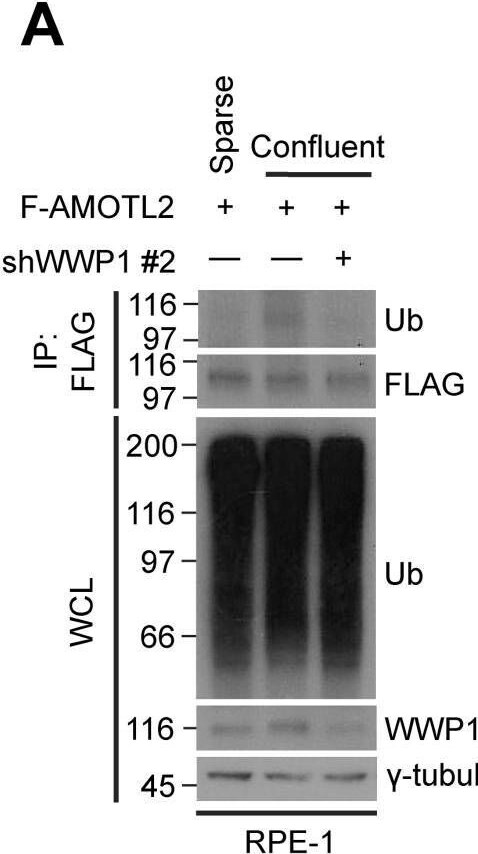
Western Blot: WWP1 Antibody (1A7) - Azide and BSA Free [H00011059-M01] -
High cell density promotes WWP1 stabilization and activation.(A) RPE-1 cells were stably transduced with FLAG-AMOTL2 and either control or WWP1 shRNAs, re-seeded to a sparse or confluent density, then subjected to in vivo ubiquitination assays. (B) mRNAs isolated from MCF10A and 293Ad cells, seeded at either a sparse or confluent density, were analyzed for the indicated genes by qRT-PCR, and expression levels were normalized to those of GAPDH mRNA (n = 4). Data are expressed as means +/- SEM (error bars; ***P < 0.001, n.s. not significant; unpaired t test). (C) MCF10A cells stably transduced with shGFP (control) or shWWP1 lentiviruses were seeded at either a sparse or confluent density and extracts were analyzed by Western blotting. (D) RPE-1 and 293Ad cells were seeded at either a sparse or confluent density, then a cycloheximide (CHX) chase assay was performed for the indicated times. The resulting extracts were analyzed by Western blotting. (E) 293Ad cells were seeded at either sparse or confluent densities and extracts were subjected to S100/P100 membrane-cytosol fractionation assays. The resulting fractions were analyzed for the indicated proteins by Western blotting. Image collected and cropped by CiteAb from the following open publication (https://pubmed.ncbi.nlm.nih.gov/34404733), licensed under a CC-BY license. Not internally tested by Novus Biologicals.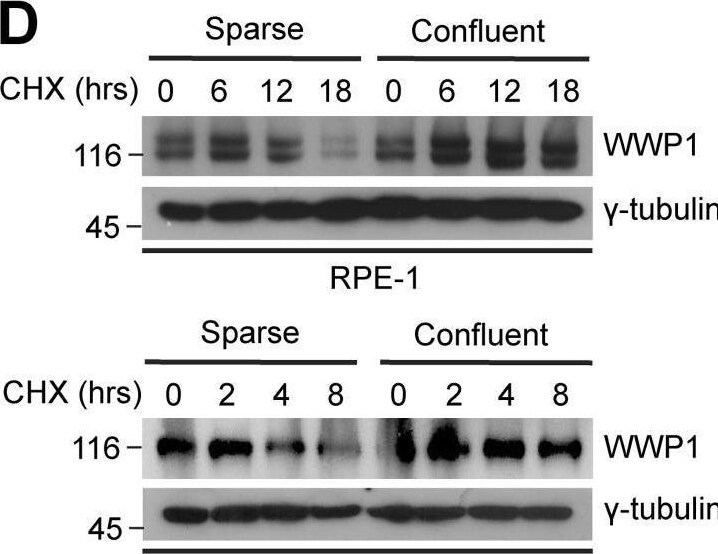
Western Blot: WWP1 Antibody (1A7) - Azide and BSA Free [H00011059-M01] -
High cell density promotes WWP1 stabilization and activation.(A) RPE-1 cells were stably transduced with FLAG-AMOTL2 and either control or WWP1 shRNAs, re-seeded to a sparse or confluent density, then subjected to in vivo ubiquitination assays. (B) mRNAs isolated from MCF10A and 293Ad cells, seeded at either a sparse or confluent density, were analyzed for the indicated genes by qRT-PCR, and expression levels were normalized to those of GAPDH mRNA (n = 4). Data are expressed as means +/- SEM (error bars; ***P < 0.001, n.s. not significant; unpaired t test). (C) MCF10A cells stably transduced with shGFP (control) or shWWP1 lentiviruses were seeded at either a sparse or confluent density and extracts were analyzed by Western blotting. (D) RPE-1 and 293Ad cells were seeded at either a sparse or confluent density, then a cycloheximide (CHX) chase assay was performed for the indicated times. The resulting extracts were analyzed by Western blotting. (E) 293Ad cells were seeded at either sparse or confluent densities and extracts were subjected to S100/P100 membrane-cytosol fractionation assays. The resulting fractions were analyzed for the indicated proteins by Western blotting. Image collected and cropped by CiteAb from the following open publication (https://pubmed.ncbi.nlm.nih.gov/34404733), licensed under a CC-BY license. Not internally tested by Novus Biologicals.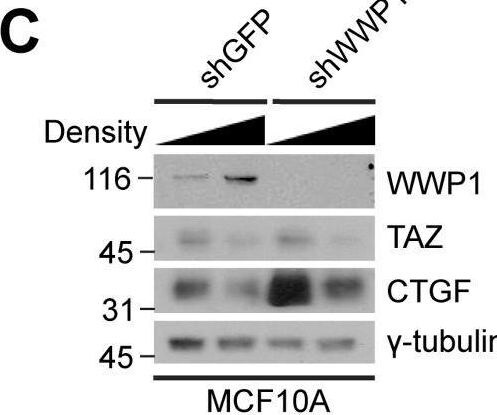
Western Blot: WWP1 Antibody (1A7) - Azide and BSA Free [H00011059-M01] -
High cell density promotes WWP1 stabilization and activation.(A) RPE-1 cells were stably transduced with FLAG-AMOTL2 and either control or WWP1 shRNAs, re-seeded to a sparse or confluent density, then subjected to in vivo ubiquitination assays. (B) mRNAs isolated from MCF10A and 293Ad cells, seeded at either a sparse or confluent density, were analyzed for the indicated genes by qRT-PCR, and expression levels were normalized to those of GAPDH mRNA (n = 4). Data are expressed as means +/- SEM (error bars; ***P < 0.001, n.s. not significant; unpaired t test). (C) MCF10A cells stably transduced with shGFP (control) or shWWP1 lentiviruses were seeded at either a sparse or confluent density and extracts were analyzed by Western blotting. (D) RPE-1 and 293Ad cells were seeded at either a sparse or confluent density, then a cycloheximide (CHX) chase assay was performed for the indicated times. The resulting extracts were analyzed by Western blotting. (E) 293Ad cells were seeded at either sparse or confluent densities and extracts were subjected to S100/P100 membrane-cytosol fractionation assays. The resulting fractions were analyzed for the indicated proteins by Western blotting. Image collected and cropped by CiteAb from the following open publication (https://pubmed.ncbi.nlm.nih.gov/34404733), licensed under a CC-BY license. Not internally tested by Novus Biologicals.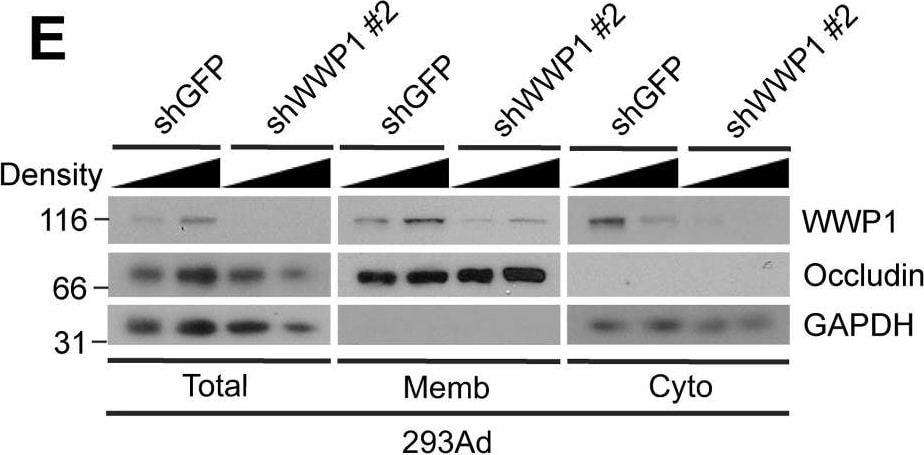
Western Blot: WWP1 Antibody (1A7) - Azide and BSA Free [H00011059-M01] -
High cell density promotes WWP1 stabilization and activation.(A) RPE-1 cells were stably transduced with FLAG-AMOTL2 and either control or WWP1 shRNAs, re-seeded to a sparse or confluent density, then subjected to in vivo ubiquitination assays. (B) mRNAs isolated from MCF10A and 293Ad cells, seeded at either a sparse or confluent density, were analyzed for the indicated genes by qRT-PCR, and expression levels were normalized to those of GAPDH mRNA (n = 4). Data are expressed as means +/- SEM (error bars; ***P < 0.001, n.s. not significant; unpaired t test). (C) MCF10A cells stably transduced with shGFP (control) or shWWP1 lentiviruses were seeded at either a sparse or confluent density and extracts were analyzed by Western blotting. (D) RPE-1 and 293Ad cells were seeded at either a sparse or confluent density, then a cycloheximide (CHX) chase assay was performed for the indicated times. The resulting extracts were analyzed by Western blotting. (E) 293Ad cells were seeded at either sparse or confluent densities and extracts were subjected to S100/P100 membrane-cytosol fractionation assays. The resulting fractions were analyzed for the indicated proteins by Western blotting. Image collected and cropped by CiteAb from the following open publication (https://pubmed.ncbi.nlm.nih.gov/34404733), licensed under a CC-BY license. Not internally tested by Novus Biologicals.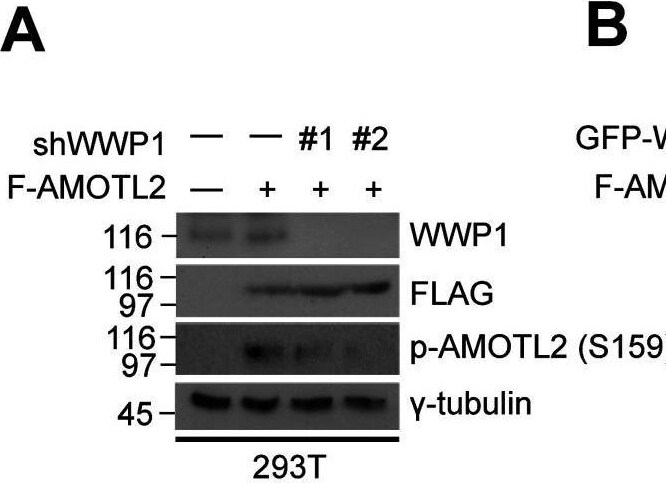
Western Blot: WWP1 Antibody (1A7) - Azide and BSA Free [H00011059-M01] -
WWP1 promotes AMOTL2 phosphorylation by LATS.(A) 293T cells stably transduced with shGFP (control) or shWWP1 lentiviruses were transfected with the indicated DNAs, then lysates were analyzed by Western blotting. (B) 293T cells were transfected with the indicated DNAs, then lysates were analyzed by Western blotting. (C) 293T cells were transfected with the indicated DNAs, then lysates were analyzed by Western blotting. (D) Control or CRISPR/Cas9-mediated LATS1/2-knockout 293T cells were transfected with the indicated DNAs, then lysates were subjected to in vivo ubiquitination assay. Image collected and cropped by CiteAb from the following open publication (https://pubmed.ncbi.nlm.nih.gov/34404733), licensed under a CC-BY license. Not internally tested by Novus Biologicals.Applications for WWP1 Antibody (1A7) - Azide and BSA Free
Application
Recommended Usage
Immunocytochemistry/ Immunofluorescence
10ug/mL
Immunohistochemistry-Paraffin
3ug/mL
Western Blot
1:500
Application Notes
Antibody reactive against cell lysate and recombinant protein for Western Blot. Has also been used for immunofluoresence, immunohistochemistry (paraffin), and ELISA.
Formulation, Preparation, and Storage
Purification
Ascites
Formulation
In 1x PBS, pH 7.4
Format
Azide and BSA Free
Preservative
No Preservative
Concentration
This product is unpurified. The exact concentration of antibody is not quantifiable.
Shipping
The product is shipped with polar packs. Upon receipt, store it immediately at the temperature recommended below.
Stability & Storage
Aliquot and store at -20C or -80C. Avoid freeze-thaw cycles.
Background: WWP1
Long Name
WW Domain Containing E3 Ubiquitin Protein Ligase 1
Alternate Names
AIP5, HSDRP1, Tiul11
Gene Symbol
WWP1
OMIM
602307 (Human)
Additional WWP1 Products
Product Documents for WWP1 Antibody (1A7) - Azide and BSA Free
Certificate of Analysis
To download a Certificate of Analysis, please enter a lot or batch number in the search box below.
Product Specific Notices for WWP1 Antibody (1A7) - Azide and BSA Free
This product is produced by and distributed for Abnova, a company based in Taiwan.
This product is for research use only and is not approved for use in humans or in clinical diagnosis. Primary Antibodies are guaranteed for 1 year from date of receipt.
Related Research Areas
Citations for WWP1 Antibody (1A7) - Azide and BSA Free
 Powered by Bioz
Customer Reviews for WWP1 Antibody (1A7) - Azide and BSA Free
There are currently no reviews for this product. Be the first to review WWP1 Antibody (1A7) - Azide and BSA Free and earn rewards!
Have you used WWP1 Antibody (1A7) - Azide and BSA Free?
Submit a review and receive an Amazon gift card!
$25/€18/£15/$25CAN/¥2500 for a review with an image
$10/€7/£6/$10CAN/¥1110 for a review without an image
Submit a review
Protocols
Find general support by application which include: protocols, troubleshooting, illustrated assays, videos and webinars.
- Antigen Retrieval Protocol (PIER)
- Antigen Retrieval for Frozen Sections Protocol
- Appropriate Fixation of IHC/ICC Samples
- Cellular Response to Hypoxia Protocols
- Chromogenic IHC Staining of Formalin-Fixed Paraffin-Embedded (FFPE) Tissue Protocol
- Chromogenic Immunohistochemistry Staining of Frozen Tissue
- ClariTSA™ Fluorophore Kits
- Detection & Visualization of Antibody Binding
- ELISA Sample Preparation & Collection Guide
- ELISA Troubleshooting Guide
- Fluorescent IHC Staining of Frozen Tissue Protocol
- Graphic Protocol for Heat-induced Epitope Retrieval
- Graphic Protocol for the Preparation and Fluorescent IHC Staining of Frozen Tissue Sections
- Graphic Protocol for the Preparation and Fluorescent IHC Staining of Paraffin-embedded Tissue Sections
- Graphic Protocol for the Preparation of Gelatin-coated Slides for Histological Tissue Sections
- How to Run an R&D Systems DuoSet ELISA
- How to Run an R&D Systems Quantikine ELISA
- How to Run an R&D Systems Quantikine™ QuicKit™ ELISA
- ICC Cell Smear Protocol for Suspension Cells
- ICC Immunocytochemistry Protocol Videos
- ICC for Adherent Cells
- IHC Sample Preparation (Frozen sections vs Paraffin)
- Immunocytochemistry (ICC) Protocol
- Immunocytochemistry Troubleshooting
- Immunofluorescence of Organoids Embedded in Cultrex Basement Membrane Extract
- Immunofluorescent IHC Staining of Formalin-Fixed Paraffin-Embedded (FFPE) Tissue Protocol
- Immunohistochemistry (IHC) and Immunocytochemistry (ICC) Protocols
- Immunohistochemistry Frozen Troubleshooting
- Immunohistochemistry Paraffin Troubleshooting
- Immunoprecipitation Protocol
- Preparing Samples for IHC/ICC Experiments
- Preventing Non-Specific Staining (Non-Specific Binding)
- Primary Antibody Selection & Optimization
- Protocol for Heat-Induced Epitope Retrieval (HIER)
- Protocol for Making a 4% Formaldehyde Solution in PBS
- Protocol for VisUCyte™ HRP Polymer Detection Reagent
- Protocol for the Fluorescent ICC Staining of Cell Smears - Graphic
- Protocol for the Fluorescent ICC Staining of Cultured Cells on Coverslips - Graphic
- Protocol for the Preparation & Fixation of Cells on Coverslips
- Protocol for the Preparation and Chromogenic IHC Staining of Frozen Tissue Sections
- Protocol for the Preparation and Chromogenic IHC Staining of Frozen Tissue Sections - Graphic
- Protocol for the Preparation and Chromogenic IHC Staining of Paraffin-embedded Tissue Sections
- Protocol for the Preparation and Chromogenic IHC Staining of Paraffin-embedded Tissue Sections - Graphic
- Protocol for the Preparation and Fluorescent ICC Staining of Cells on Coverslips
- Protocol for the Preparation and Fluorescent ICC Staining of Non-adherent Cells
- Protocol for the Preparation and Fluorescent ICC Staining of Stem Cells on Coverslips
- Protocol for the Preparation and Fluorescent IHC Staining of Frozen Tissue Sections
- Protocol for the Preparation and Fluorescent IHC Staining of Paraffin-embedded Tissue Sections
- Protocol for the Preparation of Gelatin-coated Slides for Histological Tissue Sections
- Protocol for the Preparation of a Cell Smear for Non-adherent Cell ICC - Graphic
- Quantikine HS ELISA Kit Assay Principle, Alkaline Phosphatase
- Quantikine HS ELISA Kit Principle, Streptavidin-HRP Polymer
- R&D Systems Quality Control Western Blot Protocol
- Sandwich ELISA (Colorimetric) – Biotin/Streptavidin Detection Protocol
- Sandwich ELISA (Colorimetric) – Direct Detection Protocol
- TUNEL and Active Caspase-3 Detection by IHC/ICC Protocol
- The Importance of IHC/ICC Controls
- Troubleshooting Guide: ELISA
- Troubleshooting Guide: Immunohistochemistry
- Troubleshooting Guide: Western Blot Figures
- Western Blot Conditions
- Western Blot Protocol
- Western Blot Protocol for Cell Lysates
- Western Blot Troubleshooting
- Western Blot Troubleshooting Guide
- View all Protocols, Troubleshooting, Illustrated assays and Webinars
Loading...