
XRCC1 Antibody - BSA Free
Novus Biologicals | Catalog # NBP1-87154

![Western Blot: XRCC1 Antibody [NBP1-87154]](https://resources.rndsystems.com/images/products/XRCC1-Antibody-Western-Blot-NBP1-87154-img0015.jpg "Western Blot: XRCC1 Antibody [NBP1-87154]")
Loading...
Key Product Details
Validated by
Knockout/Knockdown
Species Reactivity
Validated:
Human
Cited:
Human
Applications
Validated:
Multiplex Immunofluorescence, Immunohistochemistry, Immunohistochemistry-Paraffin, Western Blot, Immunocytochemistry/ Immunofluorescence, COMET, Knockdown Validated
Cited:
Western Blot, Immunocytochemistry/ Immunofluorescence, Immunoprecipitation
Label
Unconjugated
Antibody Source
Polyclonal Rabbit IgG
Format
BSA Free
Loading...
Product Specifications
Immunogen
This antibody was developed against Recombinant Protein corresponding to amino acids: WDRVKIVCSQPYSKDSPFGLSFVRFHSPPDKDEAEAPSQKVTVTKLGQFRVKEEDESANSLRPGALFFSRINKTSPVTASDPAGPSYAAATLQASSAASSASPVSRAIGSTSKPQESPKGKRKLDLNQEEKKT
Reactivity Notes
Immunogen displays the following percentage of sequence identity for non-tested species: Mouse (85%), Rat (85%)
Clonality
Polyclonal
Host
Rabbit
Isotype
IgG
Scientific Data Images for XRCC1 Antibody - BSA Free
![Western Blot: XRCC1 Antibody [NBP1-87154]](https://resources.rndsystems.com/images/products/XRCC1-Antibody-Western-Blot-NBP1-87154-img0009.jpg "Western Blot: XRCC1 Antibody [NBP1-87154]")
![Immunohistochemistry-Paraffin: XRCC1 Antibody [NBP1-87154]](https://resources.rndsystems.com/images/products/XRCC1-Antibody-Immunohistochemistry-Paraffin-NBP1-87154-img0013.jpg "Immunohistochemistry-Paraffin: XRCC1 Antibody [NBP1-87154]")
Immunohistochemistry-Paraffin: XRCC1 Antibody [NBP1-87154]
Immunohistochemistry-Paraffin: XRCC1 Antibody [NBP1-87154] - Staining of human pancreas shows moderate to strong nuclear positivity in exocrine glandular cells.![Western Blot: XRCC1 Antibody [NBP1-87154]](https://resources.rndsystems.com/images/products/XRCC1-Antibody-Western-Blot-NBP1-87154-img0014.jpg "Western Blot: XRCC1 Antibody [NBP1-87154]")
Western Blot: XRCC1 Antibody [NBP1-87154]
Western Blot: XRCC1 Antibody [NBP1-87154] - Analysis in control (vector only transfected HEK293T lysate) and XRCC1 over-expression lysate (Co-expressed with a C-terminal myc-DDK tag (3.1 kDa) in mammalian HEK293T cells).![Immunohistochemistry-Paraffin: XRCC1 Antibody [NBP1-87154]](https://resources.rndsystems.com/images/products/XRCC1-Antibody-Immunohistochemistry-Paraffin-NBP1-87154-img0010.jpg "Immunohistochemistry-Paraffin: XRCC1 Antibody [NBP1-87154]")
Immunohistochemistry-Paraffin: XRCC1 Antibody [NBP1-87154]
Immunohistochemistry-Paraffin: XRCC1 Antibody [NBP1-87154] - Staining of human fallopian tube shows strong nuclear positivity in glandular cells.![Immunohistochemistry-Paraffin: XRCC1 Antibody [NBP1-87154]](https://resources.rndsystems.com/images/products/XRCC1-Antibody-Immunohistochemistry-Paraffin-NBP1-87154-img0011.jpg "Immunohistochemistry-Paraffin: XRCC1 Antibody [NBP1-87154]")
Immunohistochemistry-Paraffin: XRCC1 Antibody [NBP1-87154]
Immunohistochemistry-Paraffin: XRCC1 Antibody [NBP1-87154] - Staining of human testis shows strong nuclear positivity in cells in seminiferous ducts.![Immunohistochemistry-Paraffin: XRCC1 Antibody [NBP1-87154]](https://resources.rndsystems.com/images/products/XRCC1-Antibody-Immunohistochemistry-Paraffin-NBP1-87154-img0012.jpg "Immunohistochemistry-Paraffin: XRCC1 Antibody [NBP1-87154]")
Immunohistochemistry-Paraffin: XRCC1 Antibody [NBP1-87154]
Immunohistochemistry-Paraffin: XRCC1 Antibody [NBP1-87154] - Staining of human cerebral cortex shows strong nuclear positivity in neurons.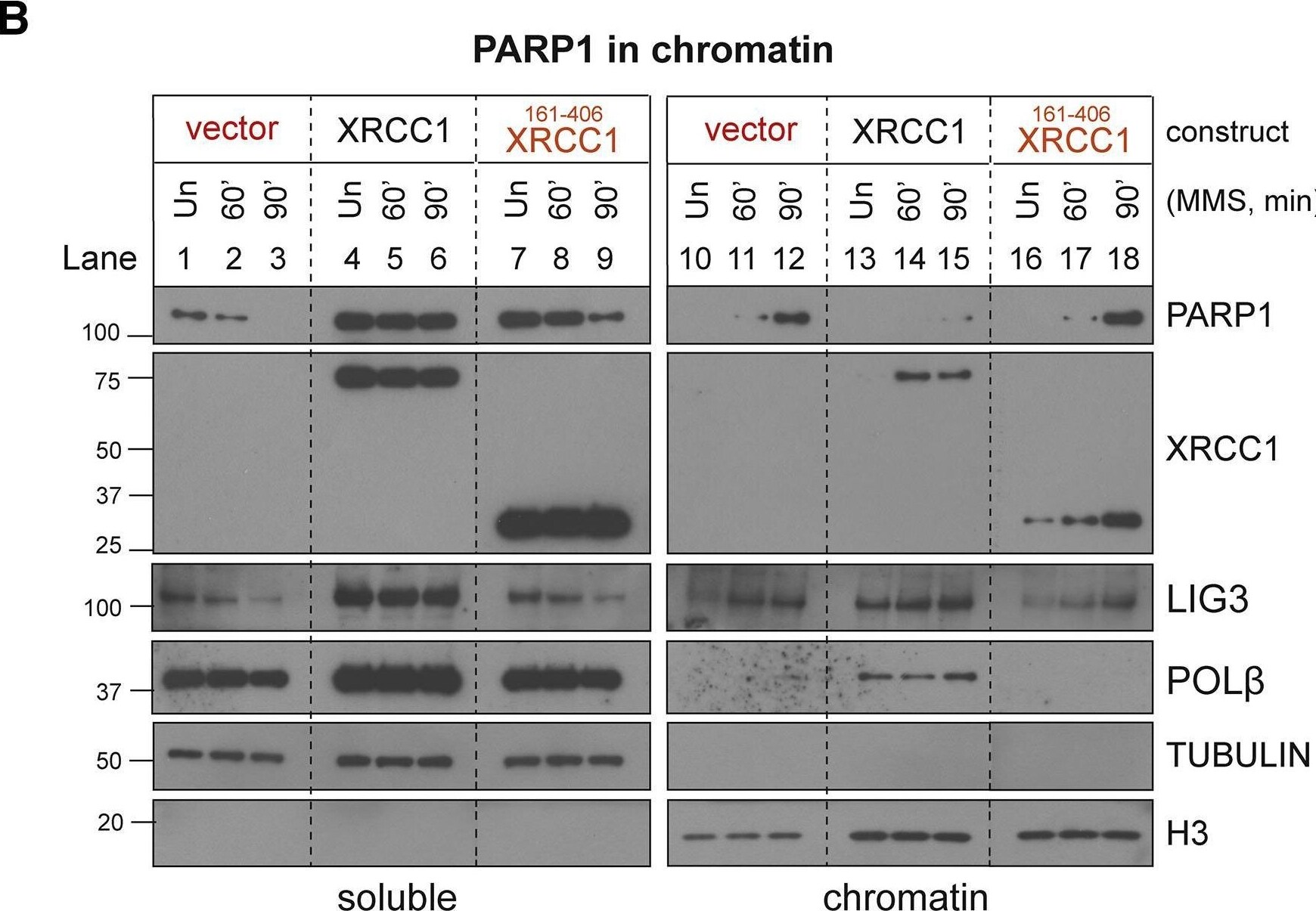
Western Blot: XRCC1 Antibody - BSA Free [NBP1-87154] -
XRCC1 assembles protein complexes that regulate PARP1 activity, NAD+ consumption, and trapping during BER(A) Levels of PARP1 auto-ribosylation detected as above in XRCC1−/− U2OS cell lines stably transfected with empty vector or with an expression vector encoding full-length recombinant Myc-His-XRCC1 or truncated Myc-His-XRCC1161–406 during incubation or not (Un) for the indicated times with 0.1 mg/mL MMS. The expression level of the recombinant XRCC1 proteins is shown (right).(B) Levels of PARP1, XRCC1, LIG3, and POL beta in cell-equivalent aliquots of soluble and chromatin-containing fractions from the indicated U2OS cell lines following treatment for the indicated times with 0.1 mg/mL MMS. The fractionated cell extracts were treated with recombinant PARG immediately prior to SDS-PAGE to ensure that auto-ribosylation did not obscure detection of PARP1.(C) DNA strand breaks quantified by alkaline comet assays in the indicated U2OS cell lines following treatment with the indicated concentrations of MMS for 15 min. Data plotted are the individual comet tail moments of 50 cells per sample per experiment, with tail moments plotted vertically and each of three independent experiments plotted side by side. Statistical significance was ascertained by one-way ANOVA of the mean tail moments from 3 independent experiments with Sidak’s post hoc multiple comparisons test (∗p ≤ 0.05, ∗∗p ≤ 0.01, ∗∗∗∗p ≤ 0.0001).(D) Cell extracts prepared from Un or MMS-treated (0.1 mg/mL, 60 min) WT and XRCC1−/− RPE-1 cells were incubated for 45 min in the absence or presence of 1 mM NAD+, as indicated.See also Figure S3. Image collected and cropped by CiteAb from the following open publication (https://pubmed.ncbi.nlm.nih.gov/34102106), licensed under a CC-BY license. Not internally tested by Novus Biologicals.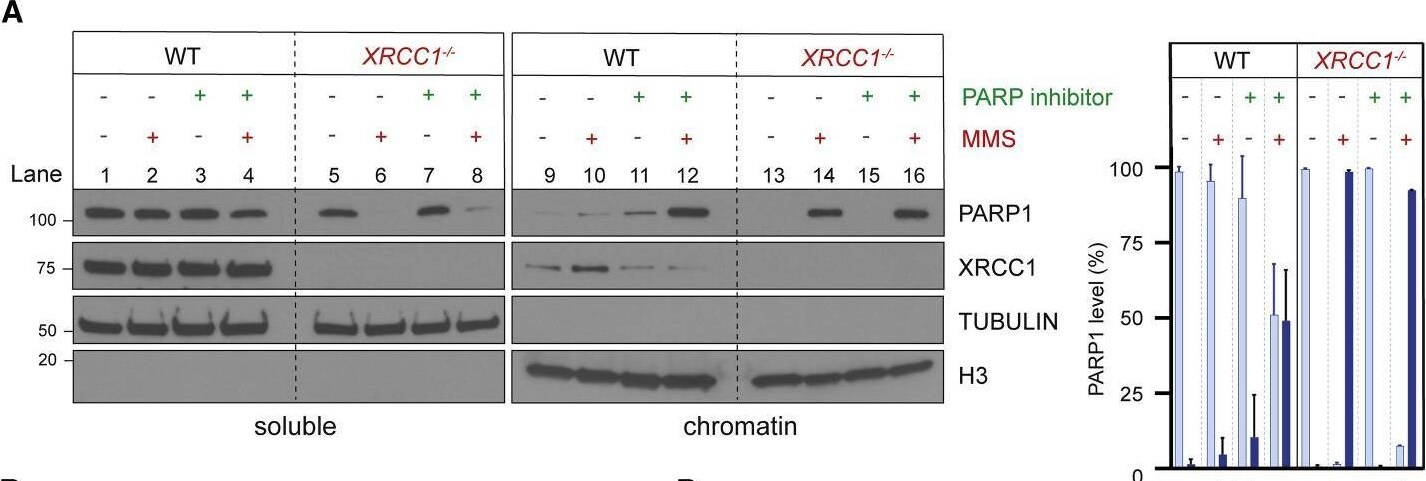
Western Blot: XRCC1 Antibody - BSA Free [NBP1-87154] -
XRCC1 suppresses endogenous PARP1 trapping during BER(A) PARP1 levels in cell-equivalent aliquots of soluble and chromatin-containing fractions of WT and XRCC1−/− RPE-1 cells, measured by western blotting. Cells were incubated or not with 10 μM PARP inhibitor (KU0058948) and/or MMS (0.1 mg/mL) for 1 h, as indicated, prior to subcellular fractionation. Representative immunoblots are shown on the left and quantification on the right. See also Figures S1C and S1D.(B) Levels of PARP1 auto-ribosylation in WT and XRCC1−/− RPE-1 cells during treatment with 0.1 mg/mL MMS, detected by the poly(ADP-ribose)-specific detection reagent MABE1031.(C) Top: PARP1 levels in cell-equivalent aliquots of soluble and chromatin-containing fractions from WT and XRCC1−/− RPE-1 cells treated for the indicated times with 0.1 mg/mL MMS. Bottom: as above, but the cell extracts were treated with recombinant PARG to remove all poly(ADP-ribose) immediately prior to SDS-PAGE.(D) DNA strand breaks quantified by alkaline comet assays in WT and XRCC1−/− RPE-1 cells during treatment with 0.1 mg/mL MMS. Data plotted are the individual comet tail moments (an arbitrary measure of DNA strand breakage) of 50 cells per sample per experiment, with tail moments for each experiment plotted vertically and three independent experiments plotted side by side. Statistical significance was ascertained by one-way ANOVA of the mean tail moments from 3 experiments with Sidak’s multiple comparisons test (∗∗∗∗p ≤ 0.0001). Image collected and cropped by CiteAb from the following open publication (https://pubmed.ncbi.nlm.nih.gov/34102106), licensed under a CC-BY license. Not internally tested by Novus Biologicals.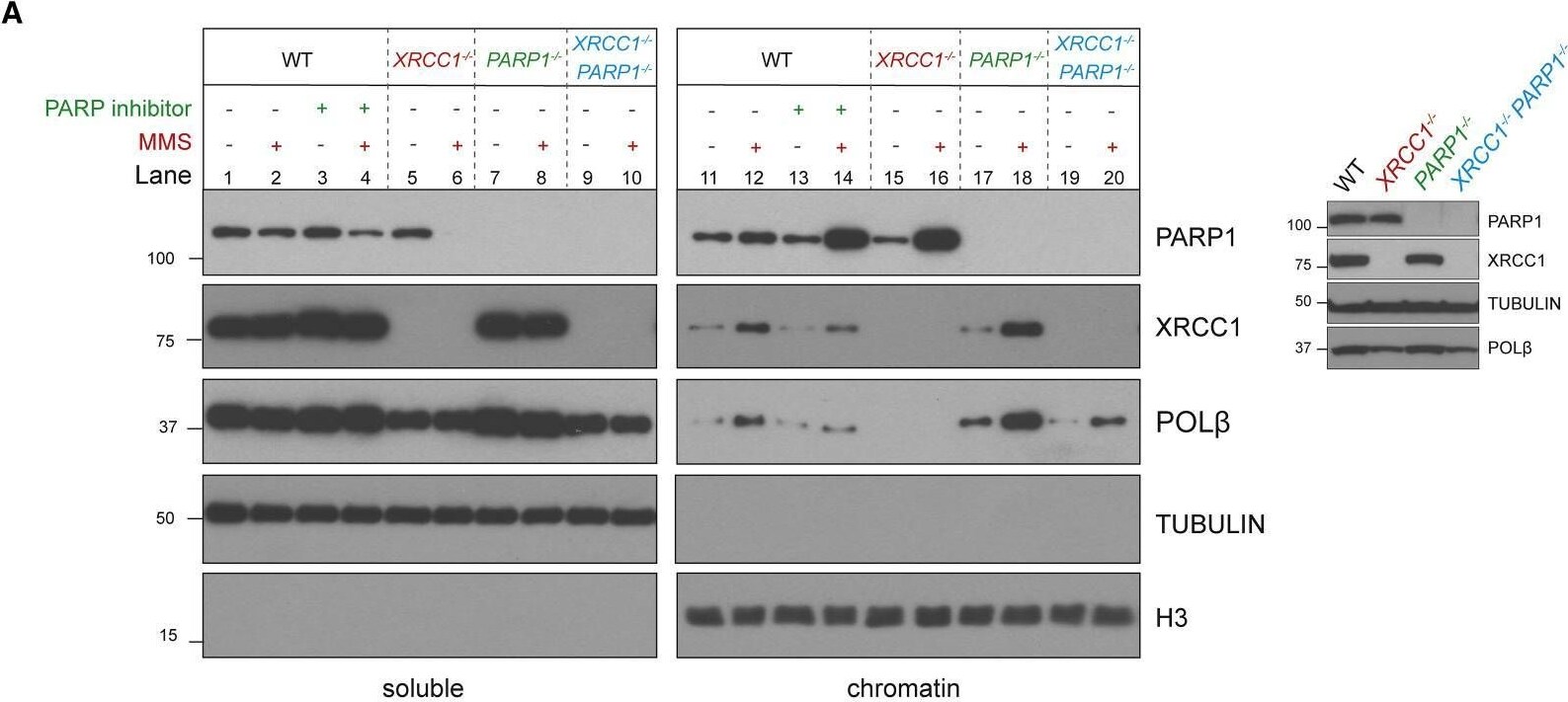
Western Blot: XRCC1 Antibody - BSA Free [NBP1-87154] -
Endogenous PARP1 trapping impedes POL beta recruitment into chromatin during BER(A) PARP1, XRCC1, and POL beta levels in the soluble and chromatin-containing fractions (1:4 cell equivalents, respectively) of WT and the indicated RPE-1 cell lines, measured by western blotting. Cells were pre-treated or not with the PARP inhibitor (10 μM) and/or MMS (0.1 mg/mL) for 1 h, as indicated. A western blot showing total PARP1, XRCC1, and POL beta levels in the cell lines is shown (right).(B) A model for endogenous PARP1 trapping during BER. Blue box: in WT cells, XRCC1 protein complexes limit PARP1 engagement and activity during BER by promoting efficient hand-off of SSB intermediates to POL beta and LIG3, preventing PARP1 from impeding repair. Orange box: in XRCC1−/− cells, the absence of XRCC1 protein complexes results in excessive cycles of PARP1 association/activation at SSB intermediates, which impedes access by other BER enzymes and blocks their repair, resulting in SSB accumulation. If this scenario is sufficiently prolonged, such as at high levels of base damage, then this increased PARP1 engagement leads progressively to NAD+ depletion, declining PARP1 auto-ribosylation and dissociation, and accumulation of PARP1 in chromatin. PARP1 trapping in this scenario thus reflects both increased PARP1 association at SSB intermediates and subsequently decreased PARP1 dissociation, both of which impede BER in a manner reminiscent of chemical PARP inhibitors (pink box shown for comparison). Green box: additional deletion of PARP1 in XRCC1−/− cells allows access of BER intermediates by POL beta, LIG3, and/or alternative DNA repair enzymes, restoring normal rates of BER. Image collected and cropped by CiteAb from the following open publication (https://pubmed.ncbi.nlm.nih.gov/34102106), licensed under a CC-BY license. Not internally tested by Novus Biologicals.![XRCC1 Antibody - BSA Free Immunocytochemistry/ Immunofluorescence: XRCC1 Antibody [NBP1-87154]](https://resources.rndsystems.com/images/products/nbp1-87154_-immunocytochemistry-immunofluorescence-639174076652459944.jpg "Immunocytochemistry/ Immunofluorescence: XRCC1 Antibody [NBP1-87154]")
Immunocytochemistry/ Immunofluorescence: XRCC1 Antibody [NBP1-87154]
Staining of human cell line U-251 MG shows localization to nucleoplasm.Applications for XRCC1 Antibody - BSA Free
Application
Recommended Usage
Immunocytochemistry/ Immunofluorescence
0.25-2 ug/ml
Immunohistochemistry
1:200 - 1:500
Immunohistochemistry-Paraffin
1:200 - 1:500
Western Blot
0.04-0.4 ug/ml
Application Notes
IHC-Paraffin, HIER pH 6 retrieval is recommended. ICC/IF, Fixation Permeabilization: Use PFA/Triton X-100.
Formulation, Preparation, and Storage
Purification
Affinity purified
Formulation
PBS (pH 7.2) and 40% Glycerol
Format
BSA Free
Preservative
0.02% Sodium Azide
Concentration
Concentrations vary lot to lot. See vial label for concentration. If unlisted please contact technical services.
Shipping
The product is shipped with polar packs. Upon receipt, store it immediately at the temperature recommended below.
Stability & Storage
Store at 4C short term. Aliquot and store at -20C long term. Avoid freeze-thaw cycles.
Background: XRCC1
Alternate Names
DNA repair protein XRCC1, RCC, X-ray repair complementing defective repair in Chinese hamster cells 1, X-ray repair cross-complementing protein 1, X-ray-repair, complementing defective, repair in Chinese hamster
Gene Symbol
XRCC1
Additional XRCC1 Products
Product Documents for XRCC1 Antibody - BSA Free
Certificate of Analysis
To download a Certificate of Analysis, please enter a lot or batch number in the search box below.
Product Specific Notices for XRCC1 Antibody - BSA Free
This product is for research use only and is not approved for use in humans or in clinical diagnosis. Primary Antibodies are guaranteed for 1 year from date of receipt.
Related Research Areas
Citations for XRCC1 Antibody - BSA Free
 Powered by Bioz
Customer Reviews for XRCC1 Antibody - BSA Free
There are currently no reviews for this product. Be the first to review XRCC1 Antibody - BSA Free and earn rewards!
Have you used XRCC1 Antibody - BSA Free?
Submit a review and receive an Amazon gift card!
$25/€18/£15/$25CAN/¥2500 for a review with an image
$10/€7/£6/$10CAN/¥1110 for a review without an image
Submit a review
Protocols
Find general support by application which include: protocols, troubleshooting, illustrated assays, videos and webinars.
- Antigen Retrieval Protocol (PIER)
- Antigen Retrieval for Frozen Sections Protocol
- Appropriate Fixation of IHC/ICC Samples
- Cellular Response to Hypoxia Protocols
- Chromogenic IHC Staining of Formalin-Fixed Paraffin-Embedded (FFPE) Tissue Protocol
- Chromogenic Immunohistochemistry Staining of Frozen Tissue
- ClariTSA™ Fluorophore Kits
- Detection & Visualization of Antibody Binding
- Fluorescent IHC Staining of Frozen Tissue Protocol
- Graphic Protocol for Heat-induced Epitope Retrieval
- Graphic Protocol for the Preparation and Fluorescent IHC Staining of Frozen Tissue Sections
- Graphic Protocol for the Preparation and Fluorescent IHC Staining of Paraffin-embedded Tissue Sections
- Graphic Protocol for the Preparation of Gelatin-coated Slides for Histological Tissue Sections
- ICC Cell Smear Protocol for Suspension Cells
- ICC Immunocytochemistry Protocol Videos
- ICC for Adherent Cells
- IHC Sample Preparation (Frozen sections vs Paraffin)
- Immunocytochemistry (ICC) Protocol
- Immunocytochemistry Troubleshooting
- Immunofluorescence of Organoids Embedded in Cultrex Basement Membrane Extract
- Immunofluorescent IHC Staining of Formalin-Fixed Paraffin-Embedded (FFPE) Tissue Protocol
- Immunohistochemistry (IHC) and Immunocytochemistry (ICC) Protocols
- Immunohistochemistry Frozen Troubleshooting
- Immunohistochemistry Paraffin Troubleshooting
- Preparing Samples for IHC/ICC Experiments
- Preventing Non-Specific Staining (Non-Specific Binding)
- Primary Antibody Selection & Optimization
- Protocol for Heat-Induced Epitope Retrieval (HIER)
- Protocol for Making a 4% Formaldehyde Solution in PBS
- Protocol for VisUCyte™ HRP Polymer Detection Reagent
- Protocol for the Fluorescent ICC Staining of Cell Smears - Graphic
- Protocol for the Fluorescent ICC Staining of Cultured Cells on Coverslips - Graphic
- Protocol for the Preparation & Fixation of Cells on Coverslips
- Protocol for the Preparation and Chromogenic IHC Staining of Frozen Tissue Sections
- Protocol for the Preparation and Chromogenic IHC Staining of Frozen Tissue Sections - Graphic
- Protocol for the Preparation and Chromogenic IHC Staining of Paraffin-embedded Tissue Sections
- Protocol for the Preparation and Chromogenic IHC Staining of Paraffin-embedded Tissue Sections - Graphic
- Protocol for the Preparation and Fluorescent ICC Staining of Cells on Coverslips
- Protocol for the Preparation and Fluorescent ICC Staining of Non-adherent Cells
- Protocol for the Preparation and Fluorescent ICC Staining of Stem Cells on Coverslips
- Protocol for the Preparation and Fluorescent IHC Staining of Frozen Tissue Sections
- Protocol for the Preparation and Fluorescent IHC Staining of Paraffin-embedded Tissue Sections
- Protocol for the Preparation of Gelatin-coated Slides for Histological Tissue Sections
- Protocol for the Preparation of a Cell Smear for Non-adherent Cell ICC - Graphic
- R&D Systems Quality Control Western Blot Protocol
- TUNEL and Active Caspase-3 Detection by IHC/ICC Protocol
- The Importance of IHC/ICC Controls
- Troubleshooting Guide: Immunohistochemistry
- Troubleshooting Guide: Western Blot Figures
- Western Blot Conditions
- Western Blot Protocol
- Western Blot Protocol for Cell Lysates
- Western Blot Troubleshooting
- Western Blot Troubleshooting Guide
- View all Protocols, Troubleshooting, Illustrated assays and Webinars
Loading...