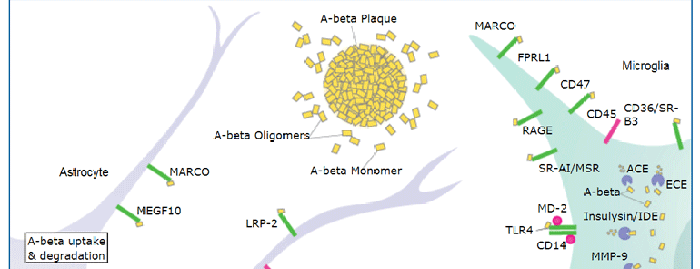
CD36 (alternatively known as platelet membrane glycoprotein IV (GPIV), thrombospondin receptor, fatty acid translocase (FAT), and scavenger receptor class B, member 3 (SR-B3)) is an 88 kDa, integral membrane glycoprotein that belongs to the class B scavenger receptor family (1, 2). The molecule is described as being ditopic, with two transmembrane segments connected by an extracellular loop (3). Mouse CD36 is synthesized as a 472 amino acid (aa) protein that contains a 6 aa N‑terminal cytoplasmic domain, a 22 aa N‑terminal transmembrane segment, a 420 aa extracellular “loop”, a 22 aa C‑terminal transmembrane segment, and a 9 aa C‑terminal cytoplasmic tail (4). Both cytoplasmic tails are palmitoylated, with the C‑terminal tail involved in oxidized LDL binding (5, 6). With respect to the extracellular loop, the N‑terminal region is believed to bind both thrombospondin-1 and Plasmodium-infected erythrocytes. Other ligands for CD36 include long-chain fatty acids, collagen, phospholipids and apoptotic cells (1). The extracellular loop of mouse CD36 shares 94%, 92%, 84% and 84% aa sequence identity with the extracellular loops of rat, hamster, human and bovine CD36, respectively. Cells known to express CD36 include capillary endothelium, adipocytes, skeletal muscle cells, intestinal epithelium, smooth muscle cells and hematopoietic cells such as RBC’s, platelets and monocytes (1). On the surface of cells, CD36 is suggested to exist as a dimer in response to ligation (7). CD36 is reported to regulate fatty uptake, act as an angiogenic with TSP-1, and participate in the clearance of apoptotic phagocytes (1, 8).
Mouse CD36/SR-B3 Antibody (324205)
R&D Systems | Catalog # MAB25191

Scientific images may be resized, cropped, or adjusted for brightness or contrast for presentation purposes. These updates are limited to presentation and do not affect the underlying scientific interpretation of the data. Where available, additional source data may be provided upon request.
Key Product Details
Species Reactivity
Validated:
Cited:
Applications
Validated:
Cited:
Label
Antibody Source
Product Specifications
Immunogen
Gly30-Lys439
Accession # Q08857
Specificity
Clonality
Host
Isotype
Scientific Data Images for Mouse CD36/SR-B3 Antibody (324205)
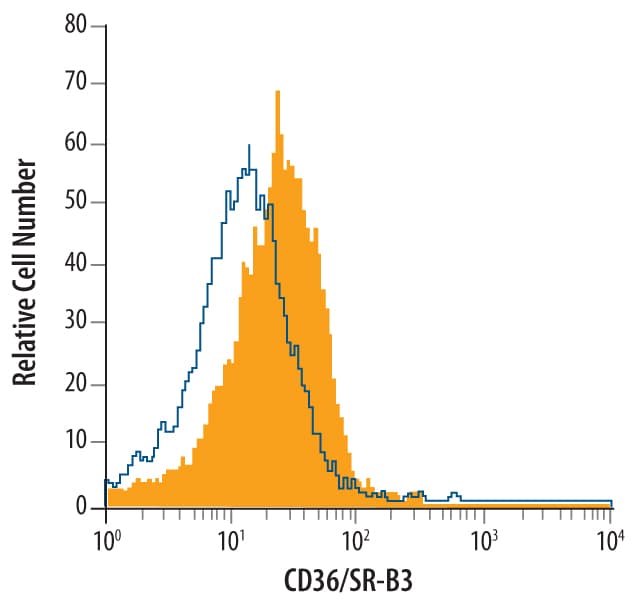
Detection of CD36/SR‑B3 in J774A.1 Mouse Cell Line by Flow Cytometry.
J774A.1 mouse reticulum cell sarcoma macrophage cell line was stained with Rat Anti-Mouse CD36/SR-B3 Monoclonal Antibody (Catalog # MAB25191, filled histogram) or isotype control antibody (Catalog # MAB005, open histogram), followed by Allophycocyanin-conjugated Anti-Rat IgG Secondary Antibody (Catalog # F0113).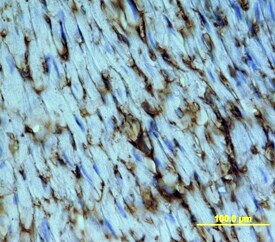
CD36/SR‑B3 in Mouse Heart.
CD36/SR-B3 was detected in immersion fixed frozen sections of mouse heart using Rat Anti-Mouse CD36/SR-B3 Monoclonal Antibody (Catalog # MAB25191) at 15 µg/mL overnight at 4 °C. Tissue was stained using the Anti-Rat HRP-DAB Cell & Tissue Staining Kit (brown; Catalog # CTS017) and counterstained with hematoxylin (blue). Specific staining was localized to cell surfaces and cytoplasm. View our protocol for Chromogenic IHC Staining of Frozen Tissue Sections.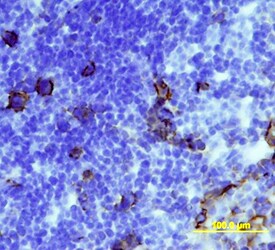
CD36/SR‑B3 in Mouse Thymus.
CD36/SR-B3 was detected in immersion fixed frozen sections of mouse thymus using Rat Anti-Mouse CD36/SR-B3 Monoclonal Antibody (Catalog # MAB25191) at 15 µg/mL overnight at 4 °C. Tissue was stained using the Anti-Rat HRP-DAB Cell & Tissue Staining Kit (brown; Catalog # CTS017) and counterstained with hematoxylin (blue). Specific staining was localized to cell surfaces and cytoplasm. View our protocol for Chromogenic IHC Staining of Frozen Tissue Sections.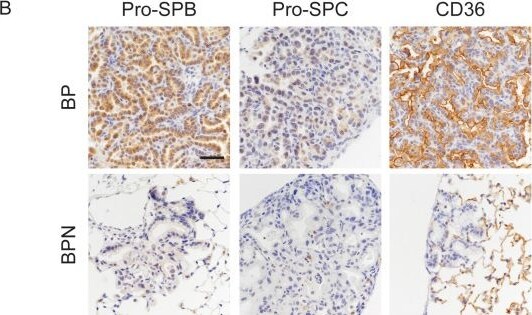
Detection of CD36/SR-B3 by Immunohistochemistry
Nkx2-1 deletion induces mucinous adenocarcinoma but impairs tumor initiation in BRAFV600E-driven lung adenocarcinoma.(A, B) Histologic phenotype of lung neoplasia arising 8 weeks after initiation with PGK-Cre lentivirus (5 × 10³ pfu/mouse) in BrafLSL-V600E/+;Trp53f/f;Nkx2-1f/+;Rosa26LSL-tdTomato/LSL-tdTomato (BP) and BrafLSL-V600E/+;Trp53f/f;Nkx2-1f/f;Rosa26LSL-tdTomato/LSL-tdTomato (BPN) mice. Immunostaining for markers of gastrointestinal (A) and pulmonary (B) differentiation. Scale bar: 100 µm. (C) Low-magnification images of H and Es for representative BP and BPN tumor-bearing lungs. Scale bar: 1000 µm. (D) H and E and NKX2-1 IHC of a representative high-grade BPN lung tumor. Scale bar: 100 µm. Image collected and cropped by CiteAb from the following open publication (https://pubmed.ncbi.nlm.nih.gov/33821796), licensed under a CC-BY license. Not internally tested by R&D Systems.Applications for Mouse CD36/SR-B3 Antibody (324205)
CyTOF-ready
Flow Cytometry
Sample: J774A.1 mouse reticulum cell sarcoma macrophage cell line
Immunohistochemistry
Sample: Immersion fixed frozen sections of mouse heart and thymus
Flow Cytometry Panel Builder
Bio-Techne Knows Flow Cytometry
Save time and reduce costly mistakes by quickly finding compatible reagents using the Panel Builder Tool.
Advanced Features
- Spectra Viewer - Custom analysis of spectra from multiple fluorochromes
- Spillover Popups - Visualize the spectra of individual fluorochromes
- Antigen Density Selector - Match fluorochrome brightness with antigen density

Formulation, Preparation, and Storage
Purification
Reconstitution
Sterile PBS to a final concentration of 0.5 mg/mL. For liquid material, refer to CoA for concentration.
Formulation
Shipping
Stability & Storage
- 12 months from date of receipt, -20 to -70 °C as supplied.
- 1 month, 2 to 8 °C under sterile conditions after reconstitution.
- 6 months, -20 to -70 °C under sterile conditions after reconstitution.
Calculators
Background: CD36/SR-B3
References
- Febbraio, M. et al. (2001) J. Clin. Invest. 108:795.
- Silverstein, R.L. and M. Febbraio (2000) Curr. Opin. Lipid. 11:483.
- Gruarin, P. et al. (2000) Biochem. Biophys. Res. Commun. 275:446.
- Endemann, G. et al. (1993) J. Biol. Chem. 268:11811.
- Malaud, E. et al. (2002) Biochem. J. 364:507.
- Tao, N. et al. (1996) J. Biol. Chem. 271:22315.
- Daviet, L. et al. (1997) Thromb. Haemost. 78:897.
- Simantov, R. and R.L. Silverstein (2003) Front. Biosci. 8:s874.
Long Name
Alternate Names
Gene Symbol
UniProt
Additional CD36/SR-B3 Products
Product Documents for Mouse CD36/SR-B3 Antibody (324205)
Certificate of Analysis
To download a Certificate of Analysis, please enter a lot or batch number in the search box below.
Note: Certificate of Analysis not available for kit components.
Product Specific Notices for Mouse CD36/SR-B3 Antibody (324205)
For research use only
Citations for Mouse CD36/SR-B3 Antibody (324205)
 Powered by Bioz
Customer Reviews for Mouse CD36/SR-B3 Antibody (324205)
There are currently no reviews for this product. Be the first to review Mouse CD36/SR-B3 Antibody (324205) and earn rewards!
Have you used Mouse CD36/SR-B3 Antibody (324205)?
Submit a review and receive an Amazon gift card!
$25/€18/£15/$25CAN/¥2500 for a review with an image
$10/€7/£6/$10CAN/¥1110 for a review without an image
Submit a review
Protocols
Find general support by application which include: protocols, troubleshooting, illustrated assays, videos and webinars.
- 7-Amino Actinomycin D (7-AAD) Cell Viability Flow Cytometry Protocol
- Antigen Retrieval Protocol (PIER)
- Antigen Retrieval for Frozen Sections Protocol
- Appropriate Fixation of IHC/ICC Samples
- Cellular Response to Hypoxia Protocols
- Chromogenic IHC Staining of Formalin-Fixed Paraffin-Embedded (FFPE) Tissue Protocol
- Chromogenic Immunohistochemistry Staining of Frozen Tissue
- ClariTSA™ Fluorophore Kits
- Detection & Visualization of Antibody Binding
- Extracellular Membrane Flow Cytometry Protocol
- Flow Cytometry Protocol for Cell Surface Markers
- Flow Cytometry Protocol for Staining Membrane Associated Proteins
- Flow Cytometry Staining Protocols
- Flow Cytometry Troubleshooting Guide
- Fluorescent IHC Staining of Frozen Tissue Protocol
- Graphic Protocol for Heat-induced Epitope Retrieval
- Graphic Protocol for the Preparation and Fluorescent IHC Staining of Frozen Tissue Sections
- Graphic Protocol for the Preparation and Fluorescent IHC Staining of Paraffin-embedded Tissue Sections
- Graphic Protocol for the Preparation of Gelatin-coated Slides for Histological Tissue Sections
- IHC Sample Preparation (Frozen sections vs Paraffin)
- Immunofluorescent IHC Staining of Formalin-Fixed Paraffin-Embedded (FFPE) Tissue Protocol
- Immunohistochemistry (IHC) and Immunocytochemistry (ICC) Protocols
- Immunohistochemistry Frozen Troubleshooting
- Immunohistochemistry Paraffin Troubleshooting
- Intracellular Flow Cytometry Protocol Using Alcohol (Methanol)
- Intracellular Flow Cytometry Protocol Using Detergents
- Intracellular Nuclear Staining Flow Cytometry Protocol Using Detergents
- Intracellular Staining Flow Cytometry Protocol Using Alcohol Permeabilization
- Intracellular Staining Flow Cytometry Protocol Using Detergents to Permeabilize Cells
- Preparing Samples for IHC/ICC Experiments
- Preventing Non-Specific Staining (Non-Specific Binding)
- Primary Antibody Selection & Optimization
- Propidium Iodide Cell Viability Flow Cytometry Protocol
- Protocol for Heat-Induced Epitope Retrieval (HIER)
- Protocol for Liperfluo
- Protocol for Making a 4% Formaldehyde Solution in PBS
- Protocol for VisUCyte™ HRP Polymer Detection Reagent
- Protocol for the Characterization of Human Th22 Cells
- Protocol for the Characterization of Human Th9 Cells
- Protocol for the Preparation & Fixation of Cells on Coverslips
- Protocol for the Preparation and Chromogenic IHC Staining of Frozen Tissue Sections
- Protocol for the Preparation and Chromogenic IHC Staining of Frozen Tissue Sections - Graphic
- Protocol for the Preparation and Chromogenic IHC Staining of Paraffin-embedded Tissue Sections
- Protocol for the Preparation and Chromogenic IHC Staining of Paraffin-embedded Tissue Sections - Graphic
- Protocol for the Preparation and Fluorescent IHC Staining of Frozen Tissue Sections
- Protocol for the Preparation and Fluorescent IHC Staining of Paraffin-embedded Tissue Sections
- Protocol for the Preparation of Gelatin-coated Slides for Histological Tissue Sections
- Protocol: Annexin V and PI Staining by Flow Cytometry
- Protocol: Annexin V and PI Staining for Apoptosis by Flow Cytometry
- TUNEL and Active Caspase-3 Detection by IHC/ICC Protocol
- The Importance of IHC/ICC Controls
- Troubleshooting Guide: Fluorokine Flow Cytometry Kits
- Troubleshooting Guide: Immunohistochemistry
- View all Protocols, Troubleshooting, Illustrated assays and Webinars