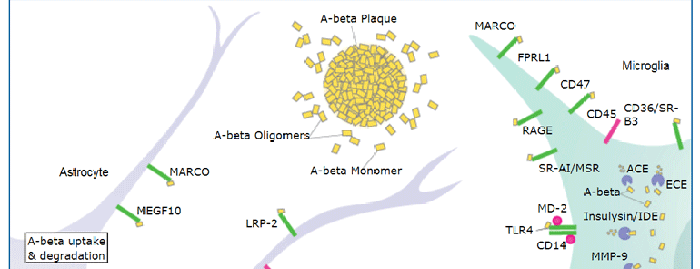
Advanced glycation endproducts (AGEs) are adducts formed by the non-enzymatic glycation of macromolecules. AGE formation is accelerated in oxidative and hyperglycemic conditions, diabetes, renal failure, atherosclerosis, Alzheimer’s disease, arthritis, and in normal aging (1‑5). Receptor for advanced glycation endproducts (RAGE) is a 35 kDa type I transmembrane protein belonging the immunoglobulin superfamily. Besides AGEs, RAGE binds beta -amyloid peptide, S100/calgranulin family proteins, HMGB1/amphoterin, and leukocyte integrins (6‑9). Mature canine RAGE consists of a 383 amino acid (aa) extracellular domain (ECD) with one Ig-like V-type domain and two Ig-like C‑type domains, a 23 aa transmembrane segment, and a 43 aa cytoplasmic domain (10). Within the ECD, canine RAGE shares 73%‑77% aa sequence identity with human, mouse, and rat RAGE. In human, soluble forms of RAGE are generated by alternate splicing and are associated with multiple disease states (11, 12). RAGE is expressed in the embryonic central nervous system and on macrophages, monocytes, smooth muscle cells, and endothelial cells (13‑15). It is upregulated in response to AGE accumulation, and its activation induces a broad proinflammatory response (6, 15). The increased production of reactive oxygen species during inflammation promotes additional AGE formation and RAGE upregulation, a cycle that exacerbates diabetic complications and inflammation‑induced tissue injury (2, 4).


Key Product Details
Species Reactivity
Canine
Applications
Western Blot, ELISA Capture (Matched Antibody Pair)
Label
Unconjugated
Antibody Source
Polyclonal Sheep IgG
Loading...
Product Specifications
Immunogen
Mouse myeloma cell line NS0-derived recombinant canine RAGE
Asp25-Val339
Accession # XP_532093
Asp25-Val339
Accession # XP_532093
Specificity
Detects canine RAGE in ELISAs and Western blots. In sandwich immunoassays, approximately 0.5% cross‑reactivity with recombinant human RAGE is observed and less than 0.1% cross-reactivity with recombinant mouse RAGE and recombinant rat RAGE is observed.
Clonality
Polyclonal
Host
Sheep
Isotype
IgG
Applications for Canine RAGE/AGER Antibody
Application
Recommended Usage
Western Blot
0.1 µg/mL
Sample: Recombinant Canine RAGE (Catalog # 4750-RG)
Sample: Recombinant Canine RAGE (Catalog # 4750-RG)
Canine RAGE Sandwich Immunoassay
Please Note: Optimal dilutions of this antibody should be experimentally determined.
Formulation, Preparation, and Storage
Purification
Antigen Affinity-purified
Reconstitution
Reconstitute at 0.2 mg/mL in sterile PBS. For liquid material, refer to CoA for concentration.
Loading...
Formulation
Lyophilized from a 0.2 μm filtered solution in PBS with Trehalose. *Small pack size (SP) is supplied either lyophilized or as a 0.2 µm filtered solution in PBS.
Shipping
Lyophilized product is shipped at ambient temperature. Liquid small pack size (-SP) is shipped with polar packs. Upon receipt, store immediately at the temperature recommended below.
Stability & Storage
Use a manual defrost freezer and avoid repeated freeze-thaw cycles.
- 12 months from date of receipt, -20 to -70 °C as supplied.
- 1 month, 2 to 8 °C under sterile conditions after reconstitution.
- 6 months, -20 to -70 °C under sterile conditions after reconstitution.
Calculators
Background: RAGE/AGER
References
- Schleicher, E. and U. Friess (2007) Kidney Int. Suppl. 106:S17.
- Herold, K. et al. (2007) J. Leukoc. Biol. 82:204.
- Thornalley, P.J. (2006) J. Ren. Nutr. 16:178.
- Goldin, A. et al. (2006) Circulation 114:597.
- Ramasamy, R. et al. (2005) Glycobiology 15:16R.
- Kislinger, T. et al. (1999) J. Biol. Chem. 274:31740.
- Yan, S.D. et al. (1996) Nature 382:685.
- Huttenen, H. et al. (2000) J. Biol. Chem. 275:40096.
- Chavakis, T. et al. (2003) J. Exp. Med. 198:1507.
- Murua Escobar, H. et al. (2006) Gene 369:45.
- Yonekura H, et al. (2003) Biochem. J. 370:1097.
- Koyama, H. et al. (2007) Mol. Med. 13:625.
- Hori, O. et al. (1995) J. Biol. Chem. 270:25752.
- Brett, J. et al. (1993) Am. J. Pathol. 143:1699.
- Bierhaus, A. et al. (2006) Curr. Opin. Investig. Drugs 7:985.
Long Name
Receptor for Advanced Glycation End Products
Alternate Names
AGER, SCARJ1
Gene Symbol
AGER
UniProt
Additional RAGE/AGER Products
Product Documents for Canine RAGE/AGER Antibody
Certificate of Analysis
To download a Certificate of Analysis, please enter a lot or batch number in the search box below.
Note: Certificate of Analysis not available for kit components.
Product Specific Notices for Canine RAGE/AGER Antibody
For research use only
Customer Reviews for Canine RAGE/AGER Antibody
There are currently no reviews for this product. Be the first to review Canine RAGE/AGER Antibody and earn rewards!
Have you used Canine RAGE/AGER Antibody?
Submit a review and receive an Amazon gift card!
$25/€18/£15/$25CAN/¥2500 for a review with an image
$10/€7/£6/$10CAN/¥1110 for a review without an image
Submit a review
Protocols
Find general support by application which include: protocols, troubleshooting, illustrated assays, videos and webinars.
- Cellular Response to Hypoxia Protocols
- R&D Systems Quality Control Western Blot Protocol
- Troubleshooting Guide: Western Blot Figures
- Western Blot Conditions
- Western Blot Protocol
- Western Blot Protocol for Cell Lysates
- Western Blot Troubleshooting
- Western Blot Troubleshooting Guide
- View all Protocols, Troubleshooting, Illustrated assays and Webinars