
Clostridium Difficile Toxin A Antibody (PCG4.1) - BSA Free
Novus Biologicals | Catalog # NB600-1066

![Immunocytochemistry/ Immunofluorescence: Clostridium Difficile Toxin A Antibody (PCG4.1) - BSA Free [NB600-1066]](https://resources.rndsystems.com/images/products/Clostridium-Difficile-Toxin-A-Antibody-PCG4-1-Immunocytochemistry-Immunofluorescence-NB600-1066-img0007.jpg "Immunocytochemistry/ Immunofluorescence: Clostridium Difficile Toxin A Antibody (PCG4.1) - BSA Free [NB600-1066]")
Key Product Details
Validated by
Species Reactivity
Validated:
Cited:
Applications
Validated:
Cited:
Label
Antibody Source
Format
Product Specifications
Immunogen
Localization
Specificity
Clonality
Host
Isotype
Scientific Data Images for Clostridium Difficile Toxin A Antibody (PCG4.1) - BSA Free
![Immunocytochemistry/ Immunofluorescence: Clostridium Difficile Toxin A Antibody (PCG4.1) - BSA Free [NB600-1066]](https://resources.rndsystems.com/images/products/Clostridium-Difficile-Toxin-A-Antibody-PCG4-1-Immunocytochemistry-Immunofluorescence-NB600-1066-img0001.jpg "Immunocytochemistry/ Immunofluorescence: Clostridium Difficile Toxin A Antibody (PCG4.1) - BSA Free [NB600-1066]")
![Immunocytochemistry/ Immunofluorescence: Clostridium Difficile Toxin A Antibody (PCG4.1) - BSA Free [NB600-1066]](https://resources.rndsystems.com/images/products/Clostridium-Difficile-Toxin-A-Antibody-PCG4-1-Immunocytochemistry-Immunofluorescence-NB600-1066-img0006.jpg "Immunocytochemistry/ Immunofluorescence: Clostridium Difficile Toxin A Antibody (PCG4.1) - BSA Free [NB600-1066]")
Immunocytochemistry/ Immunofluorescence: Clostridium Difficile Toxin A Antibody (PCG4.1) - BSA Free [NB600-1066]
Clostridium-Difficile-Toxin-A-Antibody-PCG4-1-Immunocytochemistry-Immunofluorescence-NB600-1066-img0006.jpg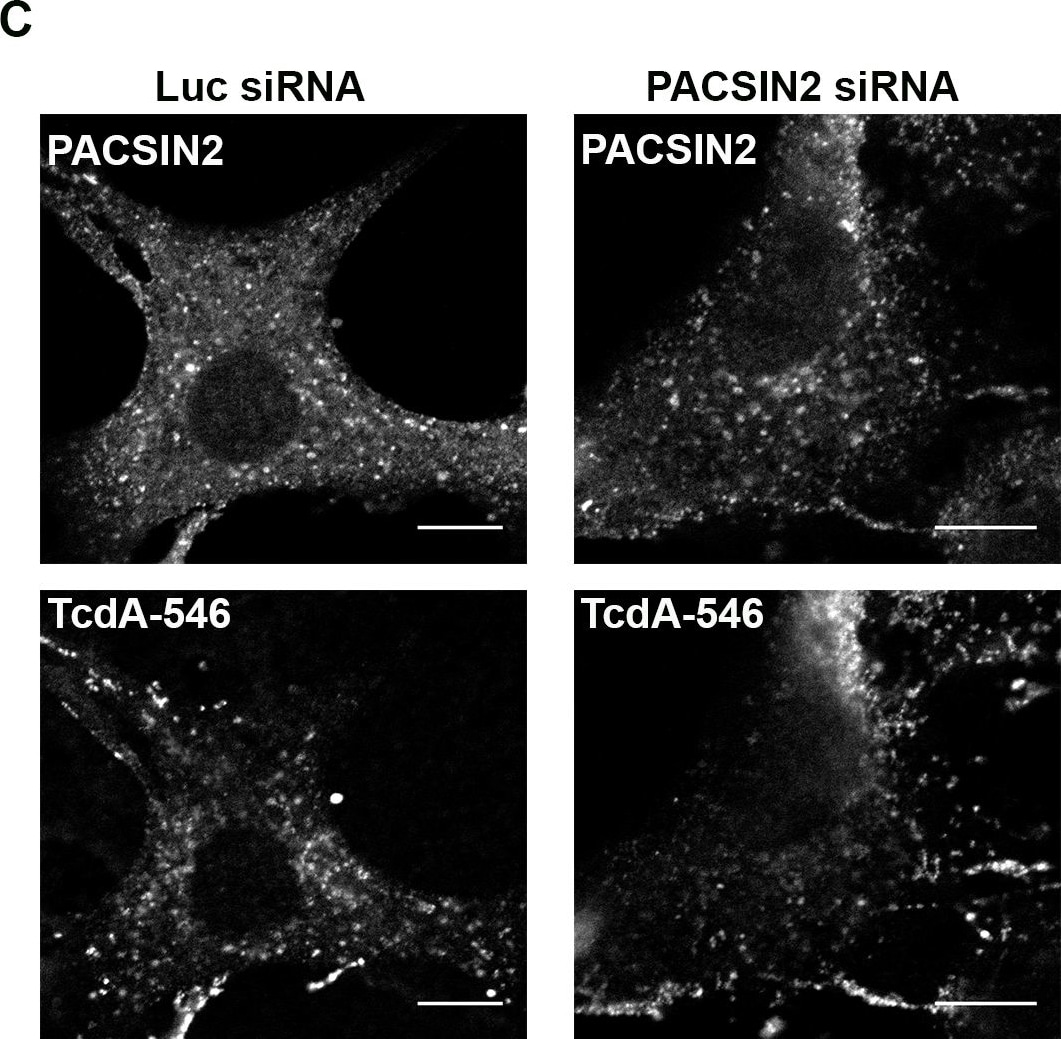
Immunocytochemistry/ Immunofluorescence: Clostridium Difficile Toxin A Antibody (PCG4.1) - BSA Free [NB600-1066] -
Immunocytochemistry/ Immunofluorescence: Clostridium Difficile Toxin A Antibody (PCG4.1) - BSA Free [NB600-1066] - PACSIN2 is required for TcdA uptake & toxin-induced rounding in wildtype MEF cells. (C), (D) & (E). Depletion of PACSIN2 reduces TcdA uptake in MEF cells. Wildtype MEF cells expressing luciferase (luc) or PACSIN2 siRNA incubated with 50 nM TcdA-546 at 10°C for 45 min. Cells allowed to warm up to 37°C for 2 min & then washed to remove unbound toxins & incubated with fresh media prewarmed to 37°C. Bound toxins allowed to internalize for 9 min at 37°C. Cells then fixed, stained for PACSIN2 & imaged by confocal microscopy. PACSIN2 & TcdA-546 staining from each condition shown in (C). Scale bars, 10 μm. The images shown representative of multiple fields imaged from two independent experiments. (D) Comparison of mean fluorescence intensities of PACSIN2 between luc & PACSIN2 siRNA transfected cells. Data represent mean & SD of 101 individual cells. Student’s t test ***p<0.0001. (E) Comparison of mean fluorescence intensities of TcdA-546 between luc & PACSIN2 siRNA transfected cells. Data represent mean & SD of 101 individual cells. Student’s t test ***p<0.0001. Cells chosen at random for intensity analyses. Image collected & cropped by CiteAb from the following publication (https://dx.plos.org/10.1371/journal.ppat.1006070), licensed under a CC0-1.0 license. Not internally tested by Novus Biologicals.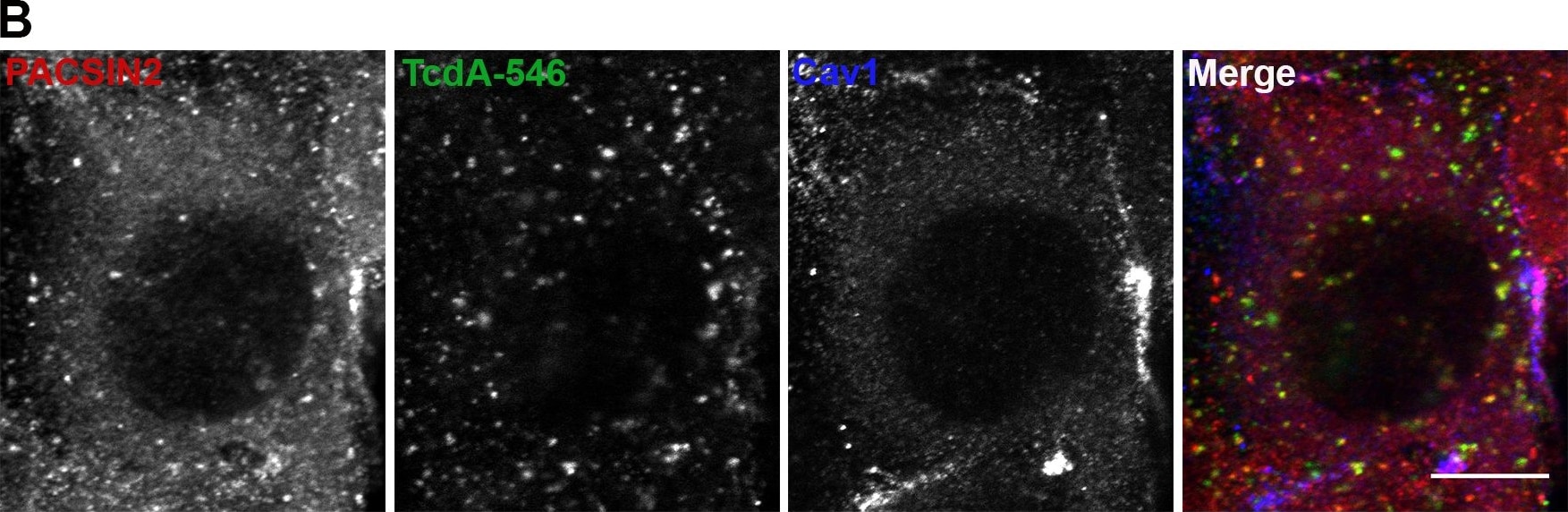
Immunocytochemistry/ Immunofluorescence: Clostridium Difficile Toxin A Antibody (PCG4.1) - BSA Free [NB600-1066] -
Immunocytochemistry/ Immunofluorescence: Clostridium Difficile Toxin A Antibody (PCG4.1) - BSA Free [NB600-1066] - TcdA colocalizes with PACSIN2 in wildtype MEF cells.(A) Wildtype MEFs on glass coverslips were allowed to bind 50 nM TcdA-546 for 45 min at 10°C, & cells were shifted to 37°C to allow internalization of toxin for 3 min. Cells were fixed, stained for PACSIN2, & analyzed by confocal microscopy. Merged images show PACSIN2 in red, toxin in green, & colocalization in yellow. Scale bars, 10 μm. The images shown are representative of multiple fields imaged from two independent experiments. (B) Immunofluorescence assays were performed as described in (A), but cells were stained for cav1 in addition to PACSIN2. Merged images show PACSIN2 in red, toxin in green, & cav1 in blue. Yellow puncta in merged images denote TcdA- & PACSIN2-positive structures. Pink punta denote caveolae-associated PACSIN2. Scale bars, 10 μm. (C) Pearson’s correlation coefficient to assess the extent of colocalization between PACSIN2, cav1 & TcdA-546 after 3 min toxin uptake. Data represent mean & SD of 31 individual cells chosen at random. Image collected & cropped by CiteAb from the following publication (https://dx.plos.org/10.1371/journal.ppat.1006070), licensed under a CC0-1.0 license. Not internally tested by Novus Biologicals.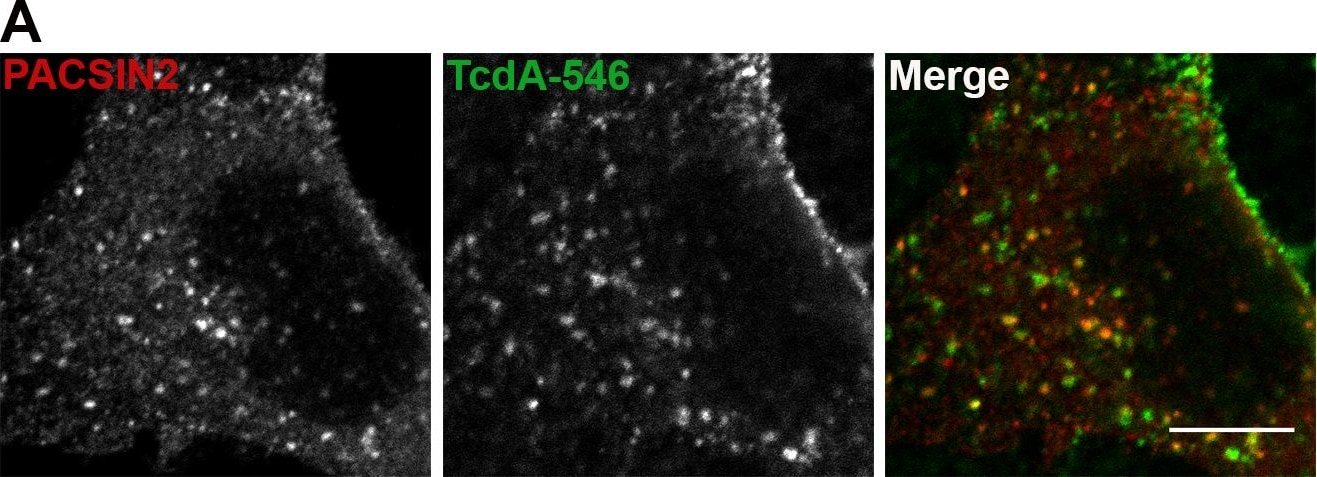
Immunocytochemistry/ Immunofluorescence: Clostridium Difficile Toxin A Antibody (PCG4.1) - BSA Free [NB600-1066] -
Immunocytochemistry/ Immunofluorescence: Clostridium Difficile Toxin A Antibody (PCG4.1) - BSA Free [NB600-1066] - TcdA colocalizes with PACSIN2 in wildtype MEF cells.(A) Wildtype MEFs on glass coverslips were allowed to bind 50 nM TcdA-546 for 45 min at 10°C, & cells were shifted to 37°C to allow internalization of toxin for 3 min. Cells were fixed, stained for PACSIN2, & analyzed by confocal microscopy. Merged images show PACSIN2 in red, toxin in green, & colocalization in yellow. Scale bars, 10 μm. The images shown are representative of multiple fields imaged from two independent experiments. (B) Immunofluorescence assays were performed as described in (A), but cells were stained for cav1 in addition to PACSIN2. Merged images show PACSIN2 in red, toxin in green, & cav1 in blue. Yellow puncta in merged images denote TcdA- & PACSIN2-positive structures. Pink punta denote caveolae-associated PACSIN2. Scale bars, 10 μm. (C) Pearson’s correlation coefficient to assess the extent of colocalization between PACSIN2, cav1 & TcdA-546 after 3 min toxin uptake. Data represent mean & SD of 31 individual cells chosen at random. Image collected & cropped by CiteAb from the following publication (https://dx.plos.org/10.1371/journal.ppat.1006070), licensed under a CC0-1.0 license. Not internally tested by Novus Biologicals.Applications for Clostridium Difficile Toxin A Antibody (PCG4.1) - BSA Free
ELISA
Western Blot
Formulation, Preparation, and Storage
Purification
Formulation
Format
Preservative
Concentration
Shipping
Stability & Storage
Background: Toxin A/TcdA
Alternate Names
Additional Toxin A/TcdA Products
Product Documents for Clostridium Difficile Toxin A Antibody (PCG4.1) - BSA Free
Certificate of Analysis
To download a Certificate of Analysis, please enter a lot or batch number in the search box below.
Product Specific Notices for Clostridium Difficile Toxin A Antibody (PCG4.1) - BSA Free
This product is for research use only and is not approved for use in humans or in clinical diagnosis. Primary Antibodies are guaranteed for 1 year from date of receipt.
Related Research Areas
Citations for Clostridium Difficile Toxin A Antibody (PCG4.1) - BSA Free
 Powered by Bioz
Customer Reviews for Clostridium Difficile Toxin A Antibody (PCG4.1) - BSA Free
There are currently no reviews for this product. Be the first to review Clostridium Difficile Toxin A Antibody (PCG4.1) - BSA Free and earn rewards!
Have you used Clostridium Difficile Toxin A Antibody (PCG4.1) - BSA Free?
Submit a review and receive an Amazon gift card!
$25/€18/£15/$25CAN/¥2500 for a review with an image
$10/€7/£6/$10CAN/¥1110 for a review without an image
Submit a review
Protocols
Find general support by application which include: protocols, troubleshooting, illustrated assays, videos and webinars.
- Appropriate Fixation of IHC/ICC Samples
- Cellular Response to Hypoxia Protocols
- ClariTSA™ Fluorophore Kits
- Detection & Visualization of Antibody Binding
- ELISA Sample Preparation & Collection Guide
- ELISA Troubleshooting Guide
- How to Run an R&D Systems DuoSet ELISA
- How to Run an R&D Systems Quantikine ELISA
- How to Run an R&D Systems Quantikine™ QuicKit™ ELISA
- ICC Cell Smear Protocol for Suspension Cells
- ICC Immunocytochemistry Protocol Videos
- ICC for Adherent Cells
- Immunocytochemistry (ICC) Protocol
- Immunocytochemistry Troubleshooting
- Immunofluorescence of Organoids Embedded in Cultrex Basement Membrane Extract
- Immunohistochemistry (IHC) and Immunocytochemistry (ICC) Protocols
- Preparing Samples for IHC/ICC Experiments
- Preventing Non-Specific Staining (Non-Specific Binding)
- Primary Antibody Selection & Optimization
- Protocol for VisUCyte™ HRP Polymer Detection Reagent
- Protocol for the Fluorescent ICC Staining of Cell Smears - Graphic
- Protocol for the Fluorescent ICC Staining of Cultured Cells on Coverslips - Graphic
- Protocol for the Preparation and Fluorescent ICC Staining of Cells on Coverslips
- Protocol for the Preparation and Fluorescent ICC Staining of Non-adherent Cells
- Protocol for the Preparation and Fluorescent ICC Staining of Stem Cells on Coverslips
- Protocol for the Preparation of a Cell Smear for Non-adherent Cell ICC - Graphic
- Quantikine HS ELISA Kit Assay Principle, Alkaline Phosphatase
- Quantikine HS ELISA Kit Principle, Streptavidin-HRP Polymer
- R&D Systems Quality Control Western Blot Protocol
- Sandwich ELISA (Colorimetric) – Biotin/Streptavidin Detection Protocol
- Sandwich ELISA (Colorimetric) – Direct Detection Protocol
- TUNEL and Active Caspase-3 Detection by IHC/ICC Protocol
- The Importance of IHC/ICC Controls
- Troubleshooting Guide: ELISA
- Troubleshooting Guide: Western Blot Figures
- Western Blot Conditions
- Western Blot Protocol
- Western Blot Protocol for Cell Lysates
- Western Blot Troubleshooting
- Western Blot Troubleshooting Guide
- View all Protocols, Troubleshooting, Illustrated assays and Webinars
FAQs for Clostridium Difficile Toxin A Antibody (PCG4.1) - BSA Free
-
Q: I am seeking monoclonal antibodies specific for the C Terminal binding regions of clostridum difficile toxins A and B (aa1852-2366)?
A: I would recommend catalog # NB100-62473. Although it is a polyclonal, it is the only one that we know binds to the C-Terminal portion of the protein. The other antibodies we have against both targets are synthesized from the full length sequence. We do not routinely epitope map our antibodies so we cannot be certain where they are binding. This polyclonal is synthesized against a small 10 amino acid region of the protein so it should be highly specific to that location.
-
Q: Two questions: 1. Do you have any available data regarding the titer of NB600-1066, Anti C. difficile toxin A mAB PGC4 in ELISA? 2. I see that you sell other C. difficile toxin A and B antibodies. Is there any available ELISA data on those antibodies? And are they free from other nonspecific antibodies? Or are all of your mABs purified from ascites?
A: 1. We do not have an in-house ELISA titer, but I have two publications that have used NB600-1066 in ELISA applications: PMID 21330434 and PMID 22851750. 2. For our other Clostridium Difficile products, the ELISA testing data came from either publications or from the clone inventors. We unfortunately do not have any in-house ELISA data for these products. Our mABs can be purified from either tissue culture supernatant or ascites. We try to include the source on our datasheet, but some of them are missing this information. If you have a specific product, we can always look this information up for you. Since our mABs are either sold unpurified or protein A/G purified, there is a possibility for some non-specific antibodies to be present. We unfortunately do not test our products for the presence of other antibodies.
-
Q: Was NB-600-1066 Clostridium Difficile Toxin A antibody PCG4.1 purified from ascites or tissue culture supernatant? We are in search of an ELISA grade anti- Tcd A antibody that does not contain other antibodies.
A: Our Clostridium Difficile Toxin A Antibody catalog number NB600-1066 was protein A purified from mouse ascites.
-
Q: I am seeking monoclonal antibodies specific for the C Terminal binding regions of clostridum difficile toxins A and B (aa1852-2366)?
A: I would recommend catalog # NB100-62473. Although it is a polyclonal, it is the only one that we know binds to the C-Terminal portion of the protein. The other antibodies we have against both targets are synthesized from the full length sequence. We do not routinely epitope map our antibodies so we cannot be certain where they are binding. This polyclonal is synthesized against a small 10 amino acid region of the protein so it should be highly specific to that location.
-
Q: Two questions: 1. Do you have any available data regarding the titer of NB600-1066, Anti C. difficile toxin A mAB PGC4 in ELISA? 2. I see that you sell other C. difficile toxin A and B antibodies. Is there any available ELISA data on those antibodies? And are they free from other nonspecific antibodies? Or are all of your mABs purified from ascites?
A: 1. We do not have an in-house ELISA titer, but I have two publications that have used NB600-1066 in ELISA applications: PMID 21330434 and PMID 22851750. 2. For our other Clostridium Difficile products, the ELISA testing data came from either publications or from the clone inventors. We unfortunately do not have any in-house ELISA data for these products. Our mABs can be purified from either tissue culture supernatant or ascites. We try to include the source on our datasheet, but some of them are missing this information. If you have a specific product, we can always look this information up for you. Since our mABs are either sold unpurified or protein A/G purified, there is a possibility for some non-specific antibodies to be present. We unfortunately do not test our products for the presence of other antibodies.
-
Q: Was NB-600-1066 Clostridium Difficile Toxin A antibody PCG4.1 purified from ascites or tissue culture supernatant? We are in search of an ELISA grade anti- Tcd A antibody that does not contain other antibodies.
A: Our Clostridium Difficile Toxin A Antibody catalog number NB600-1066 was protein A purified from mouse ascites.
-
Q: I am seeking monoclonal antibodies specific for the C Terminal binding regions of clostridum difficile toxins A and B (aa1852-2366)?
A: I would recommend catalog # NB100-62473. Although it is a polyclonal, it is the only one that we know binds to the C-Terminal portion of the protein. The other antibodies we have against both targets are synthesized from the full length sequence. We do not routinely epitope map our antibodies so we cannot be certain where they are binding. This polyclonal is synthesized against a small 10 amino acid region of the protein so it should be highly specific to that location.
-
Q: Two questions: 1. Do you have any available data regarding the titer of NB600-1066, Anti C. difficile toxin A mAB PGC4 in ELISA? 2. I see that you sell other C. difficile toxin A and B antibodies. Is there any available ELISA data on those antibodies? And are they free from other nonspecific antibodies? Or are all of your mABs purified from ascites?
A: 1. We do not have an in-house ELISA titer, but I have two publications that have used NB600-1066 in ELISA applications: PMID 21330434 and PMID 22851750. 2. For our other Clostridium Difficile products, the ELISA testing data came from either publications or from the clone inventors. We unfortunately do not have any in-house ELISA data for these products. Our mABs can be purified from either tissue culture supernatant or ascites. We try to include the source on our datasheet, but some of them are missing this information. If you have a specific product, we can always look this information up for you. Since our mABs are either sold unpurified or protein A/G purified, there is a possibility for some non-specific antibodies to be present. We unfortunately do not test our products for the presence of other antibodies.
-
Q: Was NB-600-1066 Clostridium Difficile Toxin A antibody PCG4.1 purified from ascites or tissue culture supernatant? We are in search of an ELISA grade anti- Tcd A antibody that does not contain other antibodies.
A: Our Clostridium Difficile Toxin A Antibody catalog number NB600-1066 was protein A purified from mouse ascites.