Best Seller

Glucagon Quantikine ELISA Kit

R&D Systems | Catalog # DGCG0

R&D Systems
Loading...

Key Product Details

Assay Length

4.5 hours

Sample Type & Volume Required Per Well

Cell Culture Supernates (50 µL), Serum (50 µL), EDTA Plasma (50 µL), Heparin Plasma (50 µL)

Sensitivity

14.7 pg/mL

Assay Range

31.3-2000 pg/mL (Cell Culture Supernates, Serum, EDTA Plasma, Heparin Plasma)
Loading...

Product Summary for Glucagon Quantikine ELISA Kit

The Quantikine Glucagon Immunoassay is a 4.5 hour solid-phase ELISA designed to measure Glucagon in cell culture supernates, serum, and plasma. It contains natural porcine Glucagon as the standard. The antibodies were raised against a human Glucagon synthetic peptide. This immunoassay has been shown to accurately quantitate human, mouse, rat, and porcine Glucagon.

Product Specifications

Assay Type

Solid Phase Sandwich ELISA

Format

96-well strip plate

Measurement

Quantitative ELISA

Detection Method

Colorimetric - 450nm (TMB)

Conjugate

HRP

Species

Multi-Species

Specificity

Natural Glucagon.  This assay cross-reacts <12% with Oxyntomodulin.

Cross-reactivity

Cross-reactivity observed with 1 or more available related molecules. Cross-species reactivity observed with 1 or more species tested.

Interference

No significant interference observed with available related molecules.

Precision

Intra-Assay Precision (Precision within an assay) Three samples of known concentration were tested on one plate to assess intra-assay precision.

Inter-Assay Precision (Precision between assays) Three samples of known concentration were tested in separate assays to assess inter-assay precision.

Cell Culture Supernates, EDTA Plasma, Heparin Plasma, Serum

Intra-Assay Precision Inter-Assay Precision
Sample 1 2 3 1 2 3
n 20 20 20 20 20 20
Mean (pg/mL) 315 618 1024 354 653 1080
Standard Deviation 10.3 22.0 27.6 30.7 37.8 63.6
CV% 3.3 3.6 2.7 8.7 5.8 5.9

Recovery for Glucagon Quantikine ELISA Kit

The recovery of Glucagon spiked to levels throughout the range of the assay in various matrices was evaluated.

Sample Type Average % Recovery Range %
Cell Culture Media (n=4) 98 91-108
Human EDTA Plasma (n=4) 98 86-107
Human Heparin Plasma (n=4) 96 88-100
Human Serum (n=4) 102 95-111
Mouse Serum (n=2) 99 92-106
Porcine Serum (n=2) 97 91-107
Rat Serum (n=1) 93 86-101

Linearity

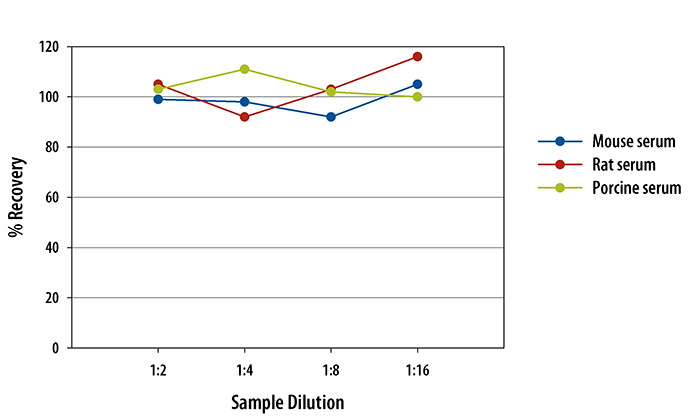
To assess the linearity of the assay, samples spiked with high concentrations of Glucagon were serially diluted with Calibrator Diluent to produce samples with values within the dynamic range of the assay.

Multi-species Glucagon ELISA Linearity

Scientific Data Images for Glucagon Quantikine ELISA Kit

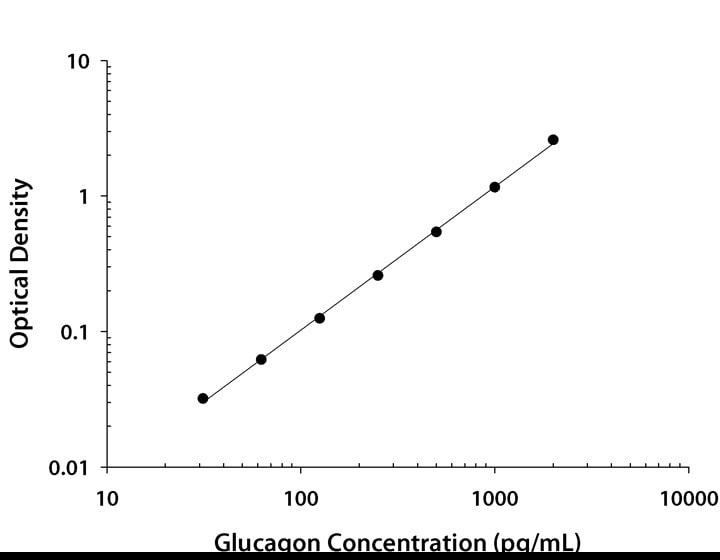
Multi-species Glucagon ELISA Standard Curve

Multi-species Glucagon ELISA Standard Curve

Preparation and Storage

Shipping

The product is shipped with polar packs. Upon receipt, store it immediately at the temperature recommended below.

Stability & Storage

Store the unopened product at 2 - 8 °C. Do not use past expiration date.

Background: Glucagon

Glucagon is a 29 amino acid (aa) peptide produced by the pancreas that plays a critical role in glucose metabolism and homeostasis (1-4). The Glucagon precursor mRNA is expressed by alpha cells ( alpha -cells) of the pancreas, L cells of the intestine, and in the brain (1, 2). Only the pancreatic alpha -cells express the prohormone convertase PC2, also called PCSK2, which is required to produce Glucagon (2). Intestinal L cells instead express the prohormone convertase PC1, which processes the precursor to the Glucagon-overlapping peptides glicentin and oxyntomodulin. L cells also produce two Glucagon-like peptides, GLP-1 and GLP-2 that are derived from the same Glucagon precursor and influence glucose metabolism, but do not share any common sequence with Glucagon (1, 2). The aa sequence of the mature Glucagon peptide is identical in human, mouse, rat, pig, dog, horse, cow, sheep, and Xenopus. 
In normal metabolism, Glucagon is secreted in response to low blood glucose (hypoglycemia) and downregulated in response to high blood glucose (hyperglycemia). Although Glucagon binding sites are found in liver, brain, pancreas, kidney, intestine, and adipose tissue, the main activity of Glucagon receptors occurs in the liver, where Glucagon stimulates gluconeogenesis and glycogenolysis, thereby increasing blood glucose (1-4). It is particularly important that the brain receive sufficient glucose, since it is unable to store more than a minute quantity. Therefore the release of Glucagon from alpha -cells is under control by both hormones and neurotransmitters, and is very responsive to circulating glucose concentration. Insulin, and/or the zinc that islet beta cells secrete with it, downregulates Glucagon secretion in intact islets (5, 6). Glucagon secretion is also downregulated by the neurotransmitter gamma -aminobutyric acid (GABA), somatostatin produced by islet delta -cells, and GLP-1, but is enhanced by the neurotransmitter L-glutamate, amino acids (especially arginine), and Glucagon itself (2-4, 7). Through receptors on the alpha -cells, these substances affect potassium, sodium, and calcium channel activity and alter intracellular calcium concentration (2-4). Glucose suppression of Glucagon secretion is probably indirect, acting through paracrine signals from other islet cells (8). 
Like insulin, Glucagon is dysregulated in type 2 diabetes (T2D) and contributes to its pathology (2-4). Glucagon secretion is less responsive to insulin-mediated suppression in times of high circulating glucose, causing glucagonemia, and increasing the risk of hyperglycemia. Glucagon is also regulated by some of the same messengers that regulate insulin (10-12). Leptin inhibits alpha -cell glucagon secretion and stimulates beta -cell insulin secretion, but glucagon blunts the leptin-mediated insulin secretion (10). Islet alpha -cells express ghrelin receptors and respond to ghrelin by increasing Glucagon secretion (11). Glucocorticoids, activated by 11 beta -HSD1, depress Glucagon secretion in hypoglycemia and insulin secretion in hyperglycemia (12). Although genetic polymorphisms of the Glucagon receptor are associated with T2D, downregulation of Glucagon secretion or deletion of the Glucagon receptor in mice that are susceptible to T2D actually improves glycemic control (13, 14).

Alternate Names

GCG, GRPP

Entrez Gene IDs

2641 (Human); 14526 (Mouse); 24952 (Rat)

Gene Symbol

GCG

Additional Glucagon Products

Product Documents for Glucagon Quantikine ELISA Kit

Certificate of Analysis

To download a Certificate of Analysis, please enter a lot or batch number in the search box below.

Note: Certificate of Analysis not available for kit components.

Product Specific Notices for Glucagon Quantikine ELISA Kit

For research use only

⚠ WARNING: This product can expose you to chemicals including N,N-Dimethylforamide, which is known to the State of California to cause cancer. For more information, go to www.P65Warnings.ca.gov.

Citations for Glucagon Quantikine ELISA Kit

Customer Reviews for Glucagon Quantikine ELISA Kit (1)

5 out of 5
1 Customer Rating
5 Stars
100%
4 Stars
0%
3 Stars
0%
2 Stars
0%
1 Stars
0%

Have you used Glucagon Quantikine ELISA Kit?

Submit a review and receive an Amazon gift card!

$25/€18/£15/$25CAN/¥2500 Yen for a review with an image

$10/€7/£6/$10CAN/¥1110 Yen for a review without an image

Submit a review
Amazon Gift Card
Showing  1 - 1 of 1 review Showing All
Filter By:
  • Glucagon Quantikine ELISA Kit
    Name: Anonymous
    Sample Tested: Serum
    Verified Customer | Posted 07/19/2017
    works for mouse serum

There are no reviews that match your criteria.

Showing  1 - 1 of 1 review Showing All

Protocols

View specific protocols for Glucagon Quantikine ELISA Kit (DGCG0):

Refer to the product for complete assay procedure.

The conjugate must be kept cold during use. Bring all other reagents and samples to room temperature before use. It is recommended that all samples, standards, and controls be assayed in duplicate.
  1.   Prepare all reagents, standard dilutions, and samples as directed in the product insert.
  2.   Remove excess microplate strips from the plate frame, return them to the foil pouch containing the desiccant pack, and reseal.
  3.   Wash and aspirate the plate a total of 2 times with Wash Buffer prior to assay.

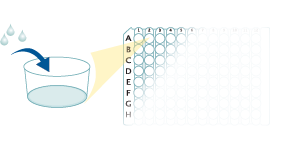
  4. 150 µL Assay Diluent
  5.   Add 150 µL of Assay Diluent to each well.

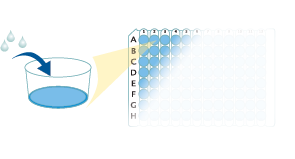
  6. 50 µL Standard, Control, or Sample
  7.   Add 50 µL of Standard, control, or sample to each well. Cover with a plate sealer, and incubate at room temperature for 3 hours.
  8.   Aspirate each well and wash, repeating the process 3 times for a total of 4 washes.

  9. 200 µL cold Conjugate
  10.   Add 200 µL of cold Conjugate to each well. Cover with a new plate sealer, and incubate at 2-8 °C for 1 hour.
  11.   Aspirate and wash 4 times.

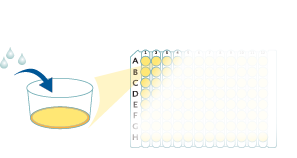
  12. 200 µL Substrate Solution
  13.   Add 200 µL Substrate Solution to each well. Incubate at room temperature for 30 minutes. PROTECT FROM LIGHT.

  14. 50 µL Stop Solution
  15. Add 50 µL of Stop Solution to each well. Read at 450 nm within 30 minutes. Set wavelength correction to 540 nm or 570 nm.

Find general support by application which include: protocols, troubleshooting, illustrated assays, videos and webinars.

FAQs

No product specific FAQs exist for this product.

View all FAQs for ELISA Kits