

Key Product Details
Species Reactivity
Human
Applications
Western Blot, Immunocytochemistry
Label
Biotin
Antibody Source
Polyclonal Sheep IgG
Loading...
Product Specifications
Immunogen
Mouse myeloma cell line NS0-derived recombinant human Brevican isoform 1
Asp23-Pro911
Accession # AAH27971
Asp23-Pro911
Accession # AAH27971
Specificity
Detects human Brevican in Western blots.
Clonality
Polyclonal
Host
Sheep
Isotype
IgG
Scientific Data Images for Human Brevican Antibody [Biotin]
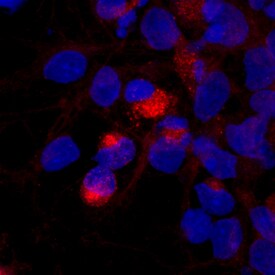
Brevican in Rat Cortical Stem Cells.
Brevican was detected in immersion fixed rat cortical stem cells differentiated for 7 days by growth factor withdrawal using Sheep Anti-Human Brevican Biotinylated Antigen Affinity-purified Polyclonal Antibody (Catalog # BAF4009) at 10 µg/mL for 3 hours at room temperature. Cells were stained using the NorthernLights™ 557-conjugated Streptavidin (red; Catalog # NL999) and counterstained with DAPI (blue). Specific staining was localized to cytoplasm. View our protocol for Fluorescent ICC Staining of Stem Cells on Coverslips.Applications for Human Brevican Antibody [Biotin]
Application
Recommended Usage
Immunocytochemistry
5-15 µg/mL
Sample: Immersion fixed rat cortical stem cells differentiated for 7 days by growth factor withdrawal
Sample: Immersion fixed rat cortical stem cells differentiated for 7 days by growth factor withdrawal
Western Blot
0.1 µg/mL
Sample: Recombinant Human Brevican (Catalog # 4009-BC)
Sample: Recombinant Human Brevican (Catalog # 4009-BC)
Formulation, Preparation, and Storage
Purification
Antigen Affinity-purified
Reconstitution
Reconstitute at 0.2 mg/mL in sterile PBS.
Loading...
Formulation
Lyophilized from a 0.2 μm filtered solution in PBS with BSA as a carrier protein.
Shipping
The product is shipped at ambient temperature. Upon receipt, store it immediately at the temperature recommended below.
Stability & Storage
Use a manual defrost freezer and avoid repeated freeze-thaw cycles.
- 12 months from date of receipt, -20 to -70 °C as supplied.
- 1 month, 2 to 8 °C under sterile conditions after reconstitution.
- 6 months, -20 to -70 °C under sterile conditions after reconstitution.
Calculators
Background: Brevican
N‑terminal fragment increase during remodeling after excitotoxic injury (11, 12). Human brevican shares 90%, 80%, and 80% aa sequence identity with bovine, mouse, and rat brevican, respectively. Within the Ig‑like and two link domains, brevican shares 45%‑51% aa sequence identity with aggrecan, neurocan, and versican.
References
- Viapiano, M.S. and R.T. Matthews (2006) Trends Mol. Med. 12:488.
- Gary, S.C. et al. (2000) Gene 256:139.
- Jaworski, D.M. et al. (1994) J. Cell Biol. 125:495.
- Seidenbecher, C.I. et al. (1995) J. Biol. Chem. 270:27206.
- Hamel, M.G. et al. (2005) J. Neurochem. 93:1533.
- Ogawa, T. et al. (2001) J. Comp. Neurol. 432:285
- Yamada, H. et al. (1997) J. Neurosci. 17:7784.
- Seidenbecher, C.I. et al. (2002) J. Neurochem. 83:738.
- Matthews, R.T. et al. (2000) J. Biol. Chem. 275:22695.
- Nakamura, H. et al. (2000) J. Biol. Chem. 275:38885.
- Mayer, J. et al. (2005) BMC Neurosci. 6:52.
- Yuan, W. et al. (2002) Neuroscience 114:1091.
- Deepa, S.S. et al. (2006) J. Biol. Chem. 281:17789.
- Jaworski, D.M. et al. (1999) Exp. Neurol. 157:327.
- Viapiano, M.S. et al. (2005) Cancer Res. 65:6726.
- Viapiano, M.S. et al. (2003) J. Biol. Chem. 278:33239.
Long Name
Brain Specific Proteoglycan in the Aggrecan Family
Alternate Names
ALPBRE, BCAN, BEHAB, CSPG7
Gene Symbol
BCAN
UniProt
Additional Brevican Products
Product Documents for Human Brevican Antibody [Biotin]
Certificate of Analysis
To download a Certificate of Analysis, please enter a lot or batch number in the search box below.
Note: Certificate of Analysis not available for kit components.
Product Specific Notices for Human Brevican Antibody [Biotin]
For research use only
Related Research Areas
Customer Reviews for Human Brevican Antibody [Biotin]
There are currently no reviews for this product. Be the first to review Human Brevican Antibody [Biotin] and earn rewards!
Have you used Human Brevican Antibody [Biotin]?
Submit a review and receive an Amazon gift card!
$25/€18/£15/$25CAN/¥2500 for a review with an image
$10/€7/£6/$10CAN/¥1110 for a review without an image
Submit a review
Protocols
Find general support by application which include: protocols, troubleshooting, illustrated assays, videos and webinars.
- Appropriate Fixation of IHC/ICC Samples
- Cellular Response to Hypoxia Protocols
- ClariTSA™ Fluorophore Kits
- Detection & Visualization of Antibody Binding
- ICC Cell Smear Protocol for Suspension Cells
- ICC Immunocytochemistry Protocol Videos
- ICC for Adherent Cells
- Immunocytochemistry (ICC) Protocol
- Immunocytochemistry Troubleshooting
- Immunofluorescence of Organoids Embedded in Cultrex Basement Membrane Extract
- Immunohistochemistry (IHC) and Immunocytochemistry (ICC) Protocols
- Preparing Samples for IHC/ICC Experiments
- Preventing Non-Specific Staining (Non-Specific Binding)
- Primary Antibody Selection & Optimization
- Protocol for VisUCyte™ HRP Polymer Detection Reagent
- Protocol for the Fluorescent ICC Staining of Cell Smears - Graphic
- Protocol for the Fluorescent ICC Staining of Cultured Cells on Coverslips - Graphic
- Protocol for the Preparation and Fluorescent ICC Staining of Cells on Coverslips
- Protocol for the Preparation and Fluorescent ICC Staining of Non-adherent Cells
- Protocol for the Preparation and Fluorescent ICC Staining of Stem Cells on Coverslips
- Protocol for the Preparation of a Cell Smear for Non-adherent Cell ICC - Graphic
- R&D Systems Quality Control Western Blot Protocol
- TUNEL and Active Caspase-3 Detection by IHC/ICC Protocol
- The Importance of IHC/ICC Controls
- Troubleshooting Guide: Western Blot Figures
- Western Blot Conditions
- Western Blot Protocol
- Western Blot Protocol for Cell Lysates
- Western Blot Troubleshooting
- Western Blot Troubleshooting Guide
- View all Protocols, Troubleshooting, Illustrated assays and Webinars
Loading...