
FK506 binding protein, also called FKBP52 and FKBP4, is a peptidyl-prolyl isomerase that catalyzes the transition between cis- and trans- proline residues critical for proper folding of proteins. It associates with HSP90 complexes that are critical for the proper folding of steroid receptors. FKBP52 knockout mice have abnormal reproductive organ development due to disruption of androgen receptor folding; and phosphorylation of FKBP52 at Thr143 seems important for steroid receptor activity.
Human FKBP52 Antibody (425123)
R&D Systems | Catalog # MAB4095


Key Product Details
Species Reactivity
Validated:
Human
Cited:
Human, Mouse
Applications
Validated:
Immunohistochemistry, Western Blot
Cited:
Immunohistochemistry, Western Blot
Label
Unconjugated
Antibody Source
Monoclonal Rat IgG1 Clone # 425123
Loading...
Product Specifications
Immunogen
E. coli-derived recombinant human FKBP52
Met1-Ala459
Accession # Q02790
Met1-Ala459
Accession # Q02790
Specificity
Detects human FKBP52 in Western blots. In Western blots, no cross-reactivity with other FKBP family members is observed.
Clonality
Monoclonal
Host
Rat
Isotype
IgG1
Scientific Data Images for Human FKBP52 Antibody (425123)
Detection of Human FKBP52 by Western Blot.
Western blot shows lysates of MCF-7 human breast cancer cell line. PVDF membrane was probed with 1 µg/mL Rat Anti-Human FKBP52 Monoclonal Antibody (Catalog # MAB4095) followed by HRP-conjugated Anti-Rat IgG Secondary Antibody (Catalog # HAF005). For additional reference, 5 ng recombinant human FKBP38, FKBP51, and FKBP52 were included. A specific band for FKBP52 was detected at approximately 62 kDa (as indicated). This experiment was conducted under reducing conditions and using Immunoblot Buffer Group 3.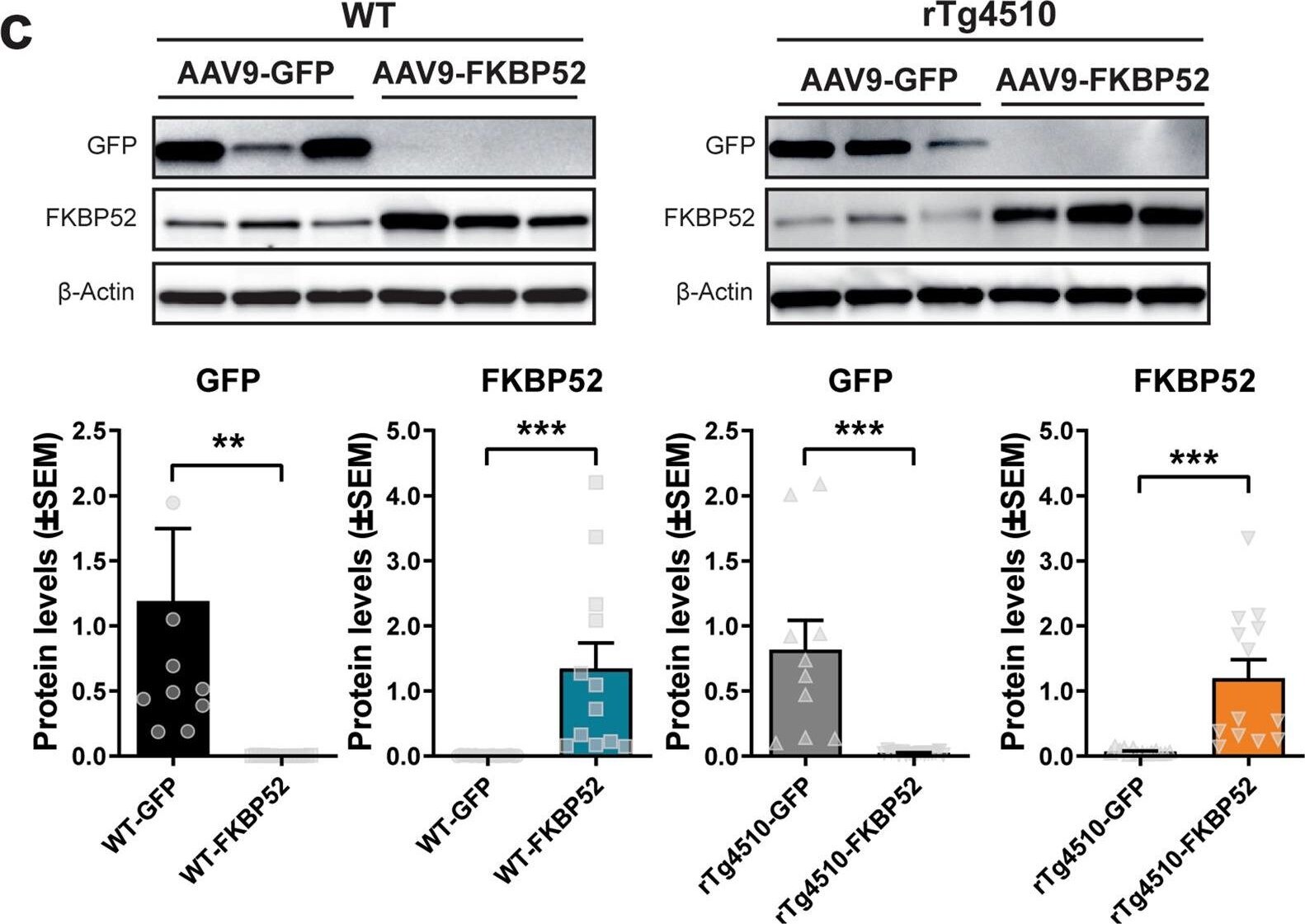
Detection of FKBP52 by Western Blot
Experimental design and confirmation of GFP and FKBP52 overexpression in the hippocampus.a Timeline of bilateral hippocampal AAV injections and experiments performed in WT and rTg4510 mice. b Representative images of AAV9-GFP and AAV9-FKBP52 hippocampal sections after 3 months of viral expression. c Representative Western blots and quantification of GFP and FKBP52 overexpression in these animals. Wild-type mice [n = 16], rTg4510 mice [n = 16]. Protein levels were normalized to beta -Actin and analyzed by unpaired t test, where statistical significance is represented by **p < 0.01 and ***p < 0.001. Scale bar represents 200 µm; inset scale represents 20 µm. AAV9 adeno-associated virus serotype 9, GFP green fluorescent protein, WT wild-type, HPC hippocampus. Image collected and cropped by CiteAb from the following open publication (https://pubmed.ncbi.nlm.nih.gov/33941782), licensed under a CC-BY license. Not internally tested by R&D Systems.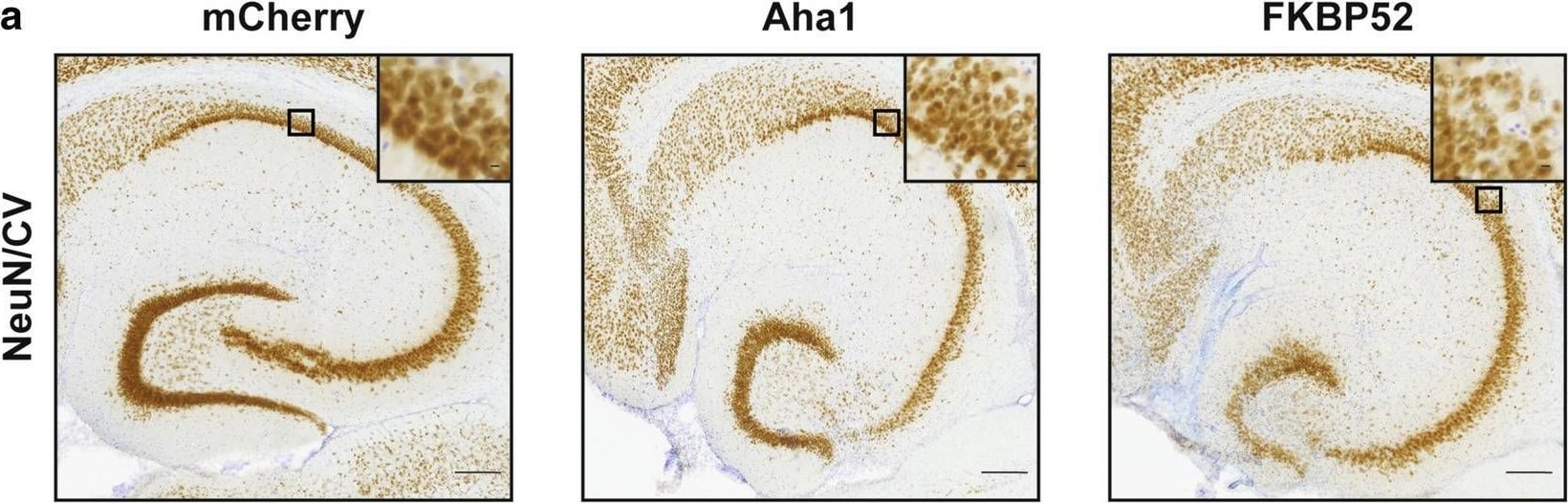
Detection of FKBP52 by Immunohistochemistry
Overexpression of FKBP52 promotes neurotoxicity in aged wild-type mice. (a) Representative images from hippocampal neurons stained with NeuN (brown) and cresyl violet (purple). These hippocampal slices correspond to AAV9-mCherry, AAV9-Aha1, and AAV9-FKBP52 injected wild-type mice. Quantification of CA1 hippocampal (b) neuronal density and (c) volume using unbiased stereology from these animals. N = 6/AAV. Results represent the standard error of the mean (± SEM). Data was analyzed by a one-way ANOVA followed by Tukey post-hoc test. *p < 0.05 and **p < 0.01 is considered statistical difference in neuronal loss. Scale bars = 100 µm and inset scale represents 10 µm. CV, cresyl violet; CA1, Cornu ammonis subfield 1; HPC, hippocampus Image collected and cropped by CiteAb from the following open publication (https://pubmed.ncbi.nlm.nih.gov/33832539), licensed under a CC-BY license. Not internally tested by R&D Systems.Applications for Human FKBP52 Antibody (425123)
Application
Recommended Usage
Immunohistochemistry
8-25 µg/mL
Sample: Immersion fixed paraffin-embedded sections of human skin cancer tissue
Sample: Immersion fixed paraffin-embedded sections of human skin cancer tissue
Western Blot
1 µg/mL
Sample: MCF-7 human breast cancer cell line
Sample: MCF-7 human breast cancer cell line
Formulation, Preparation, and Storage
Purification
Protein A or G purified from hybridoma culture supernatant
Reconstitution
Reconstitute at 0.5 mg/mL in sterile PBS. For liquid material, refer to CoA for concentration.
Loading...
Formulation
Lyophilized from a 0.2 μm filtered solution in PBS with Trehalose. *Small pack size (SP) is supplied either lyophilized or as a 0.2 µm filtered solution in PBS.
Shipping
Lyophilized product is shipped at ambient temperature. Liquid small pack size (-SP) is shipped with polar packs. Upon receipt, store immediately at the temperature recommended below.
Stability & Storage
Use a manual defrost freezer and avoid repeated freeze-thaw cycles.
- 12 months from date of receipt, -20 to -70 °C as supplied.
- 1 month, 2 to 8 °C under sterile conditions after reconstitution.
- 6 months, -20 to -70 °C under sterile conditions after reconstitution.
Calculators
Background: FKBP52
Long Name
52 kDa FK506 Binding Protein
Alternate Names
FKBP4, FKBP59, HBI, Hsp56
Gene Symbol
FKBP4
UniProt
Additional FKBP52 Products
Product Documents for Human FKBP52 Antibody (425123)
Certificate of Analysis
To download a Certificate of Analysis, please enter a lot or batch number in the search box below.
Note: Certificate of Analysis not available for kit components.
Product Specific Notices for Human FKBP52 Antibody (425123)
For research use only
Related Research Areas
Citations for Human FKBP52 Antibody (425123)
 Powered by Bioz
Customer Reviews for Human FKBP52 Antibody (425123)
There are currently no reviews for this product. Be the first to review Human FKBP52 Antibody (425123) and earn rewards!
Have you used Human FKBP52 Antibody (425123)?
Submit a review and receive an Amazon gift card!
$25/€18/£15/$25CAN/¥2500 for a review with an image
$10/€7/£6/$10CAN/¥1110 for a review without an image
Submit a review
Protocols
Find general support by application which include: protocols, troubleshooting, illustrated assays, videos and webinars.
- Antigen Retrieval Protocol (PIER)
- Antigen Retrieval for Frozen Sections Protocol
- Appropriate Fixation of IHC/ICC Samples
- Cellular Response to Hypoxia Protocols
- Chromogenic IHC Staining of Formalin-Fixed Paraffin-Embedded (FFPE) Tissue Protocol
- Chromogenic Immunohistochemistry Staining of Frozen Tissue
- ClariTSA™ Fluorophore Kits
- Detection & Visualization of Antibody Binding
- Fluorescent IHC Staining of Frozen Tissue Protocol
- Graphic Protocol for Heat-induced Epitope Retrieval
- Graphic Protocol for the Preparation and Fluorescent IHC Staining of Frozen Tissue Sections
- Graphic Protocol for the Preparation and Fluorescent IHC Staining of Paraffin-embedded Tissue Sections
- Graphic Protocol for the Preparation of Gelatin-coated Slides for Histological Tissue Sections
- IHC Sample Preparation (Frozen sections vs Paraffin)
- Immunofluorescent IHC Staining of Formalin-Fixed Paraffin-Embedded (FFPE) Tissue Protocol
- Immunohistochemistry (IHC) and Immunocytochemistry (ICC) Protocols
- Immunohistochemistry Frozen Troubleshooting
- Immunohistochemistry Paraffin Troubleshooting
- Preparing Samples for IHC/ICC Experiments
- Preventing Non-Specific Staining (Non-Specific Binding)
- Primary Antibody Selection & Optimization
- Protocol for Heat-Induced Epitope Retrieval (HIER)
- Protocol for Making a 4% Formaldehyde Solution in PBS
- Protocol for VisUCyte™ HRP Polymer Detection Reagent
- Protocol for the Preparation & Fixation of Cells on Coverslips
- Protocol for the Preparation and Chromogenic IHC Staining of Frozen Tissue Sections
- Protocol for the Preparation and Chromogenic IHC Staining of Frozen Tissue Sections - Graphic
- Protocol for the Preparation and Chromogenic IHC Staining of Paraffin-embedded Tissue Sections
- Protocol for the Preparation and Chromogenic IHC Staining of Paraffin-embedded Tissue Sections - Graphic
- Protocol for the Preparation and Fluorescent IHC Staining of Frozen Tissue Sections
- Protocol for the Preparation and Fluorescent IHC Staining of Paraffin-embedded Tissue Sections
- Protocol for the Preparation of Gelatin-coated Slides for Histological Tissue Sections
- R&D Systems Quality Control Western Blot Protocol
- TUNEL and Active Caspase-3 Detection by IHC/ICC Protocol
- The Importance of IHC/ICC Controls
- Troubleshooting Guide: Immunohistochemistry
- Troubleshooting Guide: Western Blot Figures
- Western Blot Conditions
- Western Blot Protocol
- Western Blot Protocol for Cell Lysates
- Western Blot Troubleshooting
- Western Blot Troubleshooting Guide
- View all Protocols, Troubleshooting, Illustrated assays and Webinars
Loading...