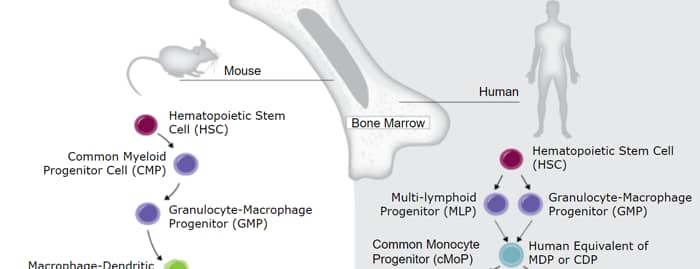
The Flt-3 (fms-like tyrosine kinase) receptor, also named Flk-2 (fetal liver kinase) and Stk-1(stem cell tyrosine kinase) is a member of the class III subfamily of receptor tyrosine kinases that also includes KIT, the receptor for SCF and FMS, the receptor for M-CSF. The extracellular region of these receptors contains five immunoglobulin-like domains and the intracellular region contains a split kinase domain. Human Flt-3 cDNA encodes a 993 amino acid (aa) residue type I membrane protein with a 26 aa residue signal peptide, a 515 aa extracellular domain with 10 potential N-linked glycosylation sites, a 21 aa residue transmembrane domain and a 431 aa residue cytoplasmic domain. Mouse Flt-3 has also been cloned and shown to share 85% amino acid sequence identity with human Flt-3. Flt-3 expression has been detected in various tissues, including placenta, gonads, and tissues of nervous and hematopoietic origin. Among hematopoietic cells, the expression of Flt-3 was found to be restricted to the highly enriched stem/progenitor cell populations. The ligand for Flt-3 (FL) has been identified to be a transmembrane protein with structural homology to M-CSF and SCF. Recombinant soluble Flt-3/Fc chimeric protein has been shown to bind FL with high affinity and is a potent FL antagonist.
Human Flt-3/Flk-2 Antibody (66903)
R&D Systems | Catalog # MAB812

Key Product Details
Species Reactivity
Validated:
Cited:
Applications
Validated:
Cited:
Label
Antibody Source
Product Specifications
Immunogen
Asn27-Asn541
Accession # AAA18947
Specificity
Clonality
Host
Isotype
Scientific Data Images for Human Flt-3/Flk-2 Antibody (66903)
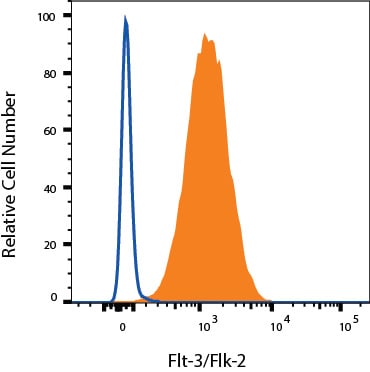
Detection of Flt‑3/Flk‑2 in THP-1 cells by Flow Cytometry.
THP-1 cells were stained with Mouse Anti-Human Flt‑3/Flk‑2 Monoclonal Antibody (Catalog # MAB812, filled histogram) or isotype control antibody (Catalog # MAB002, open histogram), followed by Phycoerythrin-conjugated Anti-Mouse IgG Secondary Antibody (Catalog # F0102B). View our protocol for Staining Membrane-associated Proteins.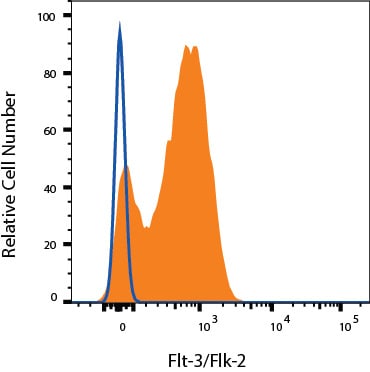
Detection of Flt‑3/Flk‑2 in PBMC monocytes by Flow Cytometry.
PBMC monocytes were stained with Mouse Anti-Human Flt‑3/Flk‑2 Monoclonal Antibody (Catalog # MAB812, filled histogram) or isotype control antibody (Catalog # MAB002, open histogram), followed by Phycoerythrin-conjugated Anti-Mouse IgG Secondary Antibody (Catalog # F0102B). View our protocol for Staining Membrane-associated Proteins.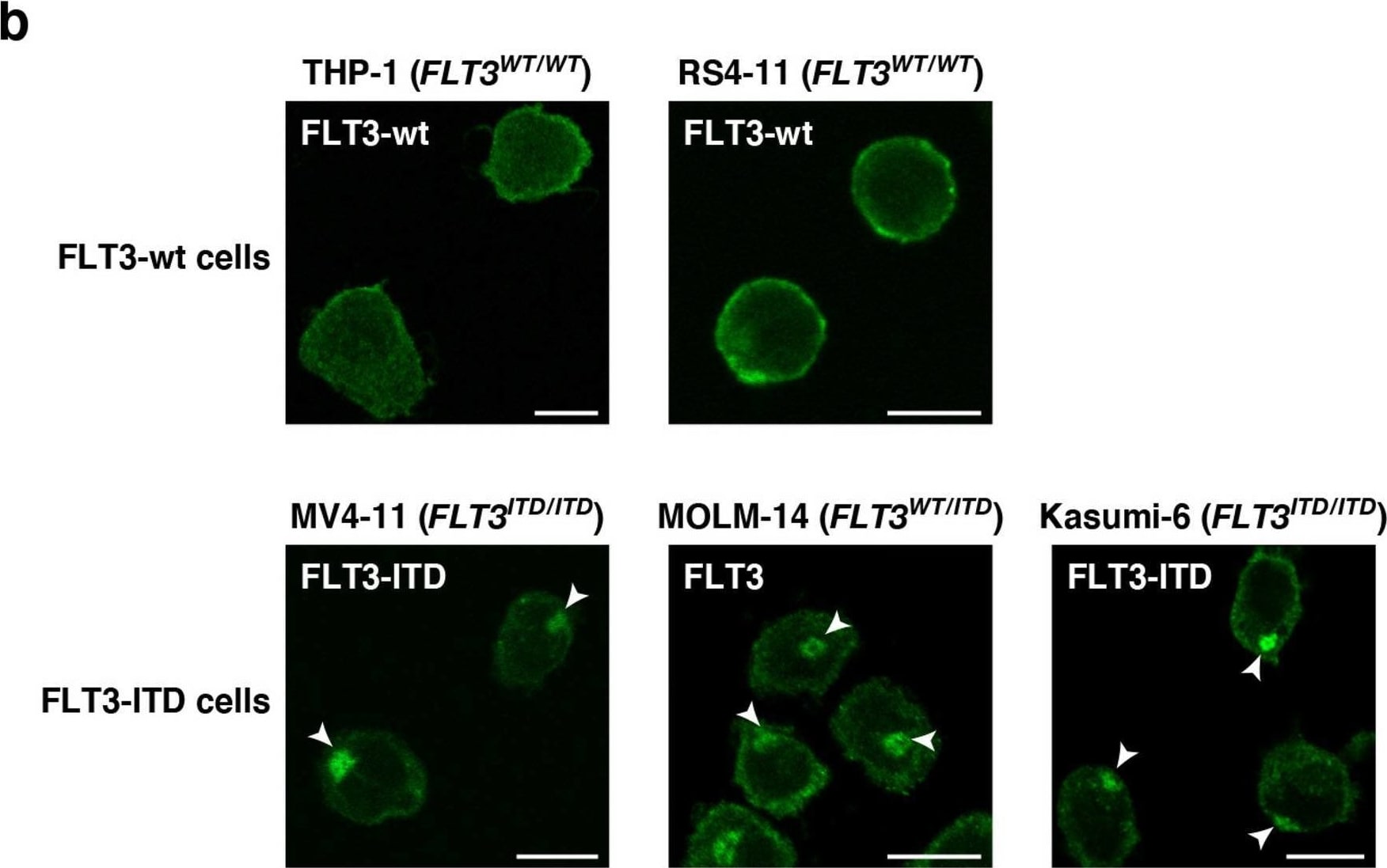
Detection of Human Flt-3/Flk-2 by Immunocytochemistry/ Immunofluorescence
FLT3-ITD mislocalizes to the perinuclear region in AML cells. (a) Schematic representations of wild-type FLT3 (FLT3-wt) and an FLT3 internal tandem duplication (FLT3-ITD) mutant showing the extracellular domain (ECD, blue), the transmembrane domain (TM, yellow), the kinase domain (pink), and the ITD (green). (b) Fixed THP-1, RS4-11, MV4-11, MOLM-14, or Kasumi-6 cells were permeabilized and subsequently immunostained with anti-FLT3 ECD antibody. Arrowheads indicate the perinuclear region. Bars, 10 µm. Note that FLT3-wt localized to the plasma membrane, whereas FLT3-ITD accumulated in the perinuclear region. Image collected and cropped by CiteAb from the following open publication (https://pubmed.ncbi.nlm.nih.gov/34811450), licensed under a CC-BY license. Not internally tested by R&D Systems.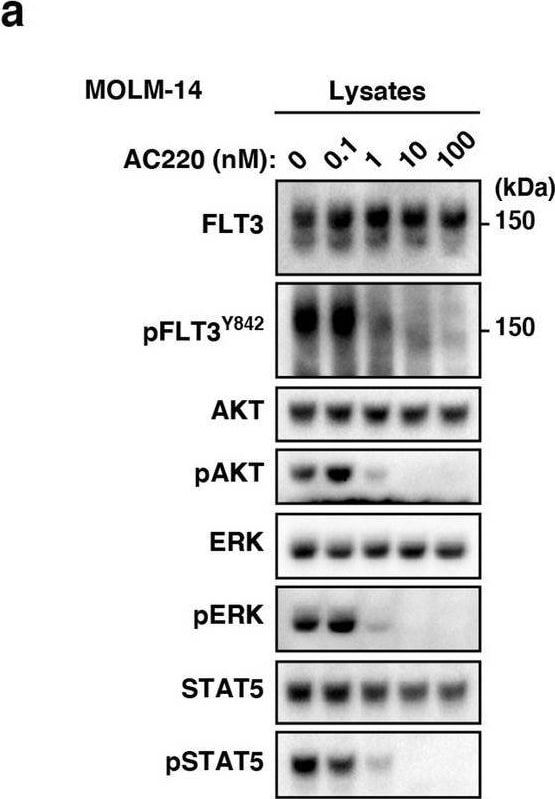
Detection of Human Flt-3/Flk-2 by Western Blot
FLT3-ITD retention in the Golgi region is dependent on its tyrosine kinase activity. (a, b) MOLM-14 cells were treated for 4 h with AC220 (a) or PKC412 (b). Lysates were immunoblotted for FLT3, phospho-FLT3 Tyr842 (pFLT3Y842), AKT, pAKT, ERK, pERK, STAT5, and pSTAT5. Full length blots are presented in Supplementary Fig. 5. (c) MOLM-14 cells were treated with AC220 (upper graph) or PKC412 (lower graph) for 48 h. Cell proliferation was assessed by ATP production. Results are means ± s.d. (n = 3). (d) Lysates from MOLM-14 were treated with peptide N-glycosidase F (PNGase F) or endoglycosidase H (endo H) then immunoblotted with anti-FLT3 antibody. CG complex-glycosylated form, HM high mannose form, DG deglycosylated form. Full length blots are presented in Supplementary Fig. 5. (e, f) MOLM-14 cells were treated with 10 nM AC220 or 100 nM PKC412 for 8 h (e) or 16 h (f). (e) Fixed cells were permeabilized, then immunostained with anti-FLT3 (red) and anti-calnexin (ER marker, green). Insets show the magnified images of the boxed area. Bars, 10 µm. (f) Non-permeabilized cells were immunostained with an anti-FLT3 extracellular domain (ECD) antibody. Bars, 10 µm. Note that FLT3 tyrosine kinase inhibitors inactivated FLT3, then released the receptor from the Golgi region for localization to the PM. Image collected and cropped by CiteAb from the following open publication (https://pubmed.ncbi.nlm.nih.gov/34811450), licensed under a CC-BY license. Not internally tested by R&D Systems.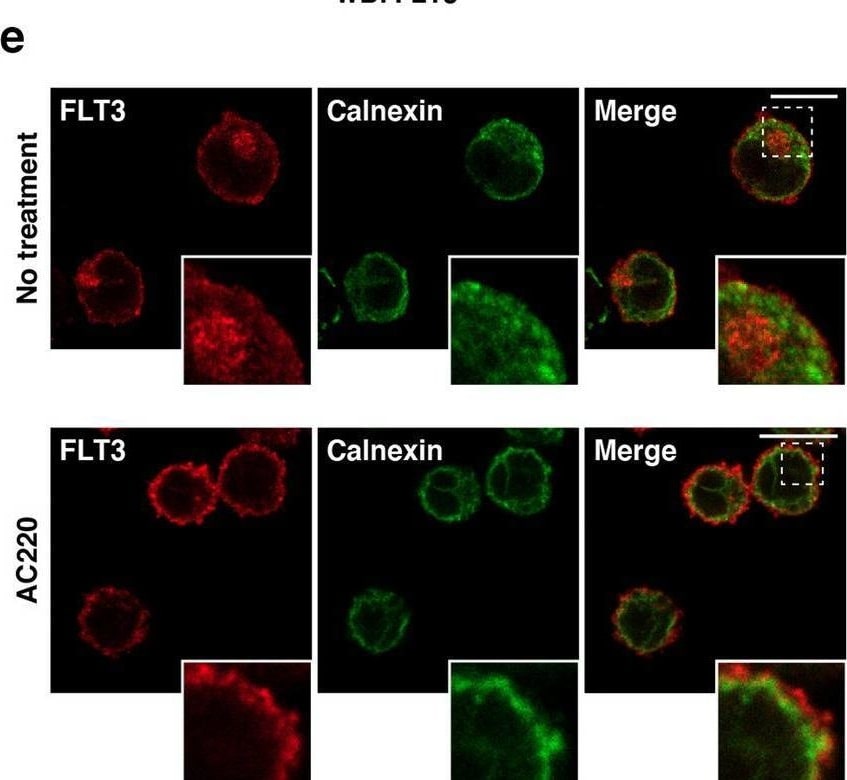
Detection of Human Flt-3/Flk-2 by Immunocytochemistry/ Immunofluorescence
FLT3-ITD retention in the Golgi region is dependent on its tyrosine kinase activity. (a, b) MOLM-14 cells were treated for 4 h with AC220 (a) or PKC412 (b). Lysates were immunoblotted for FLT3, phospho-FLT3 Tyr842 (pFLT3Y842), AKT, pAKT, ERK, pERK, STAT5, and pSTAT5. Full length blots are presented in Supplementary Fig. 5. (c) MOLM-14 cells were treated with AC220 (upper graph) or PKC412 (lower graph) for 48 h. Cell proliferation was assessed by ATP production. Results are means ± s.d. (n = 3). (d) Lysates from MOLM-14 were treated with peptide N-glycosidase F (PNGase F) or endoglycosidase H (endo H) then immunoblotted with anti-FLT3 antibody. CG complex-glycosylated form, HM high mannose form, DG deglycosylated form. Full length blots are presented in Supplementary Fig. 5. (e, f) MOLM-14 cells were treated with 10 nM AC220 or 100 nM PKC412 for 8 h (e) or 16 h (f). (e) Fixed cells were permeabilized, then immunostained with anti-FLT3 (red) and anti-calnexin (ER marker, green). Insets show the magnified images of the boxed area. Bars, 10 µm. (f) Non-permeabilized cells were immunostained with an anti-FLT3 extracellular domain (ECD) antibody. Bars, 10 µm. Note that FLT3 tyrosine kinase inhibitors inactivated FLT3, then released the receptor from the Golgi region for localization to the PM. Image collected and cropped by CiteAb from the following open publication (https://pubmed.ncbi.nlm.nih.gov/34811450), licensed under a CC-BY license. Not internally tested by R&D Systems.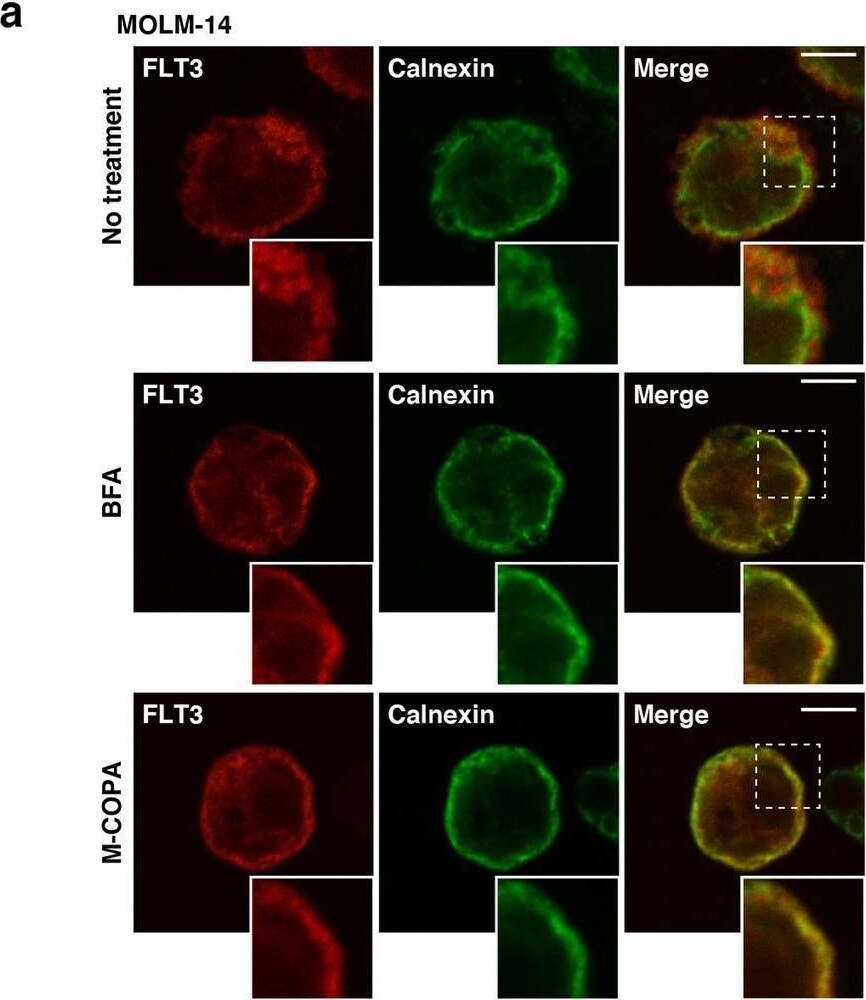
Detection of Human Flt-3/Flk-2 by Immunocytochemistry/ Immunofluorescence
In AML cells, FLT3-ITD can activate AKT, ERK, and STAT5 before it reaches the PM. (a–c) MOLM-14 (a, b), MV4-11, or Kasumi-6 cells (c) were treated with inhibitors of ER export (BFA or M-COPA) for 8 h. (a) MOLM-14 cells treated with 1 µM BFA (middle panels) or 1 µM M-COPA (bottom panels) were stained with anti-FLT3 (red) and calnexin (ER marker, green). Insets show the magnified images of the boxed area. Bars, 10 µm. (b) Lysates were immunoblotted for FLT3, phospho-FLT3 Tyr842 (pFLT3Y842), AKT, pAKT, ERK, pERK, STAT5, and pSTAT5. To examine pFLT3Y591, FLT3 was immunoprecipitated, then immunoblotted. (c) MV4-11 (left) or Kasumi-6 cells (right) were treated with M-COPA for 8 h, then immunoblotted. Full length blots are presented in Supplementary Fig. 5. Note that BFA and M-COPA inhibited the activation of AKT and ERK but not that of STAT5 through blocking FLT3-ITD trafficking from the ER to the Golgi apparatus. (d, e) MOLM-14 cells were treated with monensin (inhibitor of Golgi export) for 8 h. (d) Cells treated with 100 nM monensin were stained with anti-FLT3 (red) and lectin-HPA (Golgi marker, blue). Dashed line, cell border. Bars, 10 µm. (e) Lysates were immunoblotted with the indicated antibody. To examine pFLT3Y591, FLT3 was immunoprecipitated, then immunoblotted. Full length blots are presented in Supplementary Fig. 5. (f) MV4-11 (left) or Kasumi-6 cells (right) were treated with monensin for 8 h, then immunoblotted. Full length blots are presented in Supplementary Fig. 6. Image collected and cropped by CiteAb from the following open publication (https://pubmed.ncbi.nlm.nih.gov/34811450), licensed under a CC-BY license. Not internally tested by R&D Systems.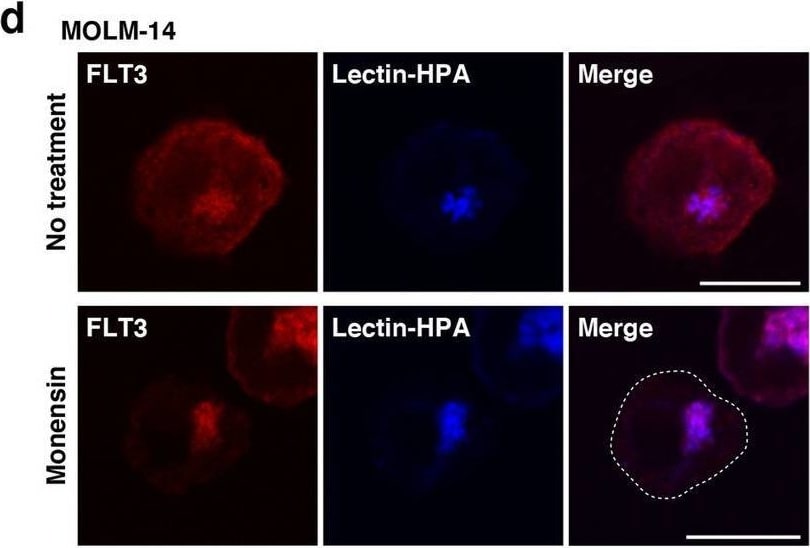
Detection of Human Flt-3/Flk-2 by Immunocytochemistry/ Immunofluorescence
In AML cells, FLT3-ITD can activate AKT, ERK, and STAT5 before it reaches the PM. (a–c) MOLM-14 (a, b), MV4-11, or Kasumi-6 cells (c) were treated with inhibitors of ER export (BFA or M-COPA) for 8 h. (a) MOLM-14 cells treated with 1 µM BFA (middle panels) or 1 µM M-COPA (bottom panels) were stained with anti-FLT3 (red) and calnexin (ER marker, green). Insets show the magnified images of the boxed area. Bars, 10 µm. (b) Lysates were immunoblotted for FLT3, phospho-FLT3 Tyr842 (pFLT3Y842), AKT, pAKT, ERK, pERK, STAT5, and pSTAT5. To examine pFLT3Y591, FLT3 was immunoprecipitated, then immunoblotted. (c) MV4-11 (left) or Kasumi-6 cells (right) were treated with M-COPA for 8 h, then immunoblotted. Full length blots are presented in Supplementary Fig. 5. Note that BFA and M-COPA inhibited the activation of AKT and ERK but not that of STAT5 through blocking FLT3-ITD trafficking from the ER to the Golgi apparatus. (d, e) MOLM-14 cells were treated with monensin (inhibitor of Golgi export) for 8 h. (d) Cells treated with 100 nM monensin were stained with anti-FLT3 (red) and lectin-HPA (Golgi marker, blue). Dashed line, cell border. Bars, 10 µm. (e) Lysates were immunoblotted with the indicated antibody. To examine pFLT3Y591, FLT3 was immunoprecipitated, then immunoblotted. Full length blots are presented in Supplementary Fig. 5. (f) MV4-11 (left) or Kasumi-6 cells (right) were treated with monensin for 8 h, then immunoblotted. Full length blots are presented in Supplementary Fig. 6. Image collected and cropped by CiteAb from the following open publication (https://pubmed.ncbi.nlm.nih.gov/34811450), licensed under a CC-BY license. Not internally tested by R&D Systems.Applications for Human Flt-3/Flk-2 Antibody (66903)
CyTOF-ready
Flow Cytometry
Sample: THP-1 and PBMC monocytes
Flow Cytometry Panel Builder
Bio-Techne Knows Flow Cytometry
Save time and reduce costly mistakes by quickly finding compatible reagents using the Panel Builder Tool.
Advanced Features
- Spectra Viewer - Custom analysis of spectra from multiple fluorochromes
- Spillover Popups - Visualize the spectra of individual fluorochromes
- Antigen Density Selector - Match fluorochrome brightness with antigen density

Formulation, Preparation, and Storage
Purification
Reconstitution
Reconstitute at 0.5 mg/mL in sterile PBS. For liquid material, refer to CoA for concentration.
Formulation
Shipping
Stability & Storage
- 12 months from date of receipt, -20 to -70 °C as supplied.
- 1 month, 2 to 8 °C under sterile conditions after reconstitution.
- 6 months, -20 to -70 °C under sterile conditions after reconstitution.
Calculators
Background: Flt-3/Flk-2
References
- Rosnet, O. et al. (1996) Acta. Haemato. 95:218.
- Drexler, H.G. (1996) Leukemia 10:588.
Long Name
Alternate Names
Gene Symbol
UniProt
Additional Flt-3/Flk-2 Products
Product Documents for Human Flt-3/Flk-2 Antibody (66903)
Certificate of Analysis
To download a Certificate of Analysis, please enter a lot or batch number in the search box below.
Note: Certificate of Analysis not available for kit components.
Product Specific Notices for Human Flt-3/Flk-2 Antibody (66903)
For research use only
Citations for Human Flt-3/Flk-2 Antibody (66903)
 Powered by Bioz
Customer Reviews for Human Flt-3/Flk-2 Antibody (66903)
There are currently no reviews for this product. Be the first to review Human Flt-3/Flk-2 Antibody (66903) and earn rewards!
Have you used Human Flt-3/Flk-2 Antibody (66903)?
Submit a review and receive an Amazon gift card!
$25/€18/£15/$25CAN/¥2500 for a review with an image
$10/€7/£6/$10CAN/¥1110 for a review without an image
Submit a review
Protocols
Find general support by application which include: protocols, troubleshooting, illustrated assays, videos and webinars.
- 7-Amino Actinomycin D (7-AAD) Cell Viability Flow Cytometry Protocol
- Extracellular Membrane Flow Cytometry Protocol
- Flow Cytometry Protocol for Cell Surface Markers
- Flow Cytometry Protocol for Staining Membrane Associated Proteins
- Flow Cytometry Staining Protocols
- Flow Cytometry Troubleshooting Guide
- Intracellular Flow Cytometry Protocol Using Alcohol (Methanol)
- Intracellular Flow Cytometry Protocol Using Detergents
- Intracellular Nuclear Staining Flow Cytometry Protocol Using Detergents
- Intracellular Staining Flow Cytometry Protocol Using Alcohol Permeabilization
- Intracellular Staining Flow Cytometry Protocol Using Detergents to Permeabilize Cells
- Propidium Iodide Cell Viability Flow Cytometry Protocol
- Protocol for Liperfluo
- Protocol for the Characterization of Human Th22 Cells
- Protocol for the Characterization of Human Th9 Cells
- Protocol: Annexin V and PI Staining by Flow Cytometry
- Protocol: Annexin V and PI Staining for Apoptosis by Flow Cytometry
- Troubleshooting Guide: Fluorokine Flow Cytometry Kits
- View all Protocols, Troubleshooting, Illustrated assays and Webinars
Associated Pathways