
Glis1 (GLI/glioma-Similar 1; also GliH1) is a 66 kDa (predicted) member of the Kruppel-like zinc finger family of proteins. In the adult, it is principally expressed in placenta and kidney, while in the embryo, it has widespread expression in mesodermal structures. Glis1 can be induced in suprabasal keratinocytes by activating cytokines, and is believed to promote a unique differentiation program. Glis1 is also effective in generating iPSCs from somatic cells (fibroblasts) when concurrently expressed with Oct3, Sox2 and Klf4. Multiple reprogramming pathways are involved, and include Myc, Wnt and Nanog molecules. Functionally, Glis1 is believed to act as a transcriptional repressor. Although it has been described as possessing an activation domain, it would appear that gene promotion is a consequence of the repression of a "repressor". The consequence sequence ACCACCCA corresponds to a GLIS binding motif. Human Glis1 is 620 amino acids (aa) in length. Based on mouse, it contains a zinc-finger repressor region (aa 197-346) plus a putative transactivation domain (aa 448-620). And again based on mouse, there might be an approximately 796 aa splice form that shows an alternative start site 171 aa upstream of the 620 aa isoform. The existence of such an isoform would generate an approximately 95-100 kDa isoform in SDS-PAGE. Over aa 446-620, human Glis1 shares 80% aa sequence identity with mouse Glis1.

Scientific images may be resized, cropped, or adjusted for brightness or contrast for presentation purposes. These updates are limited to presentation and do not affect the underlying scientific interpretation of the data. Where available, additional source data may be provided upon request.
Key Product Details
Species Reactivity
Applications
Label
Antibody Source
Product Specifications
Immunogen
Met446-Thr620
Accession # Q5VTL4
Specificity
Clonality
Host
Isotype
Scientific Data Images for Human Glis1 Antibody
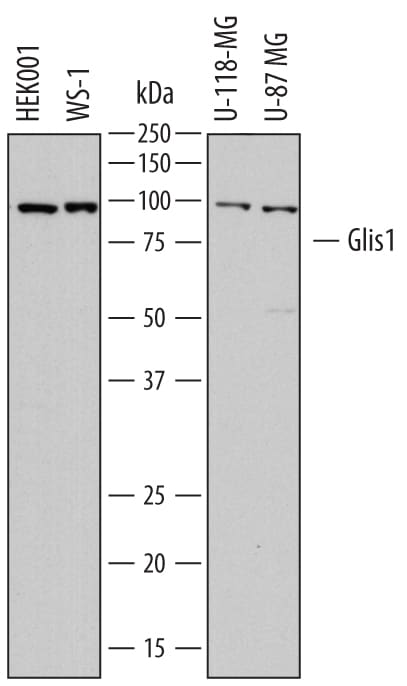
Detection of Human Glis1 by Western Blot.
Western blot shows lysates of HEK001 human epidermal keratinocyte cell line, WS-1 human fetal skin fibroblast cell line, U-118-MG human glioblastoma/astrocytoma cell line, and U-87 MG human glioblastoma/astrocytoma cell line. PVDF membrane was probed with 2 µg/mL of Sheep Anti-Human Glis1 Antigen Affinity-purified Polyclonal Antibody (Catalog # AF7618) followed by HRP-conjugated Anti-Sheep IgG Secondary Antibody (Catalog # HAF016). A specific band was detected for Glis1 at approximately 95 kDa (as indicated). This experiment was conducted under reducing conditions and using Immunoblot Buffer Group 1.Applications for Human Glis1 Antibody
Western Blot
Sample: HEK001 human epidermal keratinocyte cell line, WS‑1 human fetal skin fibroblast cell line, U‑118‑MG human glioblastoma/astrocytoma cell line, and U‑87 MG human glioblastoma/astrocytoma cell line
Formulation, Preparation, and Storage
Purification
Reconstitution
Sterile PBS to a final concentration of 0.2 mg/mL. For liquid material, refer to CoA for concentration.
Formulation
Shipping
Stability & Storage
- 12 months from date of receipt, -20 to -70 °C as supplied.
- 1 month, 2 to 8 °C under sterile conditions after reconstitution.
- 6 months, -20 to -70 °C under sterile conditions after reconstitution.
Calculators
Background: Glis1
Long Name
Alternate Names
Gene Symbol
UniProt
Additional Glis1 Products
Product Documents for Human Glis1 Antibody
Certificate of Analysis
To download a Certificate of Analysis, please enter a lot or batch number in the search box below.
Note: Certificate of Analysis not available for kit components.
Product Specific Notices for Human Glis1 Antibody
For research use only
Customer Reviews for Human Glis1 Antibody
There are currently no reviews for this product. Be the first to review Human Glis1 Antibody and earn rewards!
Have you used Human Glis1 Antibody?
Submit a review and receive an Amazon gift card!
$25/€18/£15/$25CAN/¥2500 for a review with an image
$10/€7/£6/$10CAN/¥1110 for a review without an image
Submit a review
Protocols
Find general support by application which include: protocols, troubleshooting, illustrated assays, videos and webinars.
- Cellular Response to Hypoxia Protocols
- R&D Systems Quality Control Western Blot Protocol
- Troubleshooting Guide: Western Blot Figures
- Western Blot Conditions
- Western Blot Protocol
- Western Blot Protocol for Cell Lysates
- Western Blot Troubleshooting
- Western Blot Troubleshooting Guide
- View all Protocols, Troubleshooting, Illustrated assays and Webinars